
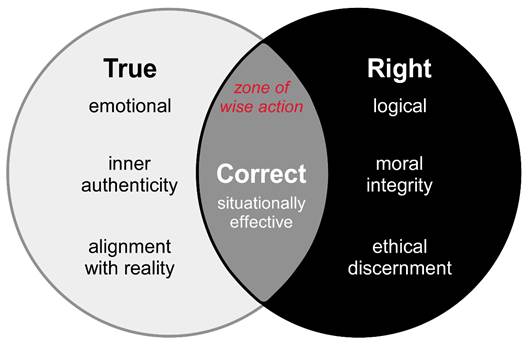
In an age dominated by speed, data, and polarization, the need for wise decision-making has never been greater. While traditional critical thinking focuses on logic and evidence, it often omits other dimensions of human understanding, such as authenticity, ethics, and contextual appropriateness. The “True, Right, Correct” framework expands critical thinking into a multidimensional model that integrates intellectual rigor with moral clarity and practical wisdom.
This model draws from philosophical reasoning, spiritual awareness, and functional discernment to offer a more holistic approach to evaluating choices, actions, and beliefs.

Expanding Critical Thinking: A Holistic Triad
Critical thinking is often defined as the ability to analyze, evaluate, and synthesize information in order to form reasoned judgments. It relies on logic, evidence, skepticism, and reasoning. However, while these tools are necessary, they are not always sufficient.
The “True, Right, Correct” framework offers a layered upgrade to conventional critical thinking:
| Aspect | Conventional Critical Thinking | True-Right-Correct Framework |
| Logic | Essential | Integrated within “Right” |
| Ethics | Optional or minimal | Central under “True” |
| Authenticity | Rarely addressed | Essential under “True” |
| Intuition/Conscience | Often ignored | Embraced within “True” and “Right” |
| Functional Aptness | Sometimes included | Core under “Correct” |
Overview of the Two-lens Model
The framework is visualized as a Venn diagram with two intersecting circles and the portion that overlaps to form a third zone:
- TRUE – Inner authenticity and alignment with reality
- RIGHT – Moral integrity and ethical discernment
- CORRECT – Balance of technical soundness and contextual precision
Where these two elements intersect is the “zone of wise action.”
1. TRUE: Alignment with Reality and Authenticity
- Definition: What aligns with one’s inner values, lived experience, or observable truth
- Includes: Self-awareness, factual clarity, personal integrity, intuitive knowing
- Example: Expressing a difficult truth even when it’s unpopular
Critical Thinking Link: Encourages self-honesty and questions personal assumptions
Reflection Questions:
- Am I being honest with myself and others?
- Is this based on what is real or what is assumed?
- Does this reflect my core values and lived experiences?
2. RIGHT: Moral and Ethical Discernment
- Definition: What is just, compassionate, and beneficial from a moral perspective
- Includes: Fairness, empathy, justice, long-term benefit to others
- Example: Choosing not to exploit a legal loophole because it harms others
Critical Thinking Link: Adds an ethical filter to decisions that might otherwise be purely strategic
Reflection Questions:
- Is this action fair and just?
- Would I consider this acceptable if done to me?
- Does this honor both the letter and spirit of the greater good?
3. CORRECT: The Balance of Functional Precision and Situational Appropriateness
- Definition: What is technically accurate, logically coherent, and situationally effective
- Includes: Evidence-based reasoning, timing, execution, contextual fit
- Example: Using the correct communication method for sensitive feedback
Critical Thinking Link: Embeds the core tools of analysis, logic, and evidence evaluation
Reflection Questions:
- Is this the best balance between true and right, that can serve the most involved?
- Is this method sound and supported by facts?
- Am I choosing the most effective way to act or express this?
- Is it appropriate for this time, place, and audience?
Applications in Teaching and Practice This framework serves as a compass for ethical leadership, personal reflection, and integrative education:
- In classrooms: Pairing logic with ethics and introspection
- In leadership: Building trust through aligned, values-driven decisions
- In personal growth: Assessing decisions using a whole-self model
- In debate and conflict: Seeking understanding through multiple lenses
Teaching Module Activities
- Case Study Analysis – Analyze real-world dilemmas from all three perspectives
- Personal Journaling – Reflect on a difficult decision using the lens of true, right, and correct
- Group Debates – Discuss how outcomes shift when one element is missing
- Visual Mapping – Place actions on a Venn diagram to assess alignment
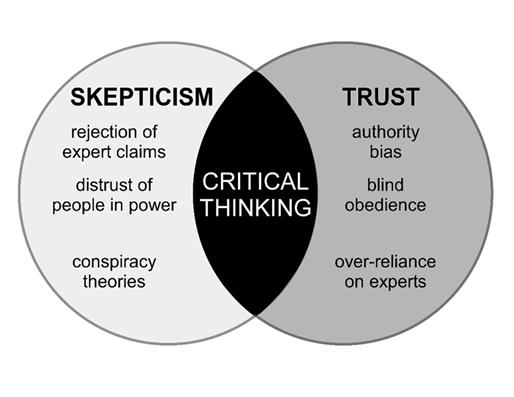
Conclusion The “True, Right, Correct” framework expands critical thinking into a richer, more human-centered process. It challenges individuals not just to think better, but to live and act more wisely through authenticity, ethical clarity, and contextual intelligence. In doing so, it reclaims critical thinking not only as a cognitive skill, but as a moral and spiritual practice.


 United Martial Arts Association