Herbal Tinctures for Pain Management

Why Conventional Methods Don’t Fix Chronic Pain Issues

When in pain, receptors become oversensitive requiring ever increasing amounts of input to dull this signal. Over time, the natural pain-killing mechanism will exhaust itself trying to keep up with the oversensitive receptors. The result being that the pain and inflammatory responses become chronic, and the pain becomes increasingly resistant to conventional pain-relief methods (ice, heat, etc.) and pain medications.

Chronic inflammation can destroy our joints completely over time. Pain relievers (NSAIDs, COX-2 inhibitors, etc.) are ineffective against this gradual degeneration. They may help somewhat with chronic pain symptoms but ultimately, they don’t repair the biological pain receptor nor joint damage.

Many pain-relieving drugs are known to have serious side effects. COX-2 inhibitors (Vioxx and Celebrex) have previously been shown to cause an increased risk of heart
ailments. NSAIDs (Ibuprofen, Naproxen, etc.) can cause bleeding ulcers and do damage to the digestive system and kidneys. Often these medicines are unable to keep the chronic inflammation from continuing to cause cartilage degradation and have little or no power to reverse the process.

Treatment for Inflammation
Inflammation can often be treated with over-the-counter medication, natural remedies (like fruits, vegetables, or herbs), or sometimes a change in diet. These options can sometimes be effective in temporarily eliminating pain from inflammation, but often only manipulates certain natural body functions, without dealing with the root cause of the inflammation. Treatment repeats as often as needed, creating a vicious cycle of treatment and then temporary relief.

The medication method introduces chemicals into the body that can eventually harm the liver and digestive tract over time. For the better results in managing inflammation, Chinese herbs could be incorporated within a healthy lifestyle. Those suffering from inflammation could introduce Chinese herbal remedies (or others) into their daily healthy habits. Natural ingredients often enhance and support various natural body functions. Herbal remedies can help keep manage inflammation and therefore pain.

Dit Da Jow (Liniment)
‘’Dit Da Jow” or “Jiao”, in Chinese means “fall and strike.” This term refers to external recipes formulated in Chinese medicine to treat injuries and trauma. Dit Da Jow is an external liniment and not for ingestion. The recipes vary primarily in whether they clear heat or are warming. Authentic Dit Da Jow recipes move blood and consequently Qi to relieve the pain of many injuries due to trauma or impact. We can also use these herbal extracts to apply to our hands, arms and other parts of our bodies for what is referred to as Iron Body training. These Jows are somewhat unique in that they reduce inflammation while at the same time increase blood circulation and promote natural healing. I have learned to produce these Jows ” and have been using them for almost 40 years to externally treat injuries, aches and pains. If overly sore or injured, we can also use curcumin poultices or store-bought plaster patches with cayenne.

_______________

Qigong, tai chi, baguazhang, and yoga are not the only methods that can be used within this formula but have proven the test of time as methods to cultivate harmony of the mind, body and spirit. These exercise practices offer a wide spectrum of physical wellness benefits, stress relief as well as means of self-awareness.  Not all teachers nor students practice these for the same goals.

I am currently offering wellness lectures and classes for group, small group & private instruction in Wekiva, Longwood and Winter Park.

For more info, contact Jim Moltzan at info@mindandbodyexercises.com, 407-234-0119 or through my site at http://www.mindandbodyexercises.com

Jim
vs181006-004
cropped-header-image2.jpg

I started my martial arts training at the age of 16, starting with Korean martial arts and evolving into BaguaZhang, Tai Chi, and Qigong. I have been training, studying and teaching for almost 40 years effectively educating hundreds of students.

As a recognized master instructor, I have trained with a diverse group of masters and high-level martial arts teachers of many different disciplines. My specialty is teaching exercises to improve chronic conditions, working with people of all ages, especially senior adults. Offering guidance and instruction, I have also worked with Parkinson Disease patients through Florida Hospital. I offer regular lectures as requested by AdventHealth (Florida Hospital) regarding the benefits of Eastern practices.

I am the author and graphic artist of numerous journals, graphic charts and study guides relative to the mind and body connection and how it relates to martial arts, fitness and self-improvement.

I continue training and teaching in the Orlando, Florida area conducting classes, seminars and lectures as my schedule allows. I balance my teaching and businesses with my own personal cultivation and time spent with my wife and two college-age kids.

Creative Meditation

There needs to be a mental intention behind whatever practice one chooses to pursue. Sometimes people get so hung up with just the word of “meditation” and thinking that to meditate one needs to become more spiritual, metaphysical or adopt some form of religion. I have taught literally hundreds of tai chi and qigong classes where at the end I explain about it being a moving meditation as well as vipassana and body scan meditations all in one. Occasionally, someone will be quite shocked and state something like “I didn’t know this was a religion; I am not interested in changing or doing your religion.” Pretty hard to try to convince someone at this point, being that they felt great while doing the exercises. However, due to some narrow-mindedness or lack of knowledge on the subject, they now feel indifferent towards the techniques. For those still open to learn, I will ask how many enjoy cooking, walking, photography, listening to music, gardening, etc. seeing that these can all be used as various forms of creative or moving meditations. Meditation is not a religion but rather a method to become more self-aware.

Creative meditation requires alert and active engagement of the consciousness, often with the goal of providing an environmental for an inner dialogue within one’s thoughts as opposed to a passive acceptance of whatever thoughts may arise. Creative practices often have a physical element involved that links the body and mind together, such as sketching, journaling, gardening, tai chi, yoga, and others.

This is somewhat different from methods like vipassana or loving kindness meditation methods, where the inner dialogue is mostly isolated from physical movements or engagements. On the other hand, creative meditations can be similar to drumming or ritual body postures in that the practitioner still needs to have an awareness of their physical being holding its space in the 3-dimensional world whether holding a yoga-like posture or a paintbrush in hand.

Another form of creative meditation that I have encountered is that of calligraphy qigong. Qigong is roughly translated to “breath work” and calligraphy is a visual art form of writing. When qigong and calligraphy are combined, practitioners develop their own qi (energy or lifeforce) resources by receiving, circulating, and storing qi while performing each brush stroke of a particular pictogram.

From my own experiences, all of these practices are neither good nor bad, nor absolute but rather fluid and able to be adjusted to an individual’s goals, perspectives and perhaps the mindset towards particular practices. Similarly, to the chef in the kitchen, who can make whatever meal they care to produce because they are in charge of all of their tools and ingredients within their cooking space, the meditator can pick and choose what suits their objectives.

References:

Monaghan, Patricia; Viereck, Eleanor G. (2011) Meditation: The Complete Guide (p. 266). New World Library. Kindle Edition.

Calligraphy Qi Gong | Calligraphy HealthLinks to an external site.

_______________

I write often about topics that affect our health and well-being. Additionally, I teach and offer lectures about qigong, tai chi, baguazhang, and yoga.

For more info, contact Jim Moltzan at info@mindandbodyexercises.com, 407-234-0119 or through my site at http://www.mindandbodyexercises.com

Chart of Various Herbal Preparations

Traditional herbal extracts consisting of various liniments, tinctures, teas, etc. are known for their unique properties, which harmonize both the mind and body, allowing the body to find its natural balance in just a short amount of time. Each traditional herbal extract formula targets a specific area of the body, just as different foods and vitamins supply nutrients to specific areas of the body or different medicines are used to treat specific illnesses.

Some herbs allow the body to naturally expel toxins from joints and tissues, enabling oxygen and vital nutrients to reach affected areas. Others stimulate the body’s natural energy to accelerate healing in the muscles, joints, nerves, and ligaments.

During physical exercise or qigong practice, the application of these herbal extracts helps to relax the muscles and increase circulation, allowing you to challenge yourself further. This then allows you to maximize your full strength and speed while preventing injury caused by shocking different parts of the body, such as: joints, nerves, and muscles.

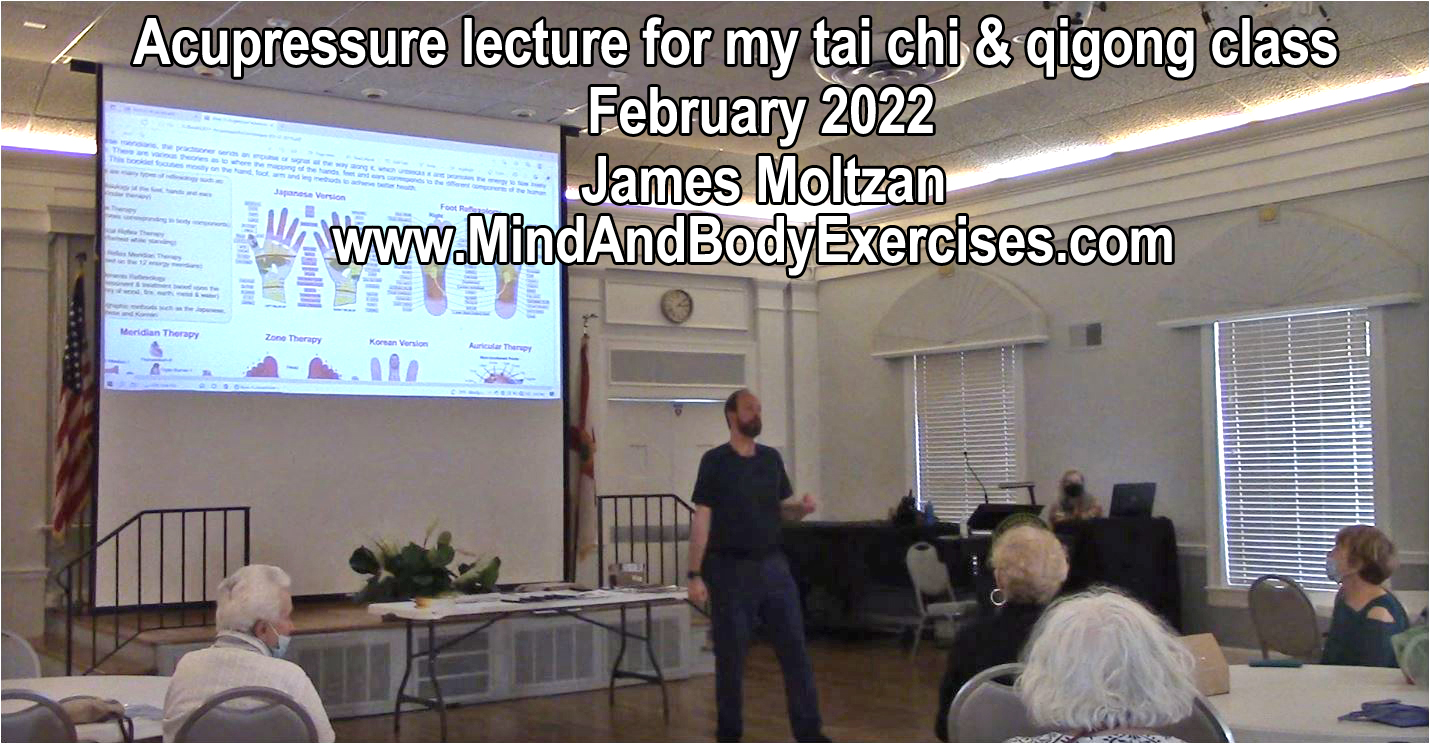
Blockages of the Qi, or chi (energy) flow usually result in poor blood circulation followed by illness. Acupressure or “pressure point” massage in conjunction with herbal extracts open the blood circulation and energy pathways increasing a flow of vitality that moves throughout the whole body. Response time to this opening of the energy pathways is usually less than 5 minutes.

__________

I write often about topics that affect our health and well-being. Additionally, I teach and offer lectures about qigong, tai chi, baguazhang, and yoga.

For more info, contact Jim Moltzan at info@mindandbodyexercises.com, 407-234-0119 or through my site at http://www.mindandbodyexercises.com

Vicious Cycle of Poor Posture

Poor posture and relative lifestyle habits are a topic I write about often, as these are such integral components in avoiding chronic pain. Chronic ailments can often escalate to other mental and physical health issues. Coping with chronic pain eventually takes its toll on the individual and those around them.

Posture is the relative placement of the human body and its components such as, but not confined to, the spine and limbs. Many people in the United States experience some type of chronic pain at some time in their lives. Causes of pain can vary depending upon the individual and their circumstances. Poor posture can be responsible for many ailments ranging from ankle, knee, hip and back pain. A spinal misalignment, due to improper posture, an injury, hereditary or even congenital conditions, can have an eventual ripple effect throughout the human body. A shift of .375″ (13mm) can cause the many ailments. A simple habitual tilt of the head or shift in the body weight over time, changes the alignment of the spine. This re-alignment begins to effect the muscles, tendons, ligaments and nerves causing a total imbalance within these body systems. An injured ankle or knee can become the spark that cause a ripple effect literally from head to toe.

Common causes of poor posture:

  • Poor standing habits
  • Driving with one arm forward, back hunched, knees higher than hips
  • Head and shoulder pinching together to hold telephone
  • Sitting or standing cross legged
  • Short leg syndrome
  • Lack of muscle tone and core strength
  • No regular exercise schedule

NOTE: Occasional execution of the a fore mentioned practices, doesn’t necessarily lead to pain and other problems. It is the repetitive and accumulative effect over years that seem to cause the dysfunction.

Straining the neck forward to see closer, puts strain on the neck and upper back. This leads to hunching forward of the spine and a gradual realignment of the 3 natural curves (cervical, thoracic & lumbar).

Poor posture, combined with long hours sitting stagnant in a chair working or driving, can cause muscles within the legs to shorten and tighten over time. These muscles, specifically the hamstrings, cause the pelvis to tilt the tailbone forward. Or the quadriceps can tighten causing the tailbone to tilt backward and the lumbar spine to arch even more forward.

Habits of stress on the cervical spine caused by posture and position of the head, specifically an increase in forward head position. This increases the weight on the cervical spine especially in the C-7 to T-1 vertebrae. Addition bone mass is accumulated in this area to compensate for the extra strain on the muscles, tendons and ligaments within the neck.

Anterior head position can cause permanent damage resulting in:
– Back, neck, shoulder arm pain
– Decrease in spinal curves
– Gastrointestinal problems
– Headaches
– Lung capacity decreased
– Muscle damage
– Nerve damage
– Spinal disc compression
– Spinal disc herniation

What is the solution to these issues?

  • get up out of the chair more often
  • become more active
  • consult with your physician or chiropractor
  • have your posture checked
  • stretch regularly
  • perform non-specific symmetrical exercises
  • inspect footwear for uneven wear patterns
  • evaluate poor posture habits and adjust
  • review career choices if necessary
  • exercises from tai chi, yoga and qigong offer methods that specifically focus on balancing poor postural habits.

______________

I write often about topics that affect our health and well-being. Additionally, I teach and offer lectures about qigong, tai chi, baguazhang, and yoga.

For more info, contact Jim Moltzan at info@mindandbodyexercises.com, 407-234-0119 or through my site at http://www.mindandbodyexercises.com

Moxibustion – Basic Theory

Traditional Chinese Medicine Method of Moxibustion

Moxibustion is the method of burning Mugwort (Ai Ye) or other herbs on, around, or above Acupuncture points. The leaves of the Moxa plant, as Mugwort is sometimes called, are usually dried in the sun, finely ground to a texture like wool or cotton, and then sifted until a fine, soft, and light green consistency is obtained. Moxa holds together well, burns evenly, and is relatively inexpensive. Moxa can be rolled into balls, shaped into cones, or purchased commercially in small or long rolls. The moxa balls and cones can be burned directly on the skin, or indirectly on a medium in between the Moxa and the skin. Small balls can also be used on the end of a needle as in the Warm needle techniques. Tiny pre-rolled Moxa or “Shish” Moxa can be purchased commercially, and is sometimes used at the end of a needle in place of loose Moxa. The longer moxa sticks, eight to ten (8-10) inch are usually used in a circular or “sparrow pecking” (rapidly moving the burning end near and far from the skin) motion around an Acupuncture point.

INDIRECT MOXIBUSTION
Practitioner places burning moxa wool on the top of the acupuncture needle. After the desired effect is achieved, the moxa is extinguished and the needle(s) removed. Indirect moxibustion is the more popular use of moxibustion because there is a much lower risk of pain or burning. Indirect moxa is probably the most commonly used as it can warm a greater area of the body with greater comfort. This too can be further broken down into the two most commonly used forms: warming needle and moxa pole. The moxa pole looks a lot like a cigar. It is lit at one end until it is smoldering hot, and then it is held over an acupuncture point or region of the body to warm it. In warming needle, an acupuncture needle is placed into a point on the body, and then a small ball of moxa is placed on the head of the needle. The moxa is then lit, so that the entire ball of moxa burns and smolders completely, thereby warming not only the surface of the skin below the moxa, but also the needle itself, and in turn the qi deep within the acupuncture point.

DIRECT MOXIBUSTION
A small, cone-shaped amount of moxa wool is placed on top of an acupuncture point and burned. Then it is extinguished or removed before it burns the skin. With direct moxibustion the patient will experience a pleasant heating sensation that penetrates deep into the skin, but should not experience any pain, blistering or scarring. Direct moxa means the moxa is applied directly onto the body. This is further broken down into what is called the scarring and the non-scarring methods. Most practitioners these days don’t perform scarring moxa anymore. It is very strong and quite effective! The non-scarring is the more common direct moxa method, and involves a small bunch of moxa being put onto the body, usually in the shape of cone, and burned down until the warmth is felt by the patient, and then removed. Many rounds of this would be done until a very strong sense of heat was felt at the point.

______________

I write often about topics that affect our health and well-being. Additionally, I teach and offer lectures about qigong, tai chi, baguazhang, and yoga.

For more info, contact Jim Moltzan at info@mindandbodyexercises.com, 407-234-0119 or through my site at http://www.mindandbodyexercises.com