
A Korean-Taoist Path of Self-Inquiry and Spiritual Return
Introduction
Within the quiet intersections of Korean martial arts, Seon Buddhism, Taoist inner alchemy, and indigenous contemplative practice, there exists a lesser-known meditative path called Chamsa (참사). Translated loosely as “true reflection” or “sincere contemplation,” this practice involves a series of inner visualizations that begin with the face and end with formless awareness. It guides the practitioner from physical identity, through spiritual regression, and into the vast, unconditioned presence that many traditions call enlightenment, nirvana, or union with the Tao.
Chamsa serves not only as a vehicle of personal transformation but also as a symbolic journey through layers of ego, memory, and form, toward a realization of the true self that was never born and never dies.

I. Origins and Conceptual Foundations
1. Linguistic Meaning
In Korean, Cham (참) means “true” or “authentic,” while Sa (사) may refer to “thought,” “contemplation,” or “reflection” (Kim, 2018). Thus, Chamsa points to a practice of authentic inward reflection, aligned with the spiritual aim of uncovering the nature of self and reality.
2. Syncretic Influences
The practice bridges three major influences:
- Seon (Zen) Buddhism: Emphasizes hwadu (Kōan-style inquiry), non-dual awareness, and meditation as a route to awakening (Aitken, 1990; Dumoulin, 2005).
- Taoist Neidan (inner alchemy): Employs visualizations, energy return, and prenatal regression to restore original spirit (Komjathy, 2013; Yang, 1997).
- Korean shamanic mysticism: Embraces spiritual vision, ancestral awareness, and altered states as portals to insight (Kim, 2018).
II. The Stages of Chamsa Practice
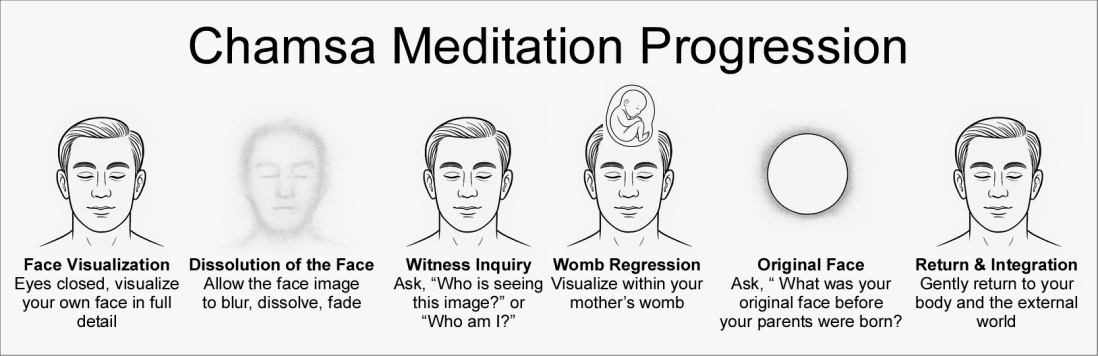
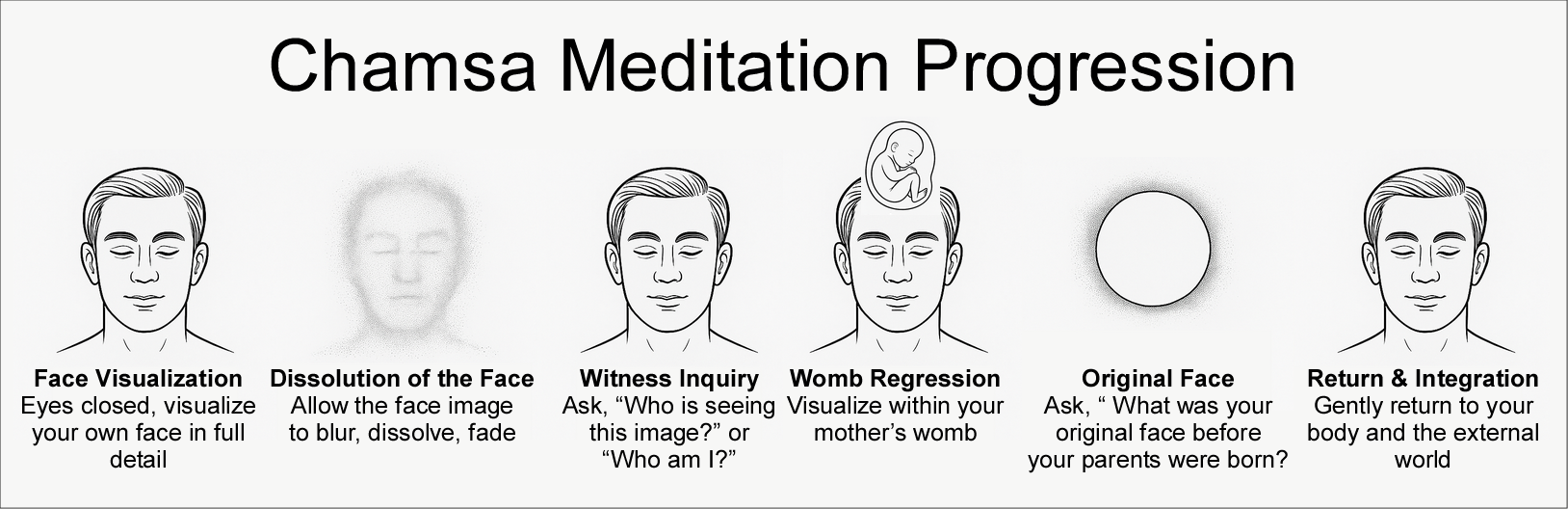
Chamsa is typically taught as a stage-based meditation, though advanced practitioners may cycle through its phases in a single session. Each stage builds upon the last, guiding the practitioner from concrete visualization to subtle realization.
Stage 1: Face Visualization
- Description: Eyes closed, visualize your own face in full, accurate detail, every wrinkle, mole, and asymmetry. Include features such as the slope of the nose, eyebrow placement, asymmetries, scars, skin texture, color, and even the micro-expressions of your resting face. The image should be as vivid and lifelike as if one were looking into a mirror with eyes open.
- Purpose: Strengthen shen (spirit), develop internal focus, and anchor awareness in the “mind mirror.” This aligns with Taoist inner vision practices (nèishì), projecting awareness from the third eye center or upper dantian (Kohn, 1993; Yang, 1997).
Stage 2: Dissolution of the Face
- Description: Allow the mental image of the face to gradually blur, dissolve, or melt away without force. Observe any resistance or attachment as the image fades.
- Purpose: Cultivate detachment from personal identity and begin breaking down the egoic image of the self. This mirrors both Zen and Taoist instructions for letting go of attachment to form (Dumoulin, 2005).
Stage 3: Witness Inquiry
- Description: With the face gone, turn awareness inward and ask: “Who is seeing this image?” or “What remains when the face disappears?”
- Purpose: This self-inquiry parallels Seon (Zen) Buddhism’s hwadu method and Taoist “reflection on the void.” It shifts attention to the formless witness, revealing the distinction between perception and identification (Aitken,1990).
Stage 4: Womb Regression
- Description: Begin to visualize yourself in the womb. Sense the floating, fluid warmth of the pre-birth state. This visualization is not merely symbolic; it is a meditative immersion into pre-verbal, pre-identity awareness.
- Purpose: Return to the state of yuan qi and yuan shen (original energy and spirit), reconnecting with the undisturbed potential of consciousness prior to conditioning. This corresponds to Taoist embryonic breathing, and the process of returning to the origin (Komjathy, 2013).
Stage 5: Original Face
- Description: Let go of all visualizations. Abide in spacious presence. Ask: “What was my original face before my parents were born?”
- Purpose: This stage reflects the heart of Zen realization. All form, memory, and thought dissolve, revealing emptiness and unconditioned awareness (Aitken, 1990).
Stage 6: Return and Integration
- Description: Slowly bring awareness back to the breath, body, and senses. Open the eyes and re-engage with the outer world from this clarified state.
- Purpose: To integrate realization into daily life. The clarity cultivated through chamsa should inform one’s behavior, relationships, and presence, aligning with both Taoist spontaneity and the Zen Ox-herding picture of reentering the world with open hands (Dumoulin, 2005; Yang, 1997).
III. Practice Progression: Gradual vs. Cyclical
Progressive Practice (for most practitioners)
| Stage | Timeframe | Developmental Aim |
| Face Visualization | 1–2 weeks | Image clarity, stillness |
| Dissolution | 1–2 weeks | Letting go, self-inquiry begins |
| Inquiry | 2+ weeks | Direct experience of the observer |
| Womb Regression | Variable | Comfort with silence and non-conceptual being |
| Original Face | Ongoing | Insight into emptiness and non-duality |
This mirrors the traditional model used in both Zen training and Taoist alchemical refinement (Komjathy, 2013; Dumoulin, 2005).
Cyclical Practice (for advanced practitioners)
Experienced meditators may move through all stages in a single sitting. This is often employed in advanced neigong, zazen, or during spiritual retreats (Yang, 1997).
IV. Chamsa and Enlightenment
1. As a Route to Enlightenment
Chamsa progressively dismantles the layers of self-identity. It leads to direct realization of formless presence, making it consistent with both Zen’s gradual approach and Taoism’s return to source (Aitken,1990; Komjathy, 2013).
2. As an Expression of Enlightenment
At deeper levels, the practice becomes a reflection of the awakened state. It is used not to attain enlightenment, but to maintain presence and live from insight (Dumoulin, 2005).
“The enlightened one returns to the marketplace with open hands.” — Zen Ox-Herding Picture #10
V. Comparative Models of Enlightenment
| Aspect | Chamsa | Zen Buddhism | Taoist Alchemy | Tibetan Dzogchen |
| Starting Point | Visualization of face | Hwadu or breath focus | Jing → Qi → Shen transmutation | Rigpa recognition |
| Key Turning Point | Dissolution and womb regression | “Great doubt” or koan resolution | Return to origin | Breakthrough to spontaneous presence |
| Final Aim | Witnessing the “original face” | Satori, then integration | Unity with Tao | Recognition of non-dual awareness |
| Method | Visual inquiry & regression | Self-inquiry & zazen | Breath, energy, visualization | Direct pointing-out instruction |
| Expression | Calm presence, embodied wisdom | Actionless action, compassion | Spontaneity, longevity, clarity | Effortless awareness, freedom |
VI. Conclusion: Returning to the Formless Mirror
Chamsa meditation is both a method and a metaphor: a way of seeing the self by watching it dissolve. It begins with the familiar image of the face and guides the practitioner back to the unconditioned awareness before identity, thought, and time.
Whether used as a route to insight or a means of stabilization, Chamsa bridges Korean, Taoist, and Buddhist traditions. It reveals that the journey inward is not a retreat, but a return to that which has always been present.
“To know the self is to forget the self. To forget the self is to be enlightened by all things.”
— Dōgen Zenji, Genjōkōan
References
Aitken, R. (1990). The Gateless Barrier: The Wu-Men Kuan (Mumonkan). North Point Press. https://archive.org/details/gatelessbarrierw0000aitk
Dumoulin, H. (2005). Zen Buddhism: A History (Vol. 2: Japan). World Wisdom. Zen Buddhism : a history : Dumoulin, Heinrich : Free Download, Borrow, and Streaming : Internet Archive
Kim, C. (2018). Korean shamanism. In Routledge eBooks. https://doi.org/10.4324/9781315198156
Kohn, L. (1993). The Taoist Experience: An Anthology. SUNY Press. https://archive.org/details/thetaoistexperienceliviakohn
Komjathy, L. (2013). The Daoist Tradition: An Introduction. Bloomsbury Academic. https://www.bloomsbury.com/us/daoist-tradition-9781441168733/
Yang, J. (1997). The Root of Chinese Qigong: Secrets of Health, Longevity, and Enlightenment. YMAA. https://archive.org/details/therootofchineseqigongbyyangjwingming1997


 United Martial Arts Association