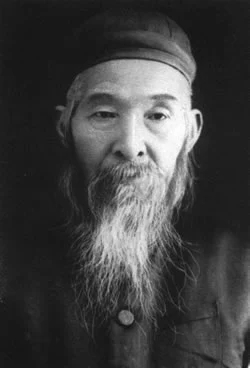
Sun-style Baguazhang (a summary of a complex mind, body & spiritual practice)

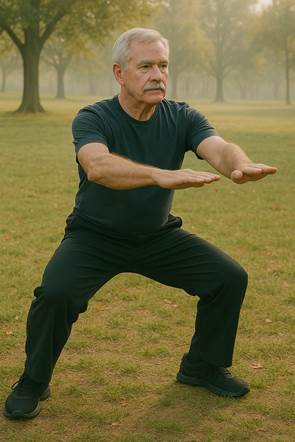
Sun-style Baguazhang founded by Sun Lutang in the early 20th century, is a unique synthesis of internal martial arts, integrating elements of:

  • Xingyi Quan (Form-Intent Fist),
  • Taiji Quan (Sun-style),
  • and traditional Baguazhang (particularly from the Cheng style under Cheng Tinghua).
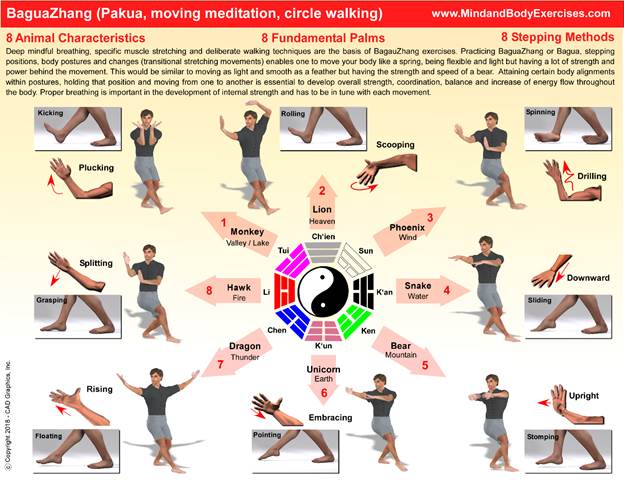
While Sun-style Baguazhang emphasizes smooth, flowing footwork, spiraling energy, and compact yet expansive movements, it also preserves the foundational concept of the “Eight Animals”, each linked to a Bagua trigram and embodying a specific energy quality, fighting method, and movement strategy.
Key Characteristics of Sun-Style Baguazhang

  • Smooth, gliding footwork (“mud-wading” step is less exaggerated than in Cheng style)
  • Vertical spirals rather than overt horizontal swings
  • Compact circular walking and short explosive bursts
  • Heavy emphasis on internal structure, breath, and intent
  • More linear expressions drawn from Sun’s Xingyi Quan influence

Training Methods

  • Single palm change and eight mother palms form the foundation
  • Animal forms are often practiced after the basics, each representing a way to internalize energy and tactics
  • Circle walking remains central, helping to refine awareness, timing, and structure

Sun Lutang’s written works, especially Baguaquan Xue (The Study of Baguazhang), emphasized the energetic and internal alchemical aspect of these animals.

The trigrams represent both cosmological and tactical frameworks. For example:

  • Dragon/Thunder (Zhèn) symbolizes suddenness, matching the explosive spirals of Dragon techniques.
  • Phoenix/Wind (Xùn) represents subtle, flowing changes, aligning with evasive and redirective qualities.
  • Unicorn is not just a mythical creature but symbolizes a fusion of gentleness and strength, perfect for the Earth trigram’s yielding-yet-solid essence.
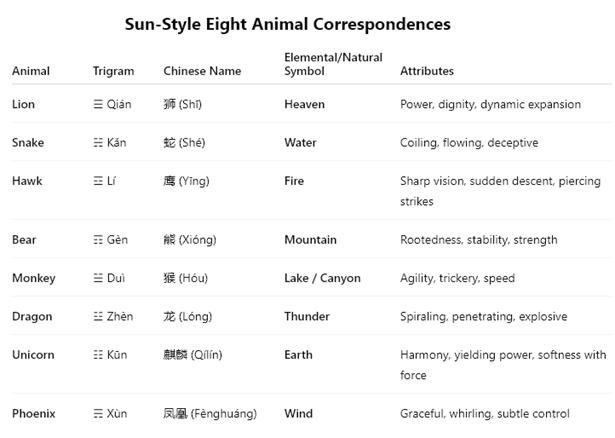
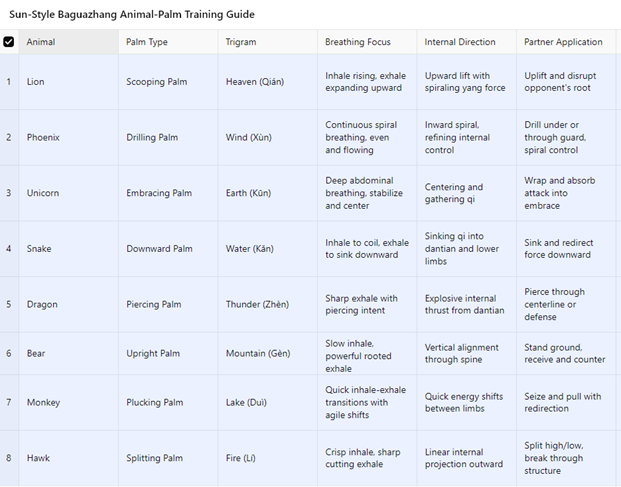
Explanation of Each Animal-Palm Correspondence

🦁 Lion – Heaven – Scooping Palm

  • Heaven (Qián) is pure Yang, representing assertive, generative force from above.
  • Lion’s energy is dignified and expansive. The scooping palm lifts and uproots, symbolizing Heaven reaching downward to lift Earth.
  • This palm captures the rising, spiraling Yang power, useful in uprooting throws and explosive redirects.

🐦 Phoenix – Wind – Drilling Palm

  • Wind (Xùn) is flexible and constant, penetrating spaces invisibly but powerfully.
  • The drilling palm spirals inward and upward like a corkscrew, expressing finesse, control, and internal power.
  • The phoenix as an image of transcendence and elegance matches the continuous, coiling intent of the drilling palm.

🦄 Unicorn – Earth – Embracing Palm

  • Earth (Kūn) is receptive, stabilizing, nurturing, the source of all.
  • The unicorn embodies gentle power, blending grace and solidity.
  • The embracing palm draws in, neutralizes, and absorbs, symbolizing the earth’s ability to contain and harmonize force.

🐍 Snake – Water – Downward Palm

  • Water (Kǎn) flows downward, seeks the lowest point, and adapts to all.
  • The snake slithers, coils, and sinks to avoid or entrap.
  • The downward palm pushes or leads energy downward, draining the opponent’s center or redirecting force into the ground, embodying water’s sinking nature.

🐉 Dragon – Thunder – Piercing Palm

  • Thunder (Zhèn) is sudden, startling, and forceful.
  • The dragon in Chinese cosmology often rides the thunderclouds, appearing with a burst.
  • The piercing palm thrusts sharply, with intent to penetrate defenses, expressing the shock and speed of thunder, coupled with dragon’s spiral motion.

🐻 Bear – Mountain – Upright Palm

  • Mountain (Gèn) is still, unmoving, and massive.
  • The bear is rooted, strong, and direct.
  • The upright palm rises vertically or stands firm against pressure, exemplifying the bear’s towering strength and the unwavering solidity of a mountain.

🐒 Monkey – Lake – Plucking Palm

  • Lake/Canyon (Duì) is reflective, deep, and often deceptive, calm on the surface but powerful underneath.
  • The monkey is clever, agile, quick to seize and let go.
  • The plucking palm snatches or intercepts, sudden entry and escape, mirroring the monkey’s unpredictability and the reflective qualities of a still surface hiding motion.

🦅 Hawk – Fire – Splitting Palm

  • Fire (Lí) is expansive, bright, and sharp — consuming and illuminating.
  • The hawk dives with speed and precision.
  • The splitting palm cleaves through space, like talons descending, fast, straight, and precise, expressing the fire-like intensity and clarity of the hawk.

Summary

Each animal-palm pairing in Sun-style Baguazhang is a holistic model:

  • Trigram (Ba Gua): Provides cosmological and energetic context.
  • Animal: Offers symbolic and behavioral metaphor.
  • Palm: Expresses physical techniques and combat function.

This creates a threefold training method, integrating heaven (intent), earth (body), and man (expression). Practicing these palm changes while circle walking allows the practitioner to cycle through energetic qualities, mental states, and combat strategies.
References

Sun Lutang. (2013). The Study of Bagua Quan (Bagua Quan Xue) (F. Fick, Trans.). Shen Long Publishing. (Original work published 1917)

Sun Lutang. (2002). Baguaquan Xue: The Study of Eight Trigrams Boxing (J. Crandall, Trans.). Smiling Tiger Martial Arts. (Original work published 1916)

Brennan, P. (2023, January 21). THE BAGUA MANUAL OF SUN LUTANG. Brennan Translation. https://brennantranslation.wordpress.com/2015/04/30/the-bagua-manual-of-sun-lutang/
Korean Neigong: Internal Cultivation Systems

Korean neigong, or internal cultivation, represents a rich and multifaceted tradition rooted in the intersections of Seon (Zen) Buddhism, Daoism, indigenous shamanism (Muism), and martial arts. Though often compared to Chinese neidan (internal alchemy), Korean systems possess their own unique methods, spiritual philosophies, and training structures. These practices cultivate internal strength, breath control, meditative awareness, and according to lineage traditions, can even develop extraordinary energetic capabilities within the human body.

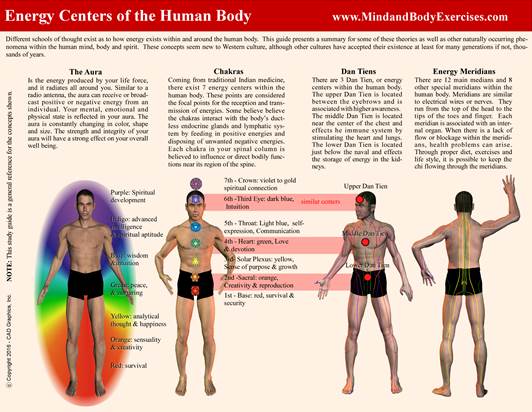
At the core of Korean neigong is the concept of danjeon training, the Korean analog to the Chinese dantian, representing energy reservoirs in the lower abdomen, heart center, and forehead. Training typically begins with breath regulation (hoheupbeop), emphasizing deep abdominal breathing and the storage of gi (qi), in the lower danjeon. Complementary postural training fosters rootedness and structural alignment to optimize energetic circulation.

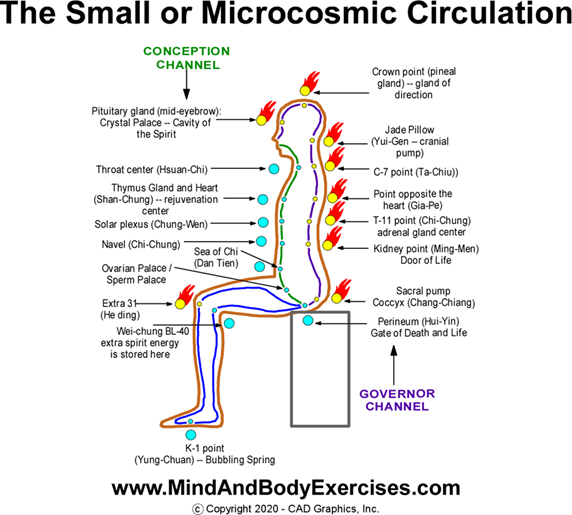
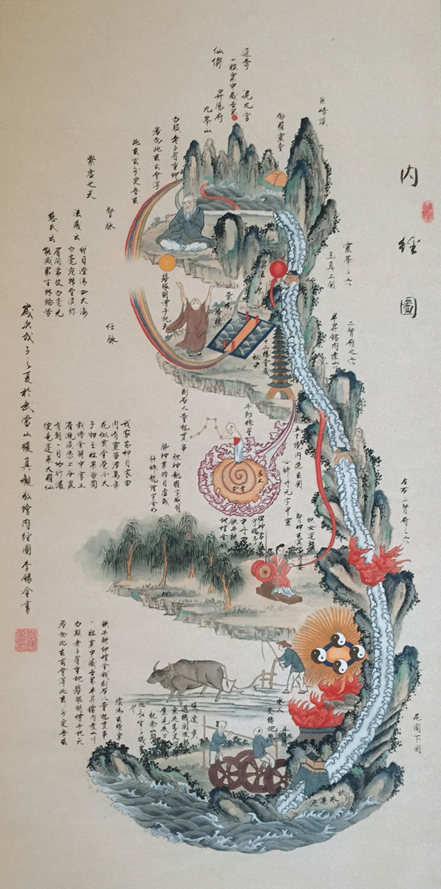
Breathing practices are often paired with dynamic postures (dong gong) and stillness meditation (jing gong). Stillness can take the form of seated meditation (jwaseon), standing meditation (ipseon), or lying meditation (woseon). These practices are further enhanced by internal visualizations and energy circuit training (e.g., small celestial circulation (so cheon-ju), echoing the microcosmic orbit known in Daoist internal work.

Ethical cultivation is not separated from physical training. In Seon Buddhism, self-discipline, clarity of mind, and non-attachment are prerequisites for deeper spiritual realization. Korean shamanism and folk practices also include cathartic or vibrational techniques intended to release emotional and energetic blockages (Kendall, 2009).

1. Breathing Techniques

  • Emphasis on abdominal breathing focused on the danjeon, Korea’s equivalent to dantian
  • Breath retention and pressurization techniques to build internal heat and energy

2. Danjeon Development

  • Training begins with the lower danjeon as the energy reservoir, with advanced practice involving the middle and upper danjeon
  • Strengthening of energy through posture, breath, and mental focus

3. Stillness & Movement Forms

  • Alternation between static meditation (jing gong) and dynamic exercises (dong gong)
  • Includes seated (jwaseon), standing (ipseon), and walking meditations (Wŏnhyo. (2007)

4. Energy Circulation Pathways

  • Refinement of energy through microcosmic and macrocosmic orbit-like methods
  • Known in Korean as So Cheon-ju and Dae Cheon-ju, reflecting small and great celestial circuits

5. Vocal Resonance and Chanting

  • Use of sound (vibration or mantra) to stimulate meridians or brain centers
  • Buddhist hwadu practice or shamanic incantations are used for energetic activation (Kendall, 2009)

6. Moral and Spiritual Development

  • Cultivation of shin (spirit) and refinement of ki (qi) is inseparable from ethical living, compassion, and clarity of mind
  • These echo the Confucian and Buddhist emphasis on inner purity (Buswell, 2007)

Korean systems typically follow a three-phase transformation of internal substances, paralleling Daoist inner alchemy:

StageFocusGoal
     1. JeongEssenceCultivation and storage in lower danjeon
     2. KiEnergyCirculation through meridians, activation
     3. ShinSpiritEnlightenment, calm, and intuitive awareness

This structure reflects a philosophical progression from form to formlessness, body to spirit, and effort to naturalness (mu-shim).

Some While historical documentation of standardized curricula is limited, several lineage-based or temple-administered systems reveal structured sequences of internal exercises.

1. Sunmudo

Sunmudo, a Korean Zen martial art maintained at Golgulsa Temple, exemplifies a synthesis of Seon meditation, martial forms, and yogic movement. Training includes:

  • Breathing forms for energy refinement
  • Dynamic martial sequences for vitality and physical strength
  • Sitting meditation to deepen spiritual awareness

While specific counts of exercises vary, temple curricula often include dozens to hundreds of postures practiced cyclically and ceremonially (Gatling & Svinth, 2010; Buswell, 1992).

2. Sundo (Kouk Sun Do)

Sundo is a Daoist-based system emphasizing long-term energetic development through structured, belt-ranked progressions:

  • Early stages introduce forms of 20–30 postures each, integrating breath and motion
  • Intermediate levels include multiple 10–12 posture forms with increased internal pressure
  • Higher ranks culminate in single postural meditations held for long durations

Though no canonical source confirms the existence of 640 exercises, advanced Sundo practitioners speak of multiple series comprising dozens of unique sequences, many kept orally or within private manuals (Baker, 2008).

3. Private and Temple-Based Neigong Curricula

Certain modern Daoist-influenced schools teach internal cultivation through sequential stages such as:

  1. Ming Jin – Obvious or external power
  2. An Jin – Hidden or internalized power
  3. Hua Jin – Transformative or refined power

Each stage includes multiple breathing patterns, static postures, shaking or loosening exercises, and visualization practices. While primarily documented in Chinese systems, some Korean offshoots follow similar developmental arcs (DaoistMagic.com, 2018).

The “640 foundational exercises” for neigong training is an intriguing concept. While there seems to be no standardized system in Korea or China universally recognized by that number, similar structured sets have been mentioned in some martial and internal arts traditions.

Possible explanations:

  1. Categorized Curricula: Some advanced traditional neigong systems (especially temple-based or private transmission lineages) are reported to have hundreds of discrete exercises, including:
    • Static postures (standing, seated)
    • Dynamic movements
    • Meridian tapping or shaking
    • Breath-retention patterns
    • Visualizations or inner orbits
  1. Numerical Symbolism: The number 640 may also be symbolic or organizational, reflecting a highly structured internal system for advanced practitioners. Comparable systems:
    • 72 movements in Sundo
    • 108 prostrations in Seon Buddhism
    • 360 meridian-related points, often doubled for bilateral flow
  1. Private or Temple Transmission: It’s plausible that a master or temple in Korea (or China) compiled a curriculum totaling 640 methods as part of a closed-door (munpa) tradition, though no academic or published source verifies this number explicitly.

Anecdotal reports from both Korean and Chinese internal arts describe practitioners capable of moving energy to specific areas of the body at will, producing heat, shaking, or subtle vibration. Some traditions describe this as “naegong hwa” (internal fire) or “danjeon activation.”

In neijia (internal martial arts) circles, Chinese masters have demonstrated:

  • Fa jin – Explosive internal force from still postures
  • Intentional energy projection through limbs or meridians
  • Energetic sensitivity during partner work, reflecting advanced internal perception

While these claims lack robust scientific verification, ethnographic accounts support that dedicated practice over years may result in unusually fine motor control, breath retention capacity, and subjective energetic awareness (Buswell, 1992; ResearchGate, 2021).

In Korean contexts, practitioners of Sunmudo and Sundo have similarly reported the ability to move internal energy in ways that affect circulation, body temperature, or mental state. These effects are typically cultivated over decades of intensive, daily practice in monastic or semi-monastic settings. However, it is important to address, that “extraordinary claims, require extraordinary evidence,” where a claim that is highly improbable or contradicts established knowledge, one should demand a higher standard of proof than for more ordinary claims. This principle, popularized by Carl Sagan, emphasizes that the strength of evidence needed to support a claim should be proportional to its degree of unusualness.

Korean neigong is a dynamic and integrated tradition combining physical health, meditative stability, and moral clarity. Its practices span breath regulation, posture, mental focus, and internal energy movement, often embedded within temple or lineage-based systems.

While the concept of 640 foundational exercises remains unverified in published literature, structured multi-stage curricula in Sunmudo, Sundo, and other private lineages offer clear evidence of comprehensive internal development systems. Stories of energetic control or internal transformation continue to circulate in traditional circles, pointing to the long-term potential of dedicated inner practice, not necessarily as supernatural, but as refined physiological, neurological, and spiritual discipline.

References

Baker, D. L. (2008). Korean Spirituality. University of Hawai‘i Press. https://uhpress.hawaii.edu/title/korean-spirituality/

Buswell, R. E., Jr. (1992). The Zen Monastic Experience: Buddhist Practice in Contemporary Korea. Princeton University Press. https://press.princeton.edu/books/paperback/9780691034775/the-zen-monastic-experience

DaoistMagic.com. (2018). Neigong Training Curriculum Overview. Retrieved July 2025, from https://www.daoistmagic.com/neigong-training-class

Kendall, L. (2009). Shamans, Nostalgias, and the IMF: South Korean Popular Religion in Motion. University of Hawai‘i Press. https://archive.org/details/shamansnostalgia0000kend

Gatling, L., & Svinth, J. (2010). Martial arts of the world: An Encyclopedia of History and innovation. http://www.academia.edu. https://www.academia.edu/3159277/Martial_arts_of_the_world_An_Encyclopedia_of_History_and_innovation

ResearchGate. (2021). Hang the Flesh off the Bones: Cultivating an Ideal Body in Taijiquan and Neigong. Retrieved from https://www.researchgate.net/publication/351059664

Wŏnhyo. (2007). Cultivating original enlightenment : Wŏnhyo’s Exposition of the vajrasamādhi-sūtra (Paperback edition). University of Hawaiʻi Press. https://searchworks.stanford.edu/view/13457065

The Misogi Challenge

A Modern Rite of Passage for Mind, Body, and Spirit

In today’s comfort-saturated world, we often forget what we’re capable of. We live behind screens, within routines, and beneath our potential. But what if, once a year, you did something so challenging, so outrageous that it forced you to face your limits and break through them? That’s the spirit of “Misogi.”

What Is Misogi?

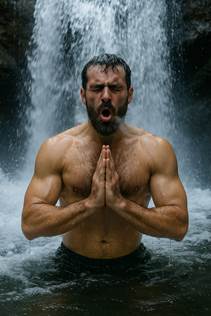
Misogi is an ancient Shinto purification ritual originating in Japan. Traditionally performed under icy waterfalls or in natural bodies of water, it involves cold-water immersion, breath control, and chanting to wash away impurities, not just physical dirt, but emotional, mental, and spiritual stagnation. It’s about cleansing the soul, aligning with nature, and stepping into renewed awareness.

“Misogi is not about strength; it’s about sincerity.” – Japanese proverb

From Ritual to Challenge: The Modern Misogi

In recent years, Misogi has evolved beyond religious rituals into a deliberate act of voluntary hardship. Misogi is a physical and mental challenge that reclaims the spirit of transformation. Spearheaded by thinkers like Dr. Marcus Elliott, the modern Misogi is a once-a-year event so difficult that there’s a 50% chance of failure.

The Rules of Modern Misogi:

  1. It should be physically and/or mentally extreme.
  2. There should be a real risk of not finishing.
  3. No audience. This is not for social media likes.
  4. It should change one’s perspective on the way you see the rest of their life.

Holistic Health Benefits of Misogi

From a holistic wellness standpoint, the Misogi Challenge is more than a test of will, it’s a full-spectrum recalibration:

Mental Fortitude

Pushing beyond perceived limits activates the prefrontal cortex, engages deep concentration, and can restructure your relationship with fear and discomfort (Tse et al., 2007).

Physical Resilience

Strenuous, unfamiliar tasks force the body to adapt, strengthen, and detoxify, stimulating lymphatic flow, cardiovascular function, and musculoskeletal balance (Nieman, 2003).

Energetic Alignment

Like cold plunges in Taoist and Ayurvedic cleansing rituals, Misogi resets energetic flow (Qi or prana), breaking through stagnation that can lead to disease (Larre et al., 1996).

Spiritual Renewal

Letting go of the ego, expectations, and habitual comforts creates space for inner clarity and reconnection to purpose. It becomes a form of sacred self-inquiry.

Designing a Misogi Challenge for Different Wellness Levels

Seniors or Holistic Wellness Groups

  • Challenge: 12-hour digital fast with 6-hour silent walking meditation
  • Why: Encourages mindfulness, self-awareness, and reconnection with breath and body
  • Modify with: Journaling and gentle breathwork (e.g., qigong or walking tai chi)

Moderate Fitness Level

  • Challenge: 20-mile nature hike with water-only fasting
  • Why: Combines physical exertion, solitude, and environmental reconnection
  • Modify with: Breaks for seated meditation or breath practice every 5 miles

Advanced Practitioners or Athletes

  • Challenge: Carrying a heavy object (rock, sandbag) across natural terrain for 2–3 hours in silence
  • Why: Deeply tests body and mind under primal conditions
  • Modify with: Incorporate chants, breath pacing, or visualization

Integration Is Key

A true Misogi doesn’t end when the task is complete. The reflection period is just as important:

  • Journal about what arose emotionally and physically
  • Meditate on what you let go of and what you discovered
  • Ask yourself: Who was I before this, and who am I now?

Misogi in the Modern World

While Misogi may sound extreme, it addresses a modern spiritual hunger or the need for voluntary adversity (strategic trauma) that leads to inner growth. We lack rites of passage in our society, and so our transformation remains stunted. Misogi reclaims this space and offers a framework for regeneration, not just resilience.

In the end, Misogi isn’t about conquest. It’s about coming clean with your body, your breath, your fears, and your forgotten strength. Misogi is less about proving you can finish and more about remembering what’s possible when you try.

Even once a year, stepping into something so bold, uncomfortable, and transformative can reset your relationship with fear, complacency, and the stories you tell yourself. Misogi is a sacred dare to become fully alive.

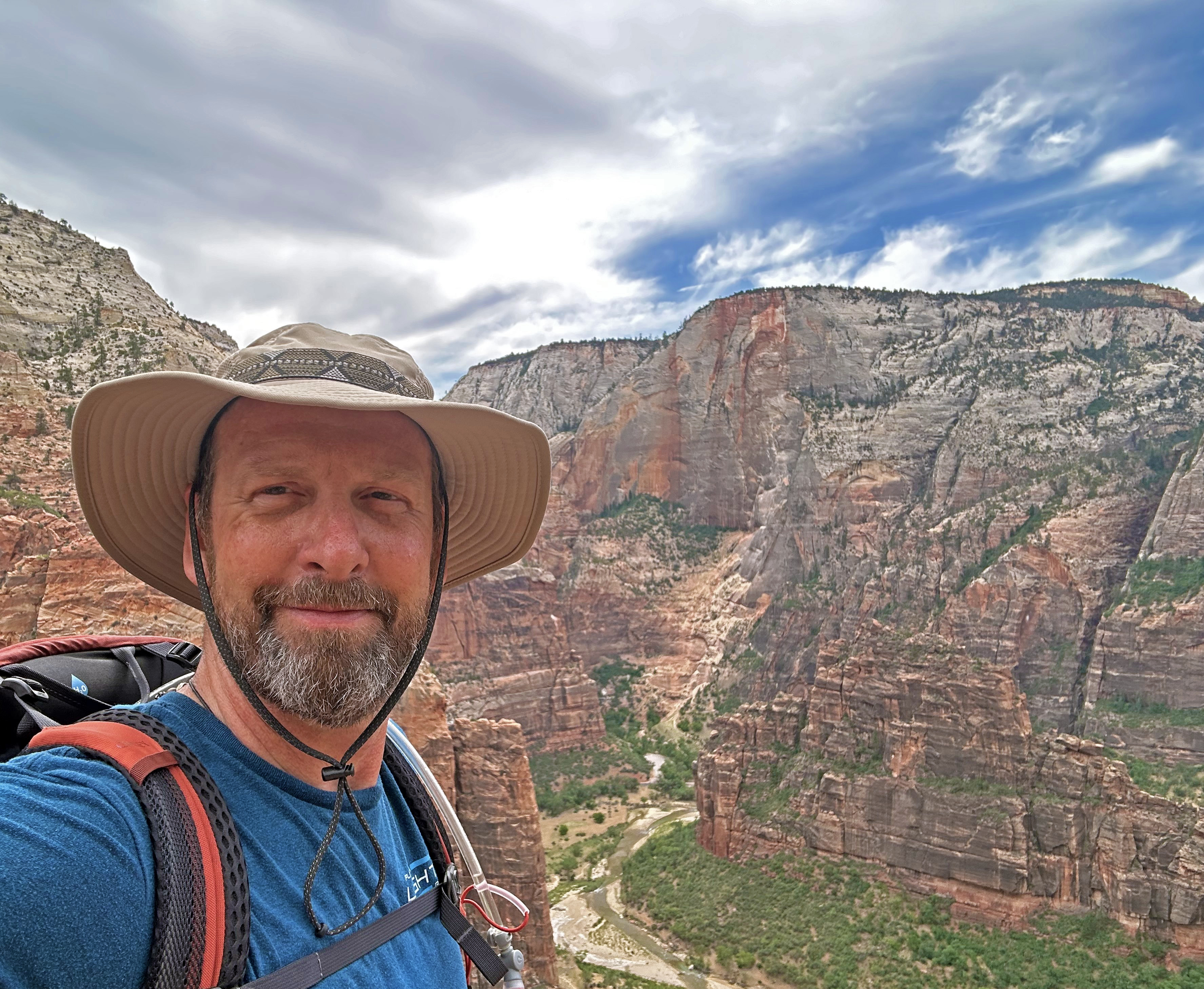
Last year, I committed to a 3-month rigorous physical training regimen to prepare for a 10-day hiking expedition across Utah’s Mighty Five national parks. A journey that demanded not only endurance but also mental clarity and emotional resilience. In many ways, it became my own version of a Misogi Challenge.

Drawing from decades of experience in Tai Chi, Qigong, and other time-tested fitness and wellness systems, I developed a holistic training protocol that addressed balance, breath, posture, flexibility, and mindset. This integrative approach not only strengthened my body for the miles ahead but also deepened my presence and appreciation for the journey itself.

I now help others design their own Misogi-style challenges, whether it’s a hiking goal, a fitness milestone, or a personal rite of passage, using adaptable practices rooted in Eastern movement arts and modern wellness science. You don’t need to be an elite athlete; you only need the willingness to step beyond comfort and toward transformation.

References

Larre, C., de la Vallée, E., & Rochat de la Vallée, E. (1996). The Eight Extraordinary Meridians: Spirit of the Vessels. Monkey Press.

Nieman, D. C. (2003). Current perspective on exercise immunology. Current Sports Medicine Reports, 2(5), 239–242. https://doi.org/10.1249/00149619-200310000-00001

Tse, D., Langston, R. F., Kakeyama, M., Bethus, I., Spooner, P. A., Wood, E. R., … & Morris, R. G. (2007). Schemas and memory consolidation. Science, 316(5821), 76-82. https://doi.org/10.1126/science.1135935

Chamsa Meditation: Inner Vision, Pre-Birth Awareness, and the Mirror of Enlightenment

A Korean-Taoist Path of Self-Inquiry and Spiritual Return

Introduction

Within the quiet intersections of Korean martial arts, Seon Buddhism, Taoist inner alchemy, and indigenous contemplative practice, there exists a lesser-known meditative path called Chamsa (참사). Translated loosely as “true reflection” or “sincere contemplation,” this practice involves a series of inner visualizations that begin with the face and end with formless awareness. It guides the practitioner from physical identity, through spiritual regression, and into the vast, unconditioned presence that many traditions call enlightenment, nirvana, or union with the Tao.

Chamsa serves not only as a vehicle of personal transformation but also as a symbolic journey through layers of ego, memory, and form, toward a realization of the true self that was never born and never dies.

I. Origins and Conceptual Foundations

1. Linguistic Meaning

In Korean, Cham (참) means “true” or “authentic,” while Sa (사) may refer to “thought,” “contemplation,” or “reflection” (Kim, 2018). Thus, Chamsa points to a practice of authentic inward reflection, aligned with the spiritual aim of uncovering the nature of self and reality.

2. Syncretic Influences

The practice bridges three major influences:

  • Seon (Zen) Buddhism: Emphasizes hwadu (Kōan-style inquiry), non-dual awareness, and meditation as a route to awakening (Aitken, 1990; Dumoulin, 2005).
  • Taoist Neidan (inner alchemy): Employs visualizations, energy return, and prenatal regression to restore original spirit (Komjathy, 2013; Yang, 1997).
  • Korean shamanic mysticism: Embraces spiritual vision, ancestral awareness, and altered states as portals to insight (Kim, 2018).

II. The Stages of Chamsa Practice

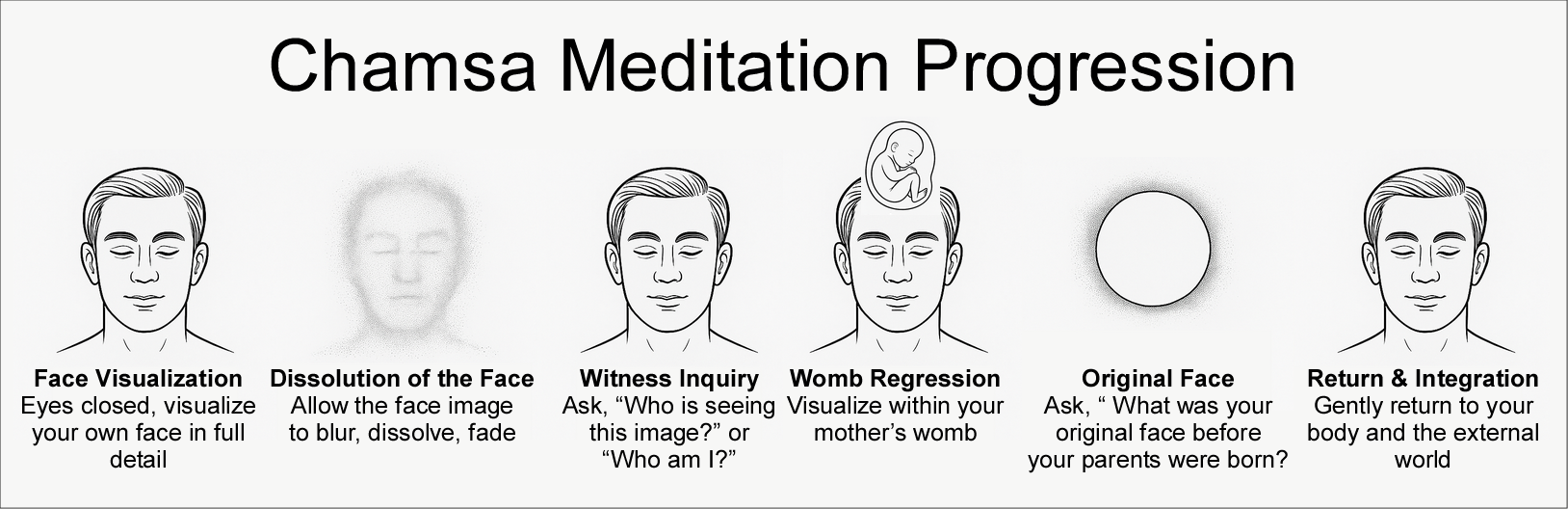
Chamsa is typically taught as a stage-based meditation, though advanced practitioners may cycle through its phases in a single session. Each stage builds upon the last, guiding the practitioner from concrete visualization to subtle realization.

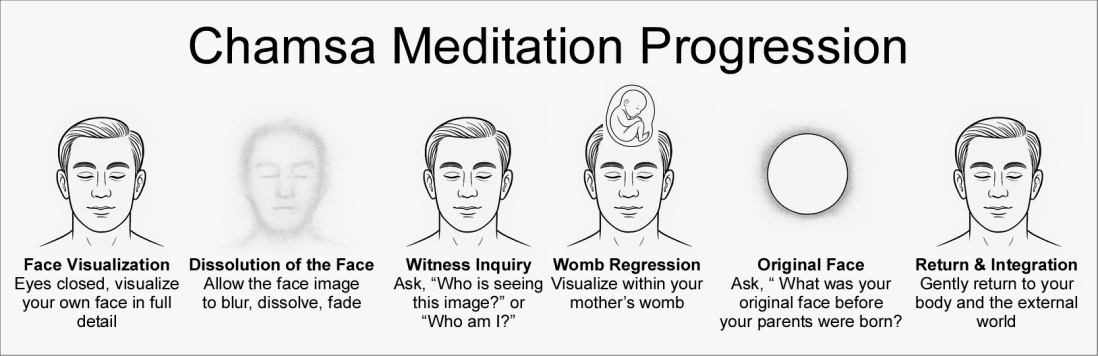
Stage 1: Face Visualization

  • Description: Eyes closed, visualize your own face in full, accurate detail, every wrinkle, mole, and asymmetry. Include features such as the slope of the nose, eyebrow placement, asymmetries, scars, skin texture, color, and even the micro-expressions of your resting face. The image should be as vivid and lifelike as if one were looking into a mirror with eyes open.
  • Purpose: Strengthen shen (spirit), develop internal focus, and anchor awareness in the “mind mirror.” This aligns with Taoist inner vision practices (nèishì), projecting awareness from the third eye center or upper dantian (Kohn, 1993; Yang, 1997).

Stage 2: Dissolution of the Face

  • Description: Allow the mental image of the face to gradually blur, dissolve, or melt away without force. Observe any resistance or attachment as the image fades.
  • Purpose: Cultivate detachment from personal identity and begin breaking down the egoic image of the self. This mirrors both Zen and Taoist instructions for letting go of attachment to form (Dumoulin, 2005).

Stage 3: Witness Inquiry

  • Description: With the face gone, turn awareness inward and ask: “Who is seeing this image?” or “What remains when the face disappears?”
  • Purpose: This self-inquiry parallels Seon (Zen) Buddhism’s hwadu method and Taoist “reflection on the void.” It shifts attention to the formless witness, revealing the distinction between perception and identification (Aitken,1990).

Stage 4: Womb Regression

  • Description: Begin to visualize yourself in the womb. Sense the floating, fluid warmth of the pre-birth state. This visualization is not merely symbolic; it is a meditative immersion into pre-verbal, pre-identity awareness.
  • Purpose: Return to the state of yuan qi and yuan shen (original energy and spirit), reconnecting with the undisturbed potential of consciousness prior to conditioning. This corresponds to Taoist embryonic breathing, and the process of returning to the origin (Komjathy, 2013).

Stage 5: Original Face

  • Description: Let go of all visualizations. Abide in spacious presence. Ask: “What was my original face before my parents were born?”
  • Purpose: This stage reflects the heart of Zen realization. All form, memory, and thought dissolve, revealing emptiness and unconditioned awareness (Aitken, 1990).

Stage 6: Return and Integration

  • Description: Slowly bring awareness back to the breath, body, and senses. Open the eyes and re-engage with the outer world from this clarified state.
  • Purpose: To integrate realization into daily life. The clarity cultivated through chamsa should inform one’s behavior, relationships, and presence, aligning with both Taoist spontaneity and the Zen Ox-herding picture of reentering the world with open hands (Dumoulin, 2005; Yang, 1997).

III. Practice Progression: Gradual vs. Cyclical

Progressive Practice (for most practitioners)

StageTimeframeDevelopmental Aim
Face Visualization1–2 weeksImage clarity, stillness
Dissolution1–2 weeksLetting go, self-inquiry begins
Inquiry2+ weeksDirect experience of the observer
Womb RegressionVariableComfort with silence and non-conceptual being
Original FaceOngoingInsight into emptiness and non-duality

This mirrors the traditional model used in both Zen training and Taoist alchemical refinement (Komjathy, 2013; Dumoulin, 2005).

Cyclical Practice (for advanced practitioners)

Experienced meditators may move through all stages in a single sitting. This is often employed in advanced neigong, zazen, or during spiritual retreats (Yang, 1997).

IV. Chamsa and Enlightenment

1. As a Route to Enlightenment

Chamsa progressively dismantles the layers of self-identity. It leads to direct realization of formless presence, making it consistent with both Zen’s gradual approach and Taoism’s return to source (Aitken,1990; Komjathy, 2013).

2. As an Expression of Enlightenment

At deeper levels, the practice becomes a reflection of the awakened state. It is used not to attain enlightenment, but to maintain presence and live from insight (Dumoulin, 2005).

“The enlightened one returns to the marketplace with open hands.” — Zen Ox-Herding Picture #10

V. Comparative Models of Enlightenment

AspectChamsaZen BuddhismTaoist AlchemyTibetan Dzogchen
Starting PointVisualization of faceHwadu or breath focusJing → Qi → Shen transmutationRigpa recognition
Key Turning PointDissolution and womb regression“Great doubt” or koan resolutionReturn to originBreakthrough to spontaneous presence
Final AimWitnessing the “original face”Satori, then integrationUnity with TaoRecognition of non-dual awareness
MethodVisual inquiry & regressionSelf-inquiry & zazenBreath, energy, visualizationDirect pointing-out instruction
ExpressionCalm presence, embodied wisdomActionless action, compassionSpontaneity, longevity, clarityEffortless awareness, freedom

VI. Conclusion: Returning to the Formless Mirror

Chamsa meditation is both a method and a metaphor: a way of seeing the self by watching it dissolve. It begins with the familiar image of the face and guides the practitioner back to the unconditioned awareness before identity, thought, and time.

Whether used as a route to insight or a means of stabilization, Chamsa bridges Korean, Taoist, and Buddhist traditions. It reveals that the journey inward is not a retreat, but a return to that which has always been present.

“To know the self is to forget the self. To forget the self is to be enlightened by all things.”
— Dōgen Zenji, Genjōkōan

References

Aitken, R. (1990). The Gateless Barrier: The Wu-Men Kuan (Mumonkan). North Point Press. https://archive.org/details/gatelessbarrierw0000aitk

Dumoulin, H. (2005). Zen Buddhism: A History (Vol. 2: Japan). World Wisdom. Zen Buddhism : a history : Dumoulin, Heinrich : Free Download, Borrow, and Streaming : Internet Archive

Kim, C. (2018). Korean shamanism. In Routledge eBooks. https://doi.org/10.4324/9781315198156

Kohn, L. (1993). The Taoist Experience: An Anthology. SUNY Press. https://archive.org/details/thetaoistexperienceliviakohn

Komjathy, L. (2013). The Daoist Tradition: An Introduction. Bloomsbury Academic. https://www.bloomsbury.com/us/daoist-tradition-9781441168733/

Yang, J. (1997). The Root of Chinese Qigong: Secrets of Health, Longevity, and Enlightenment. YMAA. https://archive.org/details/therootofchineseqigongbyyangjwingming1997

A Wake-Up Call to Modern Comfort

Review and Reflections on Huberman Lab’s Interview with Michael Easter

I recently watched a deeply insightful episode of the Huberman Lab podcast featuring Michael Easter, author of The Comfort Crisis, and I found myself nodding along with many of the points raised, especially given my own decades-long work in health, wellness, and personal growth.

What stood out immediately was the central premise: modern comfort is making us weaker, mentally and physically. Easter explains, and Andrew Huberman underscores, how we humans evolved in environments defined by discomfort, unpredictability, and physical effort. Those stressors shaped not only our physiology but our brain’s ability to focus, regulate emotion, and build resilience. In contrast, today’s frictionless, temperature-controlled, screen-dominated world removes nearly every challenge we once faced.

Easter offers the concept of “evolutionary mismatch”, a term that deserves more attention in wellness circles. Simply put, our bodies and brains are wired for adversity, such as movement, cold, hunger, boredom, and effort. Without these, we lose our edge. Chronic illness, obesity, depression, and anxiety may be symptoms of comfort, not just bad luck or bad genes. This echoes themes I’ve taught for years: growth comes through effort, not ease.

One of Easter’s personal anecdotes involves his month-long expedition to the Arctic, an experience that reconnected him to the primal challenge of survival and the small joys of modern life (like a hot shower or warm food). While not everyone can take such a dramatic journey, he proposes smaller, more accessible methods of reintroducing challenge, like his “2% rule”: in any given moment, maybe only 2% of people choose the harder but better path (e.g., stairs over the escalator). That idea resonated. How often do we bypass growth opportunities in the name of ease?

A major thread in the discussion is neurotransmitter dopamine, which Huberman expertly frames as a currency of motivation. Easter emphasizes that we’re increasingly “spending” our dopamine on empty, passive rewards like social media, sports betting, and slot-machine-style apps, rather than “investing” it in meaningful activities that require effort and yield long-term satisfaction, like exercise, creative pursuits, deep conversation, and reflection. This is a critical insight I believe we should all sit with. Our collective dopamine habits are shaping not just our behavior, but our baseline mental health and resilience.

One term Easter introduces is “misogi” which is a powerful idea for personal transformation. Derived from ancient purification rituals, misogi in this context refers to undertaking a yearly challenge so difficult it has only a 50/50 chance of success. The point isn’t to show off but to dig deep, confront limits, and emerge changed. As someone who has practiced and taught martial arts and internal training for over four decades, I see misogi as a contemporary form of rite of passage, which seems to be something sorely missing in modern American life. It’s not about ego; it’s about emergence.

Easter also champions “rucking” or walking with a weighted backpack, as a primal and functional form of exercise that builds both endurance and strength. It mimics what our ancestors did daily: carrying tools, food, and children across rough terrain. Rucking, when done correctly, is accessible, scalable, and deeply human. For those seeking a simple yet powerful shift in physical health, it’s worth trying.

Another key moment in the conversation was the validation of boredom as a tool for creativity and self-regulation. In our overstimulated culture, we’ve lost our tolerance for stillness. But Easter reminds us that boredom isn’t a problem to escape, it’s a message: a prompt to seek novelty, reflection, or meaning. I often teach this in the context of meditation and tai chi, where mental stillness is the foundation of insight. Allowing the brain space to wander without digital interruption can lead to greater emotional regulation and problem-solving capacity.

The episode closes with a discussion on community and connection. Digital interaction, while convenient, often lacks depth. Easter advocates for real, in-person experiences with shared purpose, whether through hobbies, group recovery, martial practice, or service. In my own work with seniors, fitness groups, and spiritual circles, I’ve witnessed the profound healing power of face-to-face presence. We are social creatures, and isolation, often masked as “independence” is a silent killer of well-being.

Takeaways Worth Reflecting On:

  • Discomfort is not the enemy – it’s the catalyst for growth. Modern life has insulated us from it, and we’re paying the price.
  • Dopamine needs to be earned, not stolen. Mindless scrolling and easy rewards burn us out. Meaningful effort renews us.
  • Functional movement like rucking connects us to our ancestral roots and trains strength and stamina in one practice.
  • Boredom is a gift – a doorway to creativity and presence if we stop running from it.
  • Misogi reminds us what we’re made of. Once a year, challenge yourself to something that might break you and remake you.
  • True connection heals. Community, shared struggle, and meaningful interaction will always outperform virtual validation.

This episode is well worth your time. It affirms much of what holistic health teaches: that well-being is earned through challenge, presence, and connection. Easter and Huberman deliver a grounded, research-informed, and deeply human message. I’ll be recommending it widely.

Reference

Andrew Huberman. (2025, June 16). How to grow from doing hard things | Michael Easter [Video]. YouTube. https://www.youtube.com/watch?v=SsKkZTjUJEk