Across cultures and centuries, legends of warriors moving so swiftly they appear to multiply or vanish, have captivated imaginations. In Korean and Chinese martial lore, tales of masters performing techniques like Kyung Gong Sul Bope (light body skill) or the enigmatic Sam Shim U Gye describe practitioners moving so quickly or unpredictably that they seem to split into several forms. Similarly, certain Australian Aboriginal traditions tell of “shadow walking” or “mist walking,” where skilled individuals could move in ways that made them appear as multiple figures or become nearly invisible to those pursuing them. These stories share a common thread: extraordinary mastery of timing, movement, and the environment, combined with a keen understanding of human perception.
Years back, I witnessed a live performance of Shaolin monks demonstrating extraordinary feats of physical strength as well as a level of self-discipline that I have never seen before. On another occasion, I attended a Bull’s basketball game where Michael Jordan on numerous plays demonstrated his seemingly unique ability to walk on the air beneath him. These are examples of real people demonstrating extraordinary abilities. The late Bill Moyers, a renowned and respected journalist, composed a five-part television series (Healing and the Mind, 1993) where he investigated and reported his findings on Traditional Chinese Medicine and the concept of qi. Moyers was quite surprised at the efficacy of TCM in spite of his initial skepticism (Moyers, 1993).
Martial Arts Legends of Walking on Air
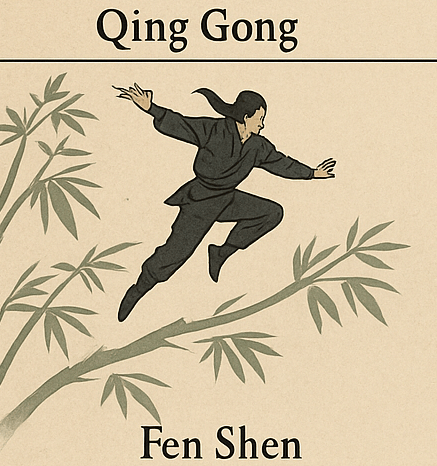
Kyung Gong Sul Bope (Korean), equivalent to the Chinese Qing Gong, is more clearly represented in martial records. These techniques developed from agility training involving explosive jumping, low stances, and breath control, often practiced by monks or guards (Shahar, 2008). The goal was not supernatural flight but increased speed, evasiveness, and physical control. There are some interesting demonstrations available online at: https://www.youtube.com/watch?v=Obx6zXADsVQ, https://www.youtube.com/watch?v=1GKwlfVCD2M, https://www.youtube.com/watch?v=hGtrZKir7sY
Martial Arts Legends of Multiplicity
In Daoist literature and Chinese mythology, the concept of fenshen, meaning “dividing the body,” is found in classical texts. For example, Ge Hong’s Baopuzi (c. 320 CE) describes adepts capable of appearing in multiple places simultaneously. Similarly, Hui Jiao’s Memoirs of Eminent Monks recounts stories of Buddhist practitioners performing multilocation or form-division feats (Hui Jiao, 1976). These accounts reflect a symbolic, ritualistic interpretation of spiritual multiplicity, rather than physical duplication.
In East Asian martial arts, the idea of Sam Shim U Gye is poorly documented but sometimes passed along in oral tradition. It is described as a principle allowing a practitioner to move so fast they seem to be in more than one place. Though not part of recognized martial literature, it echoes legends of shadow-splitting (fen shen) in Chinese folklore (Wikipedia, 2025).
The illusion of multiplicity arises from:
- Misdirection and broken rhythm
- Diagonal and lateral footwork
- Manipulation of the observer’s focus and peripheral vision
- Exploitation of low-light conditions
While no martial artist has physically been proven to have multiplied themselves, highly trained practitioners can create confusion and overwhelm opponents through rapid, deceptive movements (Henning, 1999).
Aboriginal Shadow Walking
Among Australian Aboriginal groups, oral traditions describe “shadow walking” or “mist travel,” where an individual may disappear into the landscape or appear to be more than one person. These stories, often rooted in Dreamtime cosmology, reflect actual survival and tracking expertise (Rose, 1992). Aboriginal trackers are renowned for nearly supernatural ability to read signs invisible to outsiders and move through terrain undetected.
Shadow walking includes:
- Mastery of terrain and environmental blending
- Controlled, timed movement
- Predictive awareness of pursuers’ behavior
- Use of visual and auditory manipulation
These techniques are deeply practical, even if they appear mystical to outsiders (Chatwin, 1987).
Perception and Illusion: The Neuroscience
Human perception is imperfect, especially under stress. Several neurological and visual factors can explain illusions of multiplicity:
- Persistence of vision: brief visual impressions can linger, making movement appear blurred or doubled
- Attentional blindness: the brain struggles to register abrupt directional changes
- Tunnel vision: high-stress or fight-or-flight responses narrow focus
Such phenomena mean that highly skilled martial artists can exploit these perceptual gaps, creating the illusion of multiple attackers or vanishing movement.
Dim Mak: Myth, Medicine, and Martial Mystery
Another layer of martial myth surrounds Dim Mak, often called the “death touch.” This practice, tied to dian xue (acupoint striking), claims that precise strikes to certain points can disable or kill. Stories extend to “delayed death,” pressure paralysis, or even non-contact knockouts.
While Dim Mak is thematically linked to Traditional Chinese Medicine (TCM), its more mystical claims lack scientific support:
- Acupuncture points do not correspond with discrete anatomical structures (Langevin et al., 2001)
- Striking vital areas (e.g., carotid sinus, liver, solar plexus) can incapacitate, but this is anatomical vulnerability, not energetic disruption
- No-contact or delayed effects have failed empirical testing
Dim Mak demonstrations often rely on:
- Suggestibility and peer expectation (nocebo effect)
- Compliant students and dramatized reactions
- The absence of controlled or blinded trials
Such claims are best understood as cultural mythology rather than proven combat methodology (McCarthy, 1995).
Wuxia Cinema: Martial Fantasy on Film
Crouching Tiger, Hidden Dragon (2000) exemplifies the cinematic portrayal of these legends. As part of the wuxia tradition, the film depicts martial heroes performing:
- Light-body leaps and treetop duels, a visual extension of qing gong
- Acupressure-induced paralysis during combat
- Delayed death from poisoned needles
These elements, while fictional, reflect deeper cultural themes of spiritual cultivation and moral transcendence. Wuxia films stylize martial ability to express inner mastery and dramatic stakes (Shahar, 2008).
There are very talented and gifted people among us. However, if someone has been investing decades of their lives with the ambition of being able to jump from rooftop to rooftop, land safely from jumping off an eight-story building, or being able to project their inner vital force and have not achieved or come closer to obtaining these abilities, maybe it is time to reassess the difference between myth and reality. If your lineage or course of learning claims to teach extraordinary, supernatural or miraculous feats, it may be prudent to respectfully ask your teachers to demonstrate their claims. Proof in still photograph images from decades long past, do little to exude credibility in the here and now.
Modern Performance and Extraordinary Claims
In today’s digital era, video footage showcases athletes, martial artists, and performers achieving astonishing feats. From Bruce Lee’s lightning-fast punches to parkour practitioners scaling rooftops, we witness the real potential of human movement. These skills are remarkable but remain within the bounds of physics and biology.
As physicist Carl Sagan aptly stated, “Extraordinary claims require extraordinary evidence“ (Deming, 2016). Martial arts traditions deserve respect for their transformative value, but supernatural interpretations must be held to the same standard of critical inquiry.
Conclusion
The legends of Kyung Gong Sul Bope, Sam Shim U Gye, Dim Mak, and Aboriginal shadow walking offer rich cultural insights into human potential, narrative tradition, and symbolic expression. While these phenomena are not supported by scientific evidence as literal realities, they reflect the enduring fascination with mastery, perception, and the boundaries of possibility.
Rather than diminishing these stories, understanding their metaphorical and psychological dimensions can deepen appreciation for the disciplines they arise from. In that light, they continue to inspire, challenge, and elevate the art of personal cultivation.
On a personal note, I have firsthand experience of various presentations of internal power (qi and/or neidan, nei gong) where I have felt an increase of warm vital energy through my own body. I have witnessed an individual (and not a grandmaster at that) be able to noticeably move internal energy and circulation to one arm, where their arm did become somewhat “puffy” compared to their other arm. I have seen and myself applied acupressure on numerous occasions, in specific sequences on others to both revive and incapacitate another person; first-aid and self-defense.
References
Chatwin, B. (1987). The Songlines. Viking Press.
Chinese Myths 101. (2025, February 17). Does Chinese Lightness Skill really exist? Qing Gong – Supernormal Abilities in Kung Fu [Video]. YouTube. https://www.youtube.com/watch?v=1GKwlfVCD2M
Ge Hong. (trans. Ware, J. R.). (1966). Alchemy, Medicine and Religion in the China of A.D. 320: The Nei Pien of Ko Hung. Dover Publications.
Henning, S. E. (1999). Academia encounters the Chinese martial arts. China Review International, 6(2), 319–332. https://www.jstor.org/stable/23732172
Hui Jiao. (trans. Link, A.). (1976). Lives of Eminent Monks. Berkeley Buddhist Studies Series.
Langevin, H. M., Churchill, D. L., & Cipolla, M. J. (2001). Mechanical signaling through connective tissue: a mechanism for the therapeutic effect of acupuncture. The FASEB Journal, 15(12), 2275–2282. https://doi.org/10.1096/fj.01-0015hyp
Learn Chinese Now. (2024, July 22). Supernormal abilities in Kung Fu – Lightness skill (Qing gong) [Video]. YouTube. https://www.youtube.com/watch?v=Obx6zXADsVQ
McCarthy, P. (1995). Bubishi: The classic manual of combat. Tuttle Publishing.
Moyers, B. (1993). Healing and the mind [Television series]. Public Affairs Television.
Mr. Y Talks. (2023, July 22). Unveiling the mysteries of Qing gong: the Gravity-Defying skill of Chinese kung fu [Video]. YouTube. https://www.youtube.com/watch?v=hGtrZKir7sY
Rose, D. B. (1992). Dingo makes us human: Life and land in an Australian Aboriginal culture. Cambridge University Press.
Deming, David. (2016). Do Extraordinary Claims Require Extraordinary Evidence?. Philosophia. 44. 10.1007/s11406-016-9779-7.
Shahar, M. (2008). The Shaolin Monastery: History, religion, and the Chinese martial arts. University of Hawai’i Press.
Wikipedia contributors. (2025, June 9). Fenshen. Wikipedia. https://en.wikipedia.org/wiki/Fenshen











 United Martial Arts Association