Is Joseph Cambell’s “Hero’s Journey” Relative Today?

The Hero’s Journey outline can apply to the average person’s life by representing the various stages of growth and transformation that almost everyone experiences. In our own personal journeys, we may all experience different circumstances or perceptions. There is only one truth, but infinite perceptions for any particular event. In real life, this journey could look like facing major life changes, pursuing personal goals, or overcoming significant mental, physical, and even spiritual challenges.

Here’s how it might play out in the life of an everyday person:
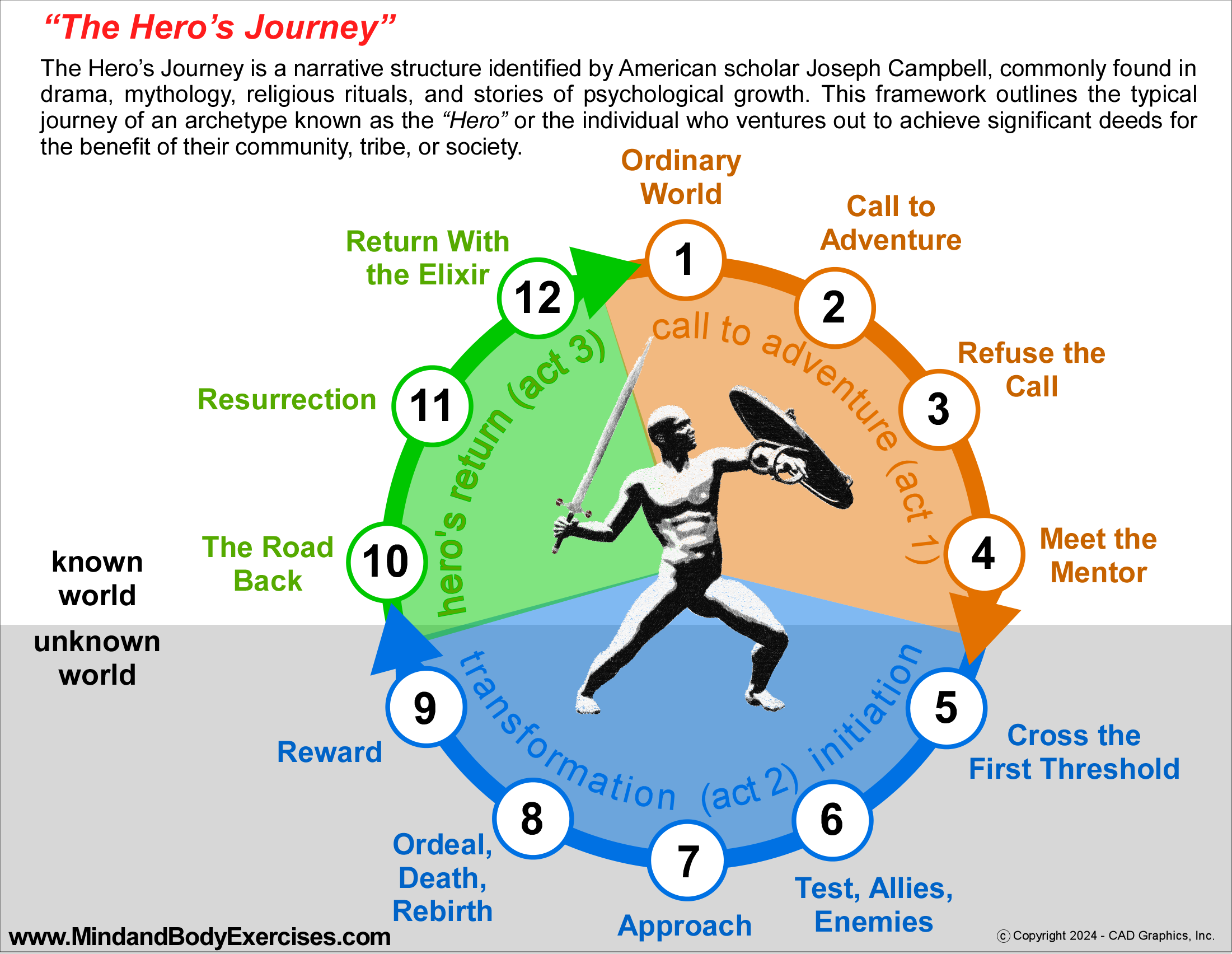
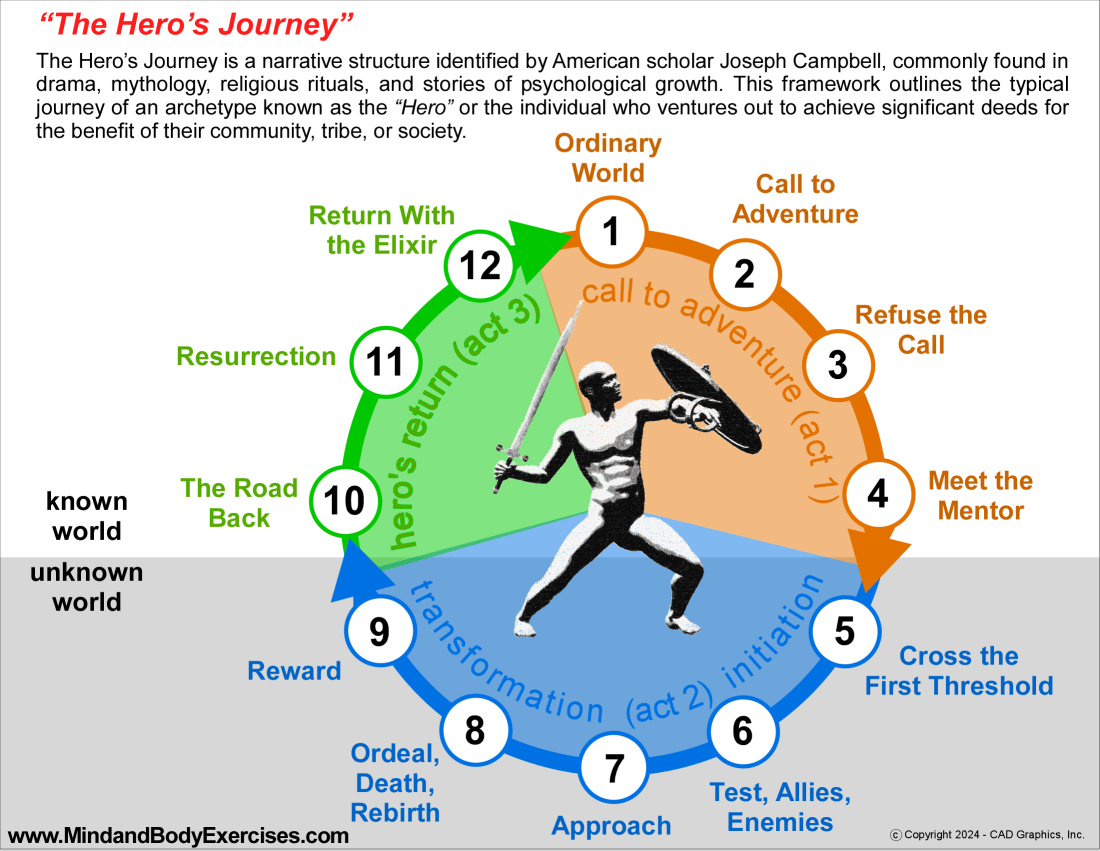
The steps of the “Hero’s Journey” include:

1- THE ORDINARY WORLD: The hero is often unaware, uneasy, or facing internal conflict, is introduced in a relatable way, allowing the audience to connect with their personal situation or struggle. The hero’s background of environment, family, and personal history, is established, revealing a feeling of opposing forces that pull the hero in different directions, creating mental and physical tension. (REAL WORLD APPLICATION: We might feel dissatisfied or unsure about something but aren’t yet driven to make a change)

2 – THE CALL TO ADVENTURE: A change is introduced to the not-yet hero, either through external forces or an internal realization, which compels the hero to confront an initial shift in their life. Something happens that urges us to change—a new job offer, a health issue, a relationship shift, or simply a sense of restlessness pushing us to grow. (REAL WORLD APPLICATION: Something happens that urges us to change such as a new job offer, a health issue, a relationship shift, or simply a sense of restlessness pushing us to grow.)

3 – REFUSAL OF THE CALL: The hero initially resists the journey, feeling uncertainty, fear of the unknown or a desire to turn away. In some cases, another 3rd party character may voice these fears and the risks involved. (REAL WORLD APPLICATION: Most often, our first reaction is resistance. We might feel afraid, overwhelmed, or doubt if we’re capable of taking on the new challenge.)

4 – MEETING WITH THE MENTOR: The hero encounters an experienced guide who provides knowledge, wisdom, training, resources, or crucial advice for the journey ahead. The hero is forced or accepts to look inward to find courage and inner wisdom. (REAL WORLD APPLICATION: In real life, mentors come in many forms like family members, friends, a teacher, a therapist, or even an inspiring book or experience that gives us insight or guidance.)


5 – CROSSING THE THRESHOLD: At the end of the first act, the hero commits to leaving behind the “ordinary world” and stepping into a new realm, filled with unknown rules and values. (REAL WORLD APPLICATION: This is the moment we commit to the journey, stepping out of our comfort zone. It could be moving to somewhere else, leaving a job, or simply deciding to make a big life change.)


6 – TESTS, ALLIES, AND ENEMIES: The hero faces various challenges, cultivates alliances, and identifies challenges and adversaries in the new world. (REAL WORLD APPLICATION: On our journey forward, we may encounter challenges and discover who supports or hinders us. We might face setbacks, doubts or obstacles while finding allies who encourage us.)


7 – APPROACH: With newly forged alliances, the hero prepares for a major trial or challenge within this unfamiliar world. (REAL WORLD APPLICATION: As we get closer to our goal, we prepare for a major challenge. This could mean making a big presentation, taking a final exam, or confronting an important fear.)


8 – THE ORDEAL: Near the story’s midpoint, the hero reaches a pivotal moment in the “unknown world,” confronting injury, death or their deepest fear. This moment of confrontation brings about a form of transformation, rebirth or renewal. (REAL WORLD APPLICATION: This is the peak moment where we face a major hurdle, fear or obstacle, like overcoming a health crisis, finally letting go of a limiting belief, or facing a major confrontation. It feels like a personal “death and rebirth,” as we emerge stronger and changed.)


9 – THE REWARD: The hero claims the reward or treasure that results from facing their challenges. There may be a celebration, though there is often still a risk of losing the reward. (REAL WORLD APPLICATION: Having faced our ordeal, we gain something valuable like greater confidence, resilience, insight, or a concrete achievement that represents our growth.)


10 – THE ROAD BACK: Around two-thirds into the story, the hero is driven to finish the adventure, returning from the unknown world to ensure the reward makes it home. Sometimes a chase scene highlights the mission’s urgency and very possibly danger. (REAL WORLD APPLICATION: With new insight or skills, we may be driven to bring our growth back to our everyday lives, sometimes facing new challenges as we try to integrate our journey’s rewards.)


11 – THE RESURRECTION: At the story’s climax, the hero undergoes a final, intense test as they approach home. They are transformed by a last act of defying death, embracing rebirth, or a sacrifice of some major merit, reaching a higher state of completion. Through the hero’s actions, the initial conflicts find resolution. (REAL WORLD APPLICATION: Before fully returning to our “normal” life, we’re often tested again, reinforcing our inner transformation. This could mean facing a problem like the one we just faced before but responding differently due to our growth.)

12 – RETURN WITH THE ELIXIR: The hero returns or continues the journey, now possessing a reward, treasure (or elixir) with transformative power, both for the hero and for the world they return to. (REAL WORLD APPLICATION: Finally, we bring valuable aspects to our daily life, whether it’s wisdom, resilience, or a new perspective. Our journey may not only transform us, but often positively impacts those around us.)

In our real life, these stages might be less dramatic and more cohesive, and maybe even more blended together. The Hero’s Journey reminds us that life is a series of growth cycles, and each challenge we face can lead to transformation, making us more resilient, self-aware, and capable.

Americans are Severely Vitamin D Deficient

Vitamin D Deficiency at Epidemic Levels

The US, and many of the world, have been facing an epidemic of vitamin D deficiency for many years, especially in areas lacking consistent daily sunlight such as the northern states of US. This trend is also seen in areas with much sunlight where people cover up their whole bodies from sun exposure. Now exacerbated by pandemic lock-downs and less outside physical activity over the last few years. Most people are unaware or care to ignore how vital vitamin D is to the immune system and overall health.

From the National Library of Medicine of May, 2022:

Vitamin D deficiency is a global public health issue. About 1 billion people worldwide have vitamin D deficiency, while 50% of the population has vitamin D insufficiency.[1] The prevalence of patients with vitamin D deficiency is highest in the elderly, obese patients, nursing home residents, and hospitalized patients. The prevalence of vitamin D deficiency was 35% higher in obese subjects irrespective of latitude and age.[7] In the United States, about 50% to 60% of nursing home residents and hospitalized patients had vitamin D deficiency. [8][9] Vitamin D deficiency may be related to populations who have higher skin melanin content and who use extensive skin coverage, particularly in Middle Eastern countries. In the United States, 47% of African American infants and 56% of Caucasian infants have vitamin D deficiency, while over 90% of infants in Iran, Turkey, and India have vitamin D deficiency. In the adult population, 35% of adults in the United States are vitamin D deficient whereas over 80% of adults in Pakistan, India, and Bangladesh are Vitamin D deficient. In the United States, 61% of the elderly population is vitamin D deficient whereas 90% in Turkey, 96% in India, 72% in Pakistan, and 67% in Iran were vitamin D deficient Sizar & et al, 2022).

This epidemic of deficiency stems from misinformation surrounding the fear of sun exposure, use of toxic sunscreens, and poor dosing recommendations that neglect the critical role that vitamin D plays in protecting against nearly every chronic disease on Earth. Mainstream experts still express fear about taking too much vitamin D, in spite of very few people ever reaching “toxic” blood levels. as well as even less people experiencing side effects from too much vitamin D (Micozzi 2018). Let us be informed that sunscreen sales in the US for 2022 are forecast at $1.83 billion (Statista, 2021) and vitamin D supplement sales spiked to $544 million in 2020 (Grebow, 2021).

Vitamin D3, also known as cholecalciferol, is produced in the skin initiated from sunlight UVB radiation or absorbed from particular foods. Vitamin D3 is then absorbed into the bloodstream and then metabolized in the liver transforming into calcidiol. From here calcidiol, travels from the liver to the kidneys and changes to calcitriol. Calcitriol then proceeds to affect metabolic functions like absorption in the intestines of calcium and phosphorus, bone regulation and cell regulation. After the age of 50, aging causes vitamin D3 production to decrease up to 75% and causing muscle weakness and a loss in bone strength and density.

Vitamin D Deficiency

Causes:

  • Winter side-effects (less sun exposure)
  • Sunscreen
  • Air pollution
  • High altitude
  • Poor diet

Imbalances:

  • Hypertension
  • Heart disease
  • Urinary infections
  • Tuberculosis
  • Depression
  • Schizophrenia
  • Liver disease
  • Rental failure
  • Crohn’s disease
  • Cystic fibrosis
  • Celiac disease
  • Muscular aches & weakness
  • Osteoporosis
  • Osteoarthritis
  • Rickets
  • Diabetes
  • Obesity

Solutions:

  • Sunlight on skin
  • Diet
  • Vitamin supplements
  • Weight-bearing exercises

(Charoenngam & Holick, 2020)

What can you do to prevent vitamin D deficiency – become educated, be more aware of your own health, get outside during the morning or late afternoon when sunlight is less intense, and get your body moving to engage your muscles and bones to tell your nervous system that you are still alive and need your body to maintain homeostasis through good health and lifestyle practices.

Get started with these three simple steps:

  1. Consult with your doctor to manage your vitamin D levels twice a year — at the end of winter and again at the end of summer. Ask for a simple blood test called the 25(OH)D (25-hydroxy vitamin D) test. (Optimal blood levels are between 50 and 75 nanomoles/Liter.)
  2. Commit to being in the sun 15 minutes a day without sunscreen. When planning on being outside longer, add some protective clothing, a hat, and sunglasses.
  3. Supplement with 10,000 IU of vitamin D3 daily. This dose in a convenient, highly-absorbable liquid form together with the potent marine carotenoid, astaxanthin, for added benefits (Micozzi, 2018).

References:

Sizar O, Khare S, Goyal A, et al. Vitamin D Deficiency. [Updated 2022 May 1]. In: StatPearls [Internet]. Treasure Island (FL): StatPearls Publishing; 2022 Jan-. Available from: https://www.ncbi.nlm.nih.gov/books/NBK532266/

Statista. (2021). Sun Protection – United States. https://www.statista.com/outlook/cmo/beauty-personal-care/skin-care/sun-protection/united-states

Grebow, J. (2021, February 19). Vitamin D made headlines over COVID-19 studies last year. Sales of vitamin D were also up in 2020. What will 2021 look like? 2021 Ingredient trends to watch for food, drinks, and dietary supplements. Nutritional Outlook. https://www.nutritionaloutlook.com/view/vitamin-d-made-headlines-over-covid-19-studies-last-year-sales-of-vitamin-d-were-also-up-in-2020-what-will-2021-look-like-2021-ingredient-trends-to-watch-for-food-drinks-and-dietary-supplements

Charoenngam, Nipith & Holick, Michael. (2020). Immunologic Effects of Vitamin D on Human Health and Disease. Nutrients. 12. 2097. 10.3390/nu12072097.

Micozzi. (2018, September 13). Are you dangerously deficient in this key nutrient? Dr. Marc Micozzi. https://drmicozzi.com/are-you-dangerously-deficient-in-this-key-nutrient

Micozzi. (2018a, June 21). Six reasons why you’re still vitamin D deficient. Dr. Marc Micozzi. https://drmicozzi.com/six-reasons-why-youre-still-vitamin-d-deficient

Alfredsson L, Armstrong BK, Butterfield DA, Chowdhury R, de Gruijl FR, Feelisch M, Garland CF, Hart PH, Hoel DG, Jacobsen R, Lindqvist PG, Llewellyn DJ, Tiemeier H, Weller RB, Young AR. Insufficient Sun Exposure Has Become a Real Public Health Problem. International Journal of Environmental Research and Public Health. 2020; 17(14):5014. https://doi.org/10.3390/ijerph17145014

_________

I have learned, studied, practiced and teach literally hundreds of various low-impact exercises that can build stronger bones, muscles and joints. Private, small or group instruction.

Control the body with the mind. Manage the mind by disciplining the body, through physical activity. Learn to be more active, eat healthier, sleep better, stress less – these are the key components to maintaining a strong mind, body, immune system, and outlook on life.

I am currently offering wellness lectures and classes for group, small group & private instruction in Wekiva, Longwood and Winter Park.

Mind and Body Exercises on Google: https://posts.gle/aD47Qo

Jim Moltzan

407-234-0119

http://www.MindAndBodyExercises.com

https://www.facebook.com/MindAndBodyExercises/

https://www.youtube.com/c/MindandBodyExercises

https://mindandbodyexercises.wordpress.com/

Masters Council

Vitamin D Metabolism & Deficiency

Vitamin D Metabolism

Vitamin D3 or cholecalciferol is produced in the skin initiated from sunlight UVB radiation or absorbed from specific foods. The vitamin D3 is absorbed into the bloodstream and then into the liver where it changes to calcidiol. From the liver to the kidneys the calcidiol changes to calcitriol. Calcitriol then goes on to affect metabolic functions such as absorption in the intestines of calcium and phosphorus, bone regulation and cell regulation. As we age, vitamin D3 production can decline up to 75% leading to at the very least, muscle weakness and a reduction in bone strength and density.

Vitamin D Deficiency

Causes:

  • Winter side-effects (less sun exposure)
  • Sunscreen
  • Air pollution
  • High altitude
  • Poor diet

Imbalances:

  • Hypertension
  • Heart disease
  • Urinary infections
  • Tuberculosis
  • Depression
  • Schizophrenia
  • Liver disease
  • Rental failure
  • Crohn’s disease
  • Cystic fibrosis
  • Celiac disease
  • Muscular aches & weakness
  • Osteoporosis
  • Osteoarthritis
  • Rickets
  • Diabetes
  • Obesity

Solutions:

  • Sunlight on skin
  • Diet
  • Vitamin supplements

I have learned, studied, practiced and teach literally hundreds of various low-impact exercises that can build stronger bones, muscles and joints. Private, small or group instruction.

Be well!

Jim Moltzan

407-234-0119

http://www.MindAndBodyExercises.com

https://www.facebook.com/MindAndBodyExercises/

https://www.youtube.com/c/MindandBodyExercises

https://mindandbodyexercises.wordpress.com/

Masters Council

The Effects of Exercise on Joint & Bone Strength

The Effects of Exercise on Joint & Bone Strength

The joints of our body are composed of two or more bones joining together, along with the muscles, tendons, cartilage, synovium and ligaments that hold the whole structure together. The shape of our bones reflect the forces applied to them. For example, small bumps, ridges and other features on the surface of our bones are the attachment sites for tendons. When muscles are put under more load through activities, stress or exercises, the corresponding attachment sites enlarge to withstand the increased forces. Bones that are under more stress become thicker and stronger, while in contrast bones that are not subjected to ordinary stresses tend to become weaker, thin and more brittle. Wolff’s law, developed by anatomist & surgeon Julius Wolff in the 19th century, states that “bone in a healthy person or animal will adapt to the loads under which it is placed.”

Regular weight-bearing exercise is an important component for maintaining healthy bone structure. Avid weight lifters often have thick bones with very prominent ridges. Non-athletes or those who have little to moderate amounts of physical activity will find weight-bearing activities are imperative for stimulating normal bone metabolism of maintenance as well as maintaining bone strength.

Changes in bones of the skeleton can take place in relatively short periods of inactivity. For example, someone uses crutches to take weight off an injured leg while they wear a cast. Within a few weeks, the unstressed bones can lose up to a third of their mass. When normal weight loading resume the bones rebuild. However, it takes longer to rebuild bone than to lose bone density. The removal of calcium salts can be a serious health hazard for long-term bedridden patients or paralyzed individuals who cannot put normal stress on their skeleton.

Bones of the skeleton become thinner and weaker as a normal part of the human aging process. Inadequate ossification is called osteopenia. Everyone of us usually become slightly osteopenic as we age. Bone mass reduction begins between ages 30 and 40. Around this age, osteoblast (bone building) activity begins to decline, while osteoclast (bone breakdown) activity continues at the previous level. Women tend to lose about 8 percent of their bone mass every decade. Men often lose less, but around 3 percent per decade. The epiphyses or ends of the long bones, the vertebrae of the spine, and our jaws lose more bone mass than other locations. Side effects of low bone mass are more fragile limbs, loss in height, and sometimes the loss of teeth.

Osteoporosis is the further reduction in bone mass that inhibits normal functions. Bones become fragile and brittle making them more likely to break when exposed to stresses that healthier individuals could easily adjust to. This can be seen when an elderly person can suffer a hip fracture when simply attempting to sit or stand. A loss of mobility, independence and consequently self-confidence can occur when fractures result in older individuals leading to further weakening of the skeleton as they become less active and fearful of future injuries.

Hormonal balances are important in maintaining bone deposition. If and when hormone levels decline, bone mass also declines. After age 45, about 29 percent of women and 18 percent of men will develop osteoporosis. With women the condition increases after menopause, from a decrease in estrogen production. Men in the same age group tend to have less severe osteoporosis due to continued production of testosterone into their later years of life.

Osteoporosis can sometimes develop into the secondary effect of many cancers. Cancers within the bone marrow, breast cancer, and other tissues release a chemical called osteoclast-activating factor. This chemical increases the number and activity of osteoclasts and produces severe osteoporosis.

By engaging our bones with strategic trauma exercise methods (or specific stress without injury) that can be regulated by the individual to make bones stronger and prevent osteopenia and/or osteoporosis. These types of exercises fall into 3 different categories of tension, impact and vibration exercises. Ironically, while some of these methods improve bone and muscular strength, they sometimes can cause pain and injury to the same joints that the individual might be trying to strengthen. Fox example, jumping rope, hiking and tennis might cause more injury to a 60+ than the benefits that might be gained from these practices.

Tension Exercises:

  • Dancing
  • Elastic Bands
  • Qigong (Chi Kung)
  • Pilates
  • Stair-Step machine
  • Tai Chi
  • Treadmill
  • Weights
  • Yard Work
  • Yoga

Impact:

  • Aerobics
  • Hiking
  • Jump rope
  • Running
  • Stair climbing
  • Tennis
  • Walking – brisk

Vibration:

  • Machine therapy
  • Tapping methods

Reference(s):

1. Martini, F., Nath, J. L., Bartholomew, E. F., Ober, W. C., Ober, C. E., Welch, K., & Hutchings, R. T. (2018). Fundamentals of anatomy & physiology. New York: Pearson Education.

————-

I have learned, studied, practiced and teach literally hundreds of various low-impact exercises that can build stronger bones, muscles and joints. Private, small or group instruction.

Be well!

Jim Moltzan

407-234-0119

http://www.MindAndBodyExercises.com

https://www.facebook.com/MindAndBodyExercises/

https://www.youtube.com/c/MindandBodyExercises

https://mindandbodyexercises.wordpress.com/

Masters Council