
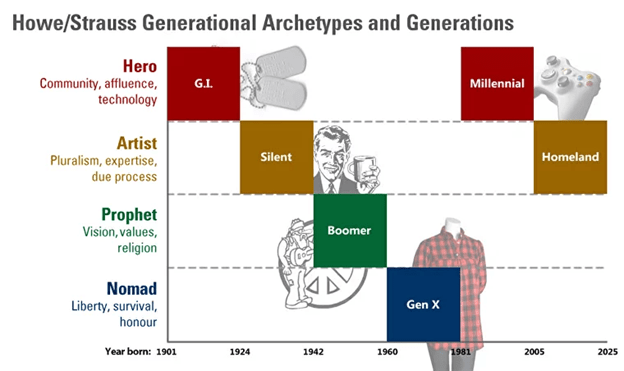
“The Fourth Turning” by William Strauss and Neil Howe articulates a generational theory of history. The authors posit that societies undergo recurring cycles, referred to as “turnings,” approximately every 80-100 years. These cycles consist of four distinct generational archetypes of the Prophet, the Nomad, the Hero, and the Artist. Each archetype plays a significant role in shaping and responding to historical events in predictable patterns.
The four turnings are:
The High – A period of societal rebuilding after a crisis, characterized by strong institutions, collective unity, and optimism (e.g., post-WWII boom in the U.S.).
The Awakening – A cultural period where individuals challenge established norms, emphasizing personal and spiritual values over conformity (e.g., the 1960s counterculture movement).
The Unraveling – Institutions weaken, individualism increases, and trust in government and societal structures declines (e.g., 1980s-2000s in the U.S.).
The Crisis (Fourth Turning) – Significant upheaval, such as war, economic downturns, or revolution, that forces society to reconstruct itself (e.g., the Great Depression and WWII).
According to their theory, the U.S. is currently in a Fourth Turning (beginning around 2008), indicating we’re in a period of crisis and transformation that will likely peak in the 2020s before leading into a new High. William Strauss and Neil Howe’s generational theory primarily focuses on Western historical cycles. They did not explicitly incorporate Eastern philosophies like Taoism or the Wu Xing (Five Elements) into their framework. Their analysis centers on patterns observed in Anglo-American history, detailing a recurring cycle of four generational archetypes where the Prophet, Nomad, Hero, and Artist, each influence societal moods and events over approximately 80-100 years.,
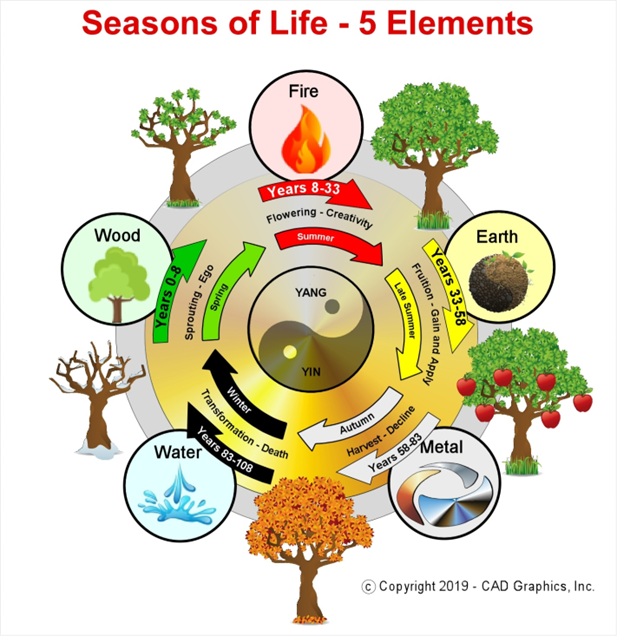
The Wu Xing in Taoist philosophy describes five interrelated elements of Wood, Fire, Earth, Metal, and Water, each associated with specific seasons, times of day, and life phases. This system emphasizes balance and the dynamic interactions between elements, reflecting the cyclical nature of the universe.
While both frameworks recognize cyclical patterns, their foundations differ: the Wu Xing is rooted in natural elements and their interactions, whereas the Strauss-Howe theory is based on generational dynamics and historical events. There isn’t direct evidence that Strauss and Howe studied or integrated Eastern philosophies into their work.
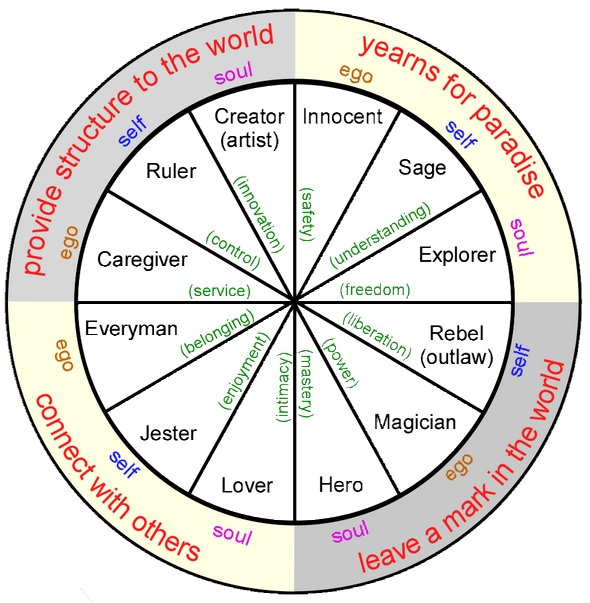
Carl Jung, a Swiss psychiatrist and psychoanalyst, introduced the idea of psychological archetypes and was significantly influenced by his study of Eastern philosophies. Jung’s incorporation of concepts from Taoism, Buddhism, and other Eastern traditions into his work on the collective unconscious and archetypes predated the Strauss-Howe generational theory by decades. While Strauss and Howe developed their own unique framework focused on historical and generational patterns, the notion of archetypes they used resonates with the broader tradition of exploring recurring patterns in human behavior and culture.
However, the concept of cyclical patterns is present in many cultural philosophies, suggesting a universal human inclination to find order and predictability in history and nature. While the specifics of the cycles differ between the Wu Xing and the Strauss-Howe generational theory, both offer perspectives on understanding the rhythms and transformations inherent in societies.
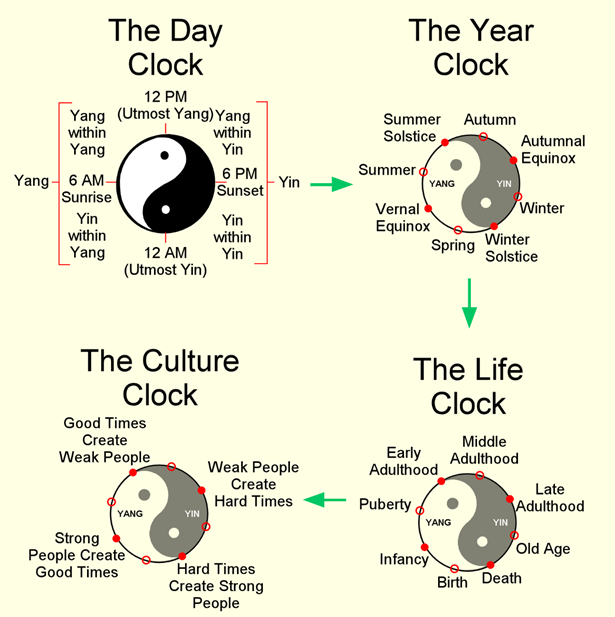
― G. Michael Hopf, Those Who Remain
Universal Cycles of Transformation
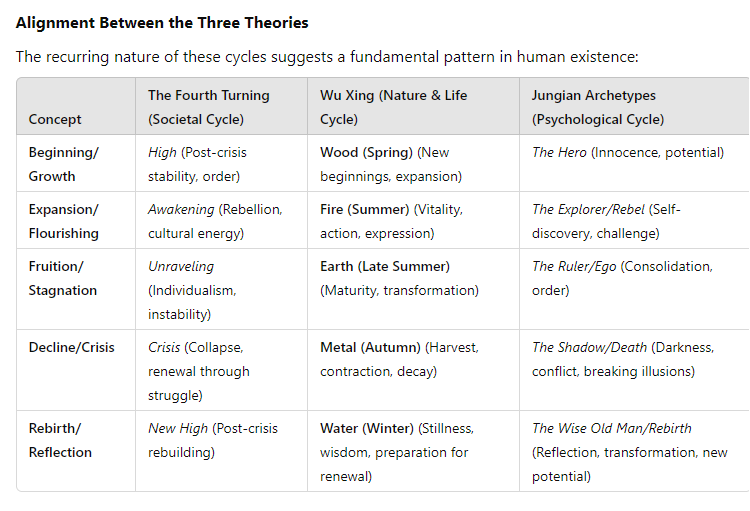
Each framework describes a repeating sequence of phases, with distinct yet interrelated roles:
Strauss & Howe’s Fourth Turning follows a four-phase generational cycle (~80-100 years), where societal moods shift from stability (High) to questioning (Awakening), fragmentation (Unraveling), and renewal through crisis (Crisis).
Wu Xing (Five Elements) describes a five-phase natural cycle (Wood, Fire, Earth, Metal, Water), applied to time, seasons, and human life. Taoism sees a person’s lifespan in ~25-year segments:
0-8 (Spring) – sprouting of one’s identity
8-33 (Summer) – flowering of one’s vitality
33-58 (Late Summer) – fruition of what has been achieved
58-83 (Autumn) – cutting away what is not needed
83-108 (Winter) – transformation and rebirth
All phases closely mirror The Fourth Turning’s phases.
Jungian Archetypes reflect psychological transformations across an individual’s life and history. His concepts of Hero, Wise Old Man, Shadow, and Rebirth mirror the rise, crisis, and renewal patterns seen in the other two theories. Jung, influenced by Taoism and the I Ching, recognized life as a process of individuation—balancing opposing forces (Yin-Yang, conscious-unconscious), much like the generational and elemental cycles.
Key Takeaways:
Generational, Natural, and Psychological Patterns Are Interwoven
Each theory observes cyclical phases that repeat over time, whether in history (Fourth Turning), nature (Wu Xing), or the psyche (Jungian archetypes).
Crisis and renewal are fundamental to change, whether societal, elemental, or personal.
Strauss & Howe’s Generational Theory May Unconsciously Reflect Jungian Archetypes
The Fourth Turning’s generational archetypes (Prophet, Nomad, Hero, Artist) resemble Jung’s archetypal roles.
Jung, who studied Taoism and Eastern philosophy, recognized cycles of transformation, much like Wu Xing’s elemental shifts.
Taoism’s Wu Xing and Jung’s Individuation Both Emphasize Balance
Wu Xing describes the dynamic interplay of elements, where excess in one leads to transformation into another.
Jung’s individuation process requires integrating all aspects of the psyche, much like how Taoist balance ensures harmony.
Crisis is a Necessary Stage for Renewal
Fourth Turning: Each crisis (e.g., WWII) paves the way for societal rebirth.
Wu Xing: Death and decay (Metal & Water) are necessary before new life (Wood).
Jung: Transformation only occurs when the individual faces their Shadow and integrates unconscious aspects.
Though emerging from different traditions, these three theories reveal a shared truth: transformation occurs through cyclical forces, shaping societies, nature, and individuals alike. Whether through generational change, elemental shifts, or psychological evolution, the rhythm of crisis and renewal is an eternal pattern in human experience.
References:
Generations X и Y: Crux, Characteristics, Application of a Theory in Recruiting. (2023). https://itluckyhunter.com/blog/generations-theory
I teach and offer lectures about holistic health, physical fitness, stress management, human behavior, meditation, phytotherapy (herbs), music for healing, self-massage (acupressure), Daoyin (yoga), qigong, tai chi, and baguazhang.
Please contact me if you, your business, organization, or group, might be interested in hosting me to speak on a wide spectrum of topics relative to better health, fitness, and well-being.
I look forward to further sharing more of my message by partnering with hospitals, wellness centers, VA centers, schools on all levels, businesses, and individuals who see the value in building a stronger nation through building a healthier population.
I also have hundreds of FREE education video classes, lectures, and seminars available on my YouTube channel at:
https://www.youtube.com/c/MindandBodyExercises
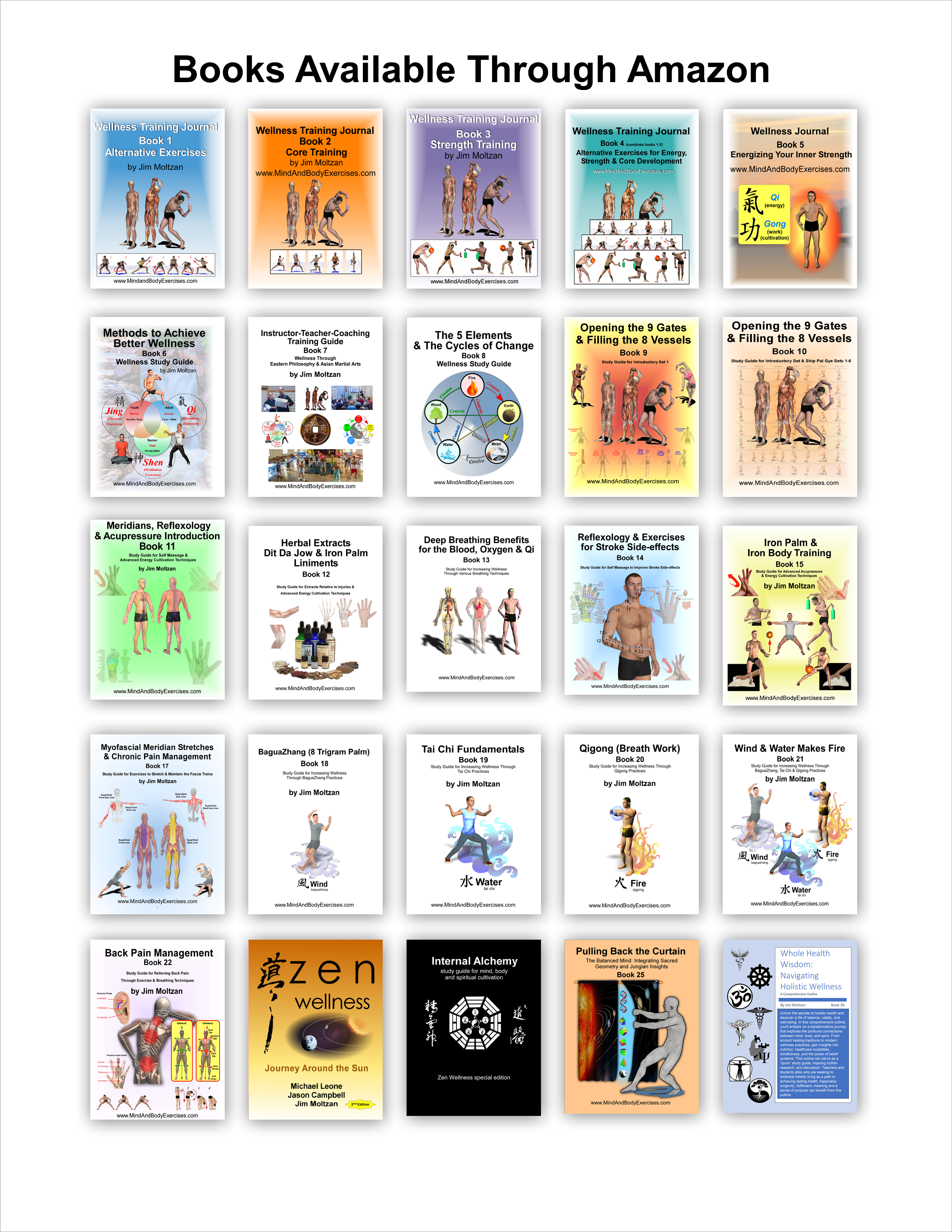
Many of my publications can be found on Amazon at:
http://www.Amazon.com/author/jimmoltzan
My holistic health blog is available at:
https://mindandbodyexercises.wordpress.com/
http://www.MindAndBodyExercises.com
Mind and Body Exercises on Google: https://posts.gle/aD47Qo
Jim Moltzan
407-234-0119





 United Martial Arts Association