Basic Shoulder Anatomy & Low Impact Exercises to Increase Strength & Range of Motion

Basic Shoulder Anatomy & Low Impact Exercises to Increase Strength & Range of Motion

Often people experience shoulder issues such as injuries, weakness and poor range of motion. Some exercise with running, stretching and weight training with little or no knowledge of how they should proceed with improving their particular issues. By practicing low impact exercises that focus more on strength and flexibility of the shoulder joint and its components, one can improve many issues without taking more drastic options such as pain medicines or surgery.
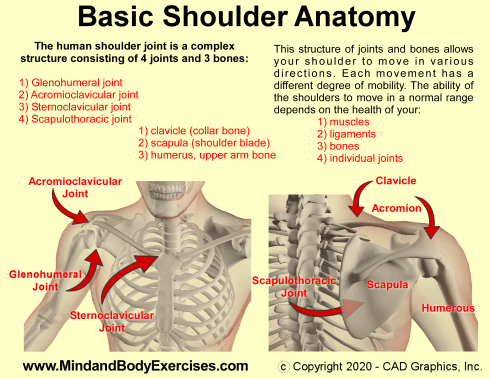
Basic Shoulder Anatomy

Additionally, having some knowledge of how the shoulder joint is composed and the natural range of motion, can help the individual to have a better understanding of what the exercises are doing and set better goals and expectations.

8 Directions of mobility

Shoulder Exercises Using Dynamic Tension and/or Light Weights

The below exercises are fairly simple and can be performed with or without dumbbells. The main goal is to increase strength within the natural range of motion in the neck, shoulders, arms, spine, hips, thighs and ankles. Light weights can help to tone muscles as well as provide increased strength in lesser used muscle groups. Weight training, even with lighter weights, has been known to help prevent osteoporosis. These exercises take up very little space and a few minutes of time to gain benefits. There should be a deep inhale at the start of each exercise, lasting about 4 seconds, followed by a deep 4 second exhalation as finishing the exercise. The muscles should remain relaxed while moving and flexed at the end position.
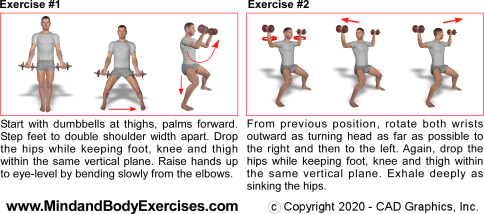
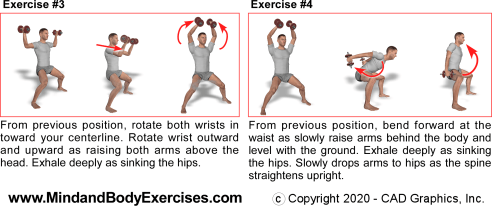
exercise 1&2

exercise 3&4

Here are a few somewhat more advance exercises.  Try and use a bean bag or a sock filled with small pebbles. Then you can adjust the amount of weight as you gain more strength in the muscles and joints. Lighter weight is always better than too heavy, which often can lead to more pain or discomfort.
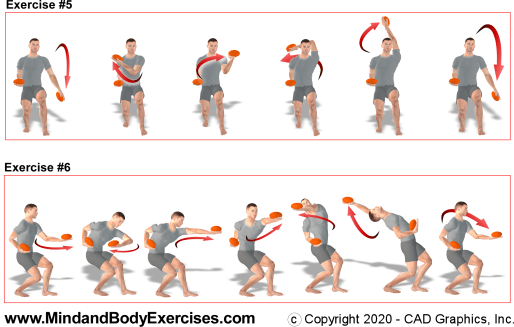
exercise 5&6

One on one instruction is often the best option for learning and practicing these types of exercises.  If interested in  learning more, contact me at 407-234-0119 or  info@MindAndBodyExercises.com

Be well, stay healthy, be wise.

Jim Moltzan

www.MindAndBodyExercises.com

https://www.facebook.com/MindAndBodyExercises/

https://www.youtube.com/c/MindandBodyExercises

https://mindandbodyexercises.wordpress.com/

How Deep Breathing Affects Your Health

How Deep Breathing Affects Your Health

Deeper breathing is a key component to having a long and healthy life. Through focused and deliberate breathing methods, many positive mental and physical benefits can be achieved.

Most people breathe too shallow and too quickly!

Much recent research has linked stress to poor breathing habits and consequently many ailments. Many modern chronic conditions can be traced back to insufficient cell oxygenation otherwise known as cell hypoxia.

Breathing is one of the few bodily rhythms that we can consciously adjust, along with sleep and elimination. All of these rhythms directly effect our body’s delicate blood chemistry. However, our breath is the root power in bringing oxygen (qi) into our body to nourish it down to the cellular level.

Faster breathing is necessary when experiencing truly stressful situations, like being chased by an animal, running from a fire or similar life-threatening situations. However, continued breathing at this pace for an extended period of time puts accumulative stress on all of the body’s systems.

Breathing Frequency

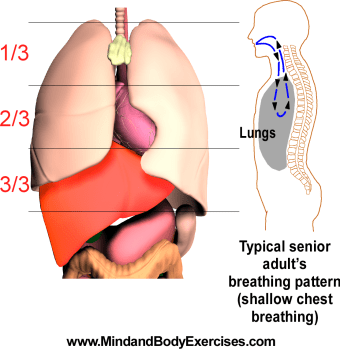
Most humans are breathing on the average, with normal activity about 12-18 breaths per minute (BPM). This amounts to very shallow breaths, using primary the top 1/3 of the lung’s capacity. Shallow chest breathing fills only the upper portion of the lungs. This reduces the ability to effectively oxygenate the circulation system.

Shallow breathing graphic

This “over-breathing” and “under-inhaling” causes an imbalance in oxygen/carbon dioxide gas exchange. This further leads to a ripple effect of other chemical (and hormonal) imbalances.

Poor oxygenation is linked to many modern chronic conditions such as asthma, COPD, obesity, diabetes, insomnia and cancer.

Emotions affects breathing rhythms.

Emotions effect the sympathetic nervous system which changes the blood chemistry.

The body releases cortisol into the bloodstream to counter stress.

Chronic elevation of cortisol effects other bodily functions in a negative manner.

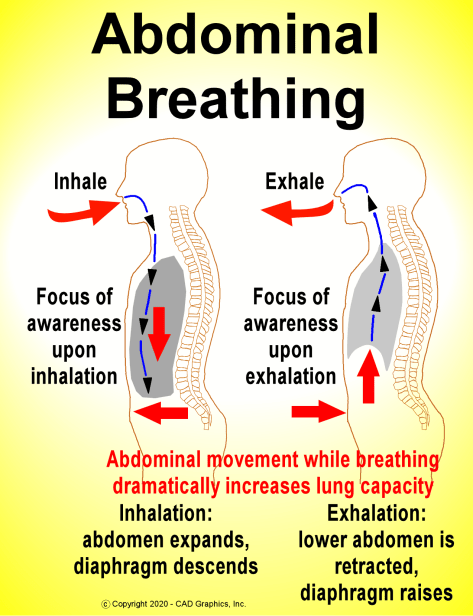
Abdominal Breathing graphic

Abdominal Breathing

Deep and deliberate breathing can be improved with practicing abdominal breathing. Diaphragm movement pushes lymph throughout the body, eliminating toxic waste consequently strengthening the immune system.

Other benefits of deep breathing include:

– Improves blood circulation and oxygenation of cells

– Changes the blood chemistry to produce “happy” hormones beneficial to organs

– Toxic C02 waste is eliminated through your breath

– Stimulates the parasympathetic nervous system

– Abdominal breathing acts as a pump to massage internal organs

– Reduces mental and physical fatigue

Learn more about these incredible wellness methods by practicing tai chi, qigong and many other ancient methods.


Be well, stay healthy, be wise.

Jim Moltzan

407-234-0119

www.MindAndBodyExercises.com

https://www.facebook.com/MindAndBodyExercises/
https://www.youtube.com/c/MindandBodyExercises

https://mindandbodyexercises.wordpress.com/


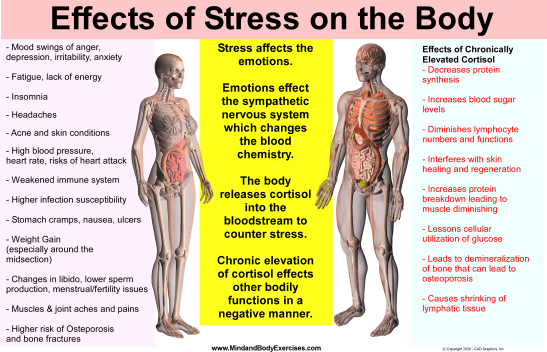
Effects of Stress on the Body

Effects of Stress on the Body

Stress effects the emotions.
Emotions effect the sympathetic nervous system which changes the blood chemistry.
The body releases cortisol into the bloodstream to counter stress.
Chronic elevation of cortisol effects other bodily functions in a negative manner.

Effects of Chronically Elevated Cortisol
– Decreases protein synthesis

– Increases blood sugar levels

– Diminishes lymphocyte numbers and functions

– Interferes with skin healing and regeneration

– Increases protein breakdown leading to muscle diminishing

– Lessons cellular utilization of glucose

– Leads to demineralization of bone that can lead to osteoporosis

– Causes shrinking of lymphatic tissue

Cortisol Side Effects

Tai Chi, yoga and qigong are all methods that regulate stress and increase the flow of energy ( and blood flow) within the body improving health and well-being.
Be well, stay healthy, be wise!

Benefits of Consistent Exercise

Exercise benefits

Stay active, eat quality food and manage emotions and stress – 3 key elements to maintaining good health. And it doesn’t cost a fortune to improve all 3; just time and self-discipline.
Pick a method – walk, run, swim, yoga, tai chi, weight training, qigong, stretch. Each has its pros and cons. JUST PICK ONE and do it consistently.
Consistent exercise helps you:
– Lower risk of obesity, cancer, heart disease, diabetes and many other illnesses
– Lose, gain, or maintain weight
– Improve resistance to infections
– Gain high-quality sleep
– Help to balance emotional health
– Prevent and relieve chronic pain
– Exercise increases size of hippocampus and improves memory
– Increase blood and oxygen flow to your brain
– Release accumulated toxins through better blood circulation
– Increase blood flow supplying nutrients necessary to keep brain cells healthy
– Improve your brain function
Tai Chi, yoga and qigong are all methods that increase the flow of energy ( and blood flow) within the body improving health and well-being.
Be well, stay healthy, be wise!

The Horary Clock (Circadian Rhythm) – 24 Hour Qi Flow Though the Meridians

Horary Clock

The Horary Clock (Circadian Rhythm) – 24 Hour Qi Flow Though the Meridians
Understanding how the human body works and interacts within nature, along with self-awareness are the basis of Traditional Chinese medicine.
The graphic shows what is known as the Horary cycle or the Circadian Clock. As Qi (energy) makes its way through the meridians, each meridian in turn with its associated organ, has a two-hour period during which it is at maximum energy. The Horary Effect is recognizable by measurable increases of Qi within an organ system and meridian during its time of maximum energy.
Harmonizing Habits:
5-7am – Wake Up, Move Bowels, Meditate
7-9am – Sex, Breakfast, Walk, Digest
9-11am – Work, Best Concentration
11am-1pm – Eat Main Meal of Day, Walk
1-3pm – Absorb Food, Short Nap, Work
3-5pm – Work or Study
5-7pm – Exercise, Light Dinner
7-9pm – Light Reading, Massage Feet
9-11pm – Calm Socializing, Flirting, Sex
11pm-1am – Go to Sleep, Cellular Repair
1-3am – Deep Sleep, Detox Liver & Blood
3-5am – Deep Sleep, Detox Lungs
Tai Chi, yoga and qigong are all methods that increase the flow of energy within the body improving health and well-being.
Be well, stay healthy, be wise!