As we transition from the active season of Fall into the quiet of Winter, it’s time to intentionally slow down and embrace one of life’s most powerful lessons:
transformation through impermanence.
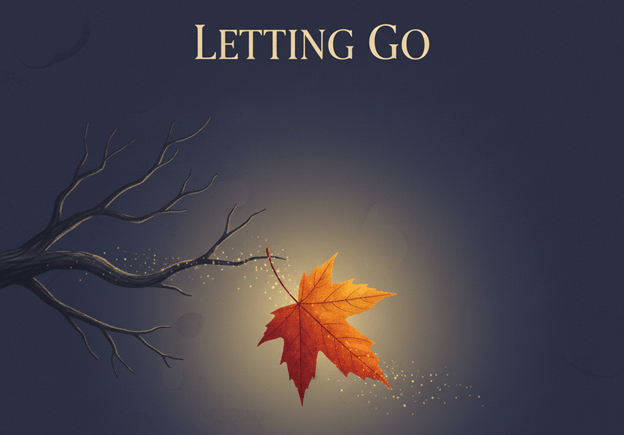
Nature shows us plainly that everything cycles. This time of year, the leaves fall, trees look bare, and the world seems to contract. But this “decay” isn’t an ending; it’s a profound process of renewal. The earth is being fertilized, getting ready for the next spring. Right now, though, our job is to observe the letting go. Fall teaches us the hardest truth for the human mind:
nothing you desperately hold onto stays, and nothing you genuinely release is truly lost, it simply converts into new potential.
Winter then brings stillness. It’s the moment for gathering energy, conserving resources, and resting. It is the great silence that precedes a new start.
The Practice of Essentialism
As the days get shorter and we naturally feel more inward, it’s the perfect time for introspection (looking within). This is your chance to reflect, declutter your life (mentally and physically), and focus only on what is essential.
Your Breath is Your Control Switch
We continue to use the breath not just for physical health, but as a direct way to manage the mind. It doesn’t matter if you take a few deep breaths or hundreds. What matters is the results of stopping the mental chatter (inner dialogue) and your internal state becomes still enough to see clearly.
Think of the breath as the doorway to your subconscious mind. You will either feed the subconscious unconsciously (with shallow, stressed breathing that reinforces survival-mode stress) or consciously (with deep, slow, intentional breaths). As soon as you breathe consciously, your entire system shifts toward calm and regulation.
This is how we manage the “Instinctual Mind.” This part of your brain is designed to run the body and excel at survival, but it floods your subconscious with anxiety and chaotic signals. To regulate this instinctual part, you must regulate your breath. To regulate your breath, you regulate your mind.
To regulate your mind is to reclaim control over your life.
Reflective Meditation: Reprocessing the Past
This time of year, is ideal for reviewing your life story. You can look back at significant life stages (e.g., grade school, adolescence, young adult, adulthood, etc.) or focus on a recent, emotionally charged event that changed your outlook, whether it was a trauma, a betrayal, a regret, or a success.
Try to tap into an experience that has lodged itself inside you, creating a kind of emotional stagnation that prevents you from moving forward.
The Method:
Get Still: Sit down, breathe consciously, and calm your mind.
Be the Witness: As a neutral observer, revisit the difficult moment.
Gain Clarity: Your goal is not to rewrite the past, but to re-experience it through the lens of your current wisdom. You may realize things like:
You may have been young and/or naïve at the time
You weren’t at your best then, and that’s okay.
They weren’t attacking you; they were simply reacting out of their own suffering.
You may realize you were collateral damage to someone else’s unprocessed pain.
The point isn’t to judge the past, but rather it’s to release the story you’ve been carrying about it. Letting go of that unnecessary narrative is the highest medicine this season offers.
Reframing to Free Your Future
You revisit the moment, see it clearly, and analyze it from the perspective of the witness, not the wounded self. You breathe into the memory, letting the emotions reorganize. This is a process that unfolds over time, not in one session. Eventually, the energy tied up in the event loosens. You emotionally “digest” the experience, the stagnation dissolves, and your vital energy is free to move forward again.
The Ultimate Check-in: Meeting Your Younger Self
Once you’ve built stability in this practice, try this powerful exercise:
Form Your Current Self: Clearly visualize the you of today as in your body, clothes, expression, and presence. This is your “Authentic Self.”
Visit the Past: Send this Authentic Self back to meet a younger version of you, say, the a time in your youth or young adulthood, or at a crucial decision point.
Just Sit: You don’t have to “heal” anything. Simply sit across from that past self, like two friends at a restaurant, and see: Would my younger self see me as an inspiration… or a warning… by who I have become?
This is the most honest mirror you’ll ever find. Your younger self knows your true, unburdened potential and remembers the promise you made to your own being. The question is: Have you kept that promise?
This honest self-assessment is the “Blade of Clarity.” It cuts away delusion and reveals the truth.
Finding Your Inner Compass
The world is constantly changing as is your circumstances, relationships, finances, and other people’s opinions are always in flux. Everything external moves.
But a mountain does not move. Its surface changes with weather and time, but its core profile, its Inner Compass or Unmoving Center,remains the same. In this philosophy,
That mountain is you.
If you don’t locate this unmoving center, you will constantly chase experiences, objects, and relationships that don’t align with your Highest Self.
The Mountain is your continuity.
It is your loyalty to your highest version.
It is the promise you keep to your future and past self.
Fall/Clarity gives you the insight to locate the mountain. Winter/Stillness gives you the stability to sit on it. Spring/Growth gives you the momentum to move from it.
We are nearing the end of this Season of Clarity, the cutting away, the letting go of old stories, the regulation of mind and breath, the reclaiming of your internal state, the reflection upon who you were, and the commitment to who you can still become.
Stay grounded, be clear, and remain loyal to yourself; your mountain.
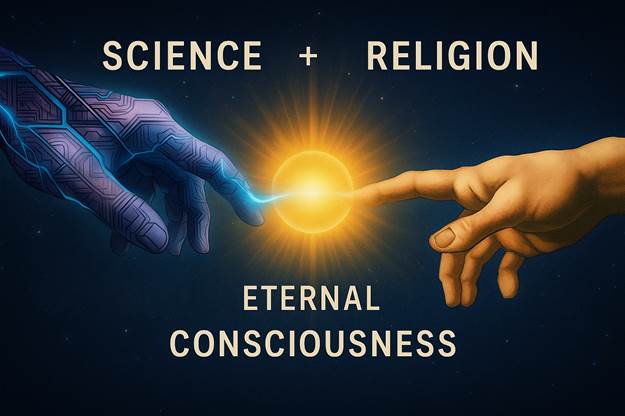
Human beings have long sensed that the deepest layer of existence is not found in linear time, external circumstance, or the physical body, but in the silent, witnessing presence that experiences them all. The ancient spiritual insight that “it has always been now” suggests that consciousness is not bound to the past or future but resides permanently in the living immediacy of the present moment. When this insight is expanded, it evokes a larger metaphysical possibility: that consciousness may be primary, timeless, and eternal, briefly expressing itself through human form. Though such a claim seems philosophical or mystical, aspects of Christian theology and modern quantum physics unexpectedly converge with this view when interpreted through their deepest lenses.
The Christian Understanding of Eternal Presence
Christian theology has long affirmed a form of “eternal present” that is foundational to the nature of God. Saint Augustine famously argued that time itself is a created dimension, and that God exists in an unchanging, timeless “Now” (Augustine, trans. 2008). This aligns with the scriptural assertion that in God, “there is no variation or shadow of turning” (James 1:17, NRSV), emphasizing a dimension of being where temporality does not apply.
Christ Himself uses the language of timeless identity: “Before Abraham was, I AM” (John 8:58). This statement echoes Exodus 3:14 of “I AM THAT I AM,” suggests a divine consciousness that is eternally present rather than confined to sequential time. The Apostle Peter supports this when he writes, “With the Lord one day is like a thousand years, and a thousand years are like one day” (2 Peter 3:8). These passages collectively reveal a clear theological framework: God is not simply everlasting but eternally present, existing beyond linear time.
Christian mystics expand this further. Meister Eckhart taught that the soul has a “spark” capable of experiencing God in the Eternal Now (Eckhart, trans. 1981). St. John of the Cross described the innermost self as a “lamp of the Lord” (echoing Proverbs 20:27) that perceives God in stillness. Brother Lawrence emphasized continual awareness of God’s presence in the present moment (Lawrence, 1982). These traditions view consciousness, particularly the silent witness within, as the point of contact between the human person and the eternal presence of God.
From a Christian perspective, then, the idea of “eternal consciousness residing temporarily in form” aligns closely with biblical anthropology: humanity receives life through the divine breath (Genesis 2:7), exists in God (Acts 17:28), and returns to God at death (Ecclesiastes 12:7). This is not pantheism, nor a denial of individuality, but a recognition that the human spirit participates in the timeless presence of God.
The Quantum Universe: Time, Observation, and Non-Locality
While Christianity approaches timelessness through theology, quantum physics approaches it through the structure of reality. Einstein’s theory of relativity first challenged the assumption of flowing time, proposing instead that past, present, and future coexist in a four-dimensional spacetime “block” (Einstein & Infeld, 1938). Physicists now widely refer to the “block universe” or eternalism, an interpretation in which time is a dimension we move through, not something that moves through us.
Quantum mechanics deepens this mystery.
1. The Observer and the Measurement Problem
In quantum theory, particles exist in a probabilistic superposition until measured. But what ends the superposition?
John von Neumann (1955) demonstrated mathematically that purely physical systems cannot complete a measurement; the chain of interaction must eventually terminate in a non-physical observer, traditionally interpreted as conscious awareness. Nobel physicist Eugene Wigner argued that consciousness plays a direct role in determining physical reality (Wigner, 1961). This does not mean “mind creates reality,” but it strongly suggests that consciousness is not an accidental byproduct of matter but rather it is woven directly into the act of manifestation.
2. Non-Locality and the Unity of Reality
Bell’s Theorem and subsequent experiments (Aspect et al., 1982) revealed that particles separated even by great distances behave as a single, non-local system. This implies that the universe is fundamentally interconnected, not composed of isolated parts. This resembles the idea of one underlying field or ground of being, expressing itself as many forms.
3. The Quantum Vacuum and Emergence of Form
Quantum field theory proposes that what we call “empty space” is in fact a powerful field of potentiality known as the zero-point field, from which all particles emerge (Davies & Brown, 1988). Matter is not fundamental; fields are. Some physicists, including David Bohm, likened this underlying order to a deeper, implicate reality (Bohm, 1980). This parallels the concept of eternal consciousness: a formless ground that expresses temporary forms.
4. The Participatory Universe
John Archibald Wheeler’s “participatory anthropic principle” boldly declared:
“Observers are necessary to bring the universe into being.” (Wheeler, 1989)
In other words: consciousness is not in the universe; the universe is participatory with consciousness.
Crossing the Bridge: Where Christianity and Quantum Physics Meet Eternal Consciousness
While Christianity and quantum mechanics differ in language and purpose, both suggest that:
Physical time is not fundamental.
Reality is not purely material.
Observation/consciousness interacts with the structure of reality.
The deepest layer of being is unified and timeless.
Human consciousness participates in something larger.
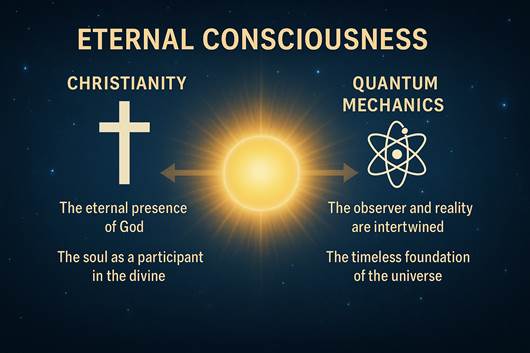
Christianity interprets this as the human spirit participating in the eternal presence of God.
Quantum mechanics interprets this as the observer participating in the manifestation of quantum events.
Both perspectives converge on a central point:
Consciousness is not merely the product of matter; it is involved in the structure of reality itself.
Neither field proves “eternal consciousness,” but both make it philosophically and scientifically plausible. The Christian view gives consciousness an eternal source (God), while quantum physics removes mechanistic constraints and reveals a universe that is deeply relational, non-local, and dependent on observation.
When understood at depth, Christianity and quantum physics do not conflict with the idea of eternal consciousness. Instead, they illuminate it from different angles. Christianity describes a divine, timeless presence in which the human spirit participates. Quantum physics reveals a universe that is non-material at its foundation, observer-dependent, and timeless in structure. Together, these perspectives support the philosophical insight that consciousness may be fundamental as an eternal presence momentarily experiencing itself through human form, always now, always here.
References:
Aspect, A., Grangier, P., & Roger, G. (1982). Experimental realization of Einstein-Podolsky-Rosen-Bohm Gedankenexperiment: A new violation of Bell’s inequalities. Physical Review Letters, 49(2), 91–94. https://doi.org/10.1103/PhysRevLett.49.91
Bridging Science, Mind–Body Practices, and Universal Law
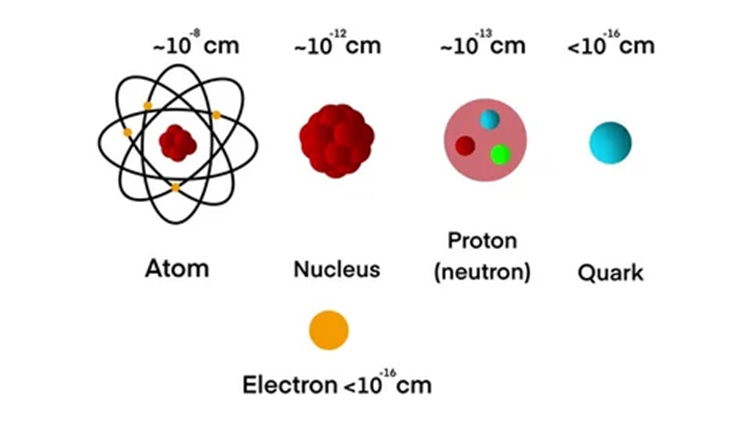
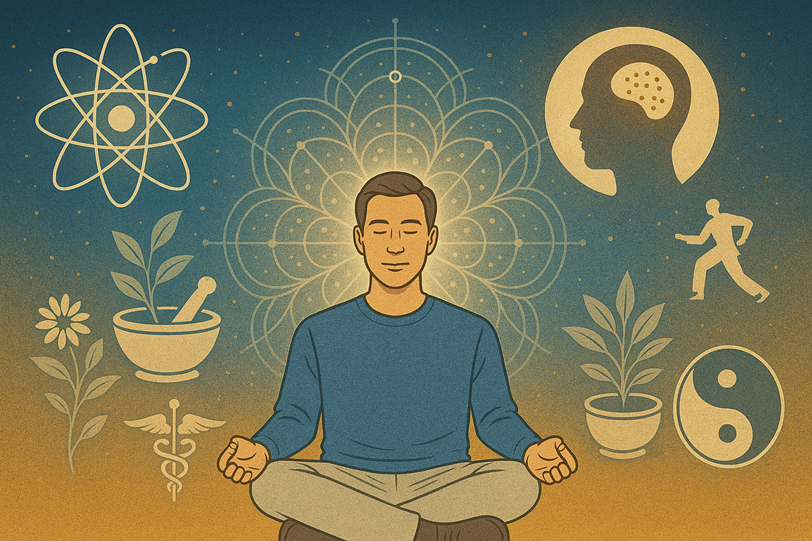
Quantum physics, once confined to subatomic phenomena, has gradually reshaped how we understand life, health, and consciousness. Its principles of nonlocality, superposition, and the observer effect are beginning to inform research in medicine, psychology, and ancient healing systems such as Traditional Chinese Medicine (TCM) and Ayurveda. These traditions, long grounded in concepts of subtle energy and consciousness, align remarkably with emerging scientific insights into mind–body interaction and the creative role of awareness in shaping reality.
Consciousness and the Quantum Field
Quantum theory proposes that all matter arises from a field of potential, or an underlying energetic continuum known as the quantum field. This mirrors spiritual concepts of Qi, Prana, and universal consciousness, which describe an intelligent energy animating and interconnecting all life. Just as the brain functions as a receiver of consciousness, the body is a conductor of subtle energies flowing through energy meridians or nadis. In both frameworks, reality manifests when consciousness interacts with potential, giving form to experience.
This synthesis challenges materialism’s assumption that consciousness is a mere by-product of brain activity. Instead, consciousness is the primary reality, a view increasingly supported by researchers like Amit Goswami (1995) and Rupert Sheldrake (2012), whose theories of morphic resonance suggest that patterns of thought and emotion can influence both biology and behavior across space and time.
The Placebo Effect and Quantum Observation
The placebo effect, where healing occurs through belief and expectation rather than pharmacological action, serves as a measurable example of consciousness influencing physical outcomes. Neuroimaging studies show that patients receiving inert treatments can trigger endorphin release, alter brain activity, and even induce measurable physiological change (Benedetti, 2014). From a quantum perspective, the placebo effect exemplifies the observer effect: belief and attention collapse probabilistic potentials into tangible results.
In this context, healing becomes less about external substances and more about the alignment of perception, belief, and intention. When the mind focuses coherently, whether through faith, meditation, or energy practice, it organizes biological systems toward balance. This parallels Traditional Chinese Medicine’s (TCM) notion that mental states influence Qi circulation and Ayurveda’s understanding that consciousness imbalance is the root of disease (Chopra, 2015).
Qigong, Tai Chi, and Quantum Coherence
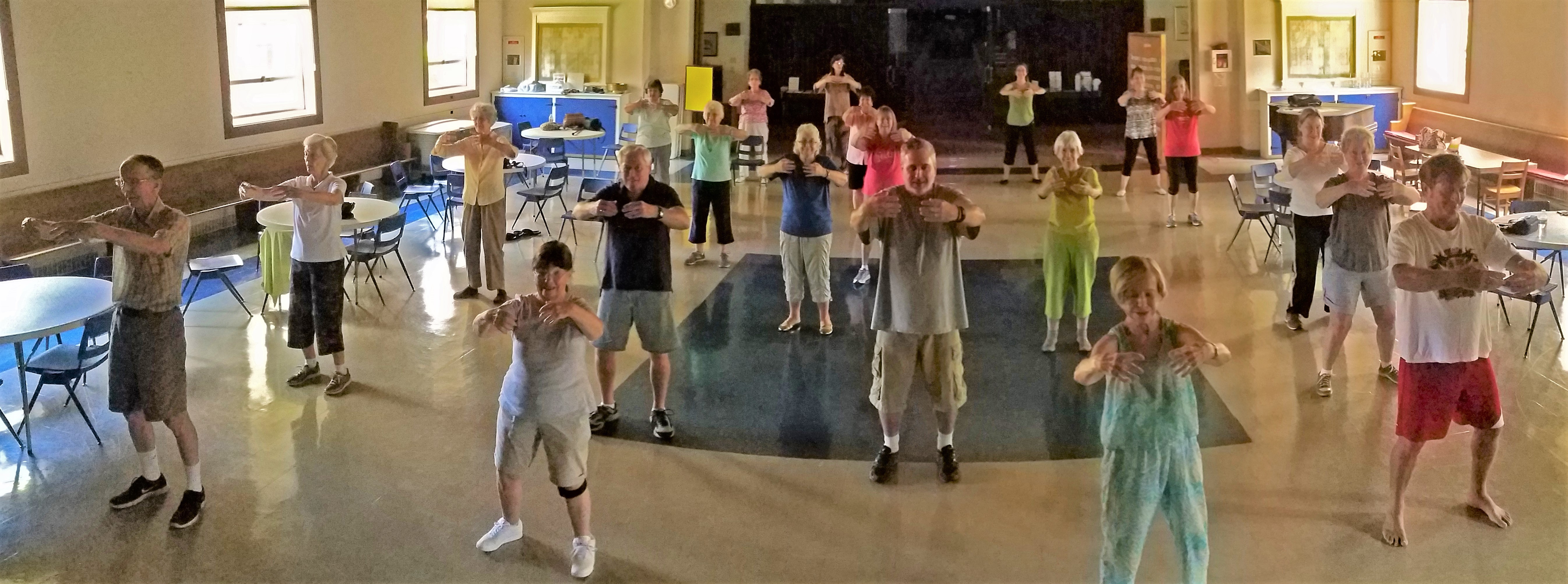
Qigong and Tai Chiare living laboratories of quantum coherence in action. Both disciplines train practitioners to harmonize body, breath, and mind, cultivating a state of flow or resonance that optimizes internal energy fields. Research has shown that these practices improve heart rate variability, reduce inflammation, and regulate brainwave synchrony, evidence of the body entering a quantum-coherent state (Jahnke et al., 2010).
In quantum terms, Qigong and Tai Chi operate as biological resonance systems. When practitioners focus attention on energy flow (Qi), they create measurable electromagnetic fields detectable around the body. These biofields, according to biophysicist Fritz-Albert Popp, may represent coherent light emissions or biophotons, quantum particles that facilitate communication between cells (Popp & Beloussov, 2003). Thus, ancient energy practices may function as methods for tuning the human organism into harmony with the quantum field.
Traditional Chinese Medicine and Ayurvedic Parallels
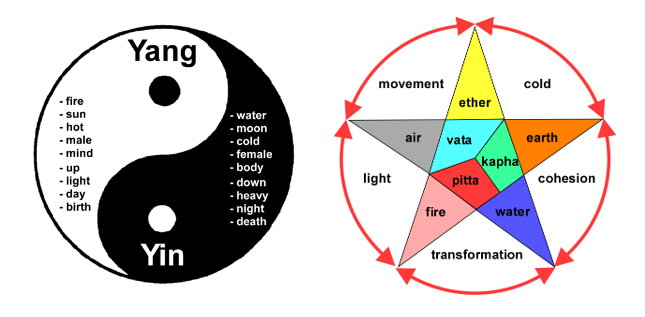
Traditional Chinese Medicine (TCM) views the universe and body as reflections of a dynamic balance between yin and yang, two complementary forces governing all existence. Similarly, Ayurveda describes health as a balance of the three doshas of Vata, Pitta, and Kapha,energetic principles derived from consciousness manifesting through the five elements. Both systems recognize that disease begins as a disruption in the flow or coherence of subtle energies before physical symptoms appear.
Quantum physics validates these insights by demonstrating that physical reality is not solid but vibrational. Just as Qi or Prana represent life energy, subatomic particles are not objects but energy waves interacting within fields. Healing, therefore, involves restoring resonance by realigning vibrational frequencies between the body’s systems and the larger universal field (Capra, 1999). Meditation, herbal medicine, sound, and mindful movement all serve to reestablish this resonance.
Conscious Mind, Subconscious Patterns, and Healing
There exist dual levels of mind, where the conscious and subconscious and their interplay shape experience. Modern psychoneuroimmunology confirms that subconscious beliefs influence immune function and cellular activity. Placebo and nocebo studies illustrate how deep-seated emotions can either heal or harm, reinforcing TCM’s emphasis on emotional balance and Ayurveda’s stress on sattvic (pure) consciousness as the foundation of well-being.
Meditation and Qigong act as tools for reprogramming the subconscious, quieting habitual thought patterns, and entraining the nervous system to a coherent rhythm. Through neuroplasticity, repeated focus on compassion, gratitude, or peace rewires neural circuits, embodying the principle that mind precedes matter (Doidge, 2007).
Ethical Integrity and Vibrational Clarity
Quantum and spiritual traditions agree that coherence requires ethical and emotional alignment. Dishonesty, anger, or greed introduce vibrational noise that distorts the clarity of consciousness. Conversely, gratitude, service, and moral integrity raise vibrational resonance, enabling access to higher frequencies of the universal field. This explains why moral cultivation is central in Confucian, Taoist, and Vedic systems, and is considered essential to effective healing and manifestation.
Toward an Integrated Science of Consciousness and Health
As science evolves, the boundaries between physics, medicine, and spirituality continue to blur. Quantum biology now examines how wave interference, entanglement, and energy coherence operate within living cells, suggesting that consciousness may be an organizing force behind biological order (Al-Khalili & McFadden, 2014). The same laws governing particles in superposition may govern energy in meridians or chakras.
The integration of quantum principles with TCM, Ayurveda, Qigong, and Tai Chi offer a profound framework for whole-person healing. One that honors both physical mechanisms and the metaphysical dimensions of consciousness. These traditions, long dismissed as mystical, now gain empirical support as science rediscovers what sages have taught for millennia: that consciousness, energy, and matter are inseparably one.
Quantum physics invites humanity to reconsider its role in creation not as passive observers, but as conscious participants in the unfolding of reality. Practices like meditation, Qigong, and Tai Chi exemplify how coherent intention can modulate physiology and align with universal laws. The placebo effect further affirms that belief, emotion, and attention are powerful instruments of healing. Integrating ancient wisdom with modern physics reveals a unified vision of human potential where health, consciousness, and the cosmos resonate in a single quantum symphony.
Jahnke, R., Larkey, L., Rogers, C., Etnier, J., & Lin, F. (2010). A comprehensive review of health benefits of qigong and tai chi. American journal of health promotion : AJHP, 24(6), e1–e25. https://doi.org/10.4278/ajhp.081013-LIT-248
Popp, F. A., & Beloussov, L. (Eds.). (2003). Integrative biophysics: Biophotonics. Springer.
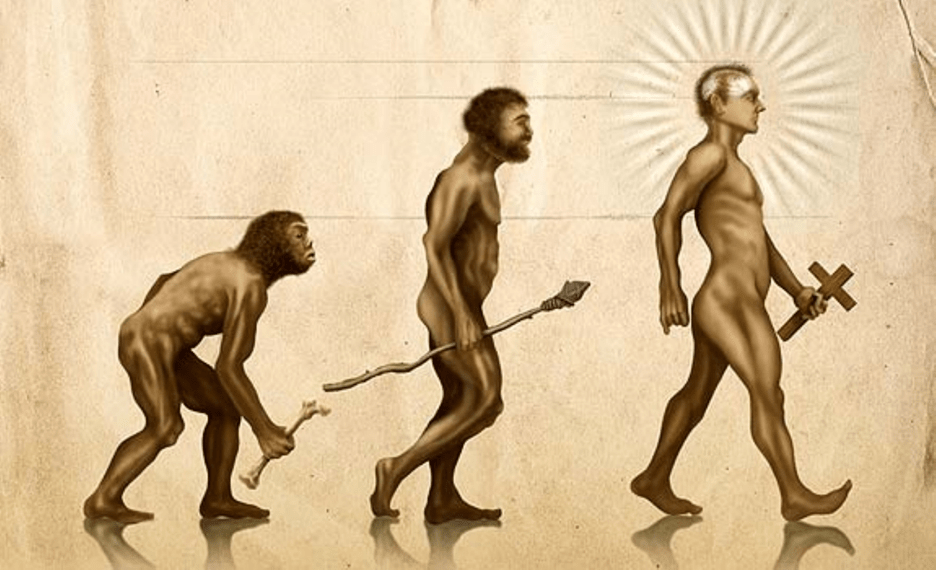
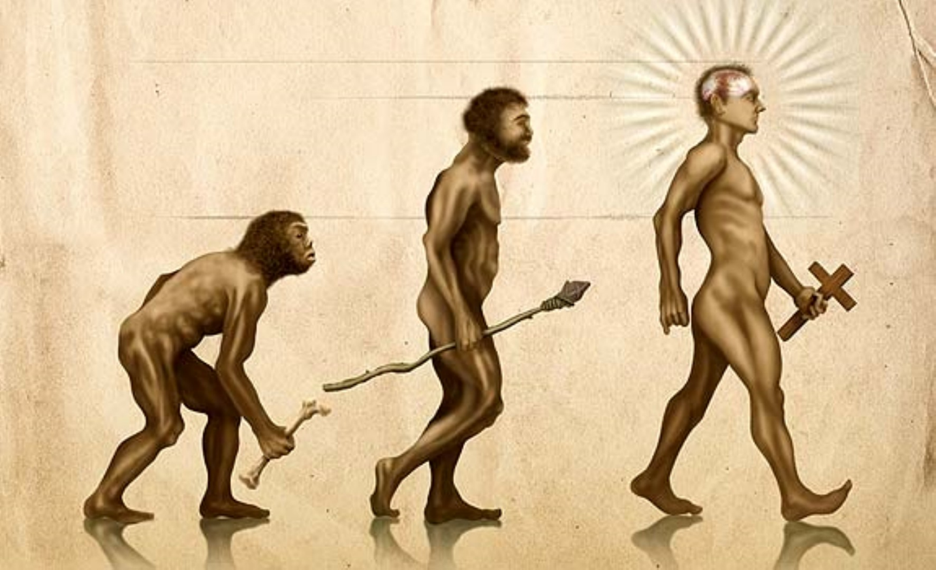
Human evolution has traditionally been described through biological shifts, evolving from Homo habilis, Homo erectus, and Homo sapiens. Yet in the 21st century, the forces shaping human development are increasingly cultural, technological, and behavioral, not solely genetic. Two contrasting models have emerged in scholarly, philosophical, and sociocultural discourse: the spiritually and ethically “evolved” Homo Sanctus, and the digitally dependent, socially attenuated Homo Technologicus.
These models represent divergent paths of human adaptation to radically new environments. One emphasizes deeper consciousness, embodied awareness, and integrated development; the other reflects disembodied cognition, algorithmic identity, and diminishing interpersonal fluency. When viewed through the lenses of psychology, epigenetics, neuroscience, and social evolution, these models are not merely metaphors, but they reflect distinct adaptive pressures shaping tomorrow’s humans.
This essay synthesizes both trajectories, integrates current scientific literature, and positions them within a holistic, mind–body–spirit framework aligned with martial arts, qigong, and embodied wisdom traditions.
(Redazione & Redazione, 2025)
1. Homo Sanctus: The Archetype of the Integrated Human
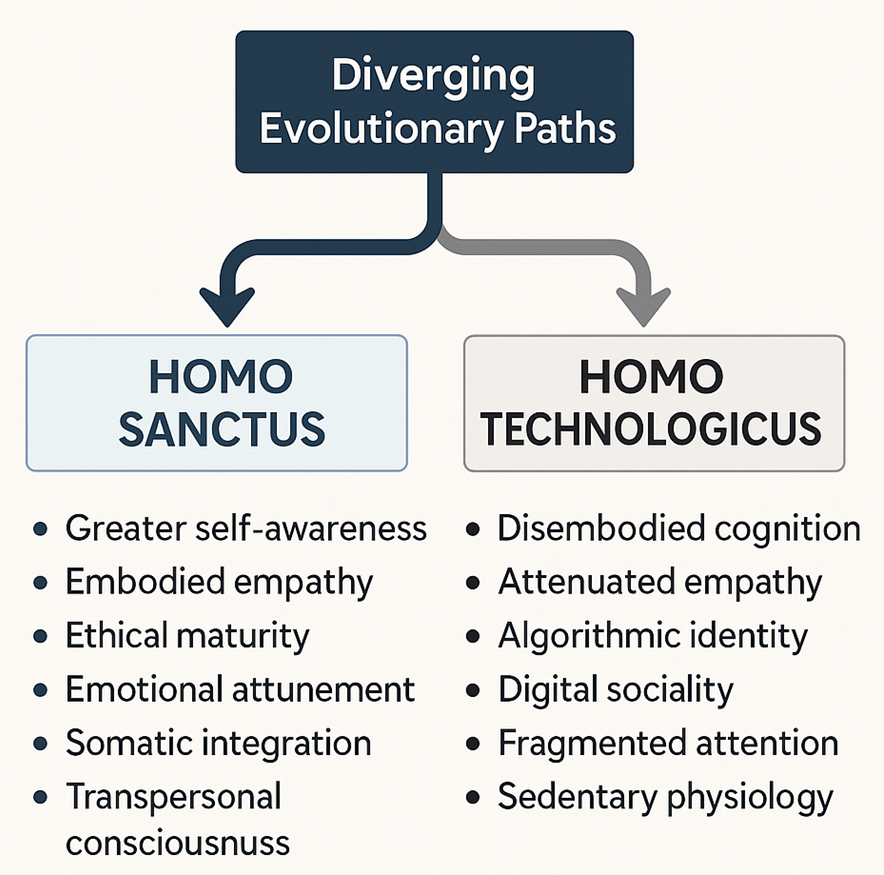
The term Homo Sanctus appears in spiritual psychology, evolutionary theology, and transpersonal philosophy to describe a “next-stage human” characterized by higher ethical consciousness, embodied awareness, and profound relational intelligence (Mukhopadhyay, 2021). Rather than a biological species, Homo Sanctus is a developmental ideal, where a human who transcends ego-fragmentation and embodies unity between body, mind, society, and spirit.
Core characteristics of Homo Sanctus include:
Embodied presence: deep interoception, somatic awareness, and emotional regulation
Ethical maturity: compassion, integrity, service
Integration of opposites: harmonizing rationality and intuition, self and other
Transpersonal consciousness: connectedness to something larger than the self
Cohesive identity: clarity of values, meaning, and purpose
This ideal parallels traditions such as the Taoist zhenren (“true person”), Confucian junzi (“noble person”), the Buddhist bodhisattva, and Christian spiritual maturity (Wilber, 2000). From an Eastern-martial perspective, this represents the Warrior–Scholar–Sage archetype: strong in body, disciplined in mind, and aligned in spirit.
Importantly, Homo Sanctus evolves through cultivation, not accident. Practices such as tai chi, qigong, meditation, dao yin, and martial mastery refine the nervous system, harmonize the meridian networks, and deepen interoception (Wayne & Kaptchuk, 2008). Such individuals become more resilient, socially attuned, and less susceptible to technological fragmentation.
2. The Counter-Trajectory: Homo Technologicus and the Decline of Interpersonal Competence
In contrast, emerging research indicates that modern humans, especially younger generations, are undergoing a decline in face-to-face relational skills, empathy, and social nuance. This pattern reflects a different adaptive pathway: Homo Technologicus, a human shaped primarily by digital environments.
Key drivers include:
heavy reliance on text-based communication
diminished exposure to real-time social cues
algorithmic reinforcement loops
parasocial relationships and AI companions
chronic sedentary behavior
online identity construction
declining sexual activity and pair bonding
This developmental pattern is supported by evidence showing measurable declines in empathy over the past 30 years (Konrath et al., 2011), reductions in attention span associated with digital multitasking (Loh & Kanai, 2016), and decreased interpersonal resilience due to avoidance of embodied conflict (Kross et al., 2013).
2.1 Loss of Social Neurobiological Skills
Human communication is 70–93% nonverbal (Burgoon et al., 2016). Digital communication removes:
microexpressions
tone, cadence, prosody
posture and gesture
physiological co-regulation
The brain circuits responsible for reading these cues, including the mirror neuron system, the insula, and the temporoparietal junction, atrophy with disuse (Iacoboni, 2009). Adolescents who use screens more than three hours daily show impairments in social brain network integration (Twenge & Campbell, 2018). This is evolutionary pressure in real time.
2.2 Declining Sexual Drive and Reproductive Behavior
Sexual activity among young adults has plummeted, with many reporting no sexual activity for months or years, often replaced by digital substitutes (Ueda et al., 2020). Chronic screen exposure, pornography addiction, disrupted circadian rhythms, and social anxiety all reduce libido and mating motivation via hormonal pathways, especially dopamine and testosterone regulation (Prause & Pfaus, 2015).
From an evolutionary lens, those who do not reproduce are naturally selected out. This creates behavioral selection pressure for traits that preserve reproductive drive and embodied bonding.
3. Sedentary Lifestyle, Biological Decline, and Epigenetic Consequences
Sedentary lifestyles, disrupted sleep patterns, virtual emotional engagement, and constant digital stimulation contribute to:
metabolic dysfunction
chronic low-grade inflammation
decreased fertility
hormonal disruption
accelerated aging
Sedentary behavior reduces mitochondrial efficiency and alters hormonal pathways related to stress, libido, and mood (Booth et al., 2012). Chronic stress, sleep disruption, and social deprivation produce epigenetic changes that can pass to offspring (Nestler, 2014).
Examples include:
altered DNA methylation affecting stress response genes
sperm epigenetic damage from obesity and inactivity
Thus, today’s lifestyle patterns may literally reshape the biological baseline of future generations, even without genetic mutation.
4. Diverging Evolutionary Forks: Homo Integralis vs. Homo Fragmentus
Taken together, contemporary conditions create a bifurcated evolutionary trajectory:
Path A: Homo Technologicus / Homo Fragmentus
Characterized by:
reduced interpersonal intelligence
emotional outsourcing to AI
fragmented identity
dopamine dysregulation
decreased libido and reproduction
digital tribalism
low distress tolerance
sedentary physiology
weakened mind–body integration
Over generations, this pathway selects for:
reduced mating drive
increased digital dependency
lower embodied cognition
This is not dystopian fiction, this is ongoing.
Path B: Homo Sanctus / Homo Integralis
Characterized by:
strong somatic awareness
embodied empathy
resilience to stress
integrated spiritual-ethical development
intentional cultivation (qigong, tai chi, martial arts)
disciplined nervous system
strong social bonds
meaningful service
stable identity
This pathway reflects the continuation of human strengths that enabled our survival for 300,000 years, community, embodiment, adaptability, and consciousness.
5. A Holistic Perspective: Embodiment as the Antidote
My life’s work of martial arts, qigong, Taoist philosophy, and holistic health, directly counters the fragmentation of Homo Technologicus.
Embodied practices strengthen:
vagal tone
emotional regulation
stress resilience
interoception
empathy
ethical clarity
community cohesion
nervous system balance
Tai Chi, for example, enhances functional connectivity in brain regions related to attention, emotion, and social cognition (Tao et al., 2016). Meditation thickens areas of the brain involved in compassion and self-regulation (Lazar et al., 2005). Qigong improves heart rate variability, endocrine balance, and neuroimmune communication (Jahnke et al., 2010).
In this context, the true “next stage” of human evolution may not be technological augmentation but re-embodiment, integration, and cultivation, aligning with the ancient ideal of Homo Sanctus.
Conclusion
Humanity stands at a developmental crossroads. One path leads toward disembodied cognition, digital dependence, diminished interpersonal capacities, and biological decline, with perhaps the emergence of Homo Technologicus and Homo Fragmentus. The other leads toward embodied presence, ethical wholeness, social coherence, and heightened consciousness, or the pathway of Homo Sanctus and Homo Integralis.
This evolutionary divergence is not predetermined. It is shaped by choices, practices, environments, and values. Through holistic training, martial arts, breathwork, qigong, and the cultivation of meaning, humans can choose to evolve toward greater integration rather than fragmentation.
My work of writings, and teachings sit firmly within this integrative lineage. In a world moving toward digital disembodiment, the embodied path has never been more necessary or more evolutionary.
Comparison Table: Emerging Human Trajectories
Dimension
Homo Sanctus
Homo Integralis (holistic path)
Homo Technologicus
Homo Fragmentus
Core Identity
Spiritually evolved, ethically matured human
Fully embodied, integrated mind–body–spirit development
Human identity shaped by technology, algorithms, digital environments
Fragmented sense of self shaped by dopamine loops, isolation, and virtual life
Consciousness
Transpersonal, expansive, meaning-driven
High interoception, self-awareness, balanced cognition
Externally directed, attention hijacked by devices
Booth, F. W., Roberts, C. K., & Laye, M. J. (2012). Lack of exercise is a major cause of chronic diseases. Comprehensive Physiology, 2(2), 1143–1211. https://doi.org/10.1002/cphy.c110025
Iacoboni, M. (2009). Mirroring people: The new science of how we connect with others. Picador.
Jahnke, R., Larkey, L., Rogers, C., Etnier, J., & Lin, F. (2010). A comprehensive review of health benefits of qigong and tai chi. American journal of health promotion : AJHP, 24(6), e1–e25. https://doi.org/10.4278/ajhp.081013-LIT-248
Konrath, S., O’Brien, E., & Hsing, C. (2011). Changes in dispositional empathy in American college students over time. Personality and Social Psychology Review, 15(2), 180–198. https://doi.org/10.1177/1088868310377395
Kross, E., Verduyn, P., Demiralp, E., et al. (2013). Facebook use predicts declines in subjective well-being. PLoS ONE, 8(8), e69841. https://doi.org/10.1371/journal.pone.0069841
Lazar, S. W., Kerr, C. E., Wasserman, R. H., et al. (2005). Meditation experience is associated with increased cortical thickness. NeuroReport, 16(17), 1893–1897. https://doi.org/10.1097/01.wnr.0000186598.66243.19
Prause, N., & Pfaus, J. (2015). Viewing Sexual Stimuli Associated with Greater Sexual Responsiveness, Not Erectile Dysfunction. Sexual medicine, 3(2), 90–98. https://doi.org/10.1002/sm2.58
Tao, J., Liu, J., Egorova, N., Chen, X., Sun, S., Xue, X., Huang, J., Zheng, G., Wang, Q., Chen, L., & Kong, J. (2016). Increased Hippocampus-Medial Prefrontal Cortex Resting-State Functional Connectivity and Memory Function after Tai Chi Chuan Practice in Elder Adults. Frontiers in aging neuroscience, 8, 25. https://doi.org/10.3389/fnagi.2016.00025
Twenge, J. M., & Campbell, W. K. (2018). Associations between screen time and lower psychological well-being among children and adolescents. Preventive Medicine Reports, 12, 271–283. https://doi.org/10.1016/j.pmedr.2018.10.003
Ueda, P., Mercer, C. H., Ghaznavi, C., & Herbenick, D. (2020). Trends in frequency of sexual activity and number of sexual partners among adults aged 18 to 44 years in the US, 2000-2018. JAMA Network Open, 3(6), e203833. https://doi.org/10.1001/jamanetworkopen.2020.3833
Wayne, P. M., & Kaptchuk, T. J. (2008). Challenges inherent to t’ai chi research: part I–t’ai chi as a complex multicomponent intervention. Journal of alternative and complementary medicine (New York, N.Y.), 14(1), 95–102. https://doi.org/10.1089/acm.2007.7170a
Wilber, K. (2000). Integral psychology: Consciousness, spirit, psychology, therapy. Shambhala.
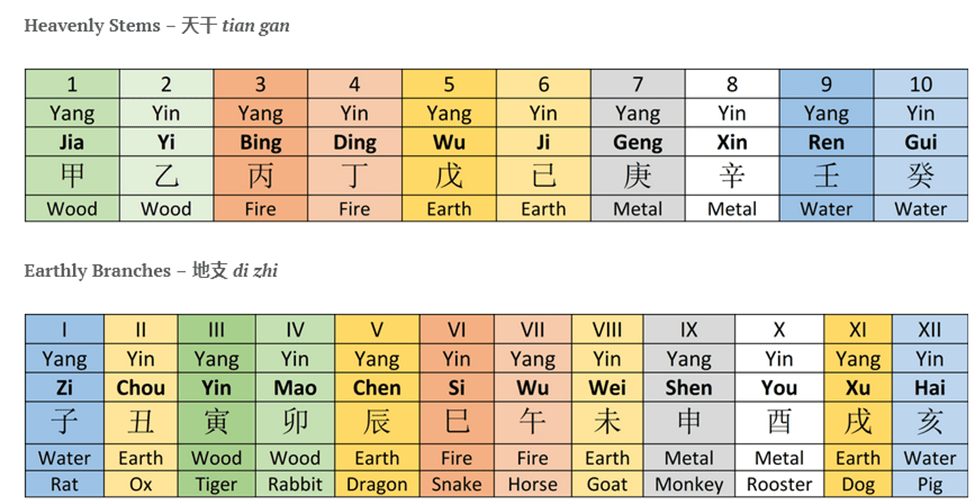
In Chinese and Korean astrology and traditional cosmology, time is conceptualized as cyclical and governed by natural forces. These systems are used in saju analysis, geomancy, and ritual calendars. Two fundamental components of this worldview are:
The 10 Heavenly Stems (Tian Gan – Chinese), Cheon‑gan – Korean)
Together with the Five Elements (Wuxing) and Yin – Yang duality, they create a sexagenary (60-day) cycle that is the basis for identifying auspicious days and mapping personal fate (Lee, 1981).
These rotating influences affect feng shui, health, and calendar-based rituals (Wu, 2005)
Part 2: The 12 Earthly Branches (Ji‑ji)
The Earthly Branches create a 12-day cycle and are symbolized by the 12 zodiac animals. Each branch has corresponding elemental, directional, and seasonal meanings.
Korean version of the 12 Earthly Branches (Di Zhi)
Branch
Animal
Element
Direction
자 (Ja)
Rat
Water
North
축 (Chuk)
Ox
Earth
NNE
인 (In)
Tiger
Wood
NE
묘 (Myo)
Rabbit
Wood
East
진 (Jin)
Dragon
Earth
ESE
사 (Sa)
Snake
Fire
SE
오 (O)
Horse
Fire
South
미 (Mi)
Goat
Earth
SSW
신 (Sin)
Monkey
Metal
SW
유 (Yu)
Rooster
Metal
West
술 (Sul)
Dog
Earth
WNW
해 (Hae)
Pig
Water
NW
Each day of the lunar month has an assigned branch, and this is one way that daily energy is determined (Kim, 2018).
Part 3: The 60-Day Cycle (Yukship Gapja)
Because 10 and 12 have a least common multiple of 60, this pairing forms a cosmological sequence that completes once every 60 days or years, depending on the calendar scale (Lee, 1981).
This cycle underlies:
Daily calendar rotation
60-year birthday celebrations
Spiritual timing for rituals and divination
The 60 units are viewed as elementally distinct days, each with specific fortune or taboo status.
Part 4: Special Days in Korean Mystical Practice
1. Sonnal – Unlucky Days
Rather than being “auspicious,” these are dangerous or unlucky days, often tied to folk shamanic beliefs. They are days when:
One should not cut hair or nails
Surgery or travel is discouraged
Avoid beginning manual tasks with construction, cutting, repairs, etc.
Spirit intrusion is considered high (Kim, 2018)
2. Gil-il – Lucky Days
These are selected based on:
Stem–branch harmony (Heavenly Stem supports the Earthly Branch)
Lack of elemental conflict with the person’s saju chart
Favorable directional flow based on geomantic readings (Yoon, 2017)
In rural traditions, agricultural festivals or ancestral rites are often aligned with these dates. These are perceived as the best days for weddings, moving into a house, starting businesses, making kimchi, conceiving a child.
3. December as Auspicious?
There is some belief that the lunar month aligned with Rat (Ja-wol), roughly December in the Gregorian calendar is energetically potent, because:
It is the start of the solar calendar (dongji, or winter solstice, marks the return of yang energy)
It represents fertility and rebirth in seasonal logic (Wu, 2005)
However, no universal doctrine marks December as always auspicious; it depends on the year’s alignment and individual energy patterns.
Part 5: Application in Korean Spiritual Life
Saju-palja: Four Pillars of Destiny combines year, month, day, and hour to forecast character, fate, and life timing. Each pillar has a stem–branch combination.
Pungsu-jiri: Korean geomancy uses directional alignments of time and space based on these cycles, to site homes, graves, and sacred spaces (Yoon, 2017).
Almanac Use: Traditional Korean almanacs list each day’s stem–branch, auspicious tasks, and prohibitions.
Conclusion
The purpose of this article is not to judge or critique these particular belief systems, but rather offer information on differing perspectives. The integration of Heavenly Stems, Earthly Branches, Five Elements, and Yin-Yang philosophy produces a deeply symbolic and cyclical framework for interpreting time in Korean mysticism. Whether identifying auspicious dates, planning ancestral rites, or decoding one’s destiny, these systems offer a structured metaphysical map of existence. Understanding them opens a window into a worldview where time, space, and spirit are intimately connected.










 United Martial Arts Association