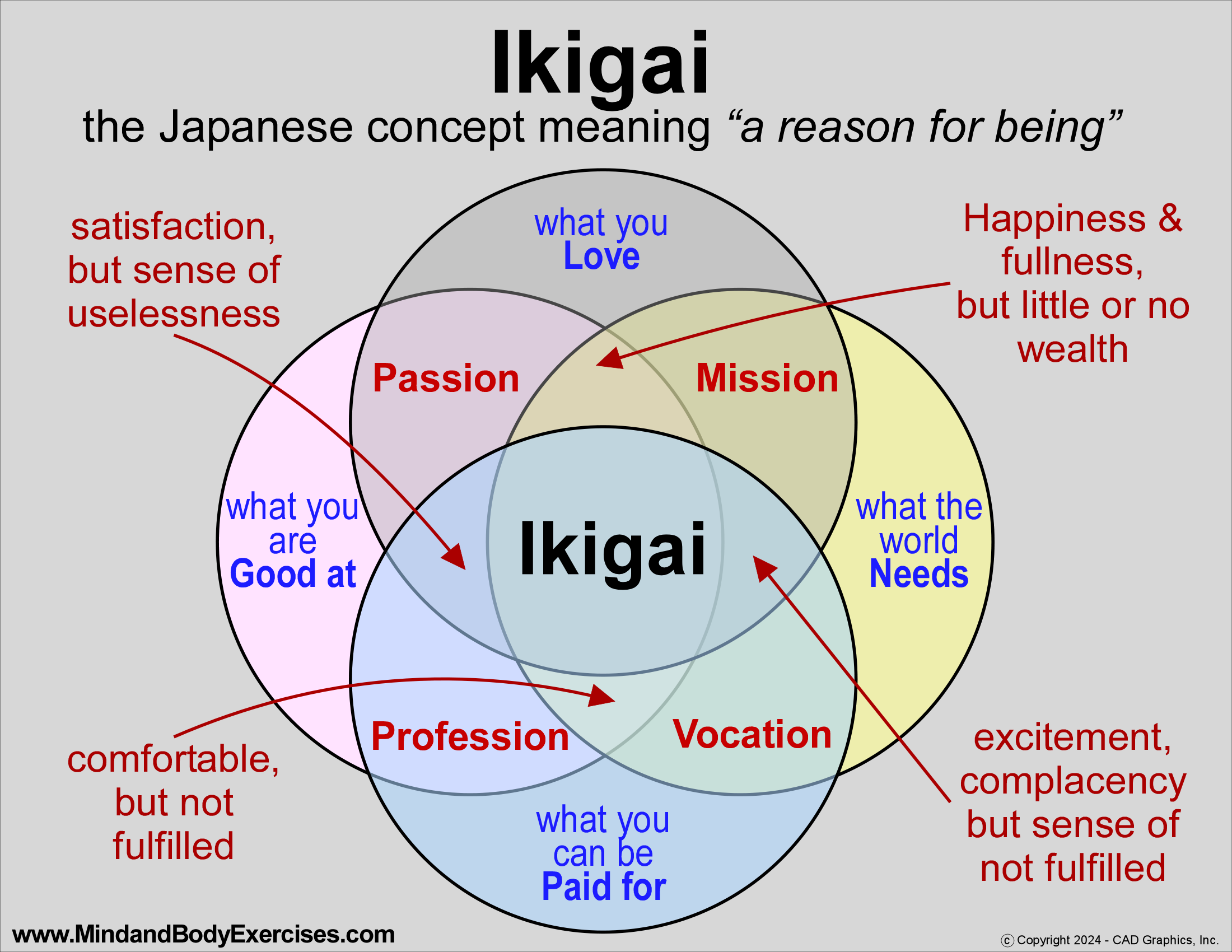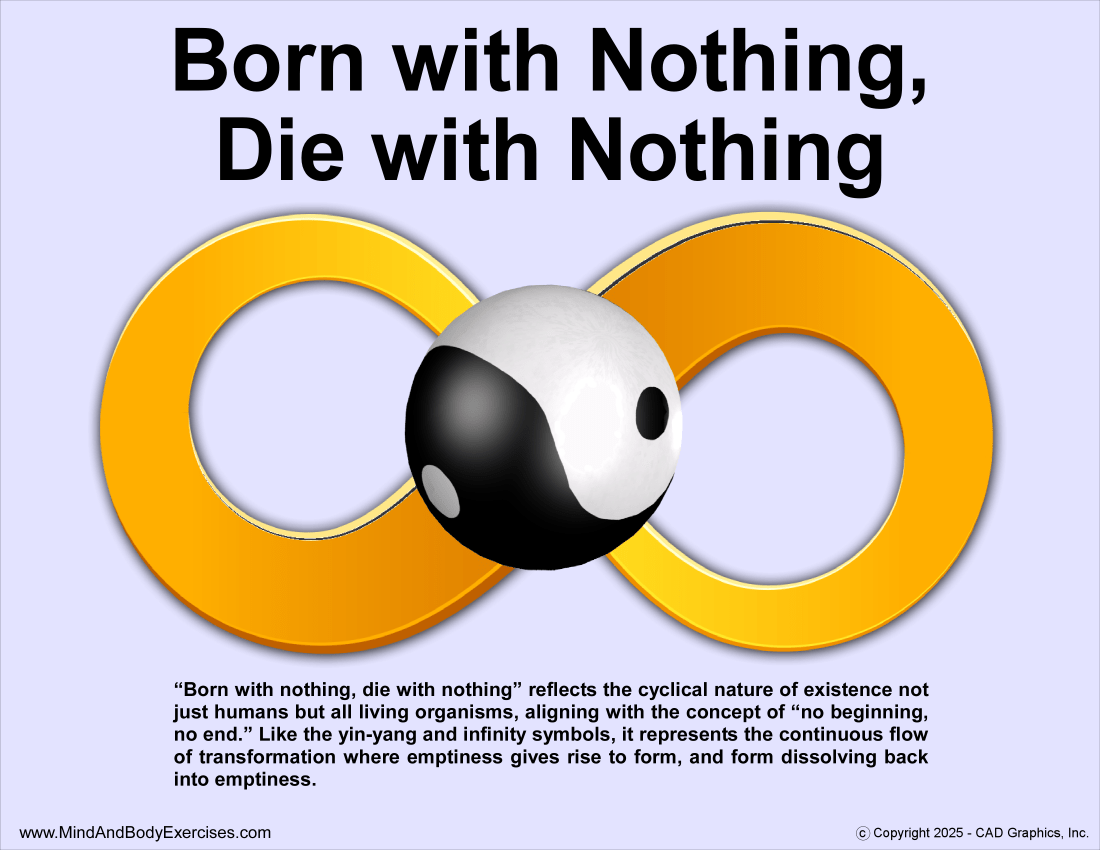
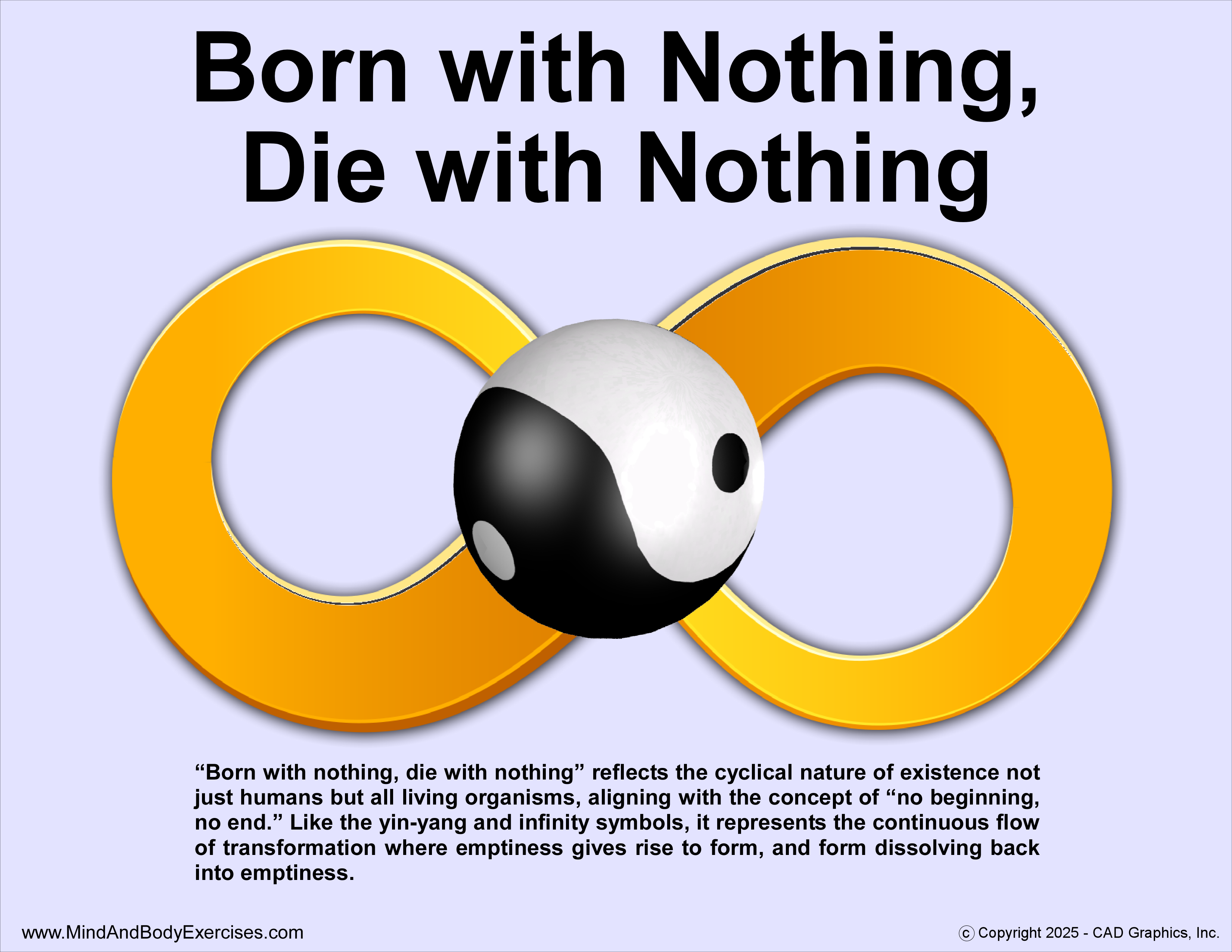
Born With Nothing, Die With Nothing”

The concept of “born with nothing, die with nothing” is a profound philosophical idea found in many Eastern traditions, including Buddhism and Taoism. It reflects the principles of impermanence, detachment, and the cyclical nature of existence. We enter this world with no possessions, and when we leave, we take nothing with us. This underscores the transient nature of material wealth and highlights the deeper value of experiences, relationships, and inner growth.

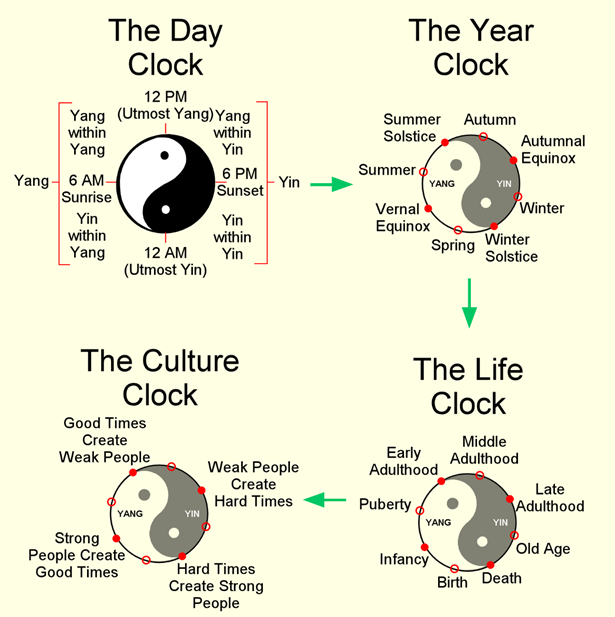
This idea extends beyond human life to all living beings, aligning with the concept of “no beginning, no end.” Like the yin-yang (☯) and infinity (∞) symbols, it represents the continuous flow of transformation, where emptiness gives rise to form, and form dissolves back into emptiness.
Human life can be seen as consciousness temporarily residing in form, experiencing the ever-shifting balance of existence before returning to the formless. In Taoism, this mirrors the Dao (道), the ever-flowing source from which all things arise and to which they ultimately return. Just as yin transforms into yang and vice versa, life and death are not endpoints but expressions of an eternal process. This perspective encourages non-attachment, balance, and harmony with the natural flow of life, recognizing that all physical possessions are ultimately borrowed, and everything returns to the Dao.

Related Concepts:

Biblical Perspective: A similar idea appears in the Book of Job, where Job states, “The Lord gave, and the Lord has taken away; may the name of the Lord be praised.” This is often interpreted as an acceptance of life’s impermanence, acknowledging that all we have is ultimately a gift and can be withdrawn at any time.

The Heart Sutra: A central text in Mahayana Buddhism, the Heart Sutra articulates the nature of emptiness, stating that all phenomena bear the mark of emptiness—their true nature is beyond birth and death, being and non-being.

Śūnyatā (Emptiness): In Mahayana Buddhism, śūnyatā refers to the understanding that all things are devoid of intrinsic existence. This insight is fundamental to recognizing the transient nature of life and the absence of a permanent self.

Samsara: This term describes the continuous cycle of birth, death, and rebirth, emphasizing the impermanence and suffering inherent in worldly existence.

Why This Concept Matters in Everyday Life

Understanding and embracing this concept can have a profound impact on how we approach daily life. It reminds us to focus on what truly matters. Our experiences, relationships, and inner development are most important, rather than being overly attached to material possessions or fleeting successes. By recognizing the impermanent nature of all things, we can cultivate greater resilience and gratitude in the face of challenges, reduce unnecessary stress, and live with greater appreciation and mindfulness.

This perspective encourages us to be present in each moment, to value the people around us, and to engage in life with a sense of peace and acceptance. It also promotes generosity and compassion, as we recognize that nothing truly belongs to us, and what we give to others is ultimately part of the greater flow of all existence.

By implementing this understanding into our lives, we can develop a deeper sense of harmony, balance, and contentment, freeing ourselves from the burdens of attachment and fear while embracing the natural rhythms of life.

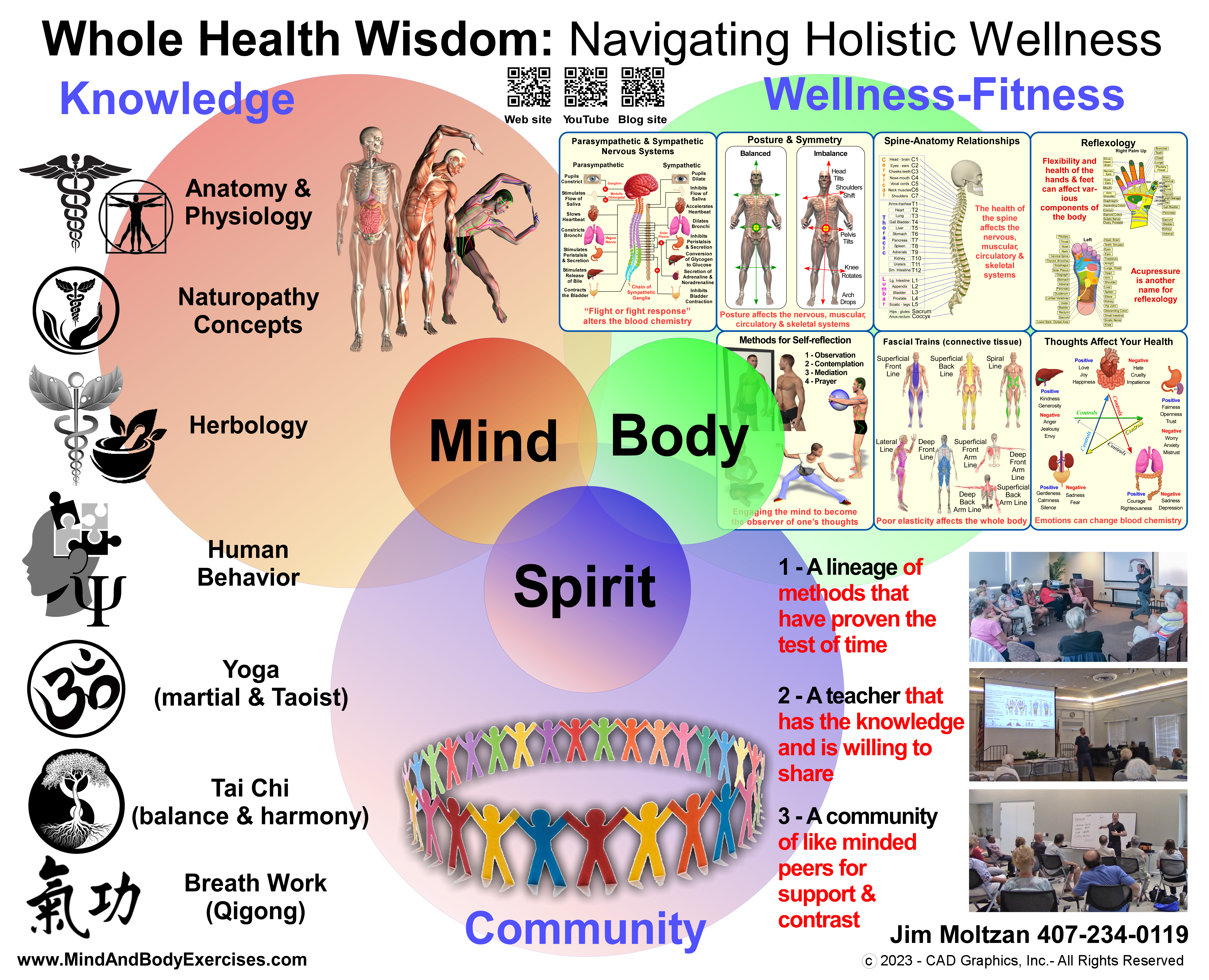
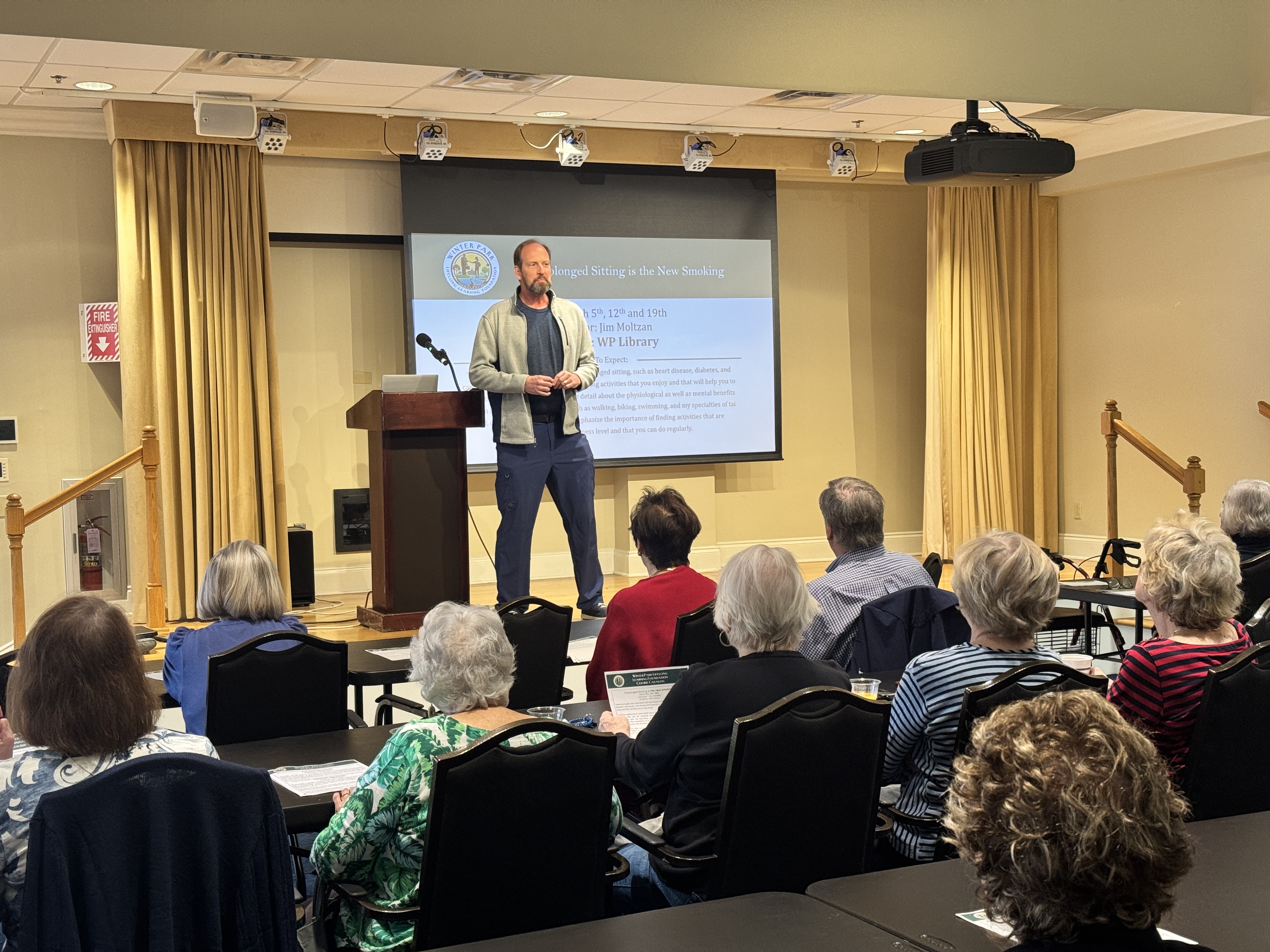
I teach and offer lectures about holistic health, physical fitness, stress management, human behavior, meditation, phytotherapy (herbs), music for healing, self-massage (acupressure), Daoyin (yoga), qigong, tai chi, and baguazhang.

Please contact me if you, your business, organization, or group, might be interested in hosting me to speak on a wide spectrum of topics relative to better health, fitness, and well-being.

I look forward to further sharing more of my message by partnering with hospitals, wellness centers, VA centers, schools on all levels, businesses, and individuals who see the value in building a stronger nation through building a healthier population.

I also have hundreds of FREE education video classes, lectures, and seminars available on my YouTube channel at:

https://www.youtube.com/c/MindandBodyExercises

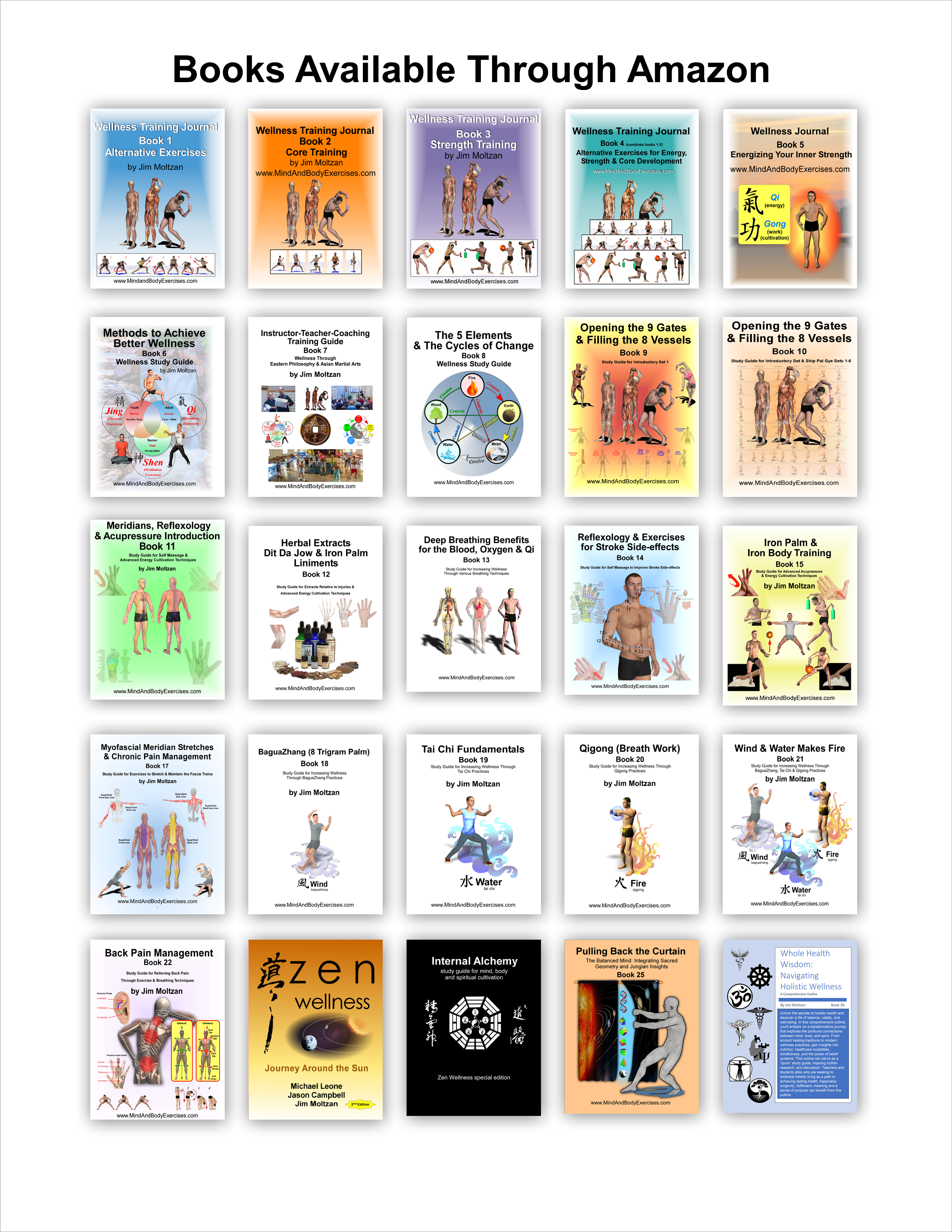
Many of my publications can be found on Amazon at:

http://www.Amazon.com/author/jimmoltzan

My holistic health blog is available at:

https://mindandbodyexercises.wordpress.com/

http://www.MindAndBodyExercises.com

Mind and Body Exercises on Google: https://posts.gle/aD47Qo

Jim Moltzan

407-234-0119

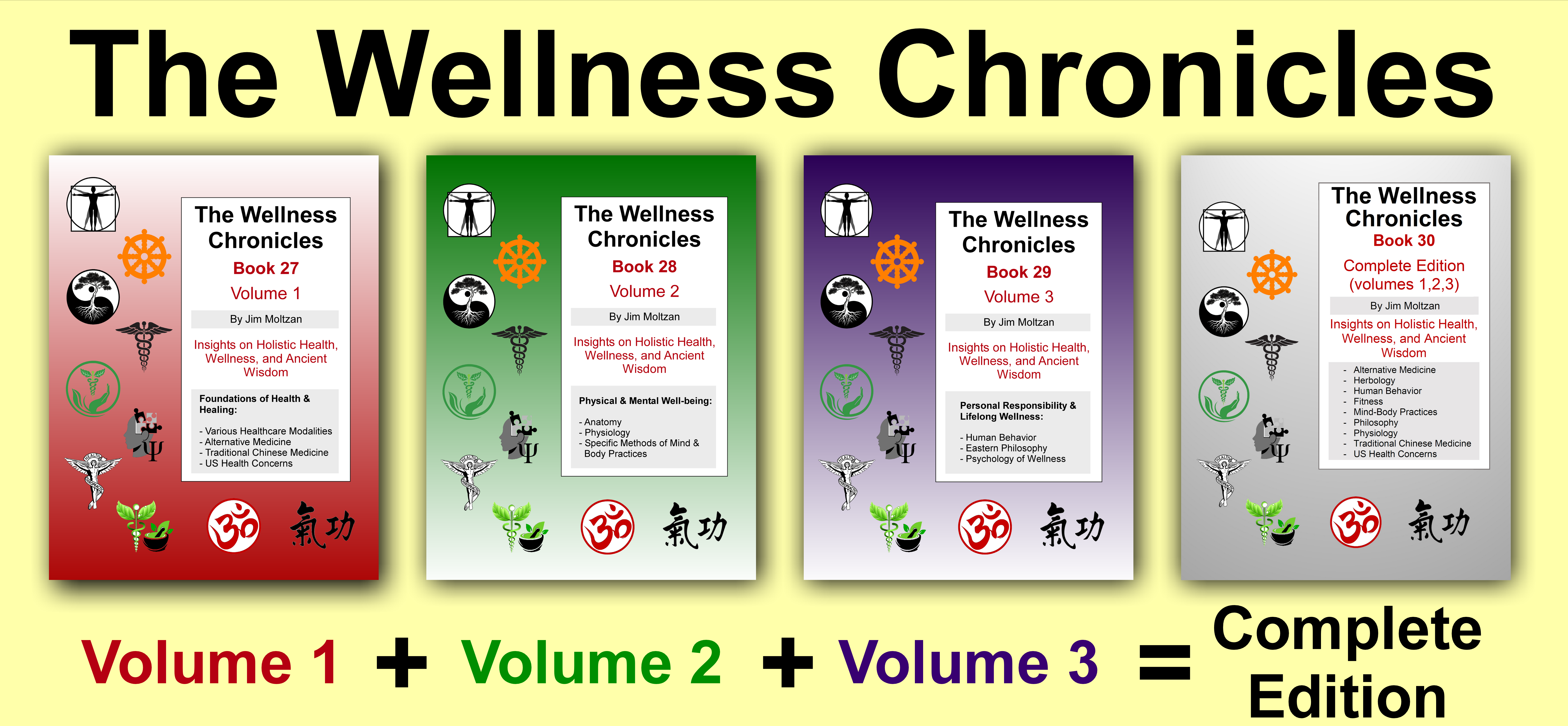
The Wellness Chronicles

I am excited to present The Wellness Chronicles, a culmination of insights gathered from my many years of writing on holistic health. These books distill key concepts from hundreds of my articles, offering a practical and thought-provoking guide to achieving well-being through a balanced approach to life.

In today’s fast-paced world, where stress and pharmaceutical dependency often overshadow self-care and preventative health, The Wellness Chronicles serves as a beacon for those seeking a deeper understanding of the mind-body-spirit connection. Each volume explores a broad spectrum of topics, including nutrition, physiology, healthcare modalities, meditation, psychology, and philosophy, all with an underlying focus on empowering individuals to take charge of their own well-being.

Readers will discover time-honored healing traditions such as Traditional Chinese Medicine (TCM) and Ayurveda alongside modern holistic approaches emphasizing balance and harmony. These books encourage self-awareness and practical application, addressing injuries and ailments through natural, non-pharmaceutical solutions while advocating for movement, breathwork, and mindfulness as essential tools for health.

Beyond physical well-being, The Wellness Chronicles delves into the intricate connections between the mind and body, and how emotions, thought patterns, and beliefs influence our nervous system, stress responses, and overall vitality. These principles are supported by both ancient wisdom and contemporary insights, illustrating the profound interplay between psychology, philosophy, and personal transformation.

As a visual complement to these insights, I have included many of my original graphics throughout these books. These illustrations highlight self-regulation techniques, eclectic exercises, and Eastern methodologies, demonstrating how the intentional control of breath (wind), circulation (water), and mental focus can cultivate resilience, restore balance, and increase vitality (fire)—a reflection of the Taoist concept that “wind and water create fire.”

The Wellness Chronicles are more than just a guide; they are an invitation to reflect, explore, and apply holistic principles in everyday life. My hope is that this book serves as both a resource and an inspiration, encouraging deeper inquiry into the art of living well.

Thank you for your engagement with this work. I am eager to share this journey with you and contribute to the collective pursuit of enduring health, happiness, and fulfillment.

Thus far, I have volumes 1, 2 & 3, which are available individually or currently as one complete edition of all 3 in one book. Additional volumes may be added as I compose more content. Books are available at: https://www.amazon.com/dp/B0DYPFZ46F?binding=hardcover&searchxofy=true

The Wellness Chronicles is a comprehensive exploration of holistic health, offering practical insights into achieving balance in mind, body, and spirit.

Complete Edition: The Definitive Guide – All three volumes combined in one masterwork, providing a full-spectrum resource for lifelong health and transformation. (515 pages)

I teach and offer lectures about holistic health, physical fitness, stress management, human behavior, meditation, phytotherapy (herbs), music for healing, self-massage (acupressure), Daoyin (yoga), qigong, tai chi, and baguazhang.

Please contact me if you, your business, organization, or group, might be interested in hosting me to speak on a wide spectrum of topics relative to better health, fitness, and well-being.

I look forward to further sharing more of my message by partnering with hospitals, wellness centers, VA centers, schools on all levels, businesses, and individuals who see the value in building a stronger nation through building a healthier population.

I also have hundreds of FREE education video classes, lectures, and seminars available on my YouTube channel at:

https://www.youtube.com/c/MindandBodyExercises

Many of my publications can be found on Amazon at:

http://www.Amazon.com/author/jimmoltzan

My holistic health blog is available at:

https://mindandbodyexercises.wordpress.com/

http://www.MindAndBodyExercises.com

Mind and Body Exercises on Google: https://posts.gle/aD47Qo

Jim Moltzan

407-234-0119

Gong De Wei Shen

The term Gong De Wei Shen (功德为神) could loosely be interpreted as “acquiring karmic merit for spiritual elevation or connection to the divine.” It’s a phrase that might not appear in ancient texts directly but captures the concept of dedicating good deeds or spiritual work to elevate one’s spiritual state, aligning with Chinese philosophies of moral virtue influencing one’s spiritual development. Gong De Wei Shen is indeed rooted in Chinese philosophical and spiritual traditions, though the exact expression isn’t commonly cited. I will break it down to the best of my understanding:

  1. Gong (功): This translates to merit, achievement, accomplishment, or work.
  2. Gong de (功德): This translates to “merit” or “karmic merit” or virtuous deeds as used in Buddhist and Taoist traditions in the sense of virtue accumulated through good deeds and moral actions of generosity and compassion towards others. In traditional Chinese thought and in Buddhism, gong de is the spiritual merit or positive karma gained through altruistic actions, spiritual practice, and moral conduct. These merits are believed to contribute to spiritual growth and favorable outcomes in this life or future lives
  3. Wei (为): This can mean “for” or “as” in this context, often used to imply that the merit serves or benefits something.
  4. Shen 神 : This translates to “spirit” or “divine” and can suggest a higher spiritual state or connection with the divine.

While gong de wei shen itself isn’t a phrase widely cited in ancient texts, some numerous classical works and studies delve into the related concepts of gong de (karmic merit), the role of shen (spirit or divine), and the accumulation of spiritual merit through virtuous actions. Here are some references that explore these themes:

  1. Dao De Jing (Tao Te Ching) by Lao Tzui: One of the foundational texts of Daoism, the Dao De Jing discusses concepts of virtue (de, 德) and alignment with the Dao (道) as a path to spiritual harmony. While it may not explicitly use gong de, it emphasizes the moral conduct and inner qualities that create harmony with the universe.
  2. The Avatamsaka Sutra (Huayan Sutra): In Mahayana Buddhism, which has heavily influenced Chinese thought, the Avatamsaka Sutra (华严经, Huayan Jing) explores the concept of merit (功德, gong de) in spiritual practice and its effect on one’s path toward enlightenment. This text connects good deeds and moral actions with spiritual progression.
  3. The Book of Changes (I Ching): Though more symbolic, the I Ching reflects on the harmony between human actions and spiritual forces, suggesting that righteous behavior impacts one’s fate and connection with higher powers.
  4. Zhuangzi: This Daoist text, attributed to the philosopher Zhuang Zhou, explores spiritual transformation and the concept of shen as something cultivated through inner clarity and virtue.

The concepts of 功德 (gong de, karmic merit) and 神修 (shen xiu, spiritual cultivation) are deeply relevant to everyday life, even for those who don’t actively follow Taoist or Buddhist traditions. Here’s why they can be important:

1. Actions Shape Our Lives and Mindset

Every small act of kindness, generosity, or ethical behavior accumulates gong de not just in a spiritual sense but in how it influences your relationships, reputation, and self-perception. Helping a friend, being honest in business, or treating people with respect builds trust and goodwill, which can often return in unexpected ways.

2. Inner Peace Comes from Spiritual Awareness

Spiritual cultivation (shen xiu) isn’t about being religious, but rather developing self-awareness, clarity, and emotional balance. In daily life, this may be practiced as:

  • Pausing before reacting negatively in a stressful situation.
  • Practicing mindfulness or gratitude to reduce anxiety.
  • Seeking wisdom in challenges rather than reacting impulsively.

3. Good Energy Attracts Good Outcomes

Many people unconsciously follow the idea of karma or energetic reciprocity. When you consistently act with integrity and positive intention, life tends to reflect that back. We sometimes call this “what goes around, comes around.” This is why some who choose to cultivate gong de often experience more fulfilling relationships, career success, and personal growth.

4. Resilience in Hard Times

Practicing gong de and shen xiu helps you build inner strength. When facing setbacks, those who have cultivated patience, kindness, and wisdom may be better equipped to manage challenges with grace, rather than feeling like a victim of circumstances.

5. A Sense of Purpose

Beyond material success, many people seek meaning in their daily lives. Spiritual cultivation (shen xiu) can provide a sense of meaning or purpose, whether through meditation, learning, creative expression, or simply striving to be a better person.

In Summary

These aren’t just ancient ideas, but rather practical tools for striving to live a more peaceful, balanced, and fulfilling life. By cultivating merit (gong de) and refining your inner spirit (shen xiu), one may naturally create a more harmonious life, both for themselves and those around them.

I teach and offer lectures about holistic health, physical fitness, stress management, human behavior, meditation, phytotherapy (herbs), music for healing, self-massage (acupressure), Daoyin (yoga), qigong, tai chi, and baguazhang.

Please contact me if you, your business, organization, or group, might be interested in hosting me to speak on a wide spectrum of topics relative to better health, fitness, and well-being.

I look forward to further sharing more of my message by partnering with hospitals, wellness centers, VA centers, schools on all levels, businesses, and individuals who see the value in building a stronger nation through building a healthier population.

I also have hundreds of FREE education video classes, lectures, and seminars available on my YouTube channel at:

https://www.youtube.com/c/MindandBodyExercises

Many of my publications can be found on Amazon at:

http://www.Amazon.com/author/jimmoltzan

My holistic health blog is available at:

https://mindandbodyexercises.wordpress.com/

http://www.MindAndBodyExercises.com

Mind and Body Exercises on Google: https://posts.gle/aD47Qo

Jim Moltzan

407-234-0119
The Four Turning, The Five Elements and Carl Jung’s Archetypes

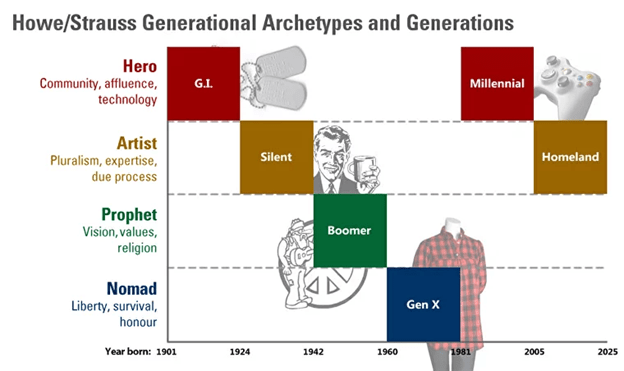
“The Fourth Turning” by William Strauss and Neil Howe articulates a generational theory of history. The authors posit that societies undergo recurring cycles, referred to as “turnings,” approximately every 80-100 years. These cycles consist of four distinct generational archetypes of the Prophet, the Nomad, the Hero, and the Artist. Each archetype plays a significant role in shaping and responding to historical events in predictable patterns.


The four turnings are:


The High – A period of societal rebuilding after a crisis, characterized by strong institutions, collective unity, and optimism (e.g., post-WWII boom in the U.S.).


The Awakening – A cultural period where individuals challenge established norms, emphasizing personal and spiritual values over conformity (e.g., the 1960s counterculture movement).

The Unraveling – Institutions weaken, individualism increases, and trust in government and societal structures declines (e.g., 1980s-2000s in the U.S.).


The Crisis (Fourth Turning) – Significant upheaval, such as war, economic downturns, or revolution, that forces society to reconstruct itself (e.g., the Great Depression and WWII).


According to their theory, the U.S. is currently in a Fourth Turning (beginning around 2008), indicating we’re in a period of crisis and transformation that will likely peak in the 2020s before leading into a new High. William Strauss and Neil Howe’s generational theory primarily focuses on Western historical cycles. They did not explicitly incorporate Eastern philosophies like Taoism or the Wu Xing (Five Elements) into their framework. Their analysis centers on patterns observed in Anglo-American history, detailing a recurring cycle of four generational archetypes where the Prophet, Nomad, Hero, and Artist, each influence societal moods and events over approximately 80-100 years.,


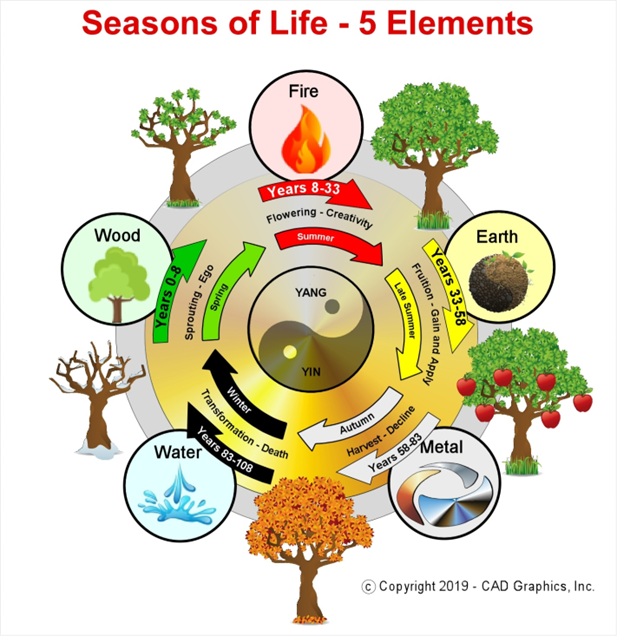
The Wu Xing in Taoist philosophy describes five interrelated elements of Wood, Fire, Earth, Metal, and Water, each associated with specific seasons, times of day, and life phases. This system emphasizes balance and the dynamic interactions between elements, reflecting the cyclical nature of the universe.


While both frameworks recognize cyclical patterns, their foundations differ: the Wu Xing is rooted in natural elements and their interactions, whereas the Strauss-Howe theory is based on generational dynamics and historical events. There isn’t direct evidence that Strauss and Howe studied or integrated Eastern philosophies into their work.


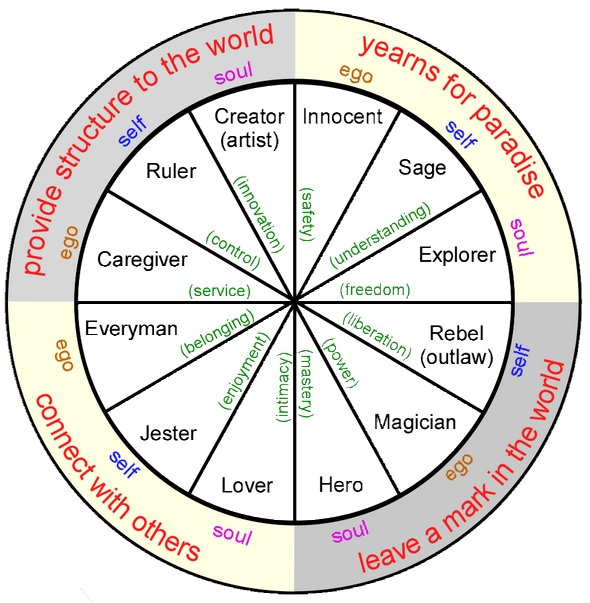
Carl Jung, a Swiss psychiatrist and psychoanalyst, introduced the idea of psychological archetypes and was significantly influenced by his study of Eastern philosophies. Jung’s incorporation of concepts from Taoism, Buddhism, and other Eastern traditions into his work on the collective unconscious and archetypes predated the Strauss-Howe generational theory by decades. While Strauss and Howe developed their own unique framework focused on historical and generational patterns, the notion of archetypes they used resonates with the broader tradition of exploring recurring patterns in human behavior and culture.

Carl Yung’s Archetypes


However, the concept of cyclical patterns is present in many cultural philosophies, suggesting a universal human inclination to find order and predictability in history and nature. While the specifics of the cycles differ between the Wu Xing and the Strauss-Howe generational theory, both offer perspectives on understanding the rhythms and transformations inherent in societies.

“Hard times create strong men. Strong men create good times. Good times create weak men. And, weak men create hard times.”

― G. Michael Hopf, Those Who Remain


Universal Cycles of Transformation


Each framework describes a repeating sequence of phases, with distinct yet interrelated roles:


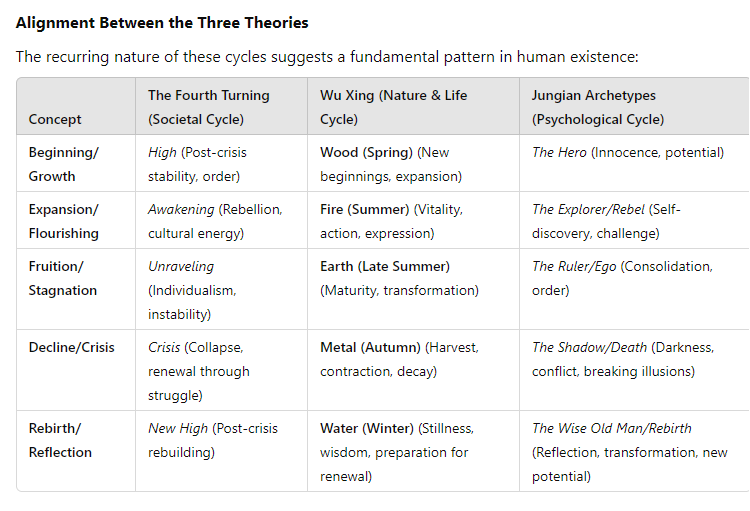
Strauss & Howe’s Fourth Turning follows a four-phase generational cycle (~80-100 years), where societal moods shift from stability (High) to questioning (Awakening), fragmentation (Unraveling), and renewal through crisis (Crisis).


Wu Xing (Five Elements) describes a five-phase natural cycle (Wood, Fire, Earth, Metal, Water), applied to time, seasons, and human life. Taoism sees a person’s lifespan in ~25-year segments:

0-8 (Spring) – sprouting of one’s identity

8-33 (Summer) – flowering of one’s vitality

33-58 (Late Summer) – fruition of what has been achieved

58-83 (Autumn) – cutting away what is not needed

83-108 (Winter) – transformation and rebirth

All phases closely mirror The Fourth Turning’s phases.


Jungian Archetypes reflect psychological transformations across an individual’s life and history. His concepts of Hero, Wise Old Man, Shadow, and Rebirth mirror the rise, crisis, and renewal patterns seen in the other two theories. Jung, influenced by Taoism and the I Ching, recognized life as a process of individuation—balancing opposing forces (Yin-Yang, conscious-unconscious), much like the generational and elemental cycles.


Key Takeaways:


Generational, Natural, and Psychological Patterns Are Interwoven
Each theory observes cyclical phases that repeat over time, whether in history (Fourth Turning), nature (Wu Xing), or the psyche (Jungian archetypes).
 
Crisis and renewal are fundamental to change, whether societal, elemental, or personal.
 
Strauss & Howe’s Generational Theory May Unconsciously Reflect Jungian Archetypes
The Fourth Turning’s generational archetypes (Prophet, Nomad, Hero, Artist) resemble Jung’s archetypal roles.
 
Jung, who studied Taoism and Eastern philosophy, recognized cycles of transformation, much like Wu Xing’s elemental shifts.
  
Taoism’s Wu Xing and Jung’s Individuation Both Emphasize Balance
Wu Xing describes the dynamic interplay of elements, where excess in one leads to transformation into another.
 
Jung’s individuation process requires integrating all aspects of the psyche, much like how Taoist balance ensures harmony.
 
 Crisis is a Necessary Stage for Renewal
Fourth Turning: Each crisis (e.g., WWII) paves the way for societal rebirth.
 
Wu Xing: Death and decay (Metal & Water) are necessary before new life (Wood).
 
Jung: Transformation only occurs when the individual faces their Shadow and integrates unconscious aspects.
Though emerging from different traditions, these three theories reveal a shared truth: transformation occurs through cyclical forces, shaping societies, nature, and individuals alike. Whether through generational change, elemental shifts, or psychological evolution, the rhythm of crisis and renewal is an eternal pattern in human experience.

 
References:
Generations X и Y: Crux, Characteristics, Application of a Theory in Recruiting. (2023). https://itluckyhunter.com/blog/generations-theory
 

I teach and offer lectures about holistic health, physical fitness, stress management, human behavior, meditation, phytotherapy (herbs), music for healing, self-massage (acupressure), Daoyin (yoga), qigong, tai chi, and baguazhang.

Please contact me if you, your business, organization, or group, might be interested in hosting me to speak on a wide spectrum of topics relative to better health, fitness, and well-being.

I look forward to further sharing more of my message by partnering with hospitals, wellness centers, VA centers, schools on all levels, businesses, and individuals who see the value in building a stronger nation through building a healthier population.

I also have hundreds of FREE education video classes, lectures, and seminars available on my YouTube channel at:

https://www.youtube.com/c/MindandBodyExercises

Many of my publications can be found on Amazon at:

http://www.Amazon.com/author/jimmoltzan

My holistic health blog is available at:

https://mindandbodyexercises.wordpress.com/

http://www.MindAndBodyExercises.com

Mind and Body Exercises on Google: https://posts.gle/aD47Qo

Jim Moltzan

407-234-0119
Wind and Water, Makes Fire

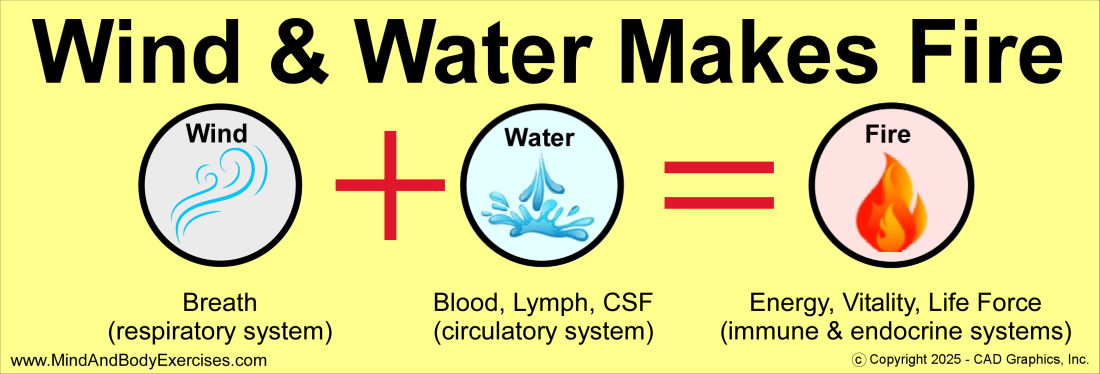
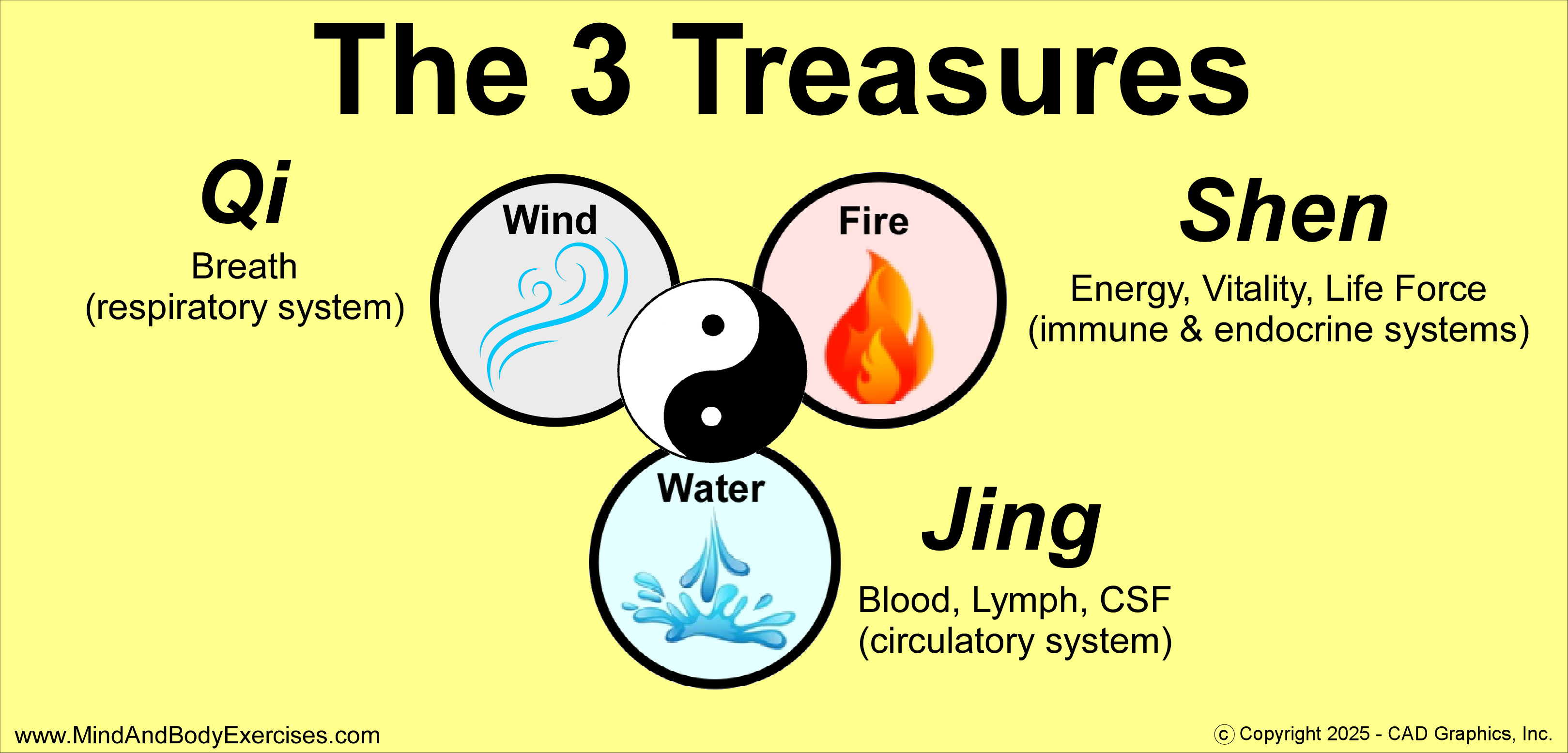
The human mind and body are integral parts of nature, constantly interacting with its energies. There is a direct correlation between the systems of nature and those of the body, with three key elements of wind, fire, and water, serving as points of connection.

  • Wind corresponds to the respiratory system, as the air we breathe sustains life.
  • Fire represents body temperature, which plays a vital role in all physiological functions.
  • Water relates to the circulatory system, essential for vitality and well-being.

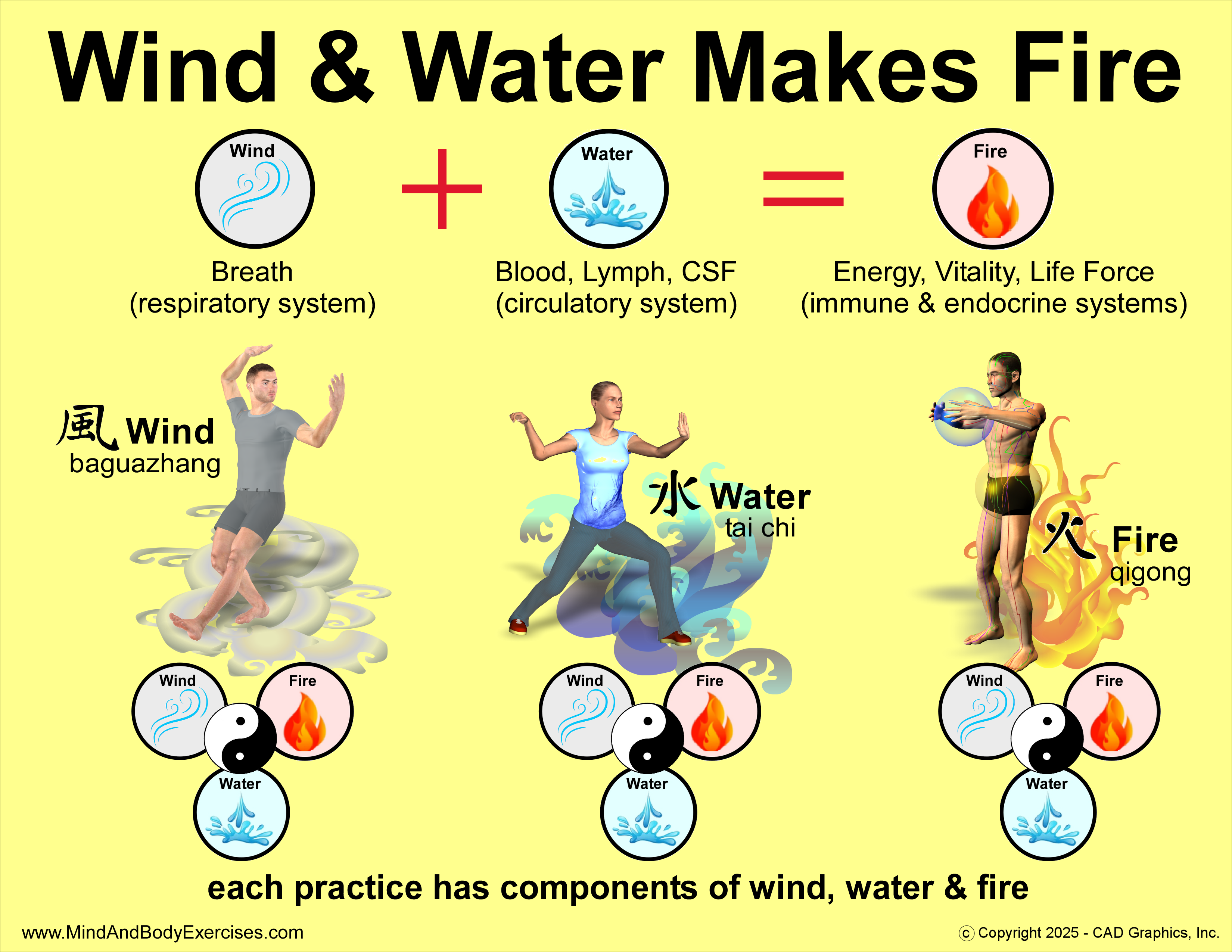
Practices such as Tai Chi, Qigong, and Bagua Zhang profoundly influence the body, impacting the organs, joints, and muscles at a deep level. In Taoist alchemy, the philosophical phrase “wind and water make fire” metaphorically represents the dynamic interactions of the Five Elements (Wu Xing) and the internal processes of self-cultivation.

Here’s a breakdown of how this concept fits into Taoist thought:

  1. Five Elements Correspondence:
    • Wind (Feng, 风) is often associated with Wood (Mu, 木), which represents growth, movement, and expansion.
    • Water (Shui, 水) corresponds to the Kidneys and the essence (Jing), which serves as the foundation for transformation.
    • Fire (Huo, 火) corresponds to Yang energy, warmth, and spirit (Shen).
    • The idea is that the interaction of movement (Wind/Wood) and nourishment (Water) can generate Fire (Yang energy, transformation).
  2. Neidan (Internal Alchemy) Interpretation:
    • Wind (Wood) and Water represent Qi and Jing, respectively.
    • Their controlled interaction through breathwork, meditation, and energy circulation can generate the internal “alchemy fire” needed to refine essence into Qi and Qi into Shen.
    • This fire is not literal but the internal warmth and energetic transformation that happens in deep meditation or Qigong.
  3. Martial & Qigong Perspective:
    • In advanced Qigong and martial arts, regulated breath (Wind) and internal fluid movement (Water) manifest into internal heat (Fire), leading to refined power and vitality.
    • This aligns with practices of Tai Chi, Qigong and BaguaZhang, where breath, body movement, and mind-intent cultivate the internal fire for vitality and martial efficiency.

I teach and offer lectures about holistic health, physical fitness, stress management, human behavior, meditation, phytotherapy (herbs), music for healing, self-massage (acupressure), Daoyin (yoga), qigong, tai chi, and baguazhang.

Please contact me if you, your business, organization, or group, might be interested in hosting me to speak on a wide spectrum of topics relative to better health, fitness, and well-being.

I look forward to further sharing more of my message by partnering with hospitals, wellness centers, VA centers, schools on all levels, businesses, and individuals who see the value in building a stronger nation through building a healthier population.

I also have hundreds of FREE education video classes, lectures, and seminars available on my YouTube channel at:

https://www.youtube.com/c/MindandBodyExercises

Many of my publications can be found on Amazon at:

http://www.Amazon.com/author/jimmoltzan

My holistic health blog is available at:

https://mindandbodyexercises.wordpress.com/

http://www.MindAndBodyExercises.com

Mind and Body Exercises on Google: https://posts.gle/aD47Qo

Jim Moltzan

407-234-0119