24 Yang Style Tai Chi

section1

What are “forms” or “sets” of Tai Chi Exercises?
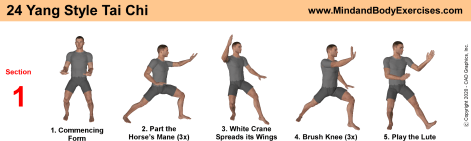
Tai Chi is a powerful art of immense depth consisting of exercise, self-defense and philosophy. The “sets” or “forms” are the structure or the foundation. Forms are individual exercises linked together to form a long flowing series of movements. According to Yang Chan Fu (who is known as the modern father of Tai Chi) “to start learning Tai Chi you have to start with the forms”. There are many styles of Tai Chi, and within each style, each has its different Forms. Even with one well-known form, there are many versions. Students might feel confused facing so many options, or one could take it as an advantage to have so many choices available.

section2

It is helpful and interesting to understand the structure and background history of the forms. Similar to an artist playing a musical composition, it is possible to play music well. To play it as a piece of art, it becomes necessary to understand the inner meaning, intention and structure of the piece.

section3

The Origin of the 24 Forms
The Chinese National Sports Committee authorized the country’s four most renowned Tai Chi experts to compose the 24 Forms in order to popularize Tai Chi; . Based on the Yang style, and by eliminating many repetitions and retaining the essential principles of Tai Chi, the 88 Forms was condensed to only 24 Forms. The 24 Forms is easier to learn, remember and practice taking about five minutes to practice. Anyone can do four times through the form in about 20 minutes. The 24 Forms has become the most popular tai chi form in the world.
section4

The Structure of the 24 Forms
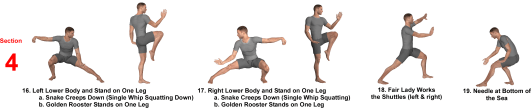
The 24 Forms is divided into five sections. The first section consists of moderate stretching of the upper and lower limbs, which works as warming up for the later exercises. The second section is more challenging with further stretching and turning of the body. The third section contains the most challenging parts with balance exercise and a few kicking movements. The fourth section contains the most technically difficult movements. Lastly, slower movements work as winding down exercises. The 24 Forms has incorporated the essential tai chi principles.

section5

Many Benefits of Tai Chi-2

Be well, stay healthy, be wise!

Jim Moltzan

www.MindAndBodyExercises.com

https://www.facebook.com/MindAndBodyExercises/

https://www.youtube.com/c/MindandBodyExercises

https://mindandbodyexercises.wordpress.com/

https://umareg.com/masters-council/

Deep Breathing Benefits

Breathing Deeper – more than just more oxygen

Learning how to regulate the breath is truly one of the key components to maintaining good health and well-being. Most people do not regulate their breath or even think about it, until a health issue presents itself.
Deep Breathing Benefits
Breathing shallow helps the body to produce cortisol and adrenaline.
Breathing deeper helps the body to produce dopamine, oxytocin, seratonin and endorphines.
Controlling how you breathe can affect your emotions.
Emotions cause the brain to adjust and affect the body’s blood chemistry.
The blood chemistry directly affects the internal organs and consequently all of the bodily systems and functions.

Moving Qigong (tae guk chung set #1)

How deep you breathe directly affects your health! And it is FREE, doesn’t require a prescription, no special clothes nor equipment. Just YOU making the effort to breathe slower and deeper.
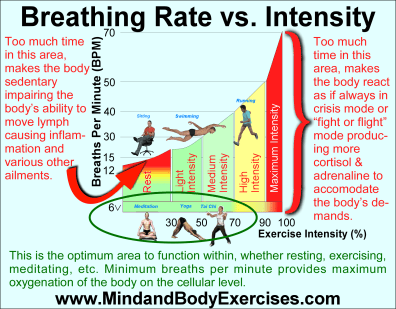
Breathing Rate vs Intensity
Breathing deep and slower is a key component to good health and longevity. We all have the ability to use the breath to take responsibility for OUR own healthcare. Desire and self-discipline are 2 more components that come into play.
The parasympathetic nervous system is activated when breaths per minute, are 10 or less. There are many ways to get to below 10 BPM, with tai chi, yoga and qigong among the most popular methods.
Be well and stay healthy!

Jim Moltzan

www.MindAndBodyExercises.com

https://www.facebook.com/MindAndBodyExercises/

https://www.youtube.com/c/MindandBodyExercises
https://mindandbodyexercises.wordpress.com/

The Cross Crawl Concept

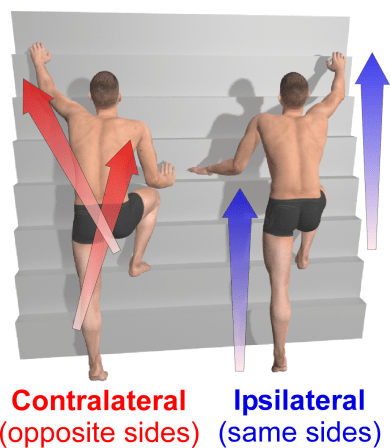
Opposition or contralateral, in regards to body movement or mechanics, means that opposite sides of the body work together to coordinate the right arm and left leg, and then the left arm and right leg. Ipsilateral refers to same side coordination.

stair climbing3

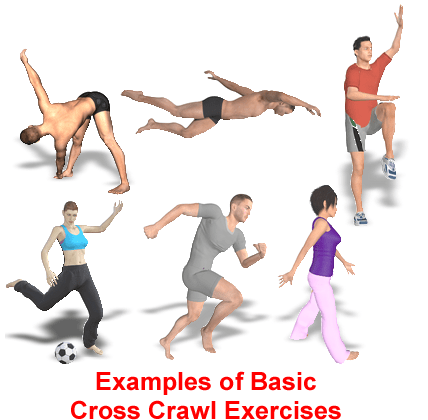
Cross crawl refers to movements in which we use opposition such as walking, climbing, crawling, walking, running, and swimming. These are intentional cross-lateral activities, which you cross the mid-line of the body. Touching the hand to the opposite knee or foot.

examples of cross crawl

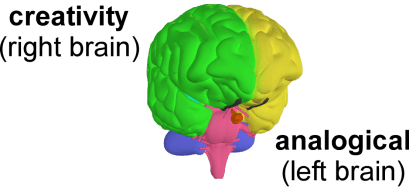
This type of movement builds the connection between the right and left hemispheres of the brain. This allows for the electrical impulses and information to pass freely between the two hemispheres. This is essential for physical coordination as well as cerebral activities, such as reading, listening, teaching or learning a skill, and hand-eye coordination.

brain2

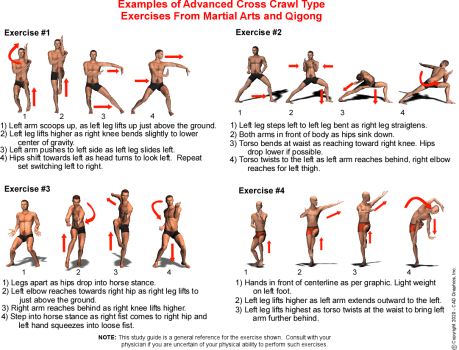
The cross crawl technique is an easy way to activate brain development and the nervous system. It gives motor and sensory stimuli needed to take control of bodily functions, thereby preventing or rehabilitating health problems. Exercises from martial arts such as Tai Chi (kung fu), qigong and yoga focus greatly on contralateral and ipsilateral movements throughout their curriculum.

Advanced examples

Exercise methods like these have been known for centuries, but are considered new or “alternative” to modern western culture.
Learn how this all works from private, small or group instruction.
Be well!


Taoist Yoga – Dao Yi – Ship Pal Gye – Noble Stances

Cutouts of 8 Vessels-DaoYi-Noble Stances

So many ways to strengthen the whole body, with low-impact and safe exercises for the mind, body & spirit. No equipment, no mat, no special clothes, no excuses! Contact me to get moving.
Be well, stay healthy & be wise.
Jim Moltzan