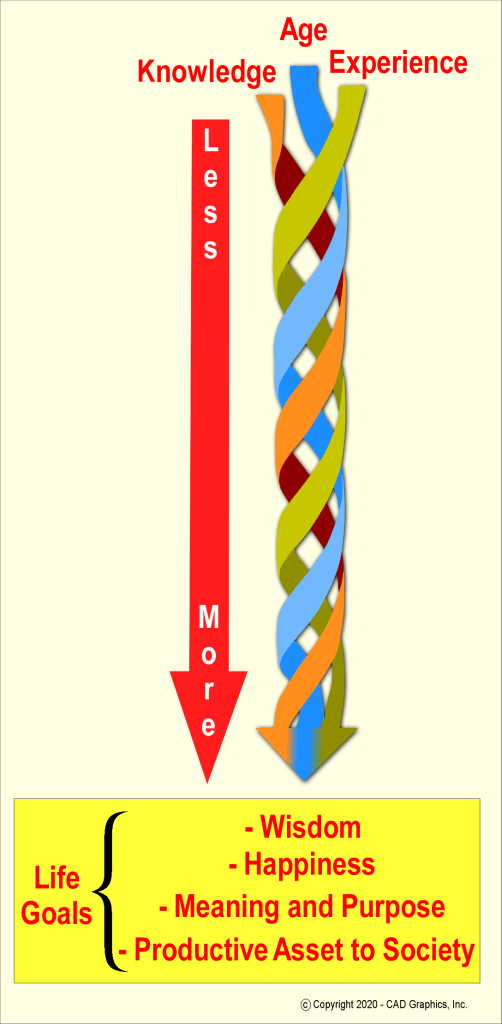
For example, in the US an individual needs to go through the school system at least until 16 years old, before they can starting working to earn an income. Then one can possibly move on to trade school, college, the military or other further education to elevate their knowledge base to their next level. Or not! Some people enter into the work force, take care of family or friends, or move onto other modes of becoming what is considered a successful life. With age, knowledge and life experience, I have found that all roads basically lead to the same goals of:
Pursuing health and happiness
Living with meaning and purpose
Becoming an asset to society
Acquiring wisdom throughout one’s life
Unless someone is independently wealthy and have innate knowledge of how to manage their resources, they need to have some plan to gain the knowledge in order to achieve the above facets of life.
Review the following graphics to see a logical progression of achieving a well earned life. Learn before earn. Never stop learning; never stop earning. Invest in yourself.
Be well, stay healthy, be wise.
I can help. I have almost 40 years worth of experience in practicing and teaching others to take control of their health and well-being. Wellness lectures, classes, study guides & booklets.For more information, contact Jim Moltzan at 407-234-0119 or www.MindAndBodyExercises.com
Can you easily stand on one leg? Why would you even care to do this?
If you can easily stand and balance on one leg for more than a few seconds, chances are you can balance even better on two legs where you spend time standing, walking, running, etc. From my research, most people do not exercise or train themselves to improve or maintain balance until an event presents itself of where the individual loses their physical balance, stumbles, and/or falls and becomes injured. Then the search begins for them to find ways to improve their balance: physical therapy, medications or even refraining from activities that are now hazardous to the individual. The following is information I have gained from my own practicing and studying of martial arts and wellness methods spanning almost 40 years. Hopefully this will put readers on a path to achieving and maintaining better balance.
The human body contains many examples of balance. We have exterior symmetry in having 2 arms, 2 legs, 2 eyes, etc. We have interior symmetry within our bodies in the way of the muscular and skeletal systems being mostly equal from left to right sides. The external body protects the internal organs, while the organs provide for the exterior. The mind governs the body while the body protects the mind. Vestibular balance is what most people think of as our spatial positioning and equilibrium in relation to standing, walking and general movement.
Let’s go into some basic anatomy and physiology relative to what allows the human body to not fall over with every movement we may execute.
Body Components Connected to Balance
Brain – the brain processes the signals from the eyes, inner ear and the sensory systems (skin, joints, muscles, nerves) of the human body.
Eyes – the eyes relate information to the brain such as spatial orientation and environmental conditions.
Inner Ear – the inner ear and the Vestibular system, regulates equilibrium while providing directional information to the brain to process.
Sensory Receptors -nerves in the joints called proprioceptors, sense vibrations that flow through joints, muscles and skin sending the information to the brain to process.
SkeletalMuscles – the muscular system provides strength and stability to the skeletal systems, while maintaining flexibility in movement.
Joints – healthy joints help form a strong foundation for the body to navigate daily activities. Vibrations in movement are transferred through the bones and muscles to the brain to process.
Factors in Maintaining Balance
Awareness – understanding where ones center of gravity sits, greatly helps to become more sensitive to correct body positioning. Also, being more observant of environmental changes such as lighting, weather, terrain, etc. can prevent loss of balance.
Focus – keeping the eyes steady, helps keep the mind focused to be able to better control the bodies fine tuning of muscle control and body positioning leading to better balance.
Muscular Strength – maintaining muscle tone contributes to having stability whether the body is in motion or stationary.
Range of Motion (flexibility) – when the limbs, muscles and joints are free to move, it is much easier to adjust ones center of gravity to a more balanced position.
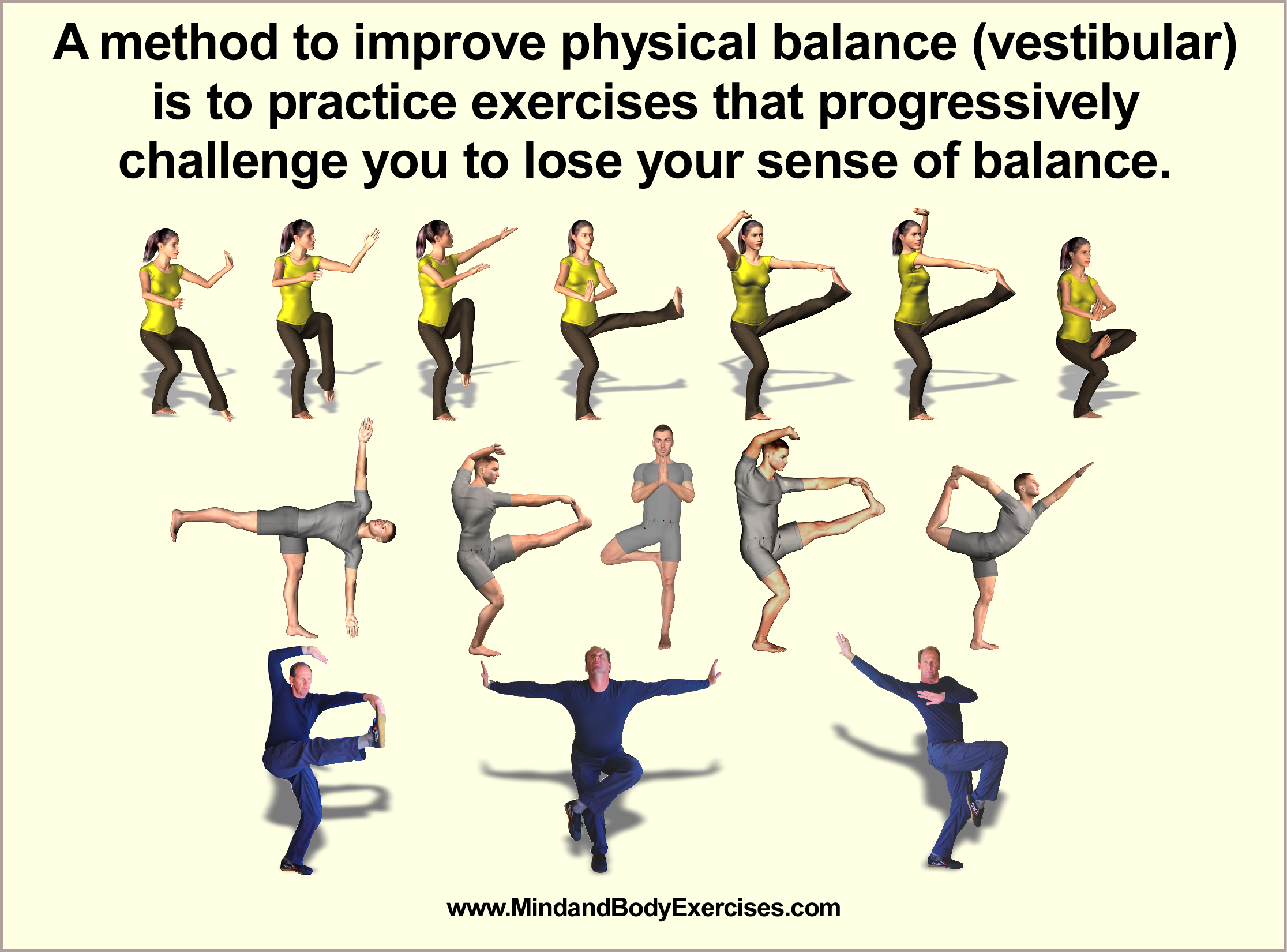
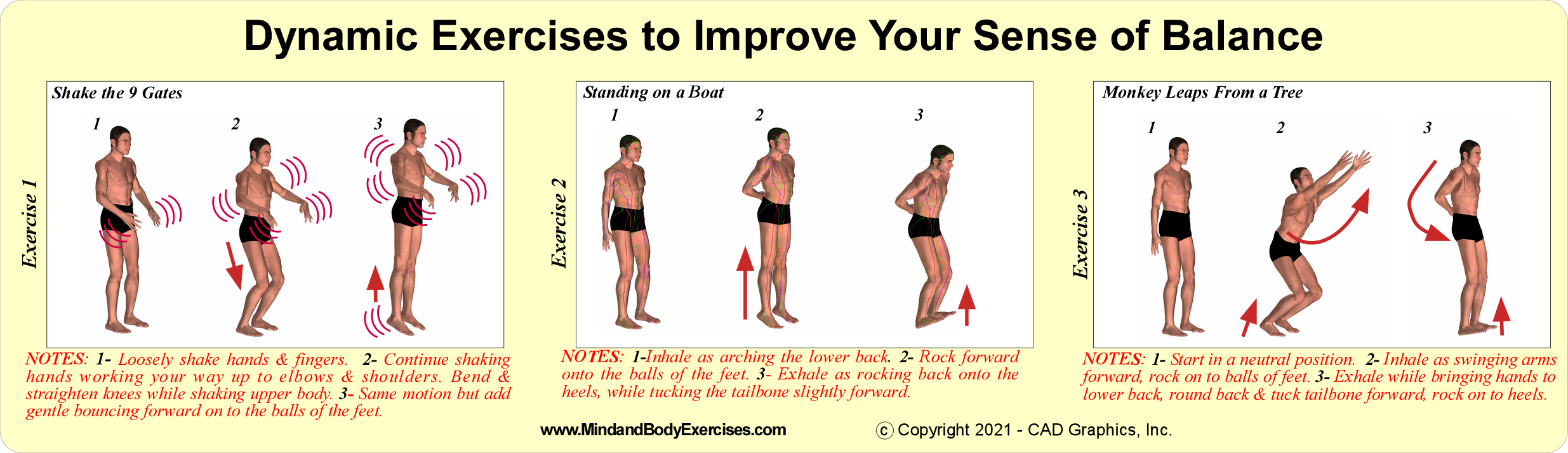
I have found and studied 2 types of balance exercises, being dynamic and static.
Dynamic Balance – maintaining stability with ones center of gravity situated outside an axis of vertical rotation, with body movement or the body in motion.
Static Balance – maintaining stability with ones center of gravity situated on an axis of vertical rotation, with little or no body movement.
Be well, stay healthy, be wise.
I can help. I have almost 40 years worth of experience in practicing and teaching others to take control of their health and well-being.
Wellness lectures, classes, study guides & booklets.For more information, contact Jim Moltzan at 407-234-0119 or www.MindAndBodyExercises.com
We really need to move beyond the thought that we can eat whatever the heck we care to, with no consequences. US Obesity is at 42% compared to 10% in 1960. What will the rate be in 2030, 50%? 100%?
What is the magic number that will wake us up that our diet, our sedentary lifestyle, our stress, our perspectives – are exactly what makes us healthy or sick?
Be well, stay healthy, be wise.
I can help. I have almost 40 years worth of experience in practicing and teaching others to take control of their health and well-being. Wellness lectures, classes, study guides & booklets.
We often talk about how important our mind, body, spirit, relationships, etc. are the most important things in our lives. How much time and effort do we actually put towards maintaining and improving these facets of our life?
Be well, stay healthy, be wise.
I can help. I have almost 40 years worth of experience in practicing and teaching others to take control of their health and well-being. Wellness lectures, classes, study guides & booklets.
We have an inner mental dialogue going on inside our head that mostly never stops. Often referred to as self-talk, inner chatter and inner speech. The next time you have a disturbing thought or emotion, remember that it does not define or control you. After all, you are not your thoughts but rather the observer to your thoughts. You can actively choose whether to participate in it or not.
Whatever thoughts or feelings that happen to present themselves in your head at any given moment do not define or control you. You are not angry, but rather can experience anger. We are not happy nor angry human beings but rather can choose to be happy, angry or whatever emotional state we care to experience at any given time. However, managing or controlling thoughts and consequently emotions is for most people, not an easy task to achieve.
Thoughts Affect Your Emotions
Every thought, has an emotional attachment on some level. Positive emotions keep organs in balance for optimal performance. Negative emotions disrupt this balance leading to other symptoms and ailments.
Emotions affect the endocrine system (body chemistry)
The body chemistry affects hormones (growth & stress)
Growth or stress hormones affects bodily functions of the physical health
Physical health affects your thoughts – completing the circuit, brings us back full circle
What You Think Affects Your Outlook If your thoughts have a mostly positive emotional attachment on some level, you may have more of an optimistic outlook in your life. Conversely, mostly negative emotions tend to make people have a somewhat pessimistic outlook in their life.
Traditional Chinese Medicine recognizes that there is a direct link from our emotions to the health of our internal organs and their functions.
Tai chi, yoga, martial arts, meditation and other time-proven methods are known practices to help manage and control the inner dialogue.
A recent article form the Wall Street Journal explains more about managing the inner chatter.
As we all continue to age, we need to decide how much time and effort we choose to put towards our health and well being. Weekly hours of time pursuing a healthy lifestyle can prevent potential hours at the doctor’s office or days in the hospital.
Be well, stay healthy, be wise.
I can help. I have almost 40 years worth of experience in practicing and teaching others to take control of their health and well-being. Wellness lectures, classes, study guides & booklets.







 United Martial Arts Association