Despite living in an age of advanced medicine and rising health awareness, chronic illness, emotional suffering, and addiction continue to rise. This contradiction invites us to question not just our treatments but also the mindset and motivations behind them. Increasingly, research and lived experience point to unprocessed pain and trauma as the core drivers of both psychological and physiological illness.
Medicine’s Narrow Focus: Suppressing Symptoms Instead of Healing
Contemporary medical practices often focus on symptom suppression rather than root-cause healing. For example, elevated cortisol, a hormone associated with stress, is frequently managed with pharmaceuticals that reduce inflammation but fail to address the underlying source of distress (Sapolsky, 2004). In cases of chronic illness, especially cancer, mainstream interventions often fall back on drastic methods: cutting (surgery), poisoning (chemotherapy), or burning (radiation), with minimal inquiry into psychosomatic or emotional contributors.
The pharmaceutical industry has also come under scrutiny for prioritizing profit-driven solutions that treat stress biochemically without offering tools for actual emotional or relational healing (Gabor Maté, 2010).
A Society Obsessed with Health Yet Unwell
We live in a paradoxical society: obsessed with fitness, diet, and health optimization, yet disconnected from authentic well-being. Emotional pain is frequently seen as a personal failure, and expressions of vulnerability are often equated with weakness. Shame becomes a hidden driver of behavior, shaping identity through internalized messages like “I’m not enough” or “My needs don’t matter” (Brown, 2012).
The metaphor of the “monster” within, like the transformation of Bruce Banner into the Hulk, illustrates how repressed emotions can erupt when unacknowledged. We often assume that other people’s issues are about us, leading to further internal conflict and disconnection.
Trauma: The Root Cause of Addiction and Illness
Pain, especially unresolved emotional pain, is at the root of many afflictions. According to trauma expert Gabor Maté (2008), addiction is not a disease or choice but a response to deep suffering. Whether through substances, work, food, or achievement, people are often trying to soothe pain they may not even fully understand.
Social disconnection, abandonment, and lack of emotional education perpetuate trauma across generations. Society offers little support or guidance for managing grief, shame, or stress. Many turn to coping mechanisms without the tools to process their trauma, which is especially evident in marginalized communities where chronic stress is linked to disproportionately higher rates of illness (Williams & Mohammed, 2009).
The Cost of Disconnection and the Need for Authenticity
In professional fields like medicine, unresolved trauma is common. Some individuals pursue high-achieving careers not from passion but to compensate for feelings of inadequacy or unlovability. Emotional detachment, often a survival strategy in childhood, becomes normalized in adulthood. This disconnection between mind and body leads to chronic stress, illness, and burnout (Van der Kolk, 2014).
Authentic healing requires honoring two essential human needs: attachment and authenticity. When these needs are in conflict, as they often are in trauma survivors, authenticity is usually sacrificed for the sake of relational survival. Reconnecting with one’s truth, expressing anger constructively, and embracing emotional honesty are key steps toward transformation.
Healing the Generational Wounds
Trauma doesn’t disappear. It is often passed from one generation to the next, not just through genetics but through behavior, belief systems, and emotional suppression. Children absorb the stress of their caregivers. Without awareness and intervention, these patterns replicate over time (Yehuda & Lehrner, 2018).
What may appear as weakness, in hypervigilance, dissociation, emotional volatility, is often a response to longstanding unmet needs. Healing begins by naming these patterns and allowing space for expression and integration.
A Shift Toward Integration and Compassion
The healing path is not just clinical, it is relational, emotional, and spiritual. Psychedelic-assisted therapy, somatic practices, plant medicines like ayahuasca, and trauma-informed psychotherapy are gaining traction because they center empathy, connection, and emotional truth (Carhart-Harris & Goodwin, 2017).
As we reevaluate addiction, trauma, and illness through this lens, we begin to see that these challenges are not signs of brokenness. Rather, they are indicators of what needs acknowledgment, healing, and reintegration. Addiction, far from being a moral failure or inherited defect, can be seen as a solution to an emotional problem, a cry for help that must be understood before it can be addressed.
Carhart-Harris, R. L., & Goodwin, G. M. (2017). The therapeutic potential of psychedelic drugs: Past, present, and future. Neuropsychopharmacology, 42(11), 2105–2113. https://doi.org/10.1038/npp.2017.84
Williams, D. R., & Mohammed, S. A. (2009). Discrimination and racial disparities in health: Evidence and needed research. Journal of Behavioral Medicine, 32(1), 20–47. https://doi.org/10.1007/s10865-008-9185-0
Yehuda, R., & Lehrner, A. (2018). Intergenerational transmission of trauma effects: Putative role of epigenetic mechanisms. World Psychiatry, 17(3), 243–257. https://doi.org/10.1002/wps.20568
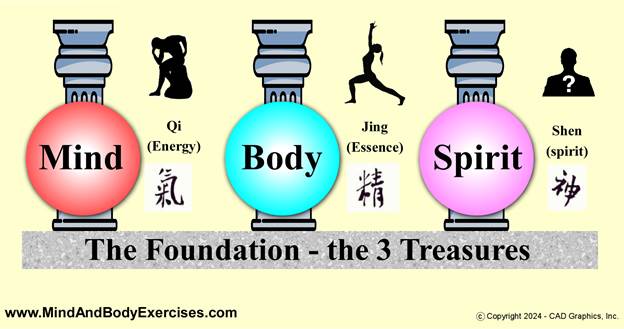
Nei Dan(nae gong, neigong) often translated as “Inner Alchemy,” is one of the most profound and esoteric branches of Daoist cultivation and traditional martial arts training. Unlike Wai Dan (or Wei Dan), or “external alchemy,” which historically referred to concocting elixirs from minerals and herbs, Nei Dan is an internal process of refining and transforming the body’s vital energies (jing, qi, and shen) into higher states of vitality, consciousness, and spiritual realization. This internal alchemical process forms the energetic and philosophical foundation of many advanced martial, meditative, and spiritual practices across Daoist, Chan Buddhist, and certain Confucian lineages.
Historical Origins and Evolution
Daoist Roots (circa 3rd–8th century CE): Nei Dan emerged from early Daoist cosmology and longevity practices (yangsheng), evolving alongside classical texts such as the Dao De Jing, Zhuangzi, and later the Cantong Qi, (The Seal of the Unity of the Three), often considered the foundational text of internal alchemy (Pregadio, 2019). Early Daoist alchemists saw the human body as a microcosm of the cosmos, mirroring the same dynamic interplay of yin and yang, five elements (wuxing), and celestial cycles. The goal was to harmonize and refine these internal forces to return the practitioner to their original, undifferentiated state (yuan jing, yuan qi, yuan shen).
Tang–Song Dynasty Expansion (7th–13th century): During the Tang and Song dynasties, Nei Dan was codified into systematic schools such as the Zhong-Lü and Nanzong lineages. These schools emphasized an internal “elixir” (neidan dan) formed through disciplined meditation, breath regulation, and energetic circulation, paralleling the external alchemical metaphor of refining base metals into gold. At this time, martial traditions, especially those influenced by Daoism and Chan Buddhism (e.g., Shaolin and Wudang), began incorporating these principles into their training as a means of enhancing internal power (nei jin), awareness, and longevity.
Integration into Martial Arts (Ming–Qing era onward): By the late imperial era, Nei Dan principles had become inseparable from Nei Jia Quan (“internal martial arts”) and most notably Taijiquan, Xingyiquan, and Baguazhang. These arts used the body as a vessel for alchemical transformation, with martial techniques functioning as vehicles for energetic refinement and spiritual cultivation. Masters such as Zhang Sanfeng (legendary founder of Taijiquan) and Dong Haichuan (founder of Baguazhang) are often described in Daoist alchemical terms, emphasizing internal stillness, energy transformation, and the unity of movement and spirit.
Core Principles and Goals of Nei Dan
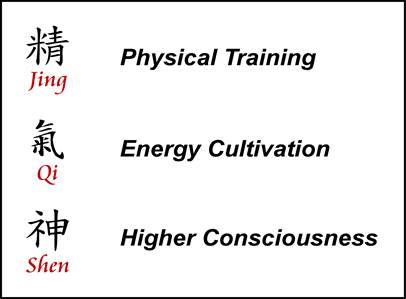
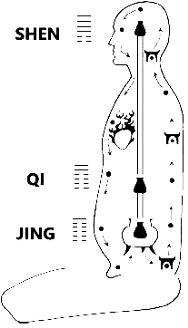
At its essence, Nei Dan is a lifelong path of internal transformation. The traditional Daoist saying — “Refine jing into qi, refine qi into shen, refine shen and return to emptiness” outlines the three fundamental stages:
Refining Jing:
Jing refers to “essence” – the foundational life force associated with physical vitality, sexual energy, and genetic potential.
Practices in this stage focus on conserving and strengthening jing through lifestyle discipline, breath regulation, and daoyin exercises. This builds the “alchemical furnace” in the lower dantian, or the body’s energetic cauldron.
Transforming Qi:
Once jing is stabilized, it is “cooked” into qi, which is the vital energy that flows through the body’s meridians.
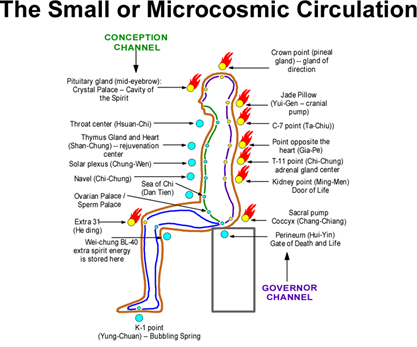
Breathwork (tu-na), microcosmic orbit circulation (xiao zhoutian), and standing post practices (zhan zhuang) are common methods. Martial expressions of this phase include issuing power (fa jin) and unifying breath with intent (yi qi heyi).
Refining Shen:
Shen, or “spirit,” is consciousness itself. At this level, practice aims at expanding awareness, cultivating emptiness (xu), and returning to the primordial source (dao).
Deep meditation, visualization, and contemplative stillness are central practices, often accompanied by subtle internal energetic processes described metaphorically as “the embryo of immortality” (shen ying).
Practices and Methods Involved
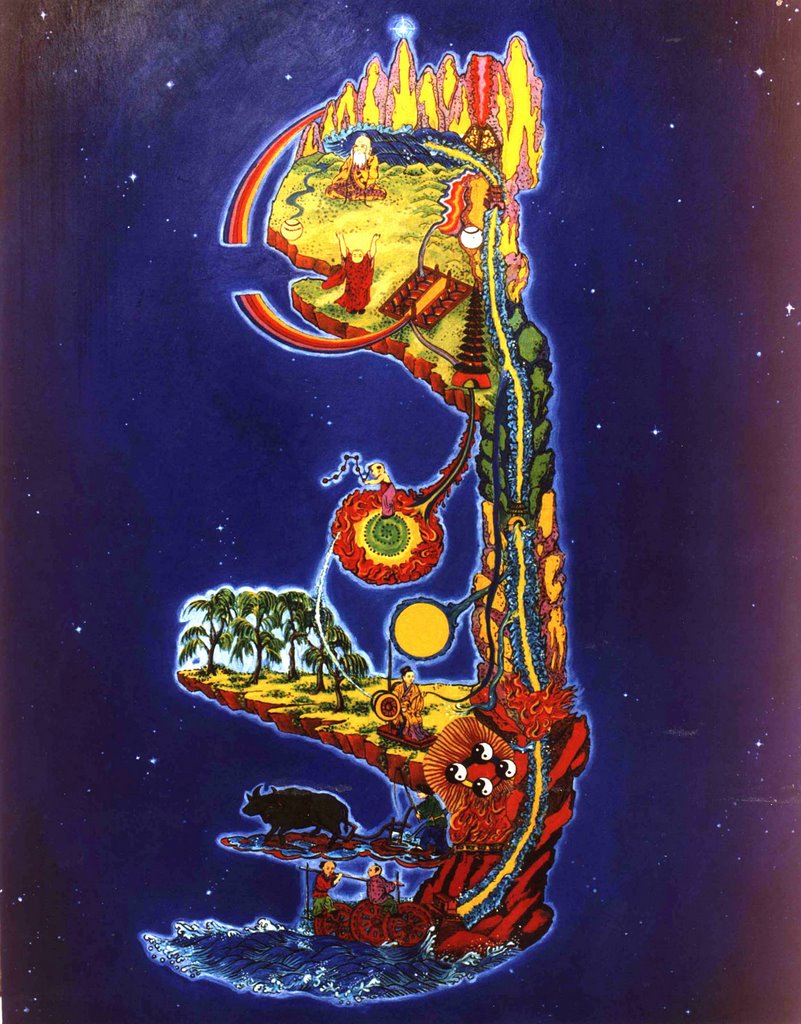
– Breath and Energy Regulation (Tiao Qi): Controlled breathing (tu-na) is fundamental, teaching practitioners to guide qi consciously through the meridians. The microcosmic orbit (circulating qi along the du and ren vessels) is one of the most well-known techniques.
– Posture and Structure (Tiao Shen): Postural alignment, rooted stance work (zhan zhuang), and slow, continuous movement (e.g., Taiji or daoyin) build the vessel for qi cultivation. Internal martial arts often hide alchemical work within physical movement.
– Mental Focus and Intention (Tiao Xin): Training the mind (yi) to direct energy (qi) is central. Practitioners cultivate stillness (jing), intention (yi), and awareness (shen ming), often through visualization of internal alchemical processes.
– Sexual Alchemy (Fangzhong Shu): Though often misrepresented, sexual alchemy is a legitimate component in many Nei Dan systems. It involves the conservation and refinement of sexual energy (jing), transforming it into spiritual power rather than expending it.
– Meditative and Cosmological Practices: Advanced practitioners engage in meditations synchronizing their internal rhythms with cosmic cycles (e.g., lunar, solar, and seasonal changes) reflecting the Daoist belief in harmonizing microcosm and macrocosm.
4. Nei Dan in Esoteric Martial Arts
In the context of esoteric martial arts, Nei Dan is not simply health practice, but rather it is a method of refining the warrior’s spirit. The martial applications go far beyond fighting techniques:
Enhanced Internal Power: Cultivation of nei jin allows practitioners to issue force with minimal muscular effort.
Heightened Awareness: Refining shen deepens perception, intuition, and responsiveness, essential traits in high-level combat.
Transformation of Self: Martial practice becomes a vehicle for self-mastery, transcending ego and aligning the individual with the Dao.
Some lineages, such as certain Wudang Daoist sects, Xingyi Nei Gong, or the “Eight Immortal Methods” of Baguazhang, embed Nei Dan principles so deeply that combat forms double as alchemical formulas, guiding practitioners through progressive energetic transformations.
5. Legacy and Contemporary Practice
Today, Nei Dan is studied worldwide, both as a martial discipline and a spiritual science. In modern qigong, taiji, and neigong schools, the terminology may vary — yet the underlying process remains unchanged: the transformation of the human being from a coarse, ordinary state to one of luminous awareness and harmonious unity with the Dao.
It is said in the Daoist classics:
“The elixir is not found in mountains or seas. It is found within one’s own body.”
This aphorism encapsulates the essence of Nei Dan: the human being is the laboratory, the mind is the alchemist, and the Dao is the final elixir.
Nei Dan – Three-Stage Map with Methods, Physiology/Energetics, Goals, and Applications
Stage / Term
Core Practice Methods
Physiological / Energetic Focus
Alchemical Goal / Transformation
Martial & Spiritual Applications
Zhújī / Lìdǐng – Laying the Foundation / Setting the Cauldron
“Leak-proof” vessel; clarity of intention; congruent life supports practice
Stable leadership presence; conflict de-escalation; trustworthy teacher-student field
Notes & mini-glossary (for manuscript margin or endnotes)
Sānbǎo: Jing–Qi–Shen — essence, energy, spirit.
Three Dantians: lower (vital/structural), middle (affective/relational), upper (cognitive/awareness).
Micro/Great orbits – conduction along Conception/Governing vessels (small), then through full channel network (great).
Huǒhòu: “Fire timing” — dosage, intensity, and pacing of practice.
Nèi jìn: Internal (elastic) power arising from whole-body integration and refined fascia/pressure dynamics.
Safety: Over-forcing breath, heat, or sexual practices can destabilize mood, sleep, or blood pressure; increase gradually, emphasize recovery.
References:
Despeux, C. (1990). Taoism and Self Cultivation: Transformation and Immortality. In L. Kohn & M. LaFargue (Eds.), Lao-tzu and the Tao-te-ching (pp. 39–52). SUNY Press.
Eskildsen, S. (2008). Daoist Body Cultivation: Traditional Models and Contemporary Practices – Edited by Livia Kohn. Religious Studies Review, 34(3), 230–231. https://doi.org/10.1111/j.1748-0922.2008.00306_4.x
Pregadio, F. (2019). The Seal of the Unity of the Three: A Study and Translation of the Cantong Qi, the Source of the Daoist Way of the Golden Elixir. Golden Elixir Press.
Robinet, I. (1993). Taoist Meditation: The Mao-shan Tradition of Great Purity. State University of New York Press.
Working, playing, living, and existing in a high-control environment, whether ideological, organizational, or social, is analogous to living within a bubble. The bubble becomes both a boundary and a lens: it filters what individuals perceive as reality, limiting awareness of the outside world while reinforcing the values, language, and narratives within. Over time, the self becomes entangled with the group identity, and what is seen through the bubble’s translucent membrane feels complete, even if it is only a fragment of reality.
This essay explores the mechanisms that create such a bubble, how it maintains psychological and social control, and why emerging from it is a gradual and deeply transformative process that can take years to complete, if at all.
Formation of the Bubble: Structure and Psychology
The “bubble” metaphor aptly describes the environment of high-control systems, whether religious, corporate, political, or familial. Sociologist Janja Lalich (2004) identified this as a “bounded choice” system or an environment where individuals feel they are exercising free will, yet their decisions are constrained by an intricate web of ideology, social pressure, and authority. The boundaries of the bubble are maintained through charismatic authority, a closed belief system, and control of behavior and information (Lalich, 2004).
People often join or remain within such systems because they fulfill psychological needs for certainty, belonging, and meaning (Manstead, 2018). According to social identity theory, group membership provides emotional security and self-esteem, particularly in times of uncertainty or perceived chaos (Hogg, 2014). Within the bubble, structure and purpose replace ambiguity, creating a sense of safety that paradoxically relies on conformity.
In practical terms, the bubble’s formation relies on several mechanisms:
Restricted external input – information from outside the group is censored or reframed to align with internal narratives (Bai et al., 2025).
Filtered internal discourse – members adopt specialized language and redefinitions that shape thought patterns.
Identity fusion – personal identity merges with the group, making independent thought feel like betrayal (Swann et al., 2012).
Dependence on internal validation -acceptance, approval, and purpose come exclusively from within the system.
Thus, the bubble becomes self-reinforcing: the more one participates, the stronger its walls become, and the more alien the outside world appears.
Dynamics Within the Bubble
Once established, the bubble governs perception, behavior, and emotion.
Cognitive and Perceptual Narrowing
Members of high-control systems experience epistemic closure, meaning alternative viewpoints are systematically excluded (Lalich, 2004). Research on “identity bubble reinforcement” confirms that repetitive exposure to uniform perspectives narrows the ability to evaluate or accept new information (Bai et al., 2025). The mind begins to interpret all experience through the group’s ideology, a phenomenon sometimes called cognitive confinement.
2. Behavioral Regulation
Rules, rituals, and social hierarchies become omnipresent. Even leisure and play serve the system’s goals. Studies of humans in isolated or closed environments such as military units or analog space missions show how confinement fosters conformity and peer surveillance while diminishing autonomy and spontaneity (Landon et al., 2024). Similarly, within social or ideological bubbles, behavior is subtly or overtly regulated by reward, shame, and collective pressure.
3. Emotional Conditioning and Identity Fusion
The bubble shapes emotional experience as well. Joy, guilt, pride, and fear become linked to compliance and performance. Identity fusion is a deep merging of personal and group identity that creates extreme loyalty and self-sacrifice (Swann et al., 2012). Members may feel love for their peers yet fear ostracism for deviation. Over time, the bubble is no longer just an environment, but rather it becomes a psychological home.
4. Living Entirely Inside the Bubble
When one’s workplace, social life, belief system, and home all exist within the same controlled sphere, the boundary between personal and institutional identity collapses. The person’s worldview becomes totalistic. Every event, thought, or external challenge is interpreted through the bubble’s lens, reducing the ability to recognize manipulation or control (Lalich, 2004). What lies beyond becomes shadowy, threatening, or meaningless.
Emerging from the Bubble: A Long-Term Process of Deconditioning
The Initial Awakening
Awakening begins when cognitive dissonance cracks the bubble, through a contradiction, a loss of trust, or an encounter with external perspectives. Yet recognition alone rarely results in immediate liberation. As Lalich (2004) notes, even when individuals want to leave, “the system of meaning remains deeply internalized.” Awareness of the bubble does not dissolve it overnight; it simply begins the process of slowly deflating its illusions.
2. De-identification and Cognitive Reconstruction
The journey out of the bubble is not instantaneous. It is rarely a matter of days, weeks, or even months, but rather a multi-year process of rebuilding perception and selfhood. Research on post-cult recovery and identity reconstruction shows that the internal belief structures and emotional dependencies cultivated within such systems can persist for years (Langone, 2017). The mind must unlearn distorted thinking, while the nervous system recalibrates to tolerate ambiguity, autonomy, and uncertainty.
In psychological terms, this is a deconditioning process, or a gradual dismantling of internalized norms, often accompanied by grief, anger, and disorientation (Lalich, 2004). Even when one consciously chooses to “step outside,” subconscious habits of thought and emotional triggers may continue to pull them back toward the familiar confines of the bubble.
3. Emotional Healing and Re-socialization
Leaving the bubble involves emotional recovery as much as cognitive change. Isolation, fear, and identity loss are common. Former members often report difficulty trusting others, setting boundaries, or believing in their own judgment (Langone, 2017). Longitudinal studies of people emerging from high-control settings, such as isolated work bubbles or pandemic quarantine environments, show increased depression and anxiety due to disrupted social rhythms and restricted autonomy (Ely, 2023). The process of re-socialization requires patience, self-compassion, and often therapeutic support.
4. Integration and Perspective
Much like a person standing too close to a tree, those living within the bubble cannot see the whole of what surrounds them. When one’s view is pressed against the trunk, the details of bark, leaves, and branches may be clear, yet the entirety of the tree in its height, shape, and place within the forest, remains unseen. Only by stepping back and gaining distance can the full form come into view. Similarly, only by separating from the bubble can individuals begin to perceive the true scope of their environment and the reality that extends beyond it.
True recovery occurs when one learns to live outside the bubble without recreating its patterns elsewhere. This means cultivating critical thinking, autonomy, and a tolerance for complexity. As Lalich (2004) emphasizes, liberation is not merely external but internal. Freedom is achieved when the bounded choice system no longer defines one’s reality.
The individual must relearn to see the world directly, rather than through the distortive lens of collective ideology. This reintegration phase may take years of ongoing reflection, self-education, and experiential contrast with broader society. It represents a journey toward authenticity, where perception aligns with lived experience rather than imposed belief.
Conclusion
Living within a high-control environment is akin to existing inside a sealed bubble that dictates one’s thoughts, behaviors, and emotional reality. The bubble offers structure, belonging, and certainty but at the cost of autonomy and authentic perception. To truly see beyond it requires more than desire. It demands time, courage, and sustained self-work.
Emerging from such confinement is a long-term metamorphosis, not a quick awakening. One must slowly deconstruct internalized narratives, rebuild personal agency, and re-establish connection with a broader, more ambiguous world. Only through this extended process can individuals reclaim their full humanity and rediscover life beyond the bubble’s transparent walls.
Appendix A
Key Psychological and Sociological Terms
Autonomy. The ability to think, decide, and act independently based on one’s own values and reasoning rather than imposed authority or group pressure (Manstead, 2018; Lalich, 2004).
Bounded Choice. A term introduced by Janja Lalich (2004) to describe a system in which individuals appear to exercise free will, but their decisions are constrained by the group’s ideology, social structure, and internalized control mechanisms (Lalich, 2004).
Cognitive Confinement (Epistemic Closure). A restriction of thought and perception in which alternative ideas are dismissed, and information is filtered through a rigid belief system, limiting one’s ability to view reality objectively (Bai et al., 2025; Lalich, 2004).
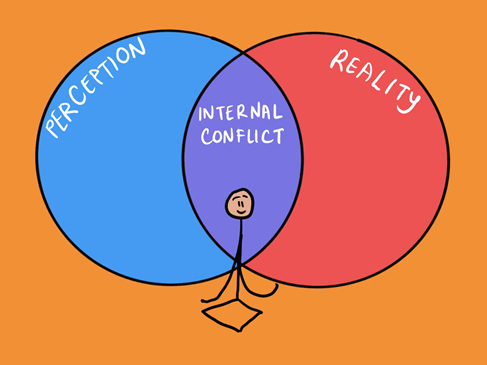
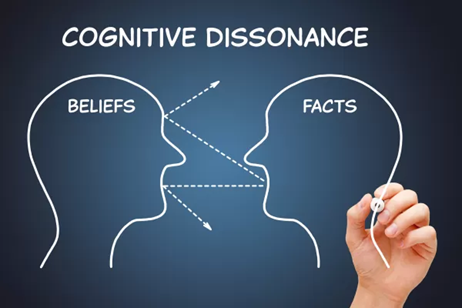
Cognitive Dissonance. A psychological state of discomfort experienced when one’s beliefs, values, or actions conflict with one another, often leading to rationalization or justification to reduce internal tension (Rashiti, 2021).
De-identification. The process of separating one’s personal identity from that of the controlling group or ideology that once defined it, often accompanied by confusion and emotional struggle (Langone, 2017).
Deconditioning. The gradual process of unlearning habits, beliefs, and conditioned responses that were instilled by an authoritarian or high-control system (Lalich, 2004; Langone, 2017).
Emotional Conditioning. The learned association of specific emotional responses—such as guilt, shame, fear, or pride—with compliance or disobedience to group norms (Langone, 2017).
Identity Fusion. A psychological phenomenon where personal and group identities merge, creating strong emotional bonds and a willingness to prioritize the group over oneself (Swann et al., 2012).
Identity Reconstruction. The rebuilding of an authentic, self-defined identity following departure from a high-control environment; involves reflection, self-awareness, and integration into a broader worldview (Langone, 2017).
Internalized Control. A condition in which external authority or group expectations become self-enforced, causing individuals to monitor and regulate their own thoughts and behaviors according to imposed standards (Lalich, 2004).
Psychological Homeostasis. The mind’s effort to maintain internal emotional stability. When disrupted—such as during deconstruction of old belief systems—temporary imbalance may occur before a new equilibrium forms (Manstead, 2018).
Re-socialization. The process of relearning social norms, boundaries, and interpersonal trust after leaving a closed or controlling environment (Langone, 2017; Ely et al., 2023).
Social Identity Theory. A framework that explains how individuals derive self-concept and meaning from group membership, promoting cohesion but also conformity and in-group bias (Hogg, 2014).
References:
Bai, X., Lian, S., Sun, X., & Niu, G. (2025). The relationship between information hoarding and selective exposure: The role of information overload, identity bubble reinforcement, and intolerance of uncertainty. BMC Psychology, 13(736). https://doi.org/10.1186/s40359-025-03062-8
Ely, G., Woodman, T., Roberts, R., Jones, E., Wedatilake, T., Sanders, P., & Peirce, N. (2023). The impact of living in a bio-secure bubble on mental health: An examination in elite cricket. Psychology of sport and exercise, 68, 102447. https://doi.org/10.1016/j.psychsport.2023.102447
Hogg, M. A. (2014). From Uncertainty to Extremism: Social Categorization and Identity Processes: Social Categorization and Identity Processes. Current Directions in Psychological Science, 23(5), 338-342. https://doi.org/10.1177/0963721414540168
Landon, L. B., Miller, J. C. W., Bell, S. T., & Roma, P. G. (2024). When people start getting real: The Group Living Skills Survey for extreme work environments. Frontiers in Psychology, 15, 1348119. https://doi.org/10.3389/fpsyg.2024.1348119
Langone, M. D. (2017). Recovery from cults: Help for victims of psychological and spiritual abuse. American Family Foundation Press.
Manstead, A. S. R. (2018). The psychology of social class: How socio-economic status influences identity, cognition, behaviour and health. British Journal of Social Psychology, 57(2), 267–291. https://doi.org/10.1111/bjso.12251
Swann, W. B., Jr., Gómez, Á., Seyle, D. C., Morales, J. F., & Huici, C. (2012). Identity fusion: The interplay of personal and social identities in extreme group behavior. Journal of Personality and Social Psychology, 96(5), 995–1011. https://doi.org/10.1037/a0013668
Why Listening to Our Better Instincts Matters in a World of Moral Complexity
There is a quiet voice that lives within each of us that is subtle yet persistent, urging us toward what we know deep down to be right. It does not shout; it rarely argues. Instead, it nudges, whispers, and stirs feelings in the pit of the stomach or the depth of the heart. This inner voice, often referred to as our “gut feeling,” “conscience,” or “innate wisdom,” is a reflection of our deepest values and lived experience. And yet, in moments of moral or ethical decision-making, it is precisely this voice that many people ignore, sometimes out of fear, sometimes for convenience, and sometimes because the noise of the external world drowns it out.
The consequences of silencing that inner guidance can be profound. To ignore it is to betray oneself, to erode the foundation of integrity, and to risk becoming complicit in harm, even when that harm is subtle or hidden beneath layers of rationalization. Trusting our inner compass is therefore not just a matter of personal well-being; it is a vital part of what it means to live an honorable and meaningful life.
The Wisdom Beneath Instinct: Conscience as an Inner Guide
Human intuition is often misunderstood as mere emotion that is fickle, unreliable, and easily swayed. In reality, our “gut” is a highly sophisticated product of subconscious cognition. Neuroscientists have found that intuition draws on vast amounts of stored knowledge, memory, and emotional intelligence, often arriving at conclusions faster than conscious reasoning can (Gigerenzer, 2007). It is not irrational but rather it is pre-rational, in the distilled wisdom of our lived experience.
But beyond cognition, there is also a moral dimension to instinct. Philosophers from Immanuel Kant to Søren Kierkegaard have argued that conscience represents a higher faculty, or a kind of inner tribunal that judges our actions and intentions. This internal sense of right and wrong is not merely taught; it is felt deeply. It can manifest as a sense of discomfort when we contemplate wrongdoing, or a sense of peace and integrity when we choose the harder, nobler path.
When Silence Becomes Complicity
History provides sobering examples of what happens when individuals ignore their inner moral voice. One of the most studied phenomena in social psychology is Stanley Milgram’s obedience experiments (1974), in which ordinary people followed orders to administer what they believed were harmful electric shocks to strangers. Many participants reported intense internal conflict where their “gut” screamed that it was wrong, yet they continued because an authority figure told them to. These findings reveal a universal truth: when external pressure is strong, people often override their instincts to conform, even when doing so violates their ethics.
The same dynamic has played out on a societal scale. During the Holocaust, countless individuals justified their roles in atrocities with phrases like “I was just following orders.” Yet, amid the darkness, there were those who did listen to their inner voice, people like Oskar Schindler, who risked everything to save over 1,000 Jews, or Irena Sendler, who smuggled Jewish children out of the Warsaw Ghetto in defiance of Nazi laws. Their actions were not driven by logic alone but by an unshakable inner conviction that this is wrong and I must act.
Everyday Decisions: The Quiet Tests of Character
Not all ethical choices occur on such a dramatic stage. In daily life, moral decisions often arise in subtle ways, deciding whether to speak up when a colleague is mistreated, whether to tell the truth when a lie would be easier, or whether to act compassionately toward someone who cannot repay the kindness. These moments may seem small, but they are where character is forged.
Consider the case of whistleblowers such as Sherron Watkins (Enron) or Frances Haugen (Facebook). Both faced enormous personal risk by exposing wrongdoing within powerful organizations. What motivated them was not personal gain, but a deep moral impulse with a feeling that staying silent would make them complicit. These decisions, born from instinctive moral clarity, not only shaped their own lives but also had profound societal impact.
In contrast, when individuals repeatedly suppress their better instincts, they may become desensitized to wrongdoing, both in themselves and in others. This erosion of conscience rarely happens overnight; it is the cumulative result of small compromises and justifications (immersion by degrees: small steps toward total commitment). Each ignored inner warning weakens the connection to one’s deeper self, making future ethical choices harder to navigate.
The Anatomy of Regret
One of the most consistent patterns in human psychology is the regret that follows when people betray their conscience. Psychologists have found that people are more likely to regret moral failures, such as acts of dishonesty, betrayal, or cowardice, than mistakes of judgment or even missed opportunities (Gilovich & Medvec, 1995). This is because ethical missteps strike at the core of identity: they reveal a gap between who we are and who we believe ourselves to be.
This inner dissonance, known as cognitive dissonance (Festinger, 1957) often lingers long after the immediate consequences of a decision have passed. It is the mind’s way of signaling that we have drifted from our values. Conversely, when we align our actions with our inner sense of right and wrong, we experience what psychologists call integrity congruence, a deep sense of authenticity and peace that reinforces moral resilience.
Listening as an Act of Courage
Trusting one’s instincts is not always comfortable. It may require swimming against the current, challenging authority, or facing isolation. Yet, this is precisely why it is so vital. Moral courage or the willingness to act on conscience despite fear is one of the highest expressions of human character. It is what led Rosa Parks to refuse to give up her seat, what guided Nelson Mandela to stand against apartheid, and what inspires ordinary people to do extraordinary things every day.
These individuals were not superhuman. They were ordinary people who, in critical moments, refused to silence the quiet voice within. They listened and in doing so, they not only transformed their own lives but also changed the course of history.
The Compass Within
We live in a world where external noise from media, politics, culture, and peers constantly tries to shape our choices. Amid that noise, the inner compass can feel faint. But it is always there, waiting to be heard. It is the part of us that remembers who we truly are and what we stand for.
Choosing to listen to that voice, to honor our better instincts is not a sign of weakness but of profound strength. It is how integrity is preserved, how trust is built, and how a life of meaning is crafted. In the end, our most important decisions are not about what we achieve or acquire, but about whether we have the courage to do what we know is right, even when no one else is watching.
Trust the Quiet Voice
In a culture that often rewards speed, compliance, and surface-level success, listening to one’s inner voice can feel like an act of rebellion. Yet it is precisely this act, this willingness to pause, feel, reflect, and trust that separates a life lived reactively from a life lived with purpose. The next time you find yourself standing at an ethical crossroads, resist the temptation to silence that quiet intuition within. Instead, lean into it. Let it guide you, even if the path it points to is harder, slower, or lonelier. Each time you honor that instinct, you strengthen the bridge between who you are and who you aspire to be. And over time, those small, courageous choices will weave the fabric of a life marked not by regret or compromise, but by integrity, wisdom, and peace.
References:
Festinger, L. (1957). A Theory of Cognitive Dissonance. Stanford University Press.
Gigerenzer, G. (2007). Gut Feelings: The Intelligence of the Unconscious. Viking.
Haidt, J. (2001). The emotional dog and its rational tail: A social intuitionist approach to moral judgment. Psychological Review, 108(4), 814–834. https://doi.org/10.1037/0033-295X.108.4.814
Milgram, S. (1974). Obedience to Authority: An Experimental View. Harper & Row.
Physiological, Psychological, and Spiritual Dimensions of a Classical Koan
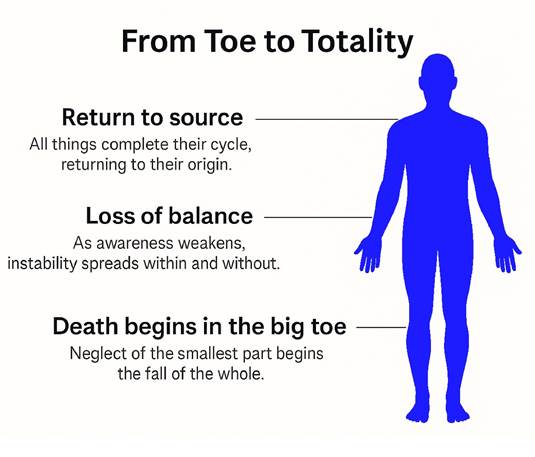
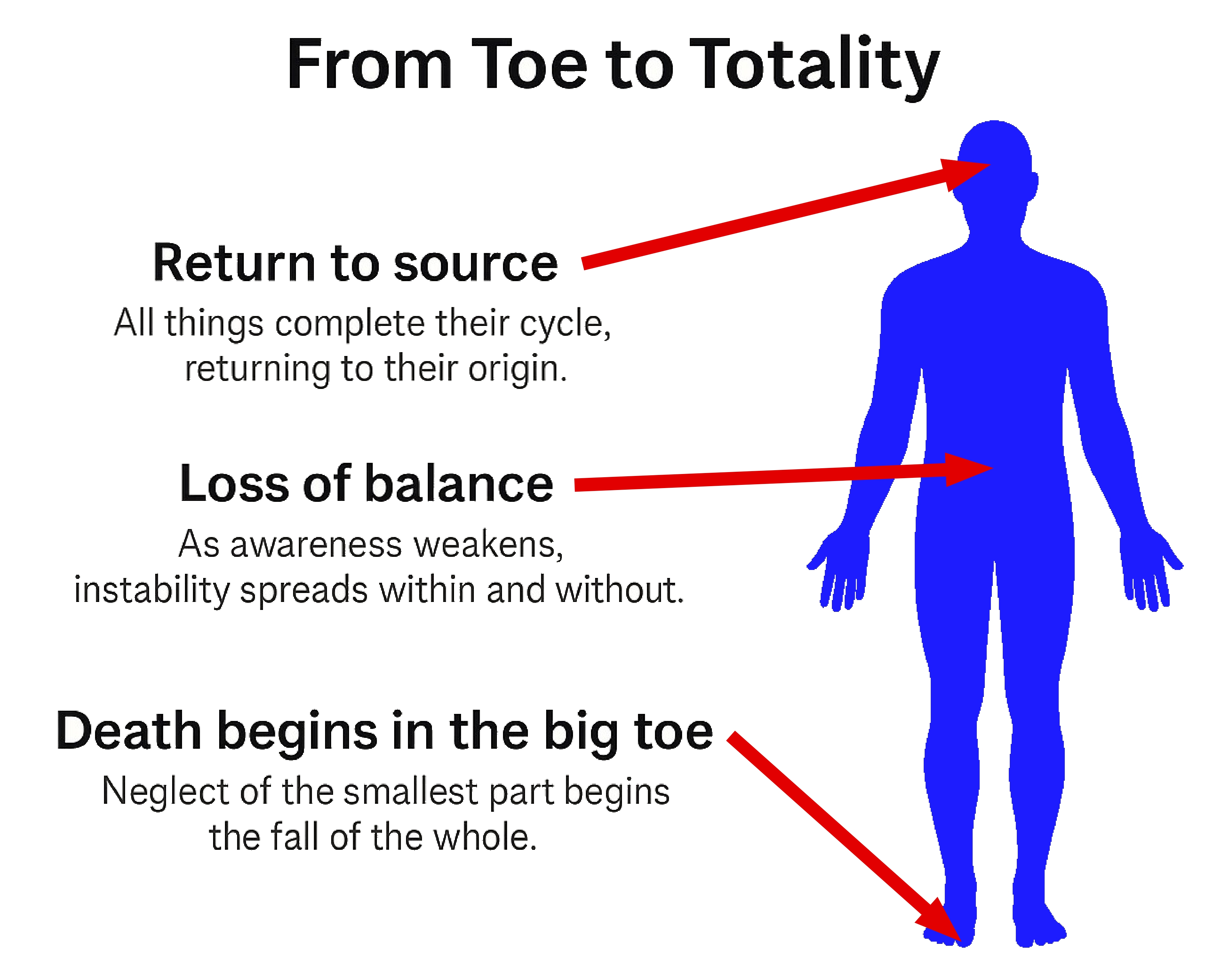
The aphorism “Death begins in the big toe” is a deceptively simple statement drawn from the long tradition of Chinese medical wisdom and Zen contemplative practice. Like many koans and proverbial sayings from classical East Asian thought, its brevity conceals a depth of layered meaning. At the surface level, it speaks to the observable fact that physiological decline often begins at the extremities. On a subtler level, it gestures toward psychological processes of neglect and dissociation that accompany aging and decay. At its deepest level, the phrase serves as a spiritual teaching about impermanence, awareness, and the cyclic nature of existence.
In Taoist medicine and Chan Buddhist teaching alike, the body is seen as a microcosm of the cosmos, and every small detail reflects the whole. The “big toe” in this aphorism symbolizes more than just anatomy: it is the farthest reach of circulation from the heart, the starting or ending point of many meridians, and the first part of the body to meet the earth with each step. That death might begin there is not a literal prediction but a metaphor for the way life’s endings emerge subtly at the margins before manifesting at the center.
Historical Origins of the Koan
Although the precise origin of the saying is difficult to trace, its spirit can be found in early Chinese medical classics and Zen writings. The Huangdi Neijing (Yellow Emperor’s Inner Canon), compiled between the 2nd century BCE and 2nd century CE, repeatedly emphasizes that “illness arises in the extremities before it reaches the organs” and that “to know the distant is to protect the center” (Unschuld, 2003). Similarly, Taoist texts such as the Dao De Jing highlight the principle that great change arises from subtle beginnings: “A tree as great as a man’s embrace springs from a tiny sprout. A journey of a thousand miles begins beneath one’s feet” (Laozi, trans. Addiss & Lombardo, 1993).
In Chan Buddhism, koans often use ordinary body parts as metaphors for the process of awakening or decay. The Tang-era master Yunmen famously remarked, “The toe that touches earth is the whole universe touching earth” (Cleary, 1998), pointing to the subtlety with which the infinite is revealed in the infinitesimal. Over centuries, the saying “death begins in the big toe” entered the shared vocabulary of physicians, monks, and martial artists alike, a succinct reminder that mortality’s first signs are often peripheral and easily overlooked.
Physiological Interpretation: The Body’s Peripheral Messengers
Peripheral Circulation and Aging
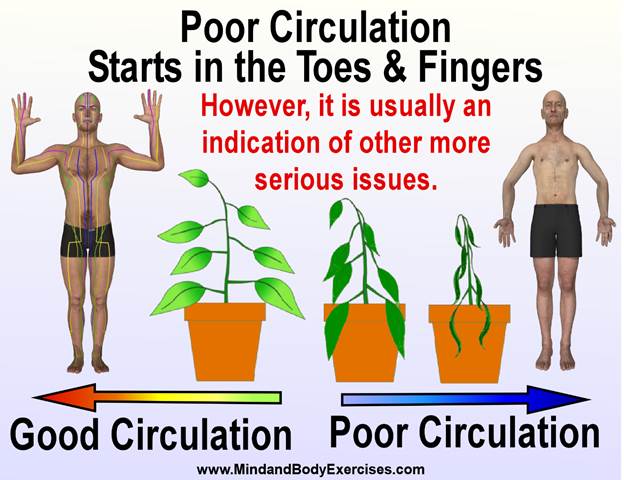
From a biomedical perspective, the big toe is not merely metaphorical. It is literally among the first regions to reveal systemic decline because it sits at the farthest point of the circulatory network. As the heart ages and vascular elasticity decreases, peripheral perfusion diminishes, often manifesting as cold, numb, or discolored toes long before symptoms appear elsewhere (Hamburg & Benjamin, 2009). Peripheral arterial disease, a common condition in older adults, often begins in the feet and toes and is associated with a significant increase in all-cause mortality (Criqui & Aboyans, 2015).
These physiological realities lend empirical support to the ancient observation. If “death” is defined as the progressive failure of the body’s regulatory systems, then it is indeed accurate to say that it begins in the places farthest from the heart and brain. The big toe, as the most distal point of the lower extremities, is the proverbial “canary in the coal mine” for vascular health.
Mobility, Balance, and Longevity
Mobility is another physiological dimension that links the toe to mortality. The toes and particularly the hallux, or great toe, play a crucial role in balance, propulsion, and gait. Degenerative changes, neuropathy, or muscular weakness that impair toe function can reduce walking speed, a biomarker strongly correlated with lifespan (Studenski et al., 2011). Gait speed below 0.8 m/s in older adults is associated with significantly increased risk of disability, hospitalization, and death (Abellan van Kan et al., 2009).
The simple ability to rise from a chair, stand on one’s toes, or walk briskly requires integrated function across multiple physiological systems of the musculoskeletal, nervous, and cardiovascular. Physical decline often first appears subtly in the toes and feet as reduced sensation, proprioception, or push-off strength. Once these diminish, the cascade toward frailty begins. As gerontologist Luigi Ferrucci observed, “Mobility is the most fundamental expression of independence, and its loss is the beginning of the end” (Ferrucci et al., 2016).
Meridians and Vital Energy Flow
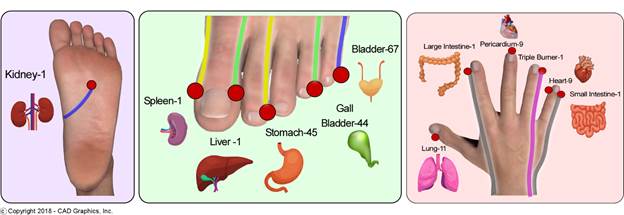
Traditional Chinese medicine (TCM) expresses similar insights through the language of qi (vital energy) and meridians. Several of the body’s primary channels, including the Liver, Spleen, Stomach, Kidney, and Bladder, either begin or end at the toes (Maciocia, 2015). These meridians govern vital processes such as digestion, reproduction, and detoxification. Disruption of flow at the periphery is believed to reverberate inward, creating systemic disharmony.
As the Lingshu Jing (a companion text to the Neijing) states, “When the qi of the extremities is blocked, the organs within will suffer” (trans. Wu, 2008). In this paradigm, coldness, stagnation, or numbness in the toes are not trivial complaints but early signs of declining vitality, the first whispers of death’s approach.
Psychological Interpretation: Awareness, Neglect, and the Periphery of Consciousness
While the physiological layer of the aphorism highlights the body’s peripheral signals as early indicators of decline, the psychological dimension explores how awareness, or lack thereof shapes that process. In this context, “death” represents not just physical decay but the gradual erosion of vitality, engagement, and responsiveness to life’s subtleties.
Dissociation and Embodiment
Modern psychology has increasingly recognized the importance of embodiment, the lived experience of inhabiting one’s physical body, as essential to mental health and cognitive function (Durt, et al (2017). Yet, in contemporary societies characterized by sedentary lifestyles and disembodied digital existence, many people lose sensitivity to their physical selves. The feet and toes, distant from the brain and often ignored, become metaphors for the neglected peripheries of awareness.
This dissociation is not benign. Studies have shown that reduced proprioception and interoception, the senses of bodily position and internal state, correlate with anxiety, depression, and diminished cognitive function (Khalsa et al., 2018). In Jungian psychology, the shadow represents the disowned or unconscious aspects of the self. In a similar way, the body’s extremities can symbolize the “shadow” of bodily awareness, parts of ourselves we rarely think about but that profoundly shape our experience. Neglecting them reflects a broader neglect of the unconscious and the subtle.
The Psychology of Small Beginnings
The aphorism also teaches that decline begins with small lapses in attention. Cognitive-behavioral theorists note that habits, both constructive and destructive can emerge gradually through repeated micro-decisions (Neal et al., 2012). In the same way, death “beginning” in the big toe symbolizes the cumulative effect of minor neglect. A blister ignored becomes an infection; a sedentary day becomes a sedentary year. The toe, seemingly insignificant, becomes the starting point of a larger process of decay.
Zen teachings mirror this concept. Master Dōgen wrote, “To neglect the small is to betray the great” (Shōbōgenzō, trans. Nishijima & Cross, 1994). Psychologically, the lesson is clear: by training awareness toward the smallest and most peripheral phenomena, the sensations in the toes, the first signs of imbalance, the whispers of discontent, one cultivates a capacity to intervene before decay becomes inevitable.
Spiritual Interpretation: Impermanence, Return, and the Subtle Path
At the spiritual level, “death begins in the big toe” is neither a physiological warning nor a psychological metaphor but a profound statement about impermanence and the nature of life itself.
Impermanence and the Gradual Approach of Death
Buddhist philosophy emphasizes that impermanence (anicca) is the fundamental characteristic of all conditioned phenomena. Life does not end abruptly but is a continuous unfolding of change, a river flowing toward the ocean of dissolution. Just as the body’s vitality wanes first at its extremities, so too does the soul’s departure begin subtly in the smallest changes of breath, the faintest shifts in sensation.
The Diamond Sutra reminds practitioners that “All conditioned things are like a dream, an illusion, a bubble, a shadow” (Red Pine, 2001). The big toe, as the furthest point from the body’s “center,” becomes a symbol of these subtle transitions. Death is not a singular event but a process that begins long before the final breath and the wise cultivate awareness of this process without fear.
The Circle of Return
Taoist cosmology frames death not as an end but as a return to the source. “Returning is the motion of the Dao,” Laozi wrote (Tao Te Ching, trans. Addiss & Lombardo, 1993). In this framework, the toe is the starting point of walking while also becoming the place where the journey ends. The path that began with the first step returns to the same ground.
This cyclical vision is echoed in many traditional arts. In Taijiquan, for example, practitioners speak of “returning to the root” where physical, energetic, and spiritual processes are symbolized by grounding through the feet. As the root weakens with age, the spirit begins its return to the Dao. “Death begins in the big toe” thus becomes a poetic recognition of the natural rhythm of return: from periphery to center, from earth to heaven, from form to formlessness.
Integrative Perspective: Caring for the Small to Preserve the Whole
Across all three dimensions. physiological, psychological, and spiritual, a single principle emerges: the state of the whole is revealed in the condition of the periphery. The big toe, distant from the heart and often neglected, becomes both a literal and metaphorical early warning system. It tells us about the integrity of our circulation, the sharpness of our awareness, and the depth of our spiritual understanding.
In preventive medicine, this principle underlies the emphasis on foot care in diabetic patients, where early interventions at the level of the toes can prevent systemic complications (Boulton et al., 2005). In psychology, mindfulness practices that cultivate awareness of the body from the ground up improve interoception and reduce emotional dysregulation (Mehling et al., 2011). In spiritual disciplines, practices like walking meditation (baguazhang), standing meditation (zhanzhuang), and barefoot qigong remind practitioners to anchor their consciousness in the humblest and forgotten parts of the body.
To say that “death begins in the big toe” is therefore to issue a call for radical attentiveness — to the smallest sensations, the earliest signs of imbalance, and the often-ignored peripheries of our existence. It is a koan not about death, but about life: a reminder that to live fully is to remain awake even to the faintest signals of change.
Big Toe as a Symbol of Decline and Awareness Across Three Dimensions
Dimension
Meaning of “Death Begins in the Big Toe”
Key Insights & Applications
Physiological
Early signs of systemic decline often appear first in the extremities (coldness, numbness, circulation issues, mobility loss).
– Toe and foot health reflect cardiovascular and neurological function. – Loss of gait speed or balance predicts mortality. – Meridians begin/end at the toes, blockages here affect the entire body. – Preventive care (mobility, balance, circulation) can slow aging.
Psychological
Neglect and dissociation often begin with the smallest, least noticed aspects of the self – the “periphery” of awareness.
– Reduced body awareness correlates with anxiety, depression, and cognitive decline. – Small acts of neglect accumulate into larger patterns of decay. – Training awareness of subtle sensations builds mindfulness and resilience. – Attention to the “shadow” parts of the self, fosters wholeness.
Spiritual
Death is a gradual return to source, beginning subtly and symbolically at the periphery – a process to be observed, not feared.
– Impermanence is revealed in subtle transitions. – The journey that begins with the first step returns to the same ground. – Awareness of small changes leads to acceptance of life’s cycles. – Practices like walking meditation and grounding cultivate spiritual presence.
Conclusion
The Chinese saying “death begins in the big toe” is more than a quaint proverb. It is a concise expression of a deep and timeless truth: that decline, decay, and death all begin subtly, in places and ways we are least likely to notice. Physiologically, the toe is the frontier where circulatory weakness, neuropathy, and frailty first manifest. Psychologically, it symbolizes the peripheries of awareness, where neglect and dissociation take root. Spiritually, it represents the cosmic rhythm of impermanence, where the journey back to the source begins in the smallest steps.
Ultimately, the koan invites us to approach life with a heightened sensitivity, to honor the periphery as we do the center, to care for the small as we do the great. It teaches that the path to vitality, wisdom, and even enlightenment often begins not with dramatic gestures but with the humble act of noticing what is happening beneath our feet.
References:
Abellan van Kan, G., Rolland, Y., Andrieu, S., Bauer, J., Beauchet, O., Bonnefoy, M., Cesari, M., Donini, L. M., Gillette Guyonnet, S., Inzitari, M., Nourhashemi, F., Onder, G., Ritz, P., Salva, A., Visser, M., & Vellas, B. (2009). Gait speed at usual pace as a predictor of adverse outcomes in community-dwelling older people an International Academy on Nutrition and Aging (IANA) Task Force. The journal of nutrition, health & aging, 13(10), 881–889. https://doi.org/10.1007/s12603-009-0246-z
Addiss, S., & Lombardo, S. (Trans.). (1993). Tao Te Ching. Hackett.
Boulton, A. J. M., Armstrong, D. G., Albert, S. F., Frykberg, R. G., Hellman, R., Kirkman, M. S., … & Sanders, L. J. (2005). Comprehensive foot examination and risk assessment: A report of the task force of the foot care interest group of the American Diabetes Association. Diabetes Care, 31(8), 1679–1685. https://doi.org/10.2337/dc08-9021
Cleary, T. (1998). Zen Essence: The Science of Freedom. Shambhala.
Ferrucci, L., Cooper, R., Shardell, M., Simonsick, E. M., Schrack, J. A., & Kuh, D. (2016). Age-Related Change in Mobility: Perspectives From Life Course Epidemiology and Geroscience. The journals of gerontology. Series A, Biological sciences and medical sciences, 71(9), 1184–1194. https://doi.org/10.1093/gerona/glw043
Hamburg, N. M., & Benjamin, E. J. (2009). Assessment of endothelial function using digital pulse amplitude tonometry. Trends in cardiovascular medicine, 19(1), 6–11. https://doi.org/10.1016/j.tcm.2009.03.001
Khalsa, S. S., Adolphs, R., Cameron, O. G., Critchley, H. D., Davenport, P. W., Feinstein, J. S., … & Zucker, N. (2018). Interoception and mental health: A roadmap. Biological Psychiatry: Cognitive Neuroscience and Neuroimaging, 3(6), 501–513. https://doi.org/10.1016/j.bpsc.2017.12.004
Maciocia, G. (2015). The Foundations of Chinese Medicine: A Comprehensive Text for Acupuncturists and Herbalists (3rd ed.). Elsevier.
Mehling, W. E., Wrubel, J., Daubenmier, J. J., Price, C. J., Kerr, C. E., Silow, T., Gopisetty, V., & Stewart, A. L. (2011). Body Awareness: a phenomenological inquiry into the common ground of mind-body therapies. Philosophy, ethics, and humanities in medicine : PEHM, 6, 6. https://doi.org/10.1186/1747-5341-6-6














 United Martial Arts Association