Born With Nothing, Die With Nothing”

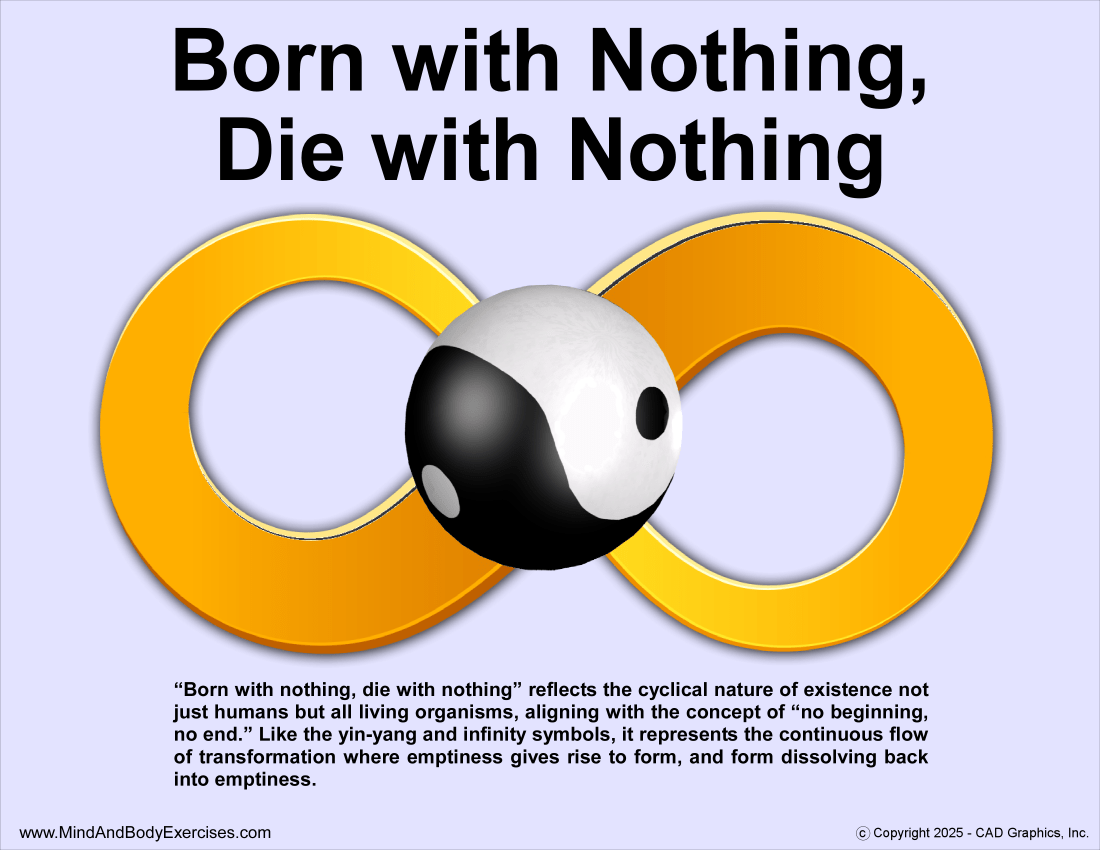
The concept of “born with nothing, die with nothing” is a profound philosophical idea found in many Eastern traditions, including Buddhism and Taoism. It reflects the principles of impermanence, detachment, and the cyclical nature of existence. We enter this world with no possessions, and when we leave, we take nothing with us. This underscores the transient nature of material wealth and highlights the deeper value of experiences, relationships, and inner growth.

This idea extends beyond human life to all living beings, aligning with the concept of “no beginning, no end.” Like the yin-yang (☯) and infinity (∞) symbols, it represents the continuous flow of transformation, where emptiness gives rise to form, and form dissolves back into emptiness.

Human life can be seen as consciousness temporarily residing in form, experiencing the ever-shifting balance of existence before returning to the formless. In Taoism, this mirrors the Dao (道), the ever-flowing source from which all things arise and to which they ultimately return. Just as yin transforms into yang and vice versa, life and death are not endpoints but expressions of an eternal process. This perspective encourages non-attachment, balance, and harmony with the natural flow of life, recognizing that all physical possessions are ultimately borrowed, and everything returns to the Dao.

Related Concepts:

Biblical Perspective: A similar idea appears in the Book of Job, where Job states, “The Lord gave, and the Lord has taken away; may the name of the Lord be praised.” This is often interpreted as an acceptance of life’s impermanence, acknowledging that all we have is ultimately a gift and can be withdrawn at any time.

The Heart Sutra: A central text in Mahayana Buddhism, the Heart Sutra articulates the nature of emptiness, stating that all phenomena bear the mark of emptiness—their true nature is beyond birth and death, being and non-being.

Śūnyatā (Emptiness): In Mahayana Buddhism, śūnyatā refers to the understanding that all things are devoid of intrinsic existence. This insight is fundamental to recognizing the transient nature of life and the absence of a permanent self.

Samsara: This term describes the continuous cycle of birth, death, and rebirth, emphasizing the impermanence and suffering inherent in worldly existence.

Why This Concept Matters in Everyday Life

Understanding and embracing this concept can have a profound impact on how we approach daily life. It reminds us to focus on what truly matters. Our experiences, relationships, and inner development are most important, rather than being overly attached to material possessions or fleeting successes. By recognizing the impermanent nature of all things, we can cultivate greater resilience and gratitude in the face of challenges, reduce unnecessary stress, and live with greater appreciation and mindfulness.

This perspective encourages us to be present in each moment, to value the people around us, and to engage in life with a sense of peace and acceptance. It also promotes generosity and compassion, as we recognize that nothing truly belongs to us, and what we give to others is ultimately part of the greater flow of all existence.

By implementing this understanding into our lives, we can develop a deeper sense of harmony, balance, and contentment, freeing ourselves from the burdens of attachment and fear while embracing the natural rhythms of life.

I teach and offer lectures about holistic health, physical fitness, stress management, human behavior, meditation, phytotherapy (herbs), music for healing, self-massage (acupressure), Daoyin (yoga), qigong, tai chi, and baguazhang.

Please contact me if you, your business, organization, or group, might be interested in hosting me to speak on a wide spectrum of topics relative to better health, fitness, and well-being.

I look forward to further sharing more of my message by partnering with hospitals, wellness centers, VA centers, schools on all levels, businesses, and individuals who see the value in building a stronger nation through building a healthier population.

I also have hundreds of FREE education video classes, lectures, and seminars available on my YouTube channel at:

https://www.youtube.com/c/MindandBodyExercises

Many of my publications can be found on Amazon at:

http://www.Amazon.com/author/jimmoltzan

My holistic health blog is available at:

https://mindandbodyexercises.wordpress.com/

http://www.MindAndBodyExercises.com

Mind and Body Exercises on Google: https://posts.gle/aD47Qo

Jim Moltzan

407-234-0119

The Buddhist Eightfold Path & the Taoist 8 Keys of Wisdom

The Eightfold Path in Buddhism and the Eight Keys of Wisdom both emphasize self-awareness, ethical living, and inner transformation, but they approach wisdom from different angles. Buddhism focuses on liberation from suffering and Taoism emphasizes harmony with the Tao (the Way). Below are summaries and correlations between them.

The Buddhist Eightfold Path is a core teaching of the Buddha, forming the practical aspect of the Four Noble Truths. It guides ethical conduct, mental discipline, and wisdom, leading to the cessation of suffering and enlightenment (nirvana).

Wisdom (Prajñā / Panna)

  1. Right View (Sammā-diṭṭhi) – Understanding the Four Noble Truths and seeing reality as it is.
  2. Right Intention (Sammā-saṅkappa) – Cultivating thoughts of goodwill, and harmlessness, avoiding harmful desires and ill-will.

Ethical Conduct (Śīla / Sīla)

  1. Right Speech (Sammā-vācā) – Speaking truthfully, kindly, and avoiding lying, gossip, or harmful words
  2. Right Action (Sammā-kammanta) – Acting ethically by resisting from harming living beings, stealing, and engaging in improper sexual conduct.
  3. Right Livelihood (Sammā-ājīva) – Earning a living in a way that does not cause harm or exploit others.

Mental Discipline (Samādhi)

  1. Right Effort (Sammā-vāyāma) – Cultivating positive states of mind, preventing negative thoughts, and striving for self-improvement.
  2. Right Mindfulness (Sammā-sati) – Maintaining awareness of one’s body, feelings, thoughts, and phenomena through consistent mindfulness practice.
  3. Right Concentration (Sammā-samādhi) – Developing deep meditative states of focus to achieve insight and tranquility.

Like the Eightfold Path, The Eight Keys of Wisdom is a core teaching in ancient wisdom, drawing from Taoism, Buddhism, and Confucianism. It guides ethical conduct, mental discipline, and wisdom, leading to the cessation of suffering and enlightenment (nirvana).

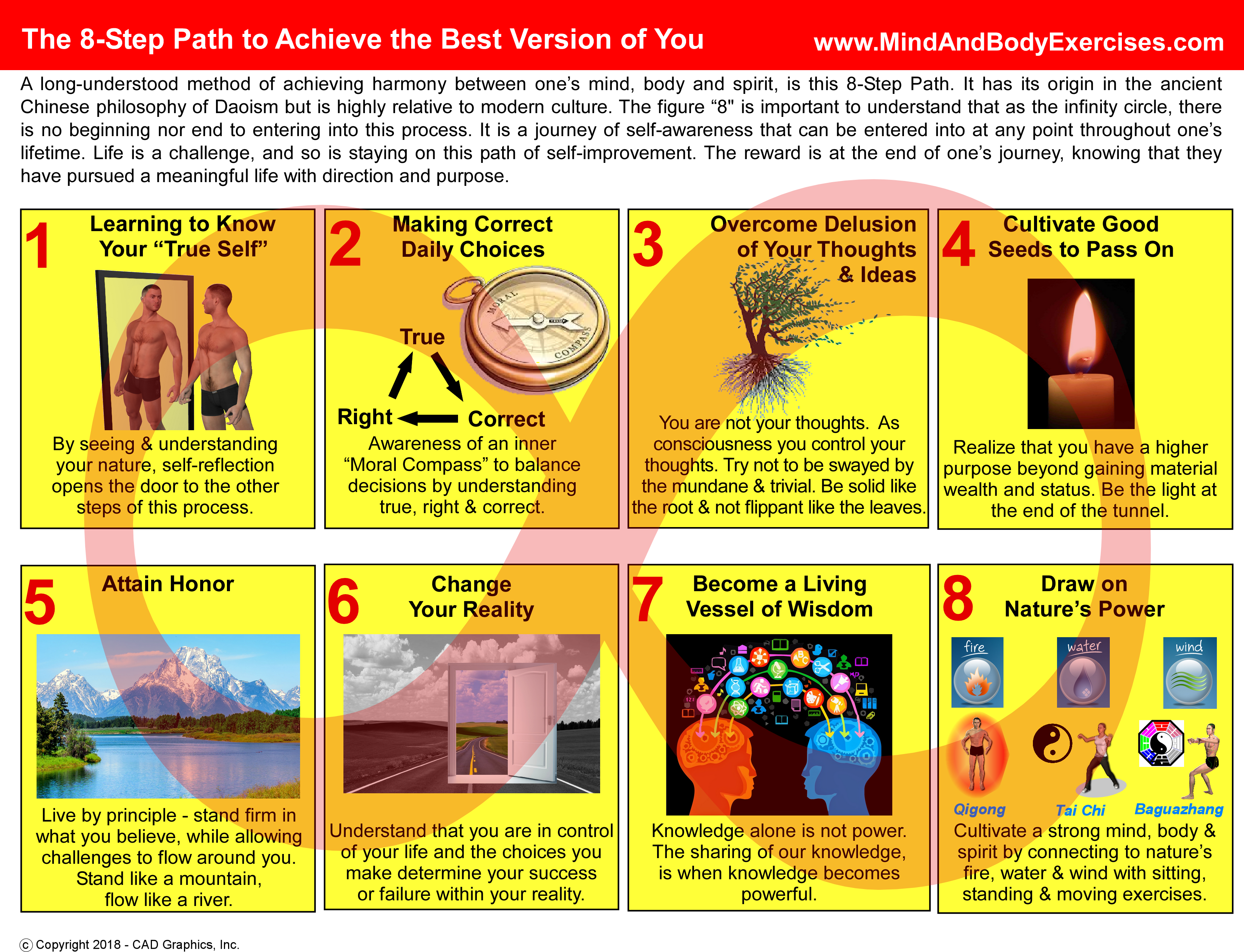
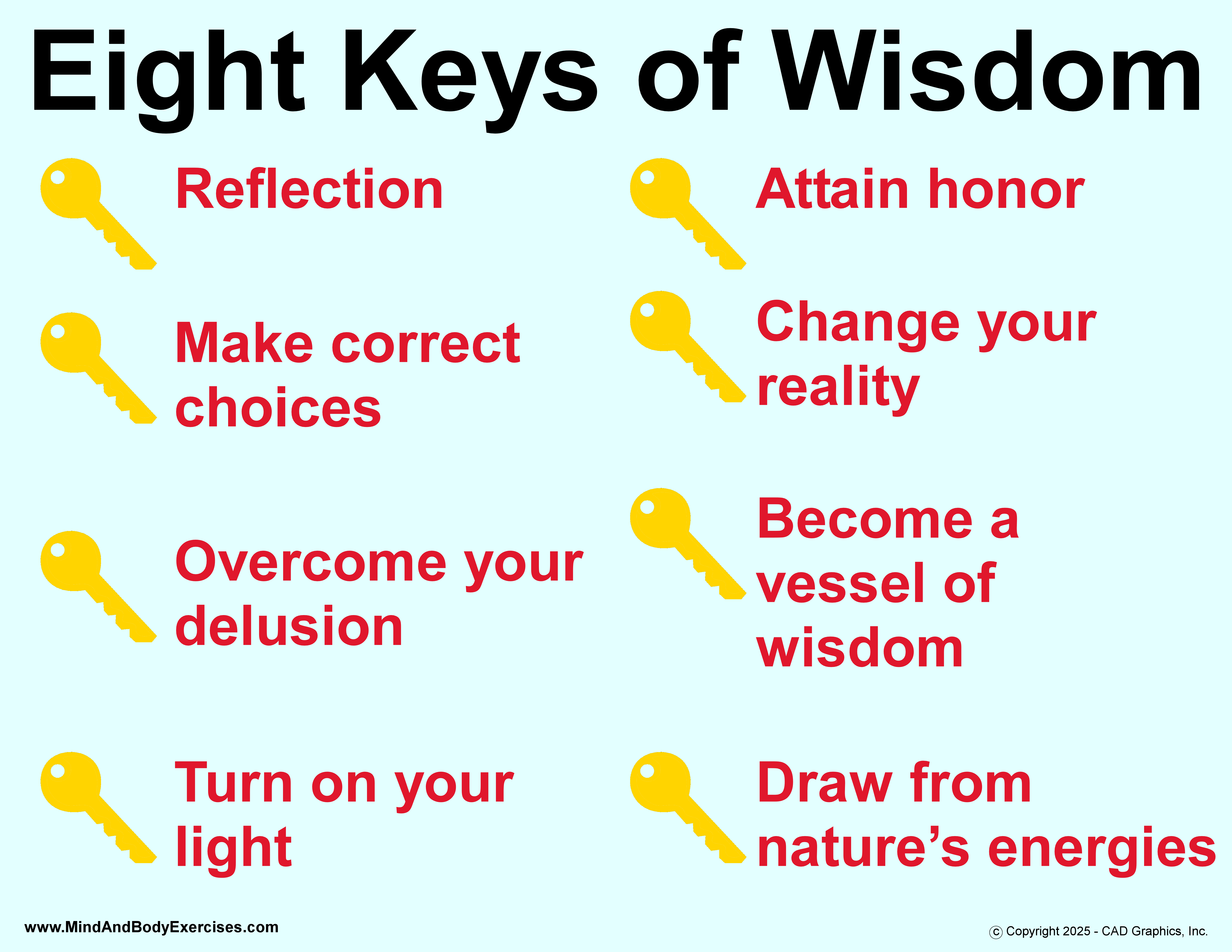
  1. Reflection – See yourself as others see you
  2. Make correct choices (Hun & Po) – Discerning true, right, and correct. Dealing with the inner conflict
  3. Overcome your delusion – 5 agents, 7 distractions
  4. Turn on your light – See and be seen, plant good seeds
  5. Be the mountain – Attain honor rooted in principle
  6. Change your reality – Assume responsibility of your fate or destiny
  7. Become a vessel of wisdom – Practice what you preach, become a role model rather than a warning
  8. Water over fire – Draw from nature’s energies
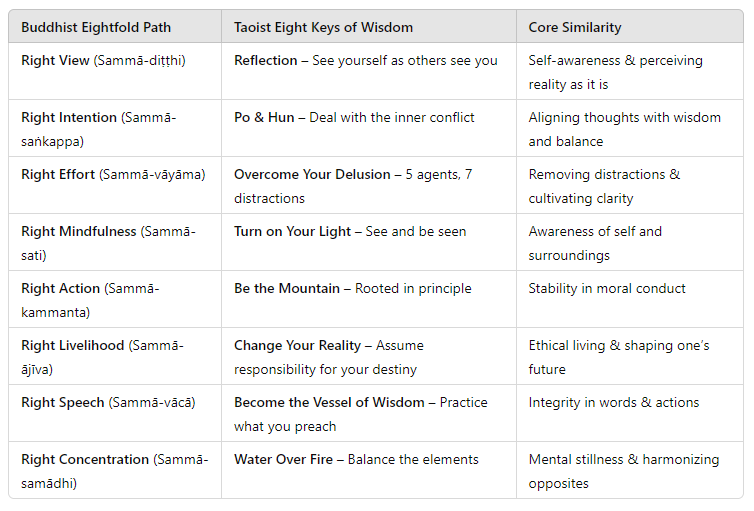
  1. ReflectionRight View (Sammā-diṭṭhi)
    • Taoist Wisdom: See yourself as others see you.
    • Buddhist Parallel: The Right View teaches seeing reality as it is, free from illusion. In Buddhism, self-awareness includes understanding how others perceive us and recognizing our attachments and biases.
  2. True, Right and Correct (Hun & Po)Right Intention (Sammā-saṅkappa)
    • Taoist Wisdom: Manage and cope with inner conflicts.
    • Buddhist Parallel: Right Intention involves aligning thoughts with ethical and wholesome goals, reducing inner conflict between desire (Po) and higher wisdom (Hun). Both traditions emphasize balancing these opposing aspects of the psyche.
  3. Overcome Your Delusion – Right Effort (Sammā-vāyāma)
    • Taoist Wisdom: 5 agents, 7 distractions (Five Elements & Emotional Imbalances).
    • Buddhist Parallel: Right Effort means actively working to remove unwholesome states (such as greed, anger, and delusion) and cultivate wisdom. In Taoism, recognizing the interplay of the Five Elements and overcoming distractions aligns with maintaining mental clarity.
  4. Turn on Your Light – Right Mindfulness (Sammā-sati)
    • Taoist Wisdom: See and be seen. Plant good seeds to leave a legacy of knowledge.
    • Buddhist Parallel: Right Mindfulness is about clear awareness of one’s actions, emotions, and thoughts. “Turning on the light” in Taoism refers to conscious self-awareness, which aligns with the Buddhist practice of mindfulness meditation.
  5. Be the Mountain – Right Action (Sammā-kammanta)
    • Taoist Wisdom: Achieve honor and respect by being rooted in principle.
    • Buddhist Parallel: Right Action means living with integrity, abstaining from harm and unethical behavior. Being “the mountain” represents stability in virtue, just as Right Action is about unwavering moral conduct.
  6. Change Your Reality – Right Livelihood (Sammā-ājīva)
    • Taoist Wisdom: Assume responsibility for your fate or destiny.
    • Buddhist Parallel: Right Livelihood encourages earning a living ethically and shaping one’s future through right choices. Taoism’s view that we shape our destiny aligns with Buddhism’s emphasis on karma and responsibility for one’s path.
  7. Become the Vessel of Wisdom – Right Speech (Sammā-vācā)
    • Taoist Wisdom: Practice what you preach. Strive to live as an example and not a warning to others.
    • Buddhist Parallel: Right Speech teaches honest, compassionate communication. In Taoism, becoming a “vessel of wisdom” means embodying truth, much like Right Speech requires sincerity in words.
  8. Water Over Fire – Right Concentration (Sammā-samādhi)
    • Taoist Wisdom: Balance the elements; maintain peace in chaos.
    • Buddhist Parallel: Right Concentration cultivates mental stillness and deep meditative absorption, similar to Taoist teachings on harmonizing the forces of water (yin) and fire (yang) to maintain balance and clarity.

I teach and offer lectures about holistic health, physical fitness, stress management, human behavior, meditation, phytotherapy (herbs), music for healing, self-massage (acupressure), Daoyin (yoga), qigong, tai chi, and baguazhang.

Please contact me if you, your business, organization, or group, might be interested in hosting me to speak on a wide spectrum of topics relative to better health, fitness, and well-being.

I look forward to further sharing more of my message by partnering with hospitals, wellness centers, VA centers, schools on all levels, businesses, and individuals who see the value in building a stronger nation through building a healthier population.

I also have hundreds of FREE education video classes, lectures, and seminars available on my YouTube channel at:

https://www.youtube.com/c/MindandBodyExercises

Many of my publications can be found on Amazon at:

http://www.Amazon.com/author/jimmoltzan

My holistic health blog is available at:

https://mindandbodyexercises.wordpress.com/

http://www.MindAndBodyExercises.com

Mind and Body Exercises on Google: https://posts.gle/aD47Qo

Jim Moltzan

407-234-0119

The Eight Keys of Wisdom

The Eight Keys of Wisdom are rooted in Taoist, Confucian, and Buddhist principles, such as:

  • Wu Wei (Effortless Action) in Taoism, similar to “Be Like Bamboo” (flexibility and balance).
  • Right Conduct and Ethics in Confucianism, similar to “The True-Right-Correct Method.”
  • Mindfulness and Detachment from Thought in Buddhism are reflected in “Stop Being Drunk on Your Own Thoughts.”

The Eight Keys of Wisdom serve as guiding principles for integrating mindfulness and meditation into daily life. Here’s a deeper look at each:

1. Reflection (Know Your True Self)

  • This key emphasizes self-awareness and authenticity.
  • It encourages recognizing personal strengths, weaknesses, and emotional patterns.
  • Understanding oneself allows for conscious decision-making and alignment with one’s true nature.

2. Make Correct Choices (The True-Right-Correct Method)

  • Rooted in Eastern philosophy, this principle teaches the importance of seeking truth and making ethical choices.
  • “True” represents inner wisdom, “Right” signifies ethical action, and “Correct” ensures that actions align with both personal integrity and universal balance.

3. Overcome Delusion (Stop Being Drunk on Your Own Thoughts)

  • Encourages detachment from overthinking and emotional reactivity.
  • Teaches mindfulness techniques to observe thoughts without being consumed by them.
  • Helps develop clarity and inner calm by breaking free from habitual negative thinking.

4. How Will You Be Remembered? (Plant Good Seeds)

  • Invites reflection on one’s legacy and the impact of actions on others.
  • Encourages living with purpose, kindness, and awareness of how one’s presence affects the world.
  • Turn on your light, becoming an inspiration and not a warning to others

5. Seek Connectedness & Honor (Be Like a Mountain)

  • Focuses on building meaningful relationships through respect, integrity, and compassion.
  • Recognizes the interconnectedness of all people and the importance of honoring those connections.
  • Teaches that true strength comes from unity rather than isolation.

6. Change Your Reality for the Better

  • Encourages personal responsibility in shaping one’s experiences.
  • Highlights the power of perspective—choosing optimism and proactive behavior over victimhood.
  • Teaches how shifting internal attitudes can influence external circumstances.

7. Become a Vessel of Wisdom (It Only Takes One Match to Light a Thousand)

  • Demonstrates the power of small actions in creating widespread change.
  • Encourages leading by example, where one positive act can inspire many others.
  • Stresses that transformation begins with individual effort, no matter how small.

8. Draw from Nature’s Energies (Be Like Bamboo)

  • Symbolizes resilience, flexibility, and strength.
  • Encourages adaptability in the face of challenges while maintaining inner strength.
  • Teaches that true power lies in balance, being strong yet flexible, firm yet yielding.

I look forward to further sharing more of my message by partnering with hospitals, wellness centers, VA centers, schools on all levels, businesses, and individuals who see the value in building a stronger nation through building a healthier population.

I also have hundreds of FREE education video classes, lectures, and seminars available on my YouTube channel at:

https://www.youtube.com/c/MindandBodyExercises

Many of my publications can be found on Amazon at:

http://www.Amazon.com/author/jimmoltzan

My holistic health blog is available at:

https://mindandbodyexercises.wordpress.com/

http://www.MindAndBodyExercises.com

Mind and Body Exercises on Google: https://posts.gle/aD47Qo

Jim Moltzan

407-234-0119

The Four Turning, The Five Elements and Carl Jung’s Archetypes

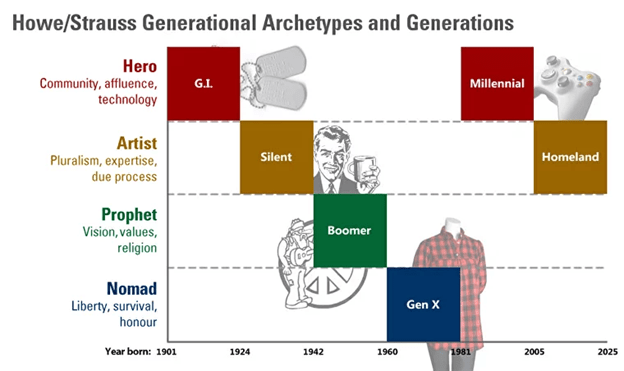
“The Fourth Turning” by William Strauss and Neil Howe articulates a generational theory of history. The authors posit that societies undergo recurring cycles, referred to as “turnings,” approximately every 80-100 years. These cycles consist of four distinct generational archetypes of the Prophet, the Nomad, the Hero, and the Artist. Each archetype plays a significant role in shaping and responding to historical events in predictable patterns.


The four turnings are:


The High – A period of societal rebuilding after a crisis, characterized by strong institutions, collective unity, and optimism (e.g., post-WWII boom in the U.S.).


The Awakening – A cultural period where individuals challenge established norms, emphasizing personal and spiritual values over conformity (e.g., the 1960s counterculture movement).

The Unraveling – Institutions weaken, individualism increases, and trust in government and societal structures declines (e.g., 1980s-2000s in the U.S.).


The Crisis (Fourth Turning) – Significant upheaval, such as war, economic downturns, or revolution, that forces society to reconstruct itself (e.g., the Great Depression and WWII).


According to their theory, the U.S. is currently in a Fourth Turning (beginning around 2008), indicating we’re in a period of crisis and transformation that will likely peak in the 2020s before leading into a new High. William Strauss and Neil Howe’s generational theory primarily focuses on Western historical cycles. They did not explicitly incorporate Eastern philosophies like Taoism or the Wu Xing (Five Elements) into their framework. Their analysis centers on patterns observed in Anglo-American history, detailing a recurring cycle of four generational archetypes where the Prophet, Nomad, Hero, and Artist, each influence societal moods and events over approximately 80-100 years.,


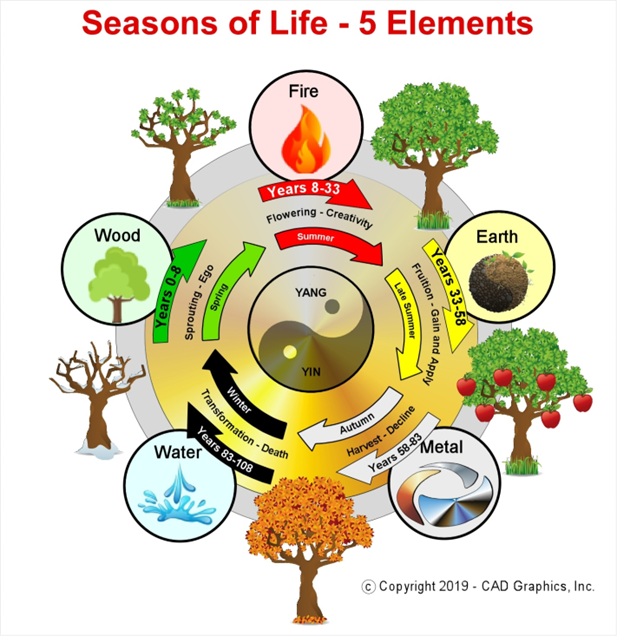
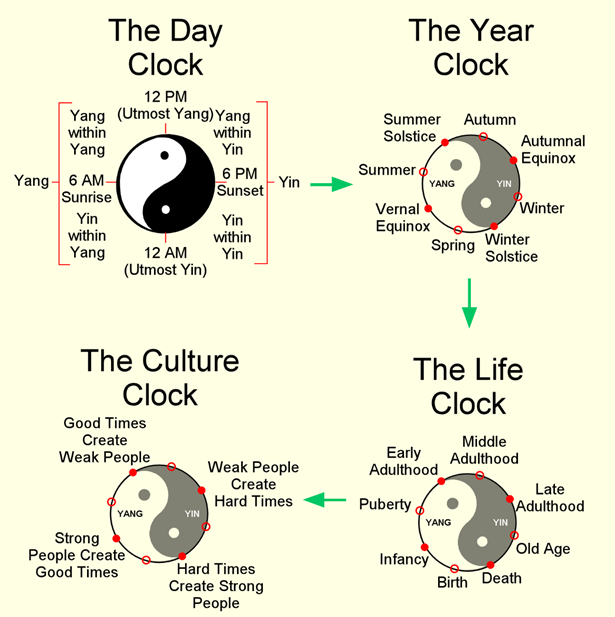
The Wu Xing in Taoist philosophy describes five interrelated elements of Wood, Fire, Earth, Metal, and Water, each associated with specific seasons, times of day, and life phases. This system emphasizes balance and the dynamic interactions between elements, reflecting the cyclical nature of the universe.


While both frameworks recognize cyclical patterns, their foundations differ: the Wu Xing is rooted in natural elements and their interactions, whereas the Strauss-Howe theory is based on generational dynamics and historical events. There isn’t direct evidence that Strauss and Howe studied or integrated Eastern philosophies into their work.


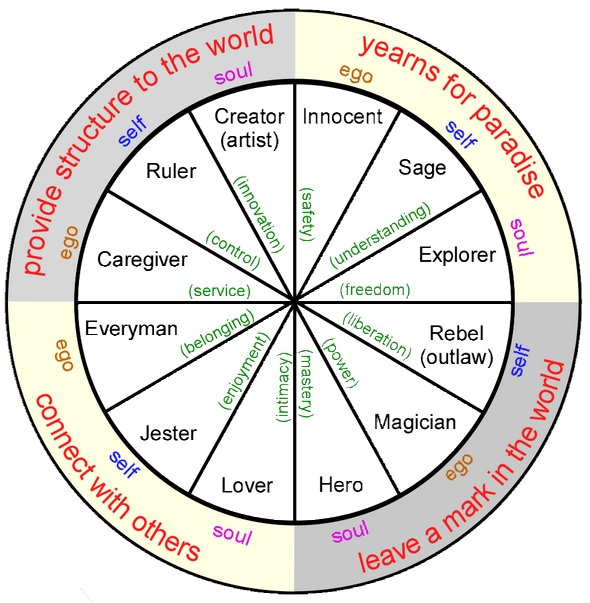
Carl Jung, a Swiss psychiatrist and psychoanalyst, introduced the idea of psychological archetypes and was significantly influenced by his study of Eastern philosophies. Jung’s incorporation of concepts from Taoism, Buddhism, and other Eastern traditions into his work on the collective unconscious and archetypes predated the Strauss-Howe generational theory by decades. While Strauss and Howe developed their own unique framework focused on historical and generational patterns, the notion of archetypes they used resonates with the broader tradition of exploring recurring patterns in human behavior and culture.

Carl Yung’s Archetypes


However, the concept of cyclical patterns is present in many cultural philosophies, suggesting a universal human inclination to find order and predictability in history and nature. While the specifics of the cycles differ between the Wu Xing and the Strauss-Howe generational theory, both offer perspectives on understanding the rhythms and transformations inherent in societies.

“Hard times create strong men. Strong men create good times. Good times create weak men. And, weak men create hard times.”

― G. Michael Hopf, Those Who Remain


Universal Cycles of Transformation


Each framework describes a repeating sequence of phases, with distinct yet interrelated roles:


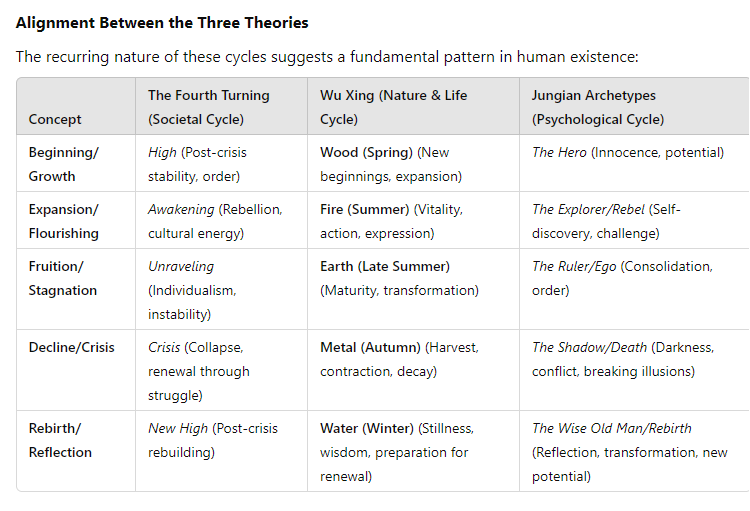
Strauss & Howe’s Fourth Turning follows a four-phase generational cycle (~80-100 years), where societal moods shift from stability (High) to questioning (Awakening), fragmentation (Unraveling), and renewal through crisis (Crisis).


Wu Xing (Five Elements) describes a five-phase natural cycle (Wood, Fire, Earth, Metal, Water), applied to time, seasons, and human life. Taoism sees a person’s lifespan in ~25-year segments:

0-8 (Spring) – sprouting of one’s identity

8-33 (Summer) – flowering of one’s vitality

33-58 (Late Summer) – fruition of what has been achieved

58-83 (Autumn) – cutting away what is not needed

83-108 (Winter) – transformation and rebirth

All phases closely mirror The Fourth Turning’s phases.


Jungian Archetypes reflect psychological transformations across an individual’s life and history. His concepts of Hero, Wise Old Man, Shadow, and Rebirth mirror the rise, crisis, and renewal patterns seen in the other two theories. Jung, influenced by Taoism and the I Ching, recognized life as a process of individuation—balancing opposing forces (Yin-Yang, conscious-unconscious), much like the generational and elemental cycles.


Key Takeaways:


Generational, Natural, and Psychological Patterns Are Interwoven
Each theory observes cyclical phases that repeat over time, whether in history (Fourth Turning), nature (Wu Xing), or the psyche (Jungian archetypes).
 
Crisis and renewal are fundamental to change, whether societal, elemental, or personal.
 
Strauss & Howe’s Generational Theory May Unconsciously Reflect Jungian Archetypes
The Fourth Turning’s generational archetypes (Prophet, Nomad, Hero, Artist) resemble Jung’s archetypal roles.
 
Jung, who studied Taoism and Eastern philosophy, recognized cycles of transformation, much like Wu Xing’s elemental shifts.
  
Taoism’s Wu Xing and Jung’s Individuation Both Emphasize Balance
Wu Xing describes the dynamic interplay of elements, where excess in one leads to transformation into another.
 
Jung’s individuation process requires integrating all aspects of the psyche, much like how Taoist balance ensures harmony.
 
 Crisis is a Necessary Stage for Renewal
Fourth Turning: Each crisis (e.g., WWII) paves the way for societal rebirth.
 
Wu Xing: Death and decay (Metal & Water) are necessary before new life (Wood).
 
Jung: Transformation only occurs when the individual faces their Shadow and integrates unconscious aspects.
Though emerging from different traditions, these three theories reveal a shared truth: transformation occurs through cyclical forces, shaping societies, nature, and individuals alike. Whether through generational change, elemental shifts, or psychological evolution, the rhythm of crisis and renewal is an eternal pattern in human experience.

 
References:
Generations X и Y: Crux, Characteristics, Application of a Theory in Recruiting. (2023). https://itluckyhunter.com/blog/generations-theory
 

I teach and offer lectures about holistic health, physical fitness, stress management, human behavior, meditation, phytotherapy (herbs), music for healing, self-massage (acupressure), Daoyin (yoga), qigong, tai chi, and baguazhang.

Please contact me if you, your business, organization, or group, might be interested in hosting me to speak on a wide spectrum of topics relative to better health, fitness, and well-being.

I look forward to further sharing more of my message by partnering with hospitals, wellness centers, VA centers, schools on all levels, businesses, and individuals who see the value in building a stronger nation through building a healthier population.

I also have hundreds of FREE education video classes, lectures, and seminars available on my YouTube channel at:

https://www.youtube.com/c/MindandBodyExercises

Many of my publications can be found on Amazon at:

http://www.Amazon.com/author/jimmoltzan

My holistic health blog is available at:

https://mindandbodyexercises.wordpress.com/

http://www.MindAndBodyExercises.com

Mind and Body Exercises on Google: https://posts.gle/aD47Qo

Jim Moltzan

407-234-0119

The 8 Dimensions of Wellbeing (3 of 3)

(part 3 in a series of 3 posts)

Post 1 – The 3 Treasures: Mind, Body & Spirit

Post 2 – The 5 Pillars of Health

Post 3 – The 8 Dimensions of Wellbeing

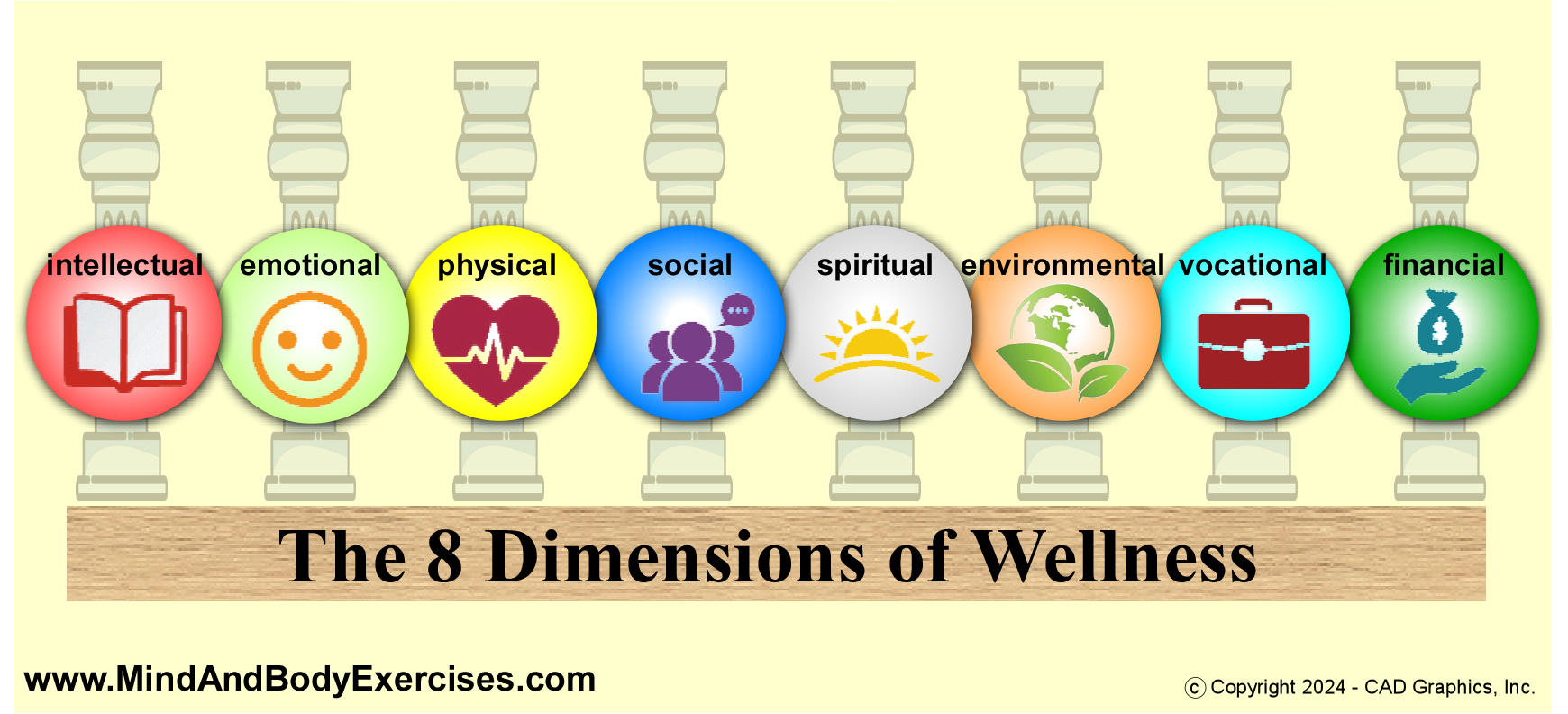
This is my third post on this topic of the most important facets of our lives. Here I illustrate and briefly describe the next manifestation of the concept of the 3 Treasures of the mind, body, and spirit to the “8 Dimensions of Wellbeing.” With this realization, we can see from the graphic below how the many sub-categories of the 5 Pillars and 8 Dimensions, are rooted in the original concepts of mind (qi) , body (jing), and spirit (Shen). Without the 3 Treasures, there are no 5 Pillars nor 8 Dimensions of Wellbeing. Without the roots, there are no trunks, branches or leaves on a tree.

Here are some brief descriptions of the 8 dimensions of well-being:

  1. Physical Wellbeing – The ability to maintain a healthy physical body through regular and consistent exercise, appropriate nutrition, adequate sleep, and striving to avoid harmful habits such as tobacco use and excessive alcohol consumption.
  2. Emotional Wellbeing – Recognizing and managing one’s emotions, coping mechanisms for minimalizing mental stress, and developing resilience, while pursuing a positive outlook on life.
  3. Intellectual Wellbeing – The ability to engage in lifelong learning that can stimulate cognitive mental activities, while also pursuing opportunities for problem-solving and creativity.
  4. Social Wellbeing – Having the ability to foster and maintain healthy relationships, cultivating a sense of belonging, and also being able to contribute to a community.
  5. Spiritual Wellbeing – Pursuing finding purpose and meaning in one’s life, having personal morals and values, while engaging in practices that can promote inner peace and harmony.
  6. Occupational Wellbeing: The pursuit of achieving satisfaction and enrichment through a career or job, while balancing work and leisure, along with aligning career goals with personal goals, skills, and values.
  7. Financial Wellbeing: Being able to manage financial resources effectively, while also planning for the future, and maintaining financial security and stability.
  8. Environmental Wellbeing: Pursuing achieving harmony with the environment, by promoting sustainability, and creating healthy and safe areas at home and in one’s community.

Each and every dimension can affect another as they are all interconnected and can contribute to overall health, well-being, and relative happiness. Balance and harmony in these dimensions can help individuals to achieve a more fulfilling and well-rounded life.

I teach and offer lectures about holistic health, stress management, qigong, tai chi, baguazhang, meditation, phytotherapy (herbs), music for healing, self-massage, and Daoyin (yoga).

Please contact me if you, your business, organization, or group, might be interested in hosting me to speak on a wide spectrum of topics relative to better health, wellness, and fitness.

I look forward to further sharing more of my message by partnering with hospitals, wellness centers, VA centers, schools on all levels, businesses, and individuals that see the value in building a stronger nation through building a healthier population. I also have hundreds of FREE education video classes, lectures, and seminars available on my YouTube channel at:

www.MindAndBodyExercises.com
https://www.facebook.com/MindAndBodyExercises/
https://www.youtube.com/c/MindandBodyExercises
https://mindandbodyexercises.wordpress.com/
https://umareg.com/masters-council/

www.Amazon.com/author/jimmoltzan

Mind and Body Exercises on Google: https://posts.gle/aD47Qo

Jim Moltzan

407-234-0119