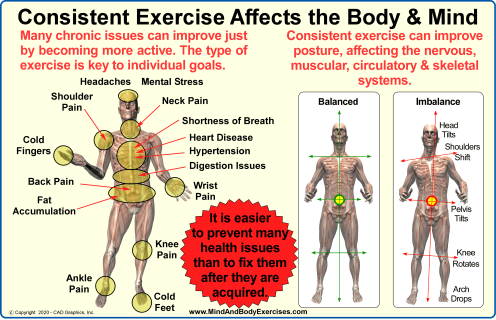
Consistent Exercise Affects the Body & Mind

“My back is stiff and seems to ache all the time.”

“Stretching with yoga and qigong can help this!”

“My feet and hands are always cold.”

“Tai chi and regular exercise can improve this!”

“I get winded walking up a flight of stairs.”

“Consistent cardio exercises like walking, swimming, and tai chi increase breathing capacity!”

“High blood pressure runs in my family.”

“Deep breathing exercises help to manage stress and hypertension!”

“I feel bloated hours after I eat.”

“Exercises that move the core, like yoga, qigong and tai chi all help improve digestion!”

“I don’t have time to exercise; I will go to the doctor, sit and wait to be seen, then get a prescription to mask my root health issues.”

“Or you could take control of your own health, exercise regularly and feel better for doing so!”

Consistent Exercise Affects the Body & Mind

Stay active, eat quality food and manage emotions and stress – 3 key elements to maintaining good health. And it doesn’t cost a fortune to improve all 3; just time and self-discipline.
Pick a method – walk, run, swim, yoga, tai chi, weight training, qigong, stretch. Each has its pros and cons. JUST PICK ONE and do it consistently.
Consistent exercise helps you:
– Strengthen the immune system
– Lower risk of obesity, cancer, heart disease, diabetes and many other illnesses
– Lose, gain, or maintain weight
– Improve resistance to infections
– Gain high-quality sleep
– Help to balance emotional health
– Prevent and relieve chronic pain
– Exercise increases size of hippocampus and improves memory
– Increase blood and oxygen flow to your brain
– Release accumulated toxins through better blood circulation
– Increase blood flow supplying nutrients necessary to keep brain cells healthy
– Improve your brain function
Tai Chi, yoga and qigong are all methods that increase the flow of energy ( and blood flow) within the body improving health and well-being.
Be well, stay healthy, be wise!

Jim Moltzan

www.MindAndBodyExercises.com

https://www.facebook.com/MindAndBodyExercises/

https://www.youtube.com/c/MindandBodyExercises

https://mindandbodyexercises.wordpres

The Meaning of the 8 Trigrams and Bagua

The Meaning of the 8 Trigrams and Bagua

The following is a very basic explanation of the The Meaning of the 8 Trigrams and Bagua. There are many books and resources that go into greater depth regarding these ancient concepts of balance and harmony.

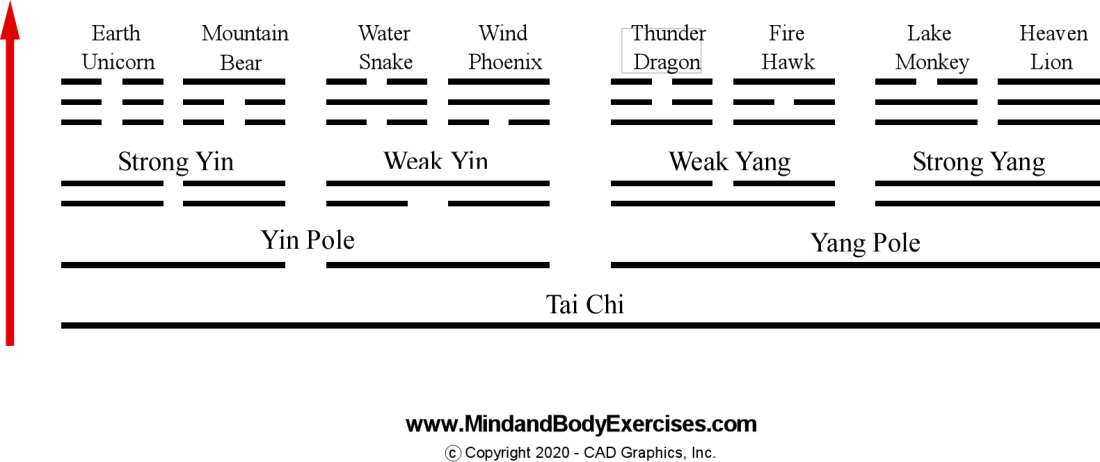
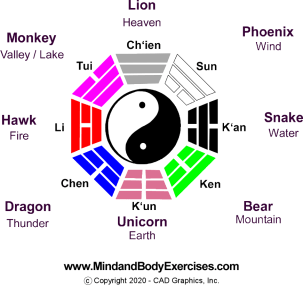
The four phases that are generated by the two poles (yin pole, yang pole) are represented by Metal, Wood, Water and Fire. They also assume the manifestation of four strengths: greater yang, lesser yang, greater yin and lesser yin. The four phases yield the eight trigrams. Heaven-Lion, Earth-Unicorn, Thunder-Dragon, Wind-Phoenix, Water-Snake, Fire-Hawk, Mountain-Bear and Lake-Monkey. The Zhou Yi also represented the above derivation with symbols. The straight line represents the Yang phase and a broken line represents the Yin phase.

The following diagrams will help you see the progression of the development of the Eight Trigrams.

trigrams


This concept then translates into the graphical representation of the bagua, or eight- sided figure as shown below.

bagua graphic

One on one instruction is often the best option for learning more about these concepts. If interested in learning more, contact me at 407-234-0119 or info@MindAndBodyExercises.com
Be well, stay healthy, be wise.
Jim Moltzan


The Small or Microcosmic Circulation

The Small or Microcosmic Circulation

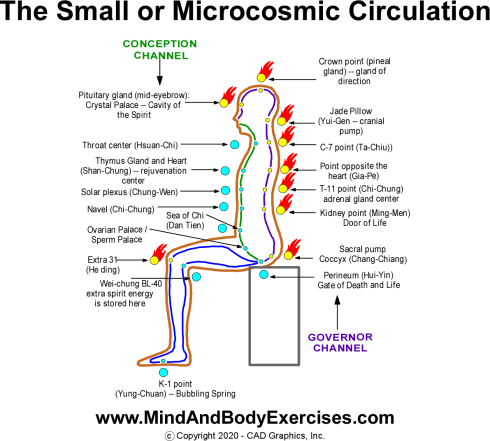
The Small Circulation, Small Circle, or the Microcosmic Orbit, is the practice of circulating one’s internal energy (Qi or chi), within the human body. The illustration below represents the awareness of energy flow throughout the Governing and Conception meridians; in this case, the fire path. These meridians are located on the center line of the body and in turn govern and regulate the other meridians. This practice has been considered to be the foundation of Internal Qigong. It was a fundamental step on the path of meditation training in ancient times. Over time, this practice has gradually been lost from many meditation traditions, and its importance diminished. Though meditation is popular today for relaxation, stress relief and general health, the ultimate goal for some people, is spiritual awareness and enlightenment. Small Circulation Meditation transforms the body from weak to strong while training the mind to be calm and focused.

small circulation

Opening of the Small Circulation

Basically, the small circulation refers to the practice of regulating and increasing the flow of one’s internal energy throughout the conception and governing channels. This increase in energy throughout the body has been known for centuries to promote health and longevity. Beginning meditation training can be started by practicing breathing deeply from the diaphragm or Abdominal Breathing. The Small Circulation can be the next stage of meditation training. Eventually, one can practice the Grand Circulation Meditation, which circulates Qi everywhere in the body. The Grand Circulation, Big Circle or Big Circulation refers to the energy flow through the Twelve Primary Qi channels or meridians. Qigong is interrelated to the energy meridians. When consistent practice reaches a certain level, the individual can feel the Qi and blood flow through the meridians. The paths of the meridians must be some-what familiar while practicing Qigong so as promote Qi to move along them.

Qigong is one way of strengthening the human body, preventing diseases and prolonging life. It includes two aspects. One being, self-training by performing postures of the human body, regulation of respiration, relaxation of the mind and body, and concentration of one’s mind. This aspect is to regulate and strengthen the physical functions of the practitioner’s own body. The second aspect is more advanced in that the spe-cialist of Qigong can send out their Qi externally to particular areas of another person in order to treat or prevent illness.

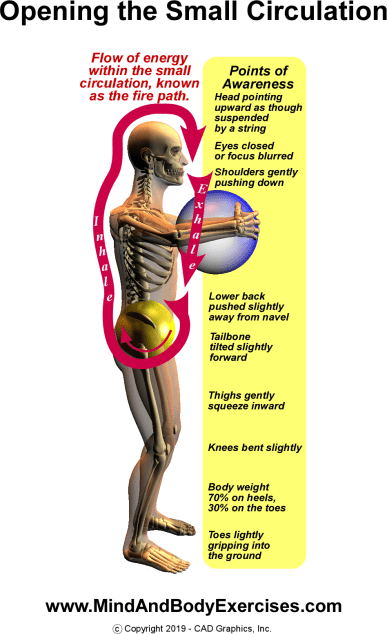
Visualize holding a weightless ball between your palms and chest, another within the pelvis. After conforming to the above body alignments, inhale while focusing just below the navel and following your center line between the legs and up the back, over the head and to the spot between the nose & upper lip. Exhale as following your awareness back to just below the navel.

Small circulation #1

One on one instruction is often the best option for learning and practicing these types of exercises.  If interested in  learning more, contact me at 407-234-0119 or  info@MindAndBodyExercises.com

Be well, stay healthy, be wise.

Jim Moltzan

www.MindAndBodyExercises.com

https://www.facebook.com/MindAndBodyExercises/

https://www.youtube.com/c/MindandBodyExercises

https://mindandbodyexercises.wordpress.com/

How Deep Breathing Affects Your Health

How Deep Breathing Affects Your Health

Deeper breathing is a key component to having a long and healthy life. Through focused and deliberate breathing methods, many positive mental and physical benefits can be achieved.

Most people breathe too shallow and too quickly!

Much recent research has linked stress to poor breathing habits and consequently many ailments. Many modern chronic conditions can be traced back to insufficient cell oxygenation otherwise known as cell hypoxia.

Breathing is one of the few bodily rhythms that we can consciously adjust, along with sleep and elimination. All of these rhythms directly effect our body’s delicate blood chemistry. However, our breath is the root power in bringing oxygen (qi) into our body to nourish it down to the cellular level.

Faster breathing is necessary when experiencing truly stressful situations, like being chased by an animal, running from a fire or similar life-threatening situations. However, continued breathing at this pace for an extended period of time puts accumulative stress on all of the body’s systems.

Breathing Frequency

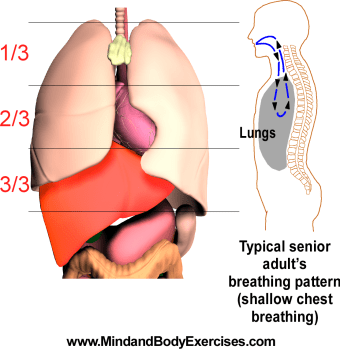
Most humans are breathing on the average, with normal activity about 12-18 breaths per minute (BPM). This amounts to very shallow breaths, using primary the top 1/3 of the lung’s capacity. Shallow chest breathing fills only the upper portion of the lungs. This reduces the ability to effectively oxygenate the circulation system.
Shallow breathing graphic

This “over-breathing” and “under-inhaling” causes an imbalance in oxygen/carbon dioxide gas exchange. This further leads to a ripple effect of other chemical (and hormonal) imbalances.

Poor oxygenation is linked to many modern chronic conditions such as asthma, COPD, obesity, diabetes, insomnia and cancer.

Emotions affects breathing rhythms.

Emotions effect the sympathetic nervous system which changes the blood chemistry.

The body releases cortisol into the bloodstream to counter stress.

Chronic elevation of cortisol effects other bodily functions in a negative manner.

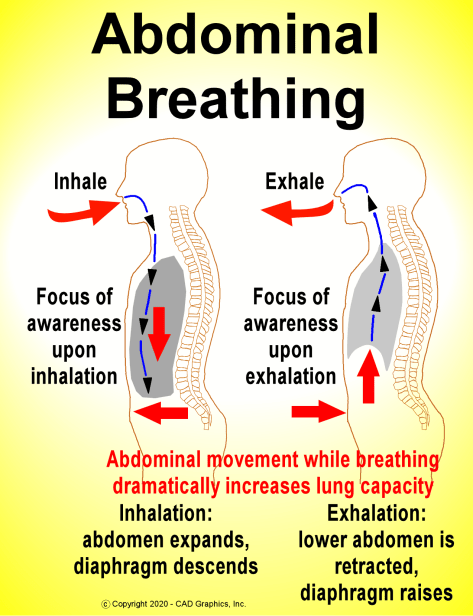
Abdominal Breathing graphic

Abdominal Breathing

Deep and deliberate breathing can be improved with practicing abdominal breathing. Diaphragm movement pushes lymph throughout the body, eliminating toxic waste consequently strengthening the immune system.

Other benefits of deep breathing include:

– Improves blood circulation and oxygenation of cells

– Changes the blood chemistry to produce “happy” hormones beneficial to organs

– Toxic C02 waste is eliminated through your breath

– Stimulates the parasympathetic nervous system

– Abdominal breathing acts as a pump to massage internal organs

– Reduces mental and physical fatigue

Learn more about these incredible wellness methods by practicing tai chi, qigong and many other ancient methods.


Be well, stay healthy, be wise.

Jim Moltzan

407-234-0119

www.MindAndBodyExercises.com

https://www.facebook.com/MindAndBodyExercises/

https://www.youtube.com/c/MindandBodyExercises

https://mindandbodyexercises.wordpress.com/


Effects of Stress on the Body

Effects of Stress on the Body

Stress effects the emotions.
Emotions effect the sympathetic nervous system which changes the blood chemistry.
The body releases cortisol into the bloodstream to counter stress.
Chronic elevation of cortisol effects other bodily functions in a negative manner.
Effects of Chronically Elevated Cortisol
– Decreases protein synthesis

– Increases blood sugar levels

– Diminishes lymphocyte numbers and functions

– Interferes with skin healing and regeneration

– Increases protein breakdown leading to muscle diminishing

– Lessons cellular utilization of glucose

– Leads to demineralization of bone that can lead to osteoporosis

– Causes shrinking of lymphatic tissue

Cortisol Side Effects

Tai Chi, yoga and qigong are all methods that regulate stress and increase the flow of energy ( and blood flow) within the body improving health and well-being.
Be well, stay healthy, be wise!