How Well Do You Sleep?

How Well Do You Sleep?

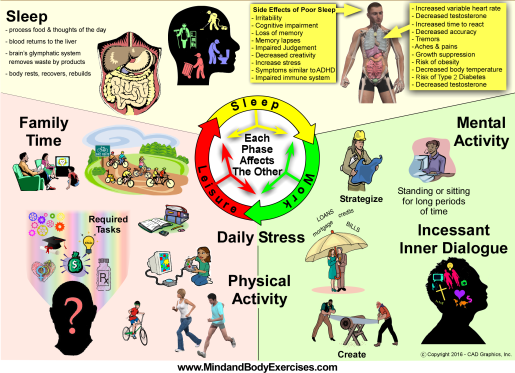
Are you low on energy?  Hard to focus throughout the day? Many chronic illnesses can be attributed to poor sleep. More serious diseases such as diabetes, heart disease, Alzheimer’s disease, are thought to be directly related to not achieving sufficient recovery during the sleep cycle. Each phase of our day is intimately interconnected with the others. What you do or don’t do during the waking hours will definitely affect the quality of the sleep time. Then the quality of the sleep affects your energy and outlook going into the next day.  This can make a never ending cycle that continues until you decide to make it change.

STRESS affects REST!

Mental activity can become stressful when trying to work, solve problems, manage a family, finances and juggling hundreds of other daily tasks.  Physical activity, relaxing and enjoyable activities are key components to balancing this daily stress.

A good night’s rest is earned, by what eat, what you think about and what types of physical activity is executed throughout the day.

Study the below graphic to gain a better understanding of the delicate balance between sleep, work and leisure.

How well do you sleep

Tai Chi, bagauzhang and qigong are all methods of exercise that also embody the philosophy balancing physical exercise with mental engagement to relieve stress and tension, while also increasing the flow of energy ( and blood flow) within the body improving health and well-being.
Be well, stay healthy, be wise!

How to Breathe Deeper

How to Breathe Deeper

Take a deep breath, relax. Do you? Can you?
Take a deep breath-relax

Often when someone tells someone else to relax by taking a deep breath, they do just the opposite and don’t relax. Most people don’t like to be told to relax. Let’s assume you are somewhat stressed, experiencing shortness of breath from minimal activity or know that you are not as healthy as you would like to be. How do you go about breathing deeper in order to reduce stress or just feel more relaxed?

I see people try to take a deep breath (usually one only) when frustrated, angry or anxious. It is usually a big gulp of air coming from an exaggerated sucking action from their mouth. This amounts to taking in one mouthful more of air for about 1 or 2 seconds.  That doesn’t really accomplish much.

Instead of the gulping air method, I suggest trying abdominal breathing. by moving the abdomen outward during inhalation, the diaphragm is engaged allowing the lungs to draw in more oxygen. Squishing the stomach muscles on the exhale pushes more of the carbon dioxide enriched air out of the lungs. Breathing all through the nose also helps with this method of breathing. If you can breath like this regularly and not just once in a while, you can gain more benefits over time. This is how babies and young children breathe instinctively; we change to chest breathing by our habits as we age.
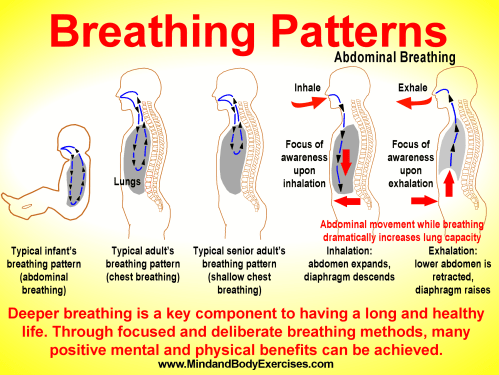
Breathing Patterns2

Diaphragm movement pushes lymph throughout the body, eliminating toxic waste consequently strengthening the immune system.

Other benefits of deep breathing include:

  • Improves blood circulation and oxygenation of cells
  • Changes the blood chemistry to produce “happy” hormones beneficial to organs
  • Toxic C02 waste is eliminated through your breath
  • Stimulates the parasympathetic nervous system
  • Abdominal breathing acts as a pump to massage internal organs
  • Reduces mental and physical fatigue

Ok great, you now know how to breath somewhat deeper.  The other important factors is breathing slower. Why is slower better than faster breathing?

Most humans are breathing on the average, with normal activity about 12-18 breaths per minute (BPM). This amounts to very shallow breaths, using primary the top 1/3 of the lung’s capacity. Shallow chest breathing fills only the upper portion of the lungs. This reduces the ability to effectively oxygenate the circulation system.
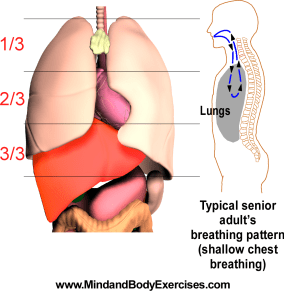
Shallow breathing graphic

This “over-breathing” and “under-inhaling” causes an imbalance in oxygen/carbon dioxide gas exchange. This further leads to a ripple effect of other chemical (and hormonal) imbalances.

Poor oxygenation is linked to many modern chronic conditions such as asthma, COPD, obesity, diabetes, insomnia and cancer.

  • Emotions affects breathing rhythms.
  • Emotions effect the sympathetic nervous system which changes the blood chemistry.
  • The body releases cortisol into the bloodstream to counter stress.
  • Chronic elevation of cortisol effects other bodily functions in a negative manner.

How do you get the breath to be slower? With a concentrated effort to change your breathing rhythm. Breathing is one of the few bodily rhythms that we can consciously adjust, along with sleep and elimination. All of these rhythms directly effect our body’s delicate blood chemistry. However, our breath is the root power in bringing oxygen (qi) into our body to nourish it down to the cellular level.

Sitting or standing while trying to deliberately slow your breathing rhythm is sometimes considered meditation; some just call it mindful breathing exercises. Certain activities can help to slow the breathing by just following the rhythm of the activity. Examples of this are slow walking, relaxed swimming, tai chi, qigong, yoga and Pilates.

Study the chart to see that if a deliberate effort is made to take a 4 second inhale, followed by a 4 second exhale, one can drop the breaths per minute (BPM) to 7.5 BPM.  10 breaths per minute or less activates the parasympathetic nervous system and the chemical release of dopamine, oxytocin, serotonin and endorphins. Add a 4 second pause before and after the exhale brings the BPM even lower for more health benefits.
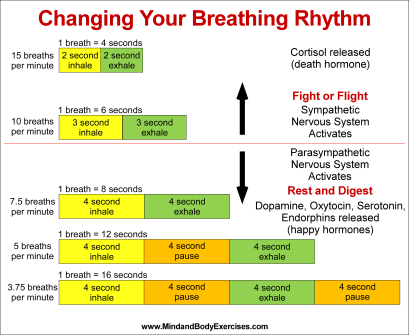
Changing Your Breathing Rhythm

The following graphic might give you a better idea of the pros and cons of managing the frequency of your breaths.
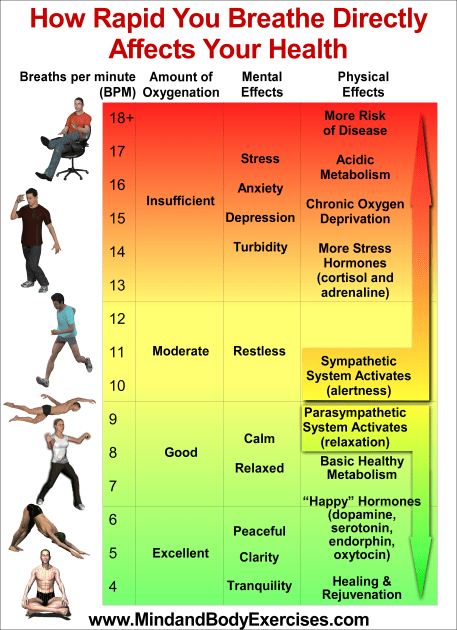
Breaths per minute graphic

_______________

For more info, contact Jim Moltzan at info@mindandbodyexercises.com, 407-234-0119 or through my site at http://www.mindandbodyexercises.com

Jim Moltzan started his martial arts training at the age of 16, starting with Korean martial arts and evolving into BaguaZhang, Tai Chi, and Qigong. Jim has been training, studying and teaching for almost 40 years effectively educating hundreds of students.

Master Instructor Jim Moltzan has trained with a diverse group of masters and high-level martial arts teachers of many different disciplines. Jim’s specialty is teaching exercises to improve chronic conditions, working with people of all ages, especially senior adults. Offering guidance and instruction, Jim has also worked with Parkinson Disease patients through Florida Hospital. Jim gives regular lectures as requested by AdventHealth (Florida Hospital) regarding the benefits of Eastern practices.

He is the author and graphic artist of numerous journals, graphic charts and study guides relative to the mind and body connection and how it relates to martial arts, fitness and self-improvement.

Jim continues his training and teaching in the Orlando, Florida area conducting classes, seminars and lectures as his schedule allows. He balances his teachings and businesses with his own personal cultivation and time spent with his wife and two college-age kids.

The 5 Element Theory

The 5 Element Theory (Wu Xing)

Most people are looking for some type of balance and harmony within their lives. Often, they have no plan nor method to achieve this other than doing their best on a day to day basis to find happiness. The 5 Element Theory represents ancient wisdom that when studied and applied, can help to find the balance we seek.
 
The following is a very basic explanation of the the meaning of the 5 elements. There are many books and resources that go into greater depth regarding these ancient concepts of balance and harmony.

Ancient Chinese scholars of the time approximately from 1600-1000 BC, recognized continuous patterns of change and transformation. Initially, these patterns were interpreted using yin-yang (balance) logic, but later these interpretations were expanded to the theory called The Five Elements. The 5 Elements Theory is based on observation, contemplation and meditation of the natural world and the environment we exist within.

5 Element-baisc graphic
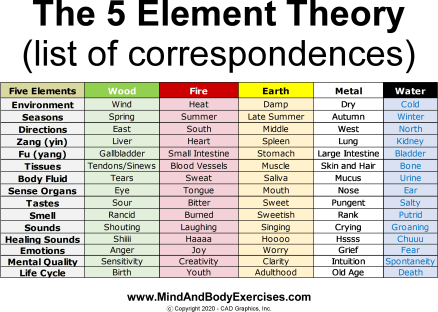
The Five Elements Theory evolved from the observation of various processes, functions, and phenomena of nature. The theory proclaims that aspects of matter, can be divided into one of five basic elements of wood, fire, earth, metal and water. Each element contains their own specific characteristics and interrelationships. In modern times, the five elements theory is still used as a tool for grouping substances, as well as a method for studying changes of natural phenomena.

5 Elements-list of corrspondences
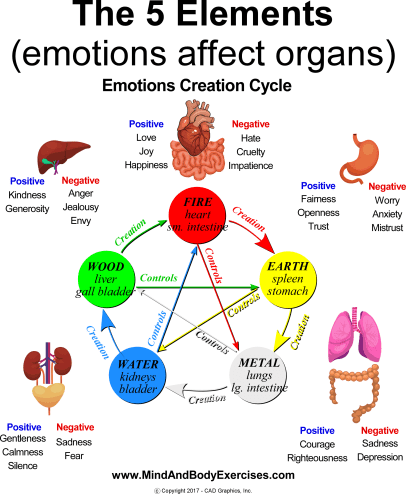
The 5 Elements Theory is a major component of thought within TCM or traditional Chinese medicine. These elements have corresponding relationships within our environment as well as within our own being specifically the internal organs and emotions connected to them.

5 Element-emotions

Tai Chi, bagauzhang and qigong are all methods of exercise that also embody the philosophy of the 5 Elements, while also increasing the flow of energy ( and blood flow) throughout the internal organs improving health and well-being.

Be well, stay healthy, be wise!


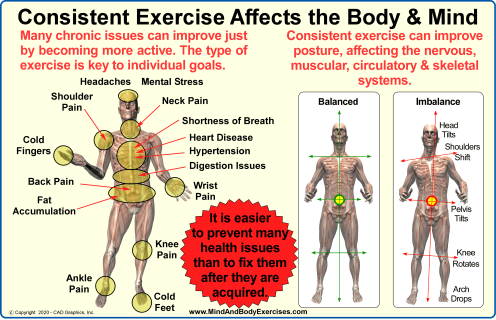
Consistent Exercise Affects the Body & Mind

“My back is stiff and seems to ache all the time.”

“Stretching with yoga and qigong can help this!”

“My feet and hands are always cold.”

“Tai chi and regular exercise can improve this!”

“I get winded walking up a flight of stairs.”

“Consistent cardio exercises like walking, swimming, and tai chi increase breathing capacity!”

“High blood pressure runs in my family.”

“Deep breathing exercises help to manage stress and hypertension!”

“I feel bloated hours after I eat.”

“Exercises that move the core, like yoga, qigong and tai chi all help improve digestion!”

“I don’t have time to exercise; I will go to the doctor, sit and wait to be seen, then get a prescription to mask my root health issues.”

“Or you could take control of your own health, exercise regularly and feel better for doing so!”

Consistent Exercise Affects the Body & Mind

Stay active, eat quality food and manage emotions and stress – 3 key elements to maintaining good health. And it doesn’t cost a fortune to improve all 3; just time and self-discipline.
Pick a method – walk, run, swim, yoga, tai chi, weight training, qigong, stretch. Each has its pros and cons. JUST PICK ONE and do it consistently.
Consistent exercise helps you:
– Strengthen the immune system
– Lower risk of obesity, cancer, heart disease, diabetes and many other illnesses
– Lose, gain, or maintain weight
– Improve resistance to infections
– Gain high-quality sleep
– Help to balance emotional health
– Prevent and relieve chronic pain
– Exercise increases size of hippocampus and improves memory
– Increase blood and oxygen flow to your brain
– Release accumulated toxins through better blood circulation
– Increase blood flow supplying nutrients necessary to keep brain cells healthy
– Improve your brain function
Tai Chi, yoga and qigong are all methods that increase the flow of energy ( and blood flow) within the body improving health and well-being.
Be well, stay healthy, be wise!

Jim Moltzan

www.MindAndBodyExercises.com

https://www.facebook.com/MindAndBodyExercises/

https://www.youtube.com/c/MindandBodyExercises

https://mindandbodyexercises.wordpres

The Small or Microcosmic Circulation

The Small or Microcosmic Circulation

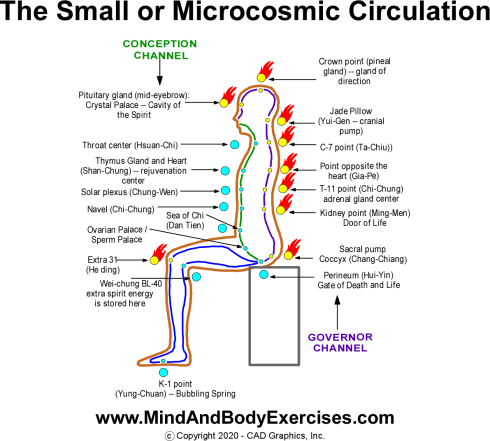
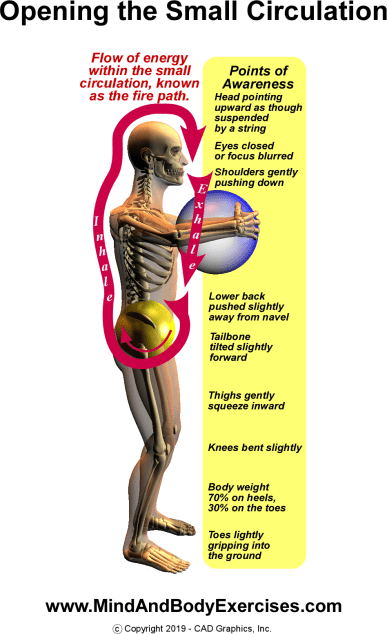
The Small Circulation, Small Circle, or the Microcosmic Orbit, is the practice of circulating one’s internal energy (Qi or chi), within the human body. The illustration below represents the awareness of energy flow throughout the Governing and Conception meridians; in this case, the fire path. These meridians are located on the center line of the body and in turn govern and regulate the other meridians. This practice has been considered to be the foundation of Internal Qigong. It was a fundamental step on the path of meditation training in ancient times. Over time, this practice has gradually been lost from many meditation traditions, and its importance diminished. Though meditation is popular today for relaxation, stress relief and general health, the ultimate goal for some people, is spiritual awareness and enlightenment. Small Circulation Meditation transforms the body from weak to strong while training the mind to be calm and focused.

small circulation

Opening of the Small Circulation

Basically, the small circulation refers to the practice of regulating and increasing the flow of one’s internal energy throughout the conception and governing channels. This increase in energy throughout the body has been known for centuries to promote health and longevity. Beginning meditation training can be started by practicing breathing deeply from the diaphragm or Abdominal Breathing. The Small Circulation can be the next stage of meditation training. Eventually, one can practice the Grand Circulation Meditation, which circulates Qi everywhere in the body. The Grand Circulation, Big Circle or Big Circulation refers to the energy flow through the Twelve Primary Qi channels or meridians. Qigong is interrelated to the energy meridians. When consistent practice reaches a certain level, the individual can feel the Qi and blood flow through the meridians. The paths of the meridians must be some-what familiar while practicing Qigong so as promote Qi to move along them.

Qigong is one way of strengthening the human body, preventing diseases and prolonging life. It includes two aspects. One being, self-training by performing postures of the human body, regulation of respiration, relaxation of the mind and body, and concentration of one’s mind. This aspect is to regulate and strengthen the physical functions of the practitioner’s own body. The second aspect is more advanced in that the spe-cialist of Qigong can send out their Qi externally to particular areas of another person in order to treat or prevent illness.

Visualize holding a weightless ball between your palms and chest, another within the pelvis. After conforming to the above body alignments, inhale while focusing just below the navel and following your center line between the legs and up the back, over the head and to the spot between the nose & upper lip. Exhale as following your awareness back to just below the navel.

Small circulation #1

One on one instruction is often the best option for learning and practicing these types of exercises.  If interested in  learning more, contact me at 407-234-0119 or  info@MindAndBodyExercises.com

Be well, stay healthy, be wise.

Jim Moltzan

www.MindAndBodyExercises.com

https://www.facebook.com/MindAndBodyExercises/

https://www.youtube.com/c/MindandBodyExercises

https://mindandbodyexercises.wordpress.com/