The Upside-Down King: A Lesson in Humility, Wisdom, and True Power

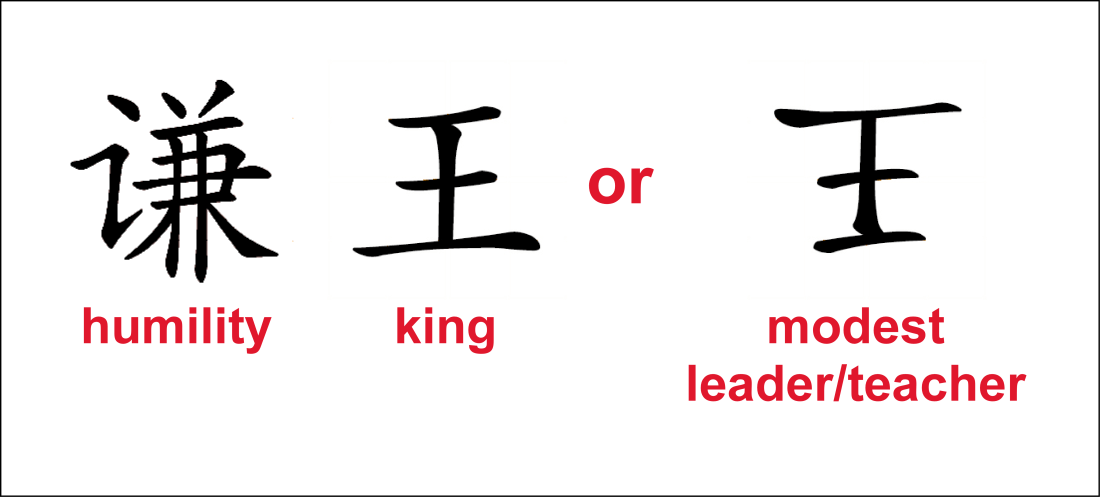
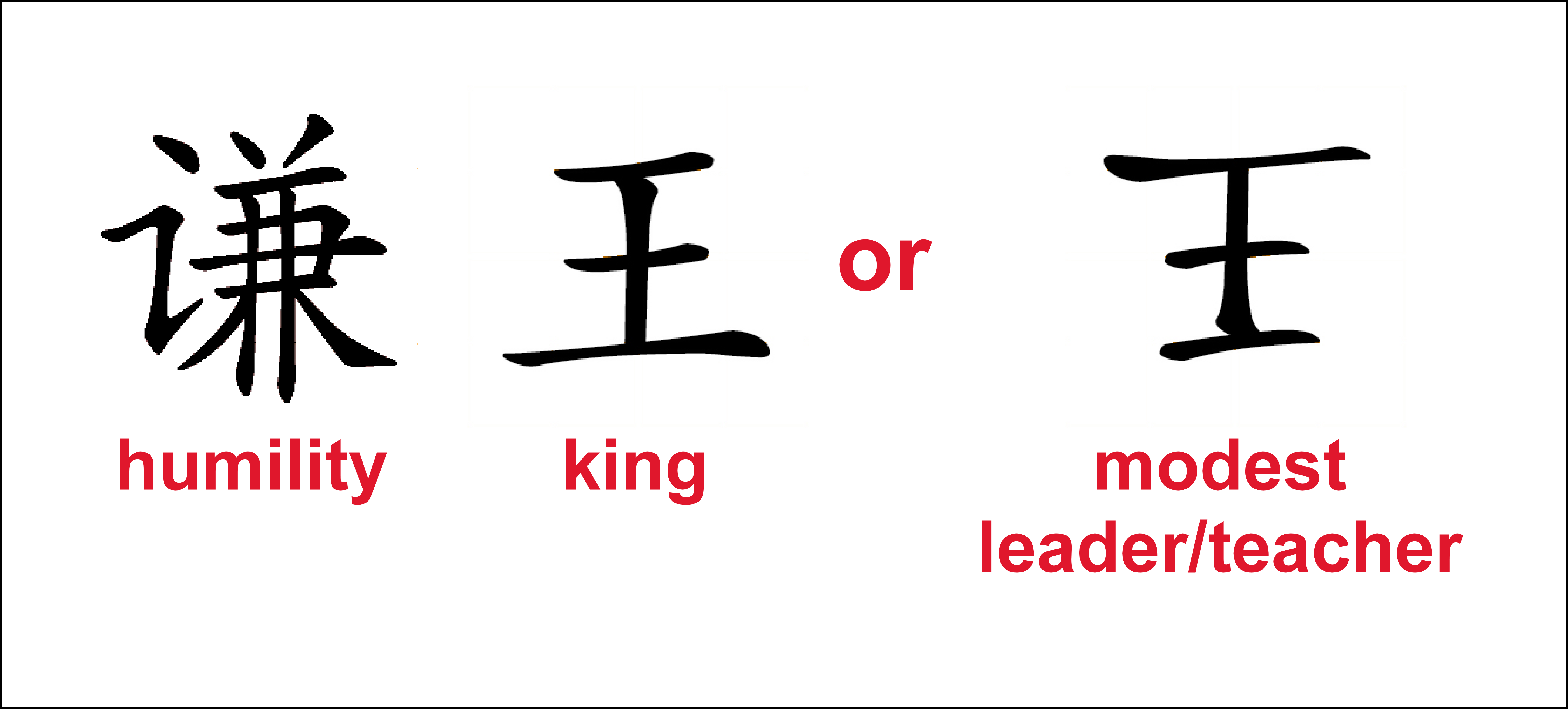
The Chinese character for humility is 谦 (qiān). The character for a king (or ruler) is 王 (wáng), but when flipped, it can be associated with something reversed, such as a reversed position, or lack of power. Combining these, one could interpret 谦王 (qiān wáng) as “humble ruler” or “modest king”, representing a ruler who is both powerful and humble.

In a time long ago, a great king ruled over a vast and prosperous land. Despite his power, he felt something was missing. Perhaps an imbalance in the heart of his kingdom and perhaps within himself. Recognizing the limits of his own understanding, the king invited a wise man to help restore harmony to his realm.

The wise man accepted the invitation, bringing with him not armies or gold, but clarity, insight, and timeless wisdom. Through thoughtful guidance, he realigned the kingdom’s priorities. Not by conquering enemies, but by restoring balance between the people and their values. He offered no lectures on dominance or strategy, but instead taught the king to listen more, act less, and lead from within. And then, without asking for any reward or recognition, the wise man quietly departed.

The king was stunned. He had expected a request for treasure or title. Instead, the king was left with only the echo of wisdom that had shifted the foundation of his being. He was no longer the same man. In honor of this transformative experience, the king ordered the Chinese character for “king” () to be turned upside down wherever it appeared in his palace.

This symbolic act was not a rejection of power, but rather a redefinition of it. By inverting the symbol of his own authority, the king declared a new truth:

The Deeper Meaning

While the tale may not be part of the classic canon of Chinese folklore, its message is deeply rooted in Eastern philosophy and holistic wisdom traditions.

In Taoist thought, the greatest rulers are often those who lead without force. The sage governs by aligning with the Tao or natural order, practicing wu wei or effortless action, and allowing things to unfold organically.

In Confucian ethics, the moral character of the ruler sets the tone for the nation. A wise and virtuous leader brings peace not through decrees but by embodying righteousness.

In Buddhist teachings, detachment from ego and recognition of impermanence guide the wise. Like the sage in the story, the Bodhisattva acts for the benefit of others without seeking personal gain.

The upside-down character becomes a living reminder: true power lies not in domination, but in service, awareness, and the willingness to learn.

A Reflection for Our Times

In today’s world, where leadership is often equated with control, and success with status, the Upside-Down King offers us a timeless teaching:

This story reminds us that holistic well-being begins with humility, whether we are leading others, caring for our health, or walking the path of self-discovery. The body may follow orders, but the soul responds to truth. And in the realm of wellness, just as in the kingdom of the wise king, balance is restored when wisdom reigns over ego.

I look forward to further sharing more of my message by partnering with hospitals, wellness centers, VA centers, schools on all levels, businesses, and individuals who see the value in building a stronger nation through building a healthier population.

I also have hundreds of FREE education video classes, lectures, and seminars available on my YouTube channel at:

https://www.youtube.com/c/MindandBodyExercises

Many of my publications can be found on Amazon at:

http://www.Amazon.com/author/jimmoltzan

My holistic health blog is available at:

https://mindandbodyexercises.wordpress.com/

http://www.MindAndBodyExercises.com

Mind and Body Exercises on Google: https://posts.gle/aD47Qo

Jim Moltzan

407-234-0119

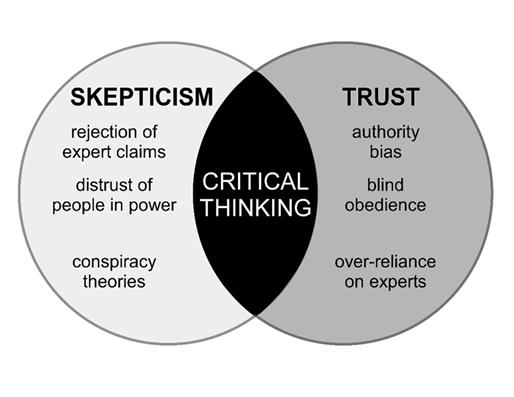
Beyond Critical Thinking: The True, Right, and Correct Framework

In an age dominated by speed, data, and polarization, the need for wise decision-making has never been greater. While traditional critical thinking focuses on logic and evidence, it often omits other dimensions of human understanding, such as authenticity, ethics, and contextual appropriateness. The “True, Right, Correct” framework expands critical thinking into a multidimensional model that integrates intellectual rigor with moral clarity and practical wisdom.

This model draws from philosophical reasoning, spiritual awareness, and functional discernment to offer a more holistic approach to evaluating choices, actions, and beliefs.

Expanding Critical Thinking: A Holistic Triad

Critical thinking is often defined as the ability to analyze, evaluate, and synthesize information in order to form reasoned judgments. It relies on logic, evidence, skepticism, and reasoning. However, while these tools are necessary, they are not always sufficient.

The “True, Right, Correct” framework offers a layered upgrade to conventional critical thinking:

AspectConventional Critical ThinkingTrue-Right-Correct Framework
LogicEssentialIntegrated within “Right”
EthicsOptional or minimalCentral under “True”
AuthenticityRarely addressedEssential under “True”
Intuition/ConscienceOften ignoredEmbraced within “True” and “Right”
Functional AptnessSometimes includedCore under “Correct”

Overview of the Two-lens Model

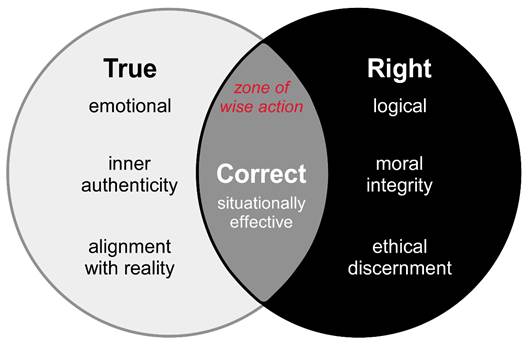
The framework is visualized as a Venn diagram with two intersecting circles and the portion that overlaps to form a third zone:

  • TRUE – Inner authenticity and alignment with reality
  • RIGHT – Moral integrity and ethical discernment
  • CORRECT – Balance of technical soundness and contextual precision

Where these two elements intersect is the “zone of wise action.”

1. TRUE: Alignment with Reality and Authenticity

  • Definition: What aligns with one’s inner values, lived experience, or observable truth
  • Includes: Self-awareness, factual clarity, personal integrity, intuitive knowing
  • Example: Expressing a difficult truth even when it’s unpopular

Critical Thinking Link: Encourages self-honesty and questions personal assumptions

Reflection Questions:

  • Am I being honest with myself and others?
  • Is this based on what is real or what is assumed?
  • Does this reflect my core values and lived experiences?

2. RIGHT: Moral and Ethical Discernment

  • Definition: What is just, compassionate, and beneficial from a moral perspective
  • Includes: Fairness, empathy, justice, long-term benefit to others
  • Example: Choosing not to exploit a legal loophole because it harms others

Critical Thinking Link: Adds an ethical filter to decisions that might otherwise be purely strategic

Reflection Questions:

  • Is this action fair and just?
  • Would I consider this acceptable if done to me?
  • Does this honor both the letter and spirit of the greater good?

3. CORRECT: The Balance of Functional Precision and Situational Appropriateness

  • Definition: What is technically accurate, logically coherent, and situationally effective
  • Includes: Evidence-based reasoning, timing, execution, contextual fit
  • Example: Using the correct communication method for sensitive feedback

Critical Thinking Link: Embeds the core tools of analysis, logic, and evidence evaluation

Reflection Questions:

  • Is this the best balance between true and right, that can serve the most involved?
  • Is this method sound and supported by facts?
  • Am I choosing the most effective way to act or express this?
  • Is it appropriate for this time, place, and audience?

Applications in Teaching and Practice This framework serves as a compass for ethical leadership, personal reflection, and integrative education:

  • In classrooms: Pairing logic with ethics and introspection
  • In leadership: Building trust through aligned, values-driven decisions
  • In personal growth: Assessing decisions using a whole-self model
  • In debate and conflict: Seeking understanding through multiple lenses

Teaching Module Activities

  1. Case Study Analysis – Analyze real-world dilemmas from all three perspectives
  2. Personal Journaling – Reflect on a difficult decision using the lens of true, right, and correct
  3. Group Debates – Discuss how outcomes shift when one element is missing
  4. Visual Mapping – Place actions on a Venn diagram to assess alignment

Conclusion The “True, Right, Correct” framework expands critical thinking into a richer, more human-centered process. It challenges individuals not just to think better, but to live and act more wisely through authenticity, ethical clarity, and contextual intelligence. In doing so, it reclaims critical thinking not only as a cognitive skill, but as a moral and spiritual practice.

Dunbar’s Number and the Limits of the Human Mind

In a world of overflowing inboxes, closets packed with clothes, and hundreds of digital “friends,” we’re constantly inundated with choices and connections. Yet, nature may have already set a quiet boundary, or a cognitive threshold that defines just how much we can meaningfully manage. This idea is known as Dunbar’s Number.

Originally developed to explain the limit of human relationships, Dunbar’s Number now resonates far beyond sociology. It hints at a broader pattern of mental ecology, a natural balance point between meaningful engagement and cognitive overload.

What Is Dunbar’s Number?

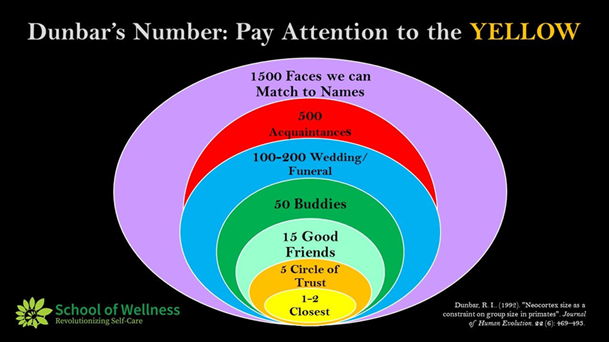
British anthropologist Robin Dunbar proposed that humans can maintain stable, meaningful social relationships with about 150 people. This number is based on research into primate brain size and social group complexity, specifically linking the size of the neocortex to the number of relationships a species can manage (Dunbar, 1992).

But the “150” isn’t a flat figure, but it represents the outer ring of a series of concentric social layers, each one decreasing in emotional intensity and time investment.

Dunbar’s Social Circles

  • 5 Close Confidants (e.g., family, best friends)
  • 15 Good Friends
  • 50 Close Acquaintances
  • 150 Meaningful Contacts
  • 500 Acquaintances
  • 1500 Recognizable Faces/Names

This layered model reflects the time and emotional energy required to maintain different levels of connection. And it turns out, it’s not just friendships that have limits.

(O’Grady, 2019)

The Broader Pattern: Where Else Does “150” Show Up?

Though Dunbar’s Number is specific to social cognition, the underlying idea that the brain can only handle so much complexity before performance drops, can be seen in many areas of life. Here are some real-world examples where a “Dunbar-like” limit seems to apply:

Short-Term Memory

Classic psychology research (Miller, 1956) suggests that we can hold 7±2 items in our short-term memory at once. While this number is much smaller than Dunbar’s 150, it reflects the same principle: our mental bandwidth is limited. Just as we can’t juggle endless thoughts, we also can’t nurture unlimited relationships.

Clothing and Possessions

Ever feel like you can’t find anything to wear, even with a full closet? That may be your cognitive load talking. While not exact science, many people report that having around 100–150 clothing items is the sweet spot where they still remember what they own, how to pair items, and what each piece is for.

Beyond that, possessions blur into mental background noise, ust like Facebook “friends” you haven’t spoken to in years.

Workplace Cohesion

Studies suggest that corporate teams function best when kept to 150 people or fewer. Beyond that, communication suffers, silos form, and social trust deteriorates. This principle has influenced everything from military units to organizational design (Hill & Dunbar, 2003).

Personal Library or Interests

You might own thousands of books or have tabs open on dozens of topics. But chances are, you can only actively track and revisit around 100–150 meaningful subjects, books, or areas of ongoing interest. This is where attention, memory, and emotional investment overlap.

Digital Files and Faces

Just like your closet, your desktop or phone storage may hold thousands of files. But in practice, people report that only a few hundred are accessed regularly, and even fewer are remembered without searching. Similarly, the number of recognizable faces we can recall is around, you guessed it is about 1500.

From Brain to Behavior: A Holistic View

So, what does all this mean for those of us pursuing a more mindful, intentional life?

Dunbar’s Number reminds us that less is often more. Whether it’s relationships, wardrobe items, digital clutter, or intellectual pursuits, our well-being depends not on volume, but on depth and manageability. We are not machines for connections. We are human beings wired for meaningful engagement.

From a holistic health perspective, this understanding is vital. Emotional burnout, digital fatigue, and decision paralysis are symptoms of cognitive overload. By curating our social circles, reducing unnecessary possessions, and aligning our mental inputs with our natural limits, we create room for clarity, creativity, and calm.

Just as Taoist teachings advise finding balance in the flow of yin and yang, Dunbar’s insights offer a secular mirror: balance in our connections, in our commitments, and in our consumption.

Final Reflection: Mental Ecology in a Noisy World

We live in a culture that celebrates more. More contacts, more options, more everything. But Dunbar’s Number challenges that notion, whispering a quieter wisdom:

“You are not meant to carry the weight of the world. Just the weight of what matters.”

Knowing your personal thresholds, whether it’s 5 close friends or 150 articles you truly care about, allows you to reclaim agency over your attention and emotional energy. In a way, this is not just science. It’s spiritual clarity.

References:

Dunbar, R. I. M. (1992). Neocortex size as a constraint on group size in primates. Journal of Human Evolution, 22(6), 469–493. https://doi.org/10.1016/0047-2484(92)90081-J

Dunbar, R. I. M. (2018). The anatomy of friendship. Trends in Cognitive Sciences, 22(1), 32–51. https://doi.org/10.1016/j.tics.2017.10.004

Hill, R. A., & Dunbar, R. I. M. (2003). Social network size in humans. Human Nature, 14(1), 53–72. https://doi.org/10.1007/s12110-003-1016-y

Miller, G. A., Jr. & Harvard University. (1956). The Magical Number Seven, Plus or Minus Two: Some Limits on our Capacity for Processing Information. In Psychological Review (Vols. 63–97) [Journal-article]. https://labs.la.utexas.edu/gilden/files/2016/04/MagicNumberSeven-Miller1956.pdf

O’Grady, E. (2019, September 5). Who are the 5 People you Spend the Most Time With? Revolutionizing Self-Care. https://eileenogrady.com/who-are-the-5-people-you-spend-the-most-time-with/

Mastery in the World of Form: Integrating Wealth, Health, and Spirit

In the pursuit of personal evolution, many traditions emphasize the renunciation of material wealth as a path to spiritual enlightenment. Yet this view may overlook an essential truth: the mastery of life requires full engagement with both the spiritual and material realms. Rather than rejecting worldly success, a more holistic path invites individuals to develop discipline, embrace responsibility, and integrate spiritual realization with material abundance.

A balanced life requires strength across physical, emotional, and spiritual dimensions. True power, especially in men, is not measured by dominance or accumulation alone, but by maturity and restraint. Without discipline, power can become dangerous, giving rise to instability and harm. Therefore, self-mastery begins with a commitment to personal responsibility, training the body, focusing the mind, and cultivating inner peace.

One foundational concept in this approach is the idea that wealth and health are not opposites of spiritual life but necessary stages in the ladder of awakening. Through conscious acquisition and enjoyment of material pleasures—followed by the ability to release attachment—one gains not only experience but freedom from the cycles of craving and aversion. This path requires mastering the “world of form,” learning to participate in it fully without being controlled by it. Those who avoid or bypass this stage may find themselves spiritually incomplete. If one believes in reincarnation, this situation may lead to further experiences in future lifetimes to fully integrate these unlearned lessons.

Conscious development can be mapped through the lens of energy centers or chakras, where each stage corresponds to an essential life lesson: from physical grounding and pleasure to peace, joy, love, compassion, and ultimately ecstatic or blissful states of awareness. These are not mere metaphors but practical tools for tracking one’s evolution. A person who cannot access joy or inner peace may need to revisit the foundations of health, safety, and stability before advancing into higher spiritual states.

Central to this journey is the rejection of victimhood. Blaming society, circumstances, or others for one’s failures hinders growth. Only by accepting full responsibility for one’s health, finances, relationships, and spiritual development can one initiate true transformation. This principle applies across life stages, which can be seen as cycles: childhood (0–8), adolescence and young adulthood (8–33), fruition (33–58), correction (58–83), and ultimately the sage or spirit phase (83–108). Each phase carries its own lessons and demands appropriate effort and reflection.

In later life, aging should not be viewed as decay, but as a biological and spiritual opportunity. With proper practice through breathwork, meditation, physical cultivation, and mental clarity, many signs of aging can be reversed or mitigated. The aim is to remain vibrant, focused, and spiritually prepared for death, which, when acknowledged consciously, becomes a motivator for authentic living.

The role of family, lineage, and tradition is also pivotal. Respect for one’s parents and ancestors does not require blind obedience or emotional entanglement but calls for honoring their place in one’s development. This maturity fosters generational healing and sets an example for those who follow.

Integration of spiritual wisdom with material responsibility is not unique to any one culture. Whether through Christian parables, Taoist discipline, or Buddhist insight, timeless truths emerge: the value of discipline, the importance of presence, the need for compassion, and the certainty of death. When viewed through this inclusive lens, spirituality becomes less about belief and more about the embodiment of universal principles.

The ideal individual, a strong, wise, and compassionate being, embodies the archetype of the strategist and warrior. Not through brute strength or spiritual aloofness, but through the unification of effort, enjoyment, reflection, and humility. Mastery is not found in a cave or an office alone, but in the weaving of both. When one lives fully, without excuses or illusions, the path reveals itself not above the world, but through it.

Early Summer in Traditional Chinese Medicine

Fire Element, Circulation, and the Nervous System

As nature enters early summer, Traditional Chinese Medicine (TCM) views this vibrant season through the lens of the Fire element, a phase of maximum Yang, warmth, expansion, and communication. Fire governs not only the Heart and blood vessels, but also the nervous system, emotions, and spiritual awareness. This inner fire fuels both our physical vitality and our mental clarity. In this unique seasonal phase, the flow of Qi, Blood, and Shen (spirit), especially through the veins, arteries, and the Eight Extraordinary Meridians takes center stage.

Understanding the dynamic between the Fire element, cardiovascular and neurological systems, and the deeper energetic channels allows us to harmonize body, mind, and spirit during this high-energy time of year.

🔥 Fire Element and Its Associations

In TCM’s Five Phase (Wu Xing) framework, Fire is associated with:

  • Season: Early Summer
  • Organs: Heart (Yin) and Small Intestine (Yang)
  • Emotions: Joy, enthusiasm, overexcitement, or mania
  • Body Tissue: Blood vessels and the nervous system
  • Sense Organ: Tongue
  • Color: Red
  • Climate: Heat
  • Direction: South
  • Taste: Bitter (Maciocia, 2005; Deadman et al., 2007)

Fire energy is expansive and expressive, symbolizing circulation, communication, and consciousness. When well-regulated, Fire fuels love, clarity, movement, and insight. When excessive, it can consume the mind and disturb the spirit.

❤️ Heart, Blood Vessels, and Nervous Regulation

The Heart (Xin) is considered the “Emperor” of the body, orchestrating the flow of Qi and Blood and serving as the seat of Shen (mind/spirit). TCM describes its functions as:

  • Governing the blood and blood vessels
  • Housing the Shen, which includes consciousness, thought, memory, and emotions
  • Regulating mental activity and sleep (Maciocia, 2005)

The blood vessels, seen as pathways of both Blood and Qi, rely on the Heart’s warmth and rhythm to remain supple and open. But TCM also suggests that nerve-like communication and coordination are part of the Heart’s governance.

In modern integrative interpretations:

  • The autonomic nervous system (ANS), particularly the parasympathetic “rest-and-digest” functions, mirrors the Heart’s role in maintaining emotional and physical balance.
  • Excess Fire may overstimulate the sympathetic nervous system, leading to agitation, insomnia, hypertension, palpitations, and anxiety.
  • Deficient Heart Fire may lead to neurovegetative fatigue, poor concentration, and low vitality (Kaptchuk, 2000).

Thus, the vascular and neurological systems are harmonized through Fire’s balance affecting everything from blood pressure to mood and mental performance.

🧠 Fire Element and the Nervous System

TCM may not anatomically label the nervous system as Western medicine does, but the concepts of Shen, Yi (intellect), and Zhi (willpower) reflect cognitive and neurological activity.

In early summer:

  • Shen becomes more active and outward, seeking expression, connection, and joy.
  • The Du Mai (Governing Vessel) linked with the brain and spine, rises in importance, guiding mental alertness and emotional regulation.
  • The Fire element’s influence supports neurotransmitter balance, sleep-wake cycles, and emotional processing.

From a modern neurobiological point of view, this aligns with the brain-heart connection:

  • Heart Rate Variability (HRV), a marker of nervous system resilience, increases with parasympathetic tone, a goal of Heart-focused qigong and meditation
  • Practices that balance Heart Fire can directly impact the vagus nerve, thereby stabilizing emotions and stress responses (Porges, 2011)

🩸 Extraordinary Meridians and Fire Circulation

The Eight Extraordinary Meridians function as deep energetic reservoirs, regulating circulation, constitutional energy, and emotional integration (Larre et al. (1996). In early summer, these vessels help modulate the Fire element’s rise and distribute Qi and Blood in ways that nourish the whole system.

1. Chong Mai (Penetrating Vessel)

  • Sea of Blood, linked to Heart and uterus
  • Balances hormonal and emotional rhythms
  • When Fire is excess: anxiety, chest oppression, uterine bleeding

2. Ren Mai (Conception Vessel)

  • Nourishes Yin; anchors the Heart through calming fluids
  • Connects deeply to Heart-Yin and Shen stabilization

3. Du Mai (Governing Vessel)

  • Axis of Yang energy; influences brain, spine, and nervous system
  • Becomes overactive when Fire flares upward, causing insomnia or hyperarousal

4. Dai Mai (Belt Vessel)

  • Regulates Qi flow around the waist, harmonizes rising Fire from middle and lower burners

By supporting these vessels through breathwork, meditation, herbs, and seasonal living, we can help regulate the Fire element’s effects on circulatory, emotional, and neurological functions.

🌿 Seasonal Strategies for Summer Balance

🔹 Qigong & Meditation

  • Heart-centered qigong and the Inner Smile meditation bring Shen home to the Heart
  • Breathing practices that lengthen the exhale can calm the nervous system and increase vagal tone
  • Include “Cooling the Fire” meditations to harmonize Du Mai and Shen

🔹 Lifestyle Adjustments

  • Avoid overstimulation, especially from social media, caffeine, or excess sun
  • Go to bed earlier, maintain emotional equanimity
  • Emphasize connection over excitement
  • Prioritize joyful stillness rather than external thrill-seeking

🌀 Summary: Fire’s Intelligence in the Body

Early summer is the season of Shen and circulation, a time when the Fire element stimulates outward movement, connection, and the full flowering of human potential. Yet this power must be anchored. Overexertion, excess heat, and emotional overload can disrupt the Heart, destabilize the nervous system, and drain the blood vessels and extraordinary meridians.

Through awareness, breath, and regulation, we can cultivate a sovereign Heart, a resilient mind, and an inner flame that warms but never burns.

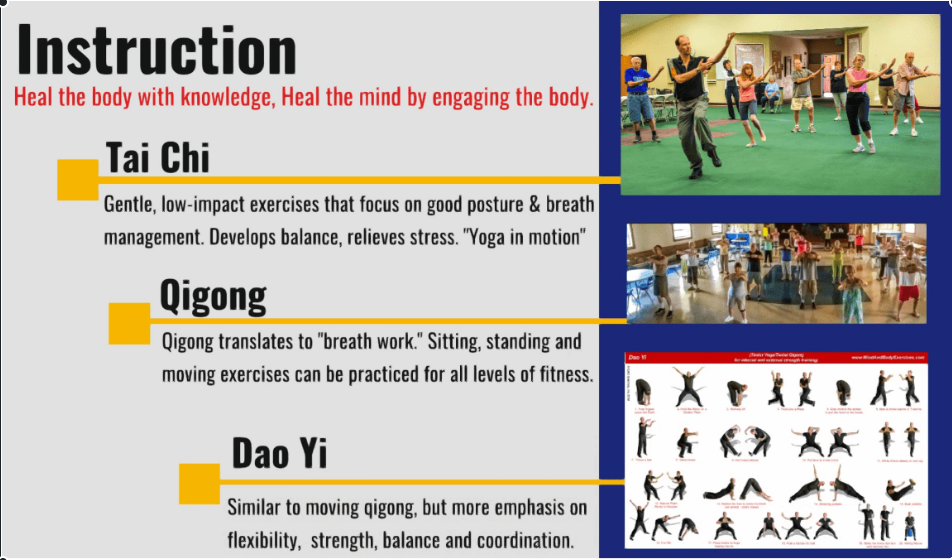
8 Vessels Qigong

References:

Deadman, P., Al-Khafaji, M., & Baker, K. (2007). A Manual of Acupuncture. Journal of Chinese Medicine Publications.

Kaptchuk, T. J. (2000). The Web That Has No Weaver: Understanding Chinese Medicine (2nd ed.). McGraw-Hill.

Larre, C., de la Vallée, E., & Rochat de la Vallée, E. (1996). The Eight Extraordinary Meridians: Spirit of the Vessels. Monkey Press.

Maciocia, G. (2005). The Foundations of Chinese Medicine: A Comprehensive Text for Acupuncturists and Herbalists (2nd ed.). Elsevier Churchill Livingstone.

Porges, S. W. (2011). The polyvagal theory: Neurophysiological foundations of emotions, attachment, communication, and self-regulation. W. W. Norton & Company.