Fight or Flight, Rest & Digest – Managing Stress

Stress in managed within the human body through the nervous system. More specifically the interaction between the sympathetic and parasympathetic nervous systems. Most people pay no attention the functions until they are out of balance and begin to affect their health and happiness. Often people will deal with the imbalance through medications, drugs, alcohol, and sometimes diet. You might be surprised at how much control we have over managing our own stress through exercise, nutrition, social interactions and awareness of our emotions, and our breathing patterns.

The sympathetic nervous is system is often referred to as the “fight or flight” response. Here the brain receives stimuli that engages specific organs and their functions to make adjustments to respond to the threat of defending the individual. This could be the actions of increased eye pupil dilation to see better, dilated bronchi to bring more oxygen into the lungs and bloodstream and increased heartbeat for more blood flow to the muscles. These are the same adjustments that happen in everyday life to address normal stress in activities such as working, exercising, social interactions and others. However, the problems begin when these adjustments become the norm where the body is in a constant state of “fight or flight”. This could be looked upon similarly to having the heat and air-conditioning constantly running in the extreme direction one way or the other, all of the time, day and night, everyday. Being hot all of the time is usually not comfortable just as always be cold is not comfortable. Your body needs to adjust to your environment to find your comfort zone; your nervous system works similarly to deal with your ups and downs to find your physical as well as emotional comfort zone.

The compliment to the stress-reactive sympathetic is the “rest and digest” parasympathetic nervous system. The brain also receives stimuli to engage specific organs and their functions to make adjustments to respond to the becoming more calm and relaxed. Actions here are of decreased eye pupil dilation, constricted bronchi in the lungs and a slower heartbeat. These are the same adjustments that happen in everyday life to address normal relaxing in activities such as reading, relaxing, calm social interactions and food digestion. Too much time in this state is not healthy either as the human body needs to be able to cycle between dealing with stress and being able to relax and rejuvenate.

How Deep Breathing Affects Your Health

I write about proper breathing often. Our 1st breath as a newborn baby and the last breath before we die defines the physical human life span. Deeper breathing is a key component to having a long and healthy life. Through focused and deliberate breathing methods, many positive mental and physical benefits can be achieved.

The average person breathes 12-18 breathes per minute (BPM) during regular activity of standing, sitting & walking, engaging the sympathetic nervous system (SNS). Constant duration in the SNS dumps neurotransmitters of cortisol and norepinephrine into the blood stream putting the vital organs in a state of constant high alert and stress. Health and fitness experts suggest that 6 BPM is optimal for the lungs to properly oxygenate the whole body, balance the blood chemistry and also remove toxins. The lungs are responsible for removing 70% of the body’s waste by-products through exhalation. This is more easily accomplished through mindful breathing patterns from exercises such as mediation, qigong, tai chi and yoga. During these types of exercises, the nervous system initiates functions to secrete the happy hormones of:

Dopamine – the brain’s reward system neurotransmitter

Oxytocin – helps promote trust, empathy, nurturing, bonding in relationships

Serotonin – helps regulate mood, sleep, appetite, memory

Endorphins- our body’s natural pain reliever

Take the first letter of each hormone and you get DOSE; a healthier dose of chemicals manufactured within our bodies that make us feel better and don’t tear the body down over time like cortisol does.

Most people breathe too shallow and too quickly!

Much recent research has linked stress to poor breathing habits and consequently many ailments. Many modern chronic conditions can be traced back to insufficient cell oxygenation otherwise known as cell hypoxia.

Breathing is one of the few bodily rhythms that we can consciously adjust, along with sleep and elimination. All of these rhythms directly effect our body’s delicate blood chemistry. However, our breath is the root power in bringing oxygen (qi) into our body to nourish it down to the cellular level.

I can help. I have almost 40 years worth of experience in practicing and teaching others to take control of their health and well-being. Wellness lectures, classes, study guides & booklets.For more information, contact Jim Moltzan at 407-234-0119 or www.MindAndBodyExercises.com

Be well!

Jim Moltzan

407-234-0119

http://www.MindAndBodyExercises.com

https://www.facebook.com/MindAndBodyExercises/

https://www.youtube.com/c/MindandBodyExercises

https://mindandbodyexercises.wordpress.com

/https://umareg.com/masters-council/

Taming the Inner Dialogue

We have an inner mental dialogue going on inside our head that mostly never stops. Often referred to as self-talk, inner chatter and inner speech. The next time you have a disturbing thought or emotion, remember that it does not define or control you. After all, you are not your thoughts but rather the observer to your thoughts. You can actively choose whether to participate in it or not.

Whatever thoughts or feelings that happen to present themselves in your head at any given moment do not define or control you. You are not angry, but rather can experience anger. We are not happy nor angry human beings but rather can choose to be happy, angry or whatever emotional state we care to experience at any given time. However, managing or controlling thoughts and consequently emotions is for most people, not an easy task to achieve.

Thoughts Affect Your Emotions

Every thought, has an emotional attachment on some level. Positive emotions keep organs in balance for optimal performance. Negative emotions disrupt this balance leading to other symptoms and ailments.

  • Emotions affect the endocrine system (body chemistry)
  • The body chemistry affects hormones (growth & stress)
  • Growth or stress hormones affects bodily functions of the physical health
  • Physical health affects your thoughts – completing the circuit, brings us back full circle

What You Think Affects Your Outlook
If your thoughts have a mostly positive emotional attachment on some level, you may have more of an optimistic outlook in your life. Conversely, mostly negative emotions tend to make people have a somewhat pessimistic outlook in their life.

Traditional Chinese Medicine recognizes that there is a direct link from our emotions to the health of our internal organs and their functions.

Tai chi, yoga, martial arts, meditation and other time-proven methods are known practices to help manage and control the inner dialogue.

A recent article form the Wall Street Journal explains more about managing the inner chatter.

https://www.wsj.com/articles/how-to-stop-the-negative-chatter-in-your-head-11609876801?page=1

As we all continue to age, we need to decide how much time and effort we choose to put towards our health and well being. Weekly hours of time pursuing a healthy lifestyle can prevent potential hours at the doctor’s office or days in the hospital.

Be well, stay healthy, be wise.

I can help. I have almost 40 years worth of experience in practicing and teaching others to take control of their health and well-being. Wellness lectures, classes, study guides & booklets.

For more information, contact Jim Moltzan at 407-234-0119 or www.MindAndBodyExercises.com

Slower Breathing & How Physiologically it is a Key Component in Longevity

How Deep Breathing Affects Your Health

Deeper breathing is a key component to having a long and healthy life. Through focused and deliberate breathing methods, many positive mental and physical benefits can be achieved.

The average person breathes 12-18 breathes per minute (BPM) during regular activity of standing, sitting & walking, engaging the sympathetic nervous system (SNS). Constant duration in the SNS dumps neurotransmitters of cortisol and norepinephrine into the blood stream putting the vital organs in a state of constant high alert and stress. Health and fitness experts suggest that 6 BPM is optimal for the lungs to properly oxygenate the whole body, balance the blood chemistry and also remove toxins. The lungs are responsible for removing 70% of the body’s waste by-products through exhalation. This is more easily accomplished through mindful breathing patterns from exercises such as mediation, qigong, tai chi and yoga.

Most people breathe too shallow and too quickly!

Much recent research has linked stress to poor breathing habits and consequently many ailments. Many modern chronic conditions can be traced back to insufficient cell oxygenation otherwise known as cell hypoxia.

Breathing is one of the few bodily rhythms that we can consciously adjust, along with sleep and elimination. All of these rhythms directly affect our body’s delicate blood chemistry. However, our breath is the root power in bringing oxygen (qi) into our body to nourish it down to the cellular level.

Faster breathing is necessary when experiencing truly stressful situations, like being chased by an animal, running from a fire or similar life-threatening situations. However, continued breathing at this pace for an extended period of time puts accumulative stress on all of the body’s systems.

The following link has more information from the US National Library of Medicine, National Institutes of Health that goes a bit deeper into the science of why lower breaths per minute (BPM) is so beneficial.

https://www.ncbi.nlm.nih.gov/pmc/articles/PMC5709795/

I can help. I have almost 40 years worth of experience in practicing and teaching others to take control of their health and well-being. Wellness lectures, classes, study guides & booklets.For more information, contact Jim Moltzan at 407-234-0119 or www.MindAndBodyExercises.com

Be well!

Jim Moltzan

407-234-0119

http://www.MindAndBodyExercises.com

https://www.facebook.com/MindAndBodyExercises/

https://www.youtube.com/c/MindandBodyExercises

https://mindandbodyexercises.wordpress.com

/https://umareg.com/masters-council/

Happy New Year! Now get to work.

Happy New Year!

New Year’s resolutions are seldom kept. Rather, make a promise or commitment to yourself to maintain a healthy lifestyle.

I can help. I have almost 40 years worth of experience in practicing and teaching others to take control of their health and well-being. Wellness lectures, classes, study guides & booklets.For more information, contact Jim Moltzan at 407-234-0119 or www.MindAndBodyExercises.com

Almost 40 years ago, I began taking notes of what I was learning from my teachers of martial arts, fitness and wellness practices.

Then I started taking graphical notes from doctors, chiropractors, Traditional Chinese Medicine practitioners, acupuncturists, professors and my other health-related teachers.

As technology evolved, so did my note taking.

The video below shows part of my collection of graphical notes from my years of training, studying and learned life lessons.

I have created over 300 graphics depicting various topics or concepts.

I have composed over 20 journals each with a particular health-related theme.

And I have co-authored a book, The Journey Around the Sun.

All of these graphics represent the following topics that I passionately teach in lectures and classes.

  • Anatomy and physiology
  • Body mechanics
  • Wellness concepts
  • Learning concepts
  • Stress management
  • Chronic pain management
  • Physical rehabilitation
  • Functionally specific exercise sets
  • Self awareness
  • Traditional Chinese Medicine
  • Eastern philosophy
  • Energetic anatomy

Never stop learning. Be well, stay healthy, be wise.

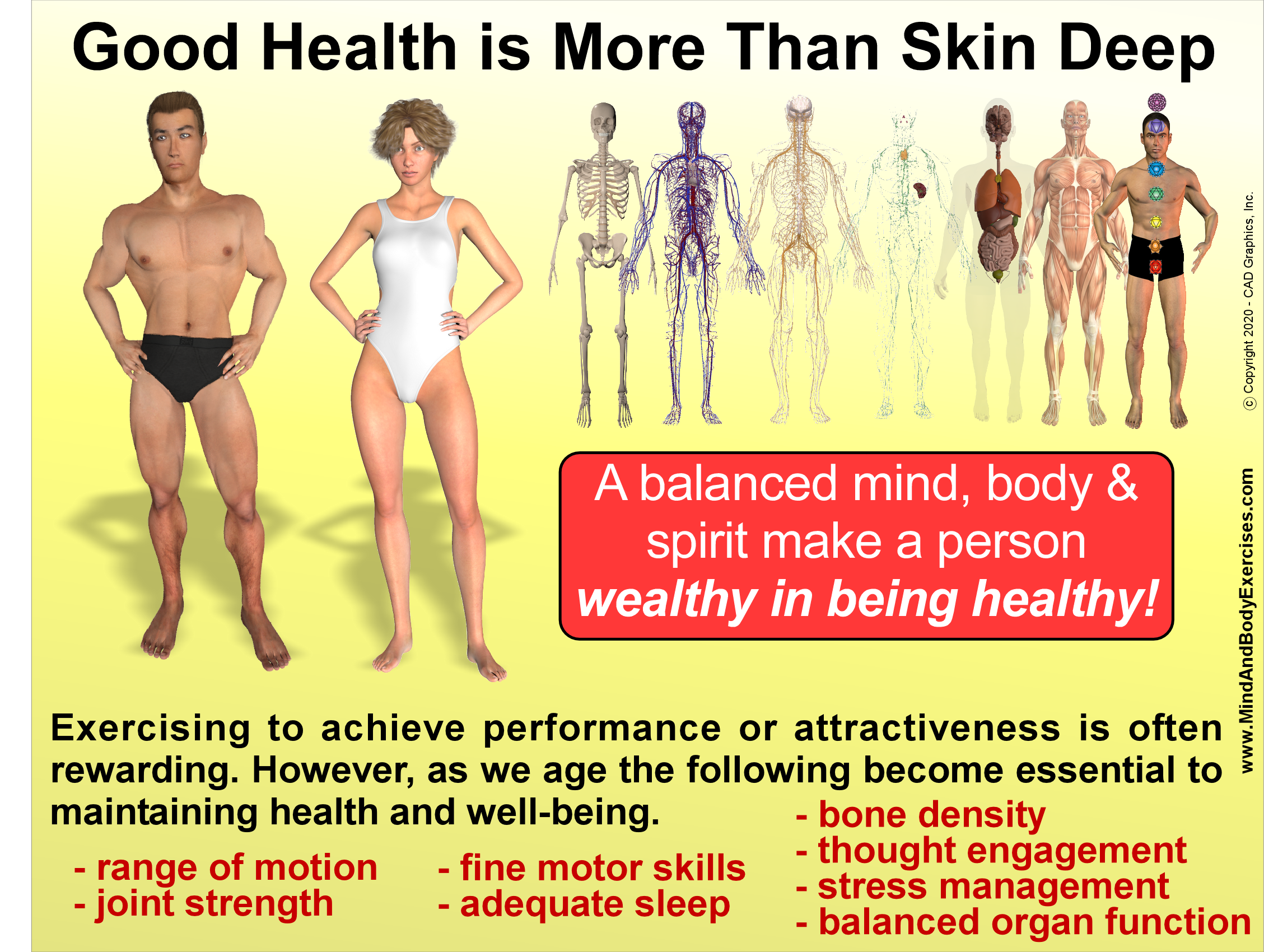
Health is Wealth

A balanced mind, body & spirit make a person wealthy in being healthy!

Exercising to achieve performance or attractiveness is often rewarding. However, as we age the following become essential to maintaining health and well-being.

  • range of motion
  • joint strength
  • fine motor skills
  • adequate sleep
  • bone density
  • thought engagement
  • stress management
  • balanced organ function
  • vestibular balance

Self-discipline Can be Developed.

Anything of value is always going to require some amount of sacrifice of time, effort and resources.

For most people, it is very difficult to train or discipline their mind and consequently, their body. People often say or do things they regret only to realize later that they lacked the self control and self awareness to make good decisions to begin with.

By gaining control of the physical anatomy, a relationship with the physical body is developed. When aligning the limbs and joints to stretch and strengthen them, while also maintaining deep and deliberate breathing rhythms, an individual can cultivate a more harmonious link between the mind, body and spirit (self awareness). Practice of exercises that truly engage the mind and body, (very much like yoga) to improve health & wellness. The mind directs the body, while the body protects the mind.

Discipline the mind in order to discipline the body!

Learn how this all works from private, small or group instruction.

Be well!

Jim Moltzan

407-234-0119

http://www.MindAndBodyExercises.com

https://www.facebook.com/MindAndBodyExercises/

https://www.youtube.com/c/MindandBodyExercises

https://mindandbodyexercises.wordpress.com

https://umareg.com/masters-council/