
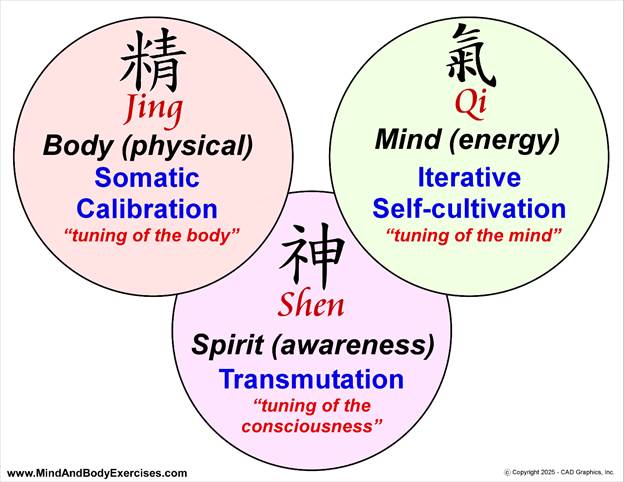
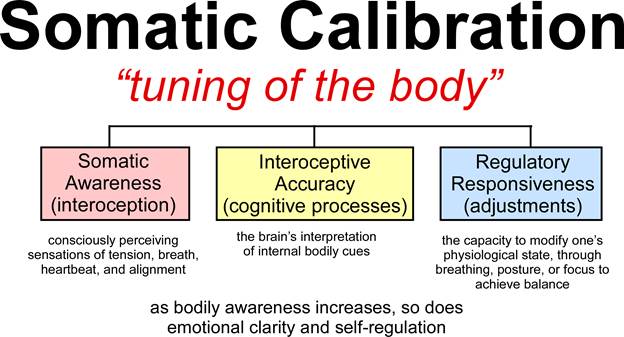
Phase 1 — Foundational Awareness: Somatic Calibration (Jing)
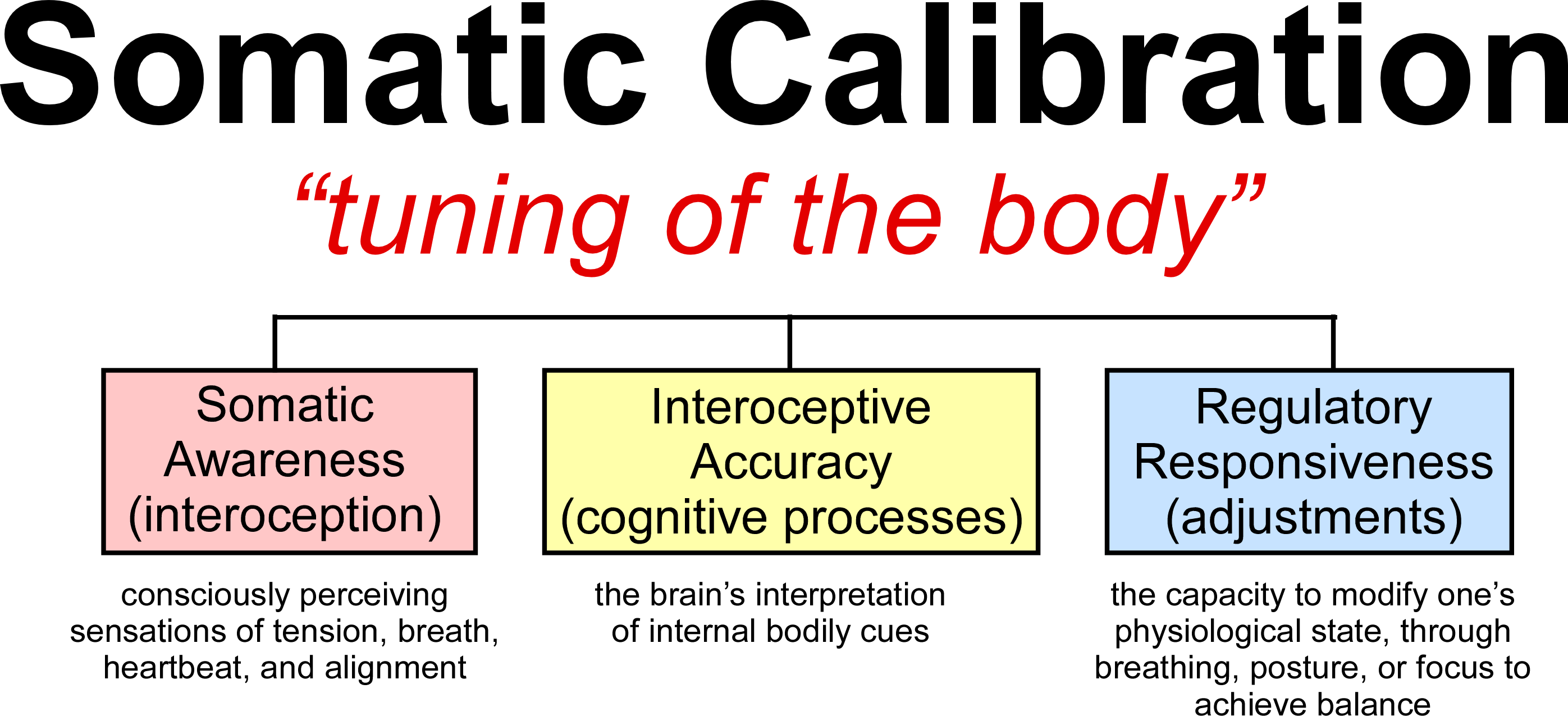
Phase 1 represents the foundational stage where the practitioner learns to attune their physical body, the Jing level, through heightened somatic awareness and physiological regulation. At this level, the focus is on:
- Interoception: sensing internal signals such as breath, heartbeat, and muscular tension
- Proprioception: detecting body position and micro-adjustments
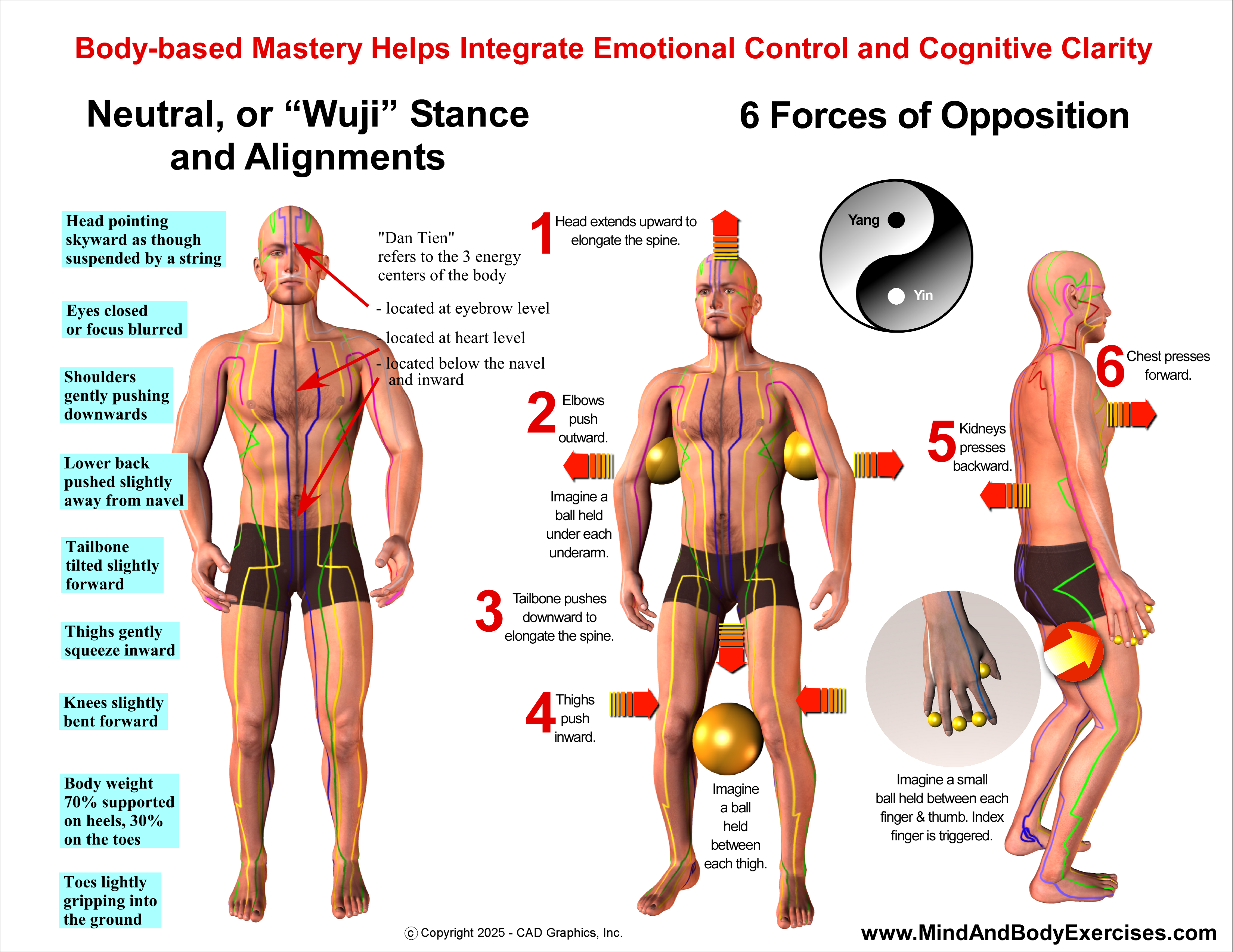
- Regulatory Responsiveness: adjusting posture, breathing, and alignment
Somatic calibration stabilizes the “base material” of the human system. In Taoist internal arts, this is the earliest refinement of Jing: raw essence becoming cleaner, clearer, and more governable.
Neuroscientifically, this phase strengthens communication between the insula (interoceptive awareness), anterior cingulate cortex (attention and motivation), and prefrontal cortex (regulation and decision-making). When these systems integrate, the practitioner becomes capable of sensing imbalances long before they erupt into dysfunction (Khalsa et al., 2018).
This phase is therefore concerned with:
- Cultivating “felt sense”
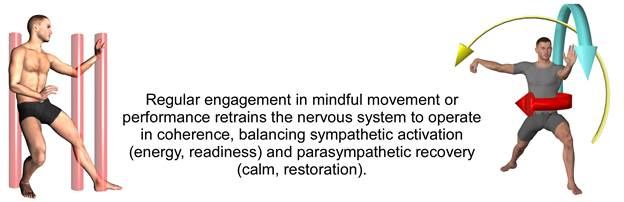
- Stabilizing the nervous system
- Learning to “hear” the body
- Establishing physical coherence
Without Phase 1, progression into deeper phases becomes imbalanced or potentially unsafe.
This is the Jing → stability transformation.
Phase 2 — Cyclical Refinement: Iterative Self-cultivation (Qi)
Once somatic clarity is established, the practitioner advances toward the mental-energetic domain, the Qi level. This phase introduces iterative practice and self-correction, forming the living engine of personal development.
Here, the operating principle is iteration:
Practice → feedback → correction → integration → renewed practice
Across martial arts, meditation, and qigong lineages, this cyclical refinement is recognized as gongfu (kung fu), not mere skill, but the cultivated discipline earned through dedicated repetition. Each iteration reshapes:
- Motor pathways
- Emotional patterns
- Cognitive habits
- Energetic circulation
Modern neuroscience parallels this with experience-dependent neuroplasticity or the gradual restructuring of brain networks for resilience, emotional regulation, and attentional stability (Davidson & McEwen, 2012).
Spiritually and philosophically, Phase 2 is where one begins forging de (virtue, cultivated inner power). The practitioner transitions from merely feeling the body to shaping the self.
At this stage, Qi becomes more coherent and directed. Mental habits are tuned, intentions sharpen, and discipline becomes embodied.
This is the Qi → refinement transformation.
Phase 3 — Synthetic Integration: Transmutation (Shen)
Phase 3 transitions from refinement into whole-system synthesis, corresponding to the Shen level, with awareness, meaning, and inner illumination.
Here the practitioner no longer simply adjusts the body (Phase 1) or trains the mind through iteration (Phase 2). Instead, they convert base tendencies into higher capacities. This includes:
- fear → insight
- pain → empathy
- discipline → wisdom
- adversity → meaning
This is the essence of transmutation in internal alchemy (neidan):
Jing → Qi → Shen → back to emptiness and clarity
Physiologically, this level parallels harmonization of endocrine rhythms, autonomic coherence, and emotional centers that once produced reactivity but now produce calm presence.
Psychologically, the practitioner embodies authenticity rather than performance. Their presence becomes stabilizing to others, as they can become “the light that guides.”
Phase 3 is where:
- the body listens
- the mind learns
- consciousness reorients toward clarity
This is the Shen → illumination transformation.
Bring it all together – the Harmonization (Integration of Jing–Qi–Shen)
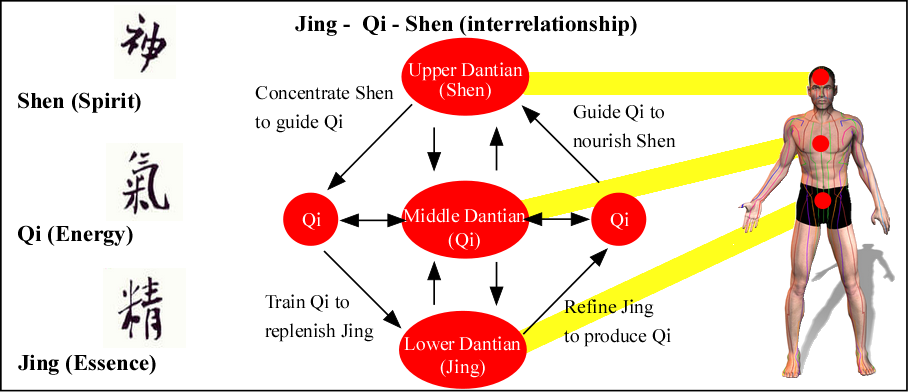
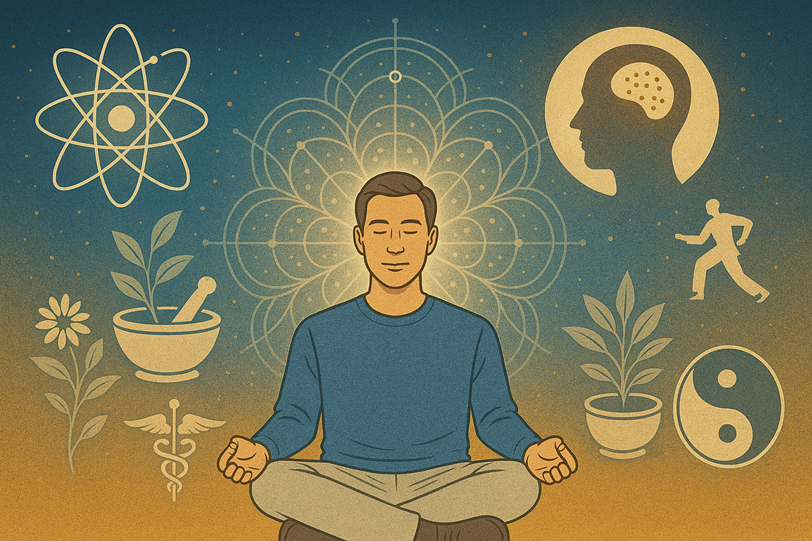
My diagrams and progression of images naturally imply a fourth phase, which is the integrative stage where Jing, Qi, and Shen no longer operate as separate domains but revolve in a recursive living spiral.
Here, the practitioner reaches a point where:
- Somatic calibration is continuous and automatic
- Iterative self-cultivation is self-initiating
- Transmutation becomes a way of life
- All three influence each other simultaneously
This is the phase where the circle completes itself yet continues upward, a spiral path rather than a linear one.
In this 4th Phase the practitioner embodies:
- Physical alignment (Jing)
Effortless posture, efficient movement, regulated physiology.
- Mental clarity and energetic coherence (Qi)
Stable attention, balanced emotions, refined intentions.
- Spiritual awareness (Shen)
Insight, compassion, spaciousness, wisdom.
- Harmonized integration
The practitioner is no longer “performing techniques” as
they have become the technique.
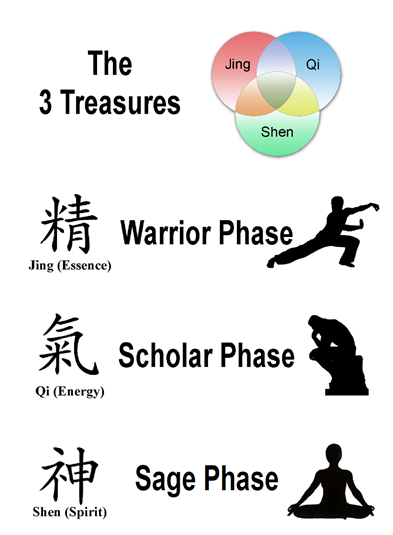
This is the lived outcome of the entire model of the Warrior, Scholar and Sage:
Somatic Calibration → Iterative Self-cultivation → Transmutation → Integrated Being.
How the Four Phases Correspond to my Diagrams (Stages 1–4)
Stage 1 (Jing/Qi/Shen circles):
Introduces the classical triad, three aspects as separate yet related.
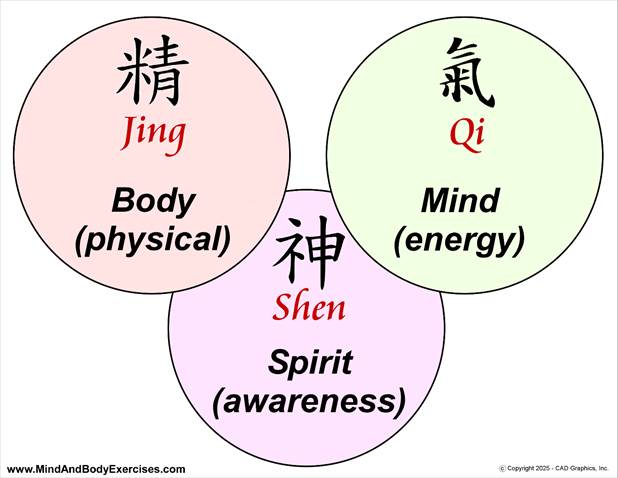
Stage 2 (Physiology/Psychology/Philosophy overlay):
Connects each classical aspect with modern disciplines.
This becomes the foundation of Phase 1.

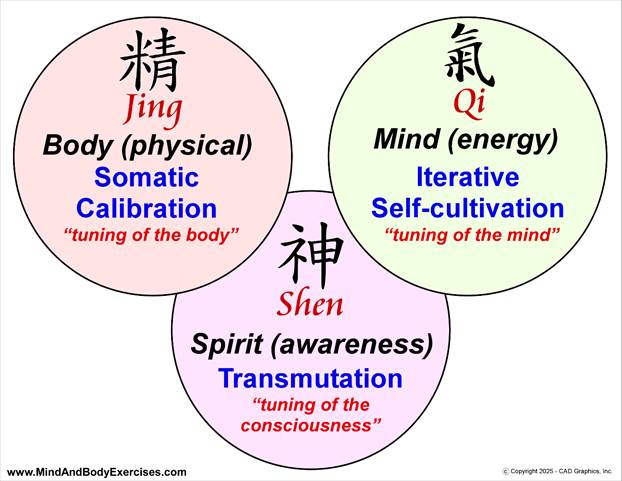
Stage 3 (Somatic Calibration / Iterative Self-cultivation / Transmutation overlay):
Maps each classical component into the three functional processes.
This is Phase 2 and Phase 3.
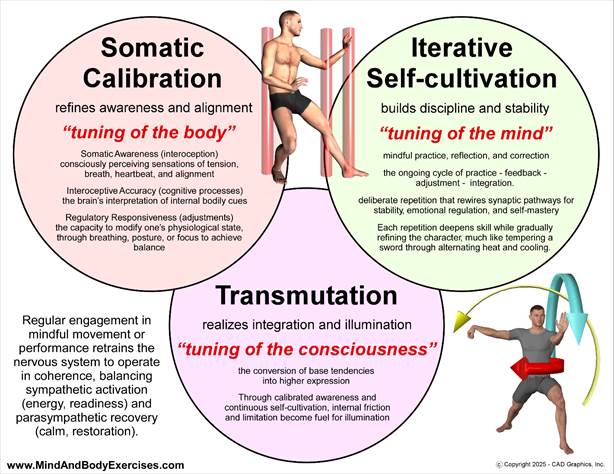
Stage 4 (Full elaborated diagram with figures):
Demonstrates the mature, embodied expression of all three components working in harmony.
This represents Phase 4.
Integrated Summary
- Phase 1—Somatic Calibration: tuning the body (Jing), establishing stability and awareness.
- Phase 2—Iterative Self-cultivation: tuning the mind (Qi), cultivating discipline, neuroplasticity, and virtuous habits.
- Phase 3—Transmutation: tuning the consciousness (Shen), converting tendencies into illumination.
- Phase 4—Recursive Harmonization: integrating Jing–Qi–Shen into a coherent, unified mode of being.
Together these phases describe a complete developmental alchemical model bridging Taoist tradition, neuroscience, psychology, and embodied martial philosophy.








 United Martial Arts Association