
I saw many similarities with the ritual body postures from Felicitas Goodman and my own practices of qigong and daoyin (martial arts yoga). Consequently, I decided to purchase her book, Where the Spirits Ride the Wind, to do more research on these methods. Goodman writes about how a specific posture; the “bear posture” can help heal not only the practitioner but for others in the group setting who were not able to hold the posture (Goodman,1990, pg. 33). This goes beyond the thought that we practice healing methods not just for ourselves, but for others in our group or community, quite similar to why people pray for themselves and/or others.
Goodman has named another posture the “Mayan Empowerment posture” and describes it as being able to help generate healing energies (Monaghan, 1999, pg.41). I have again learned and practiced similar exercises in my qigong training. I think as other cultures, such as Eastern Asian, Native American, South American and others merge into Western and US culture there may be more of a need for scientific research. Documented research may help some of these practices to become more acceptable and mainstream instead of being considered alternative, metaphysical, or even a bit far-fetched for some. Unfortunately, many of these practices do not translate well into the standard of randomized double-blind studies.
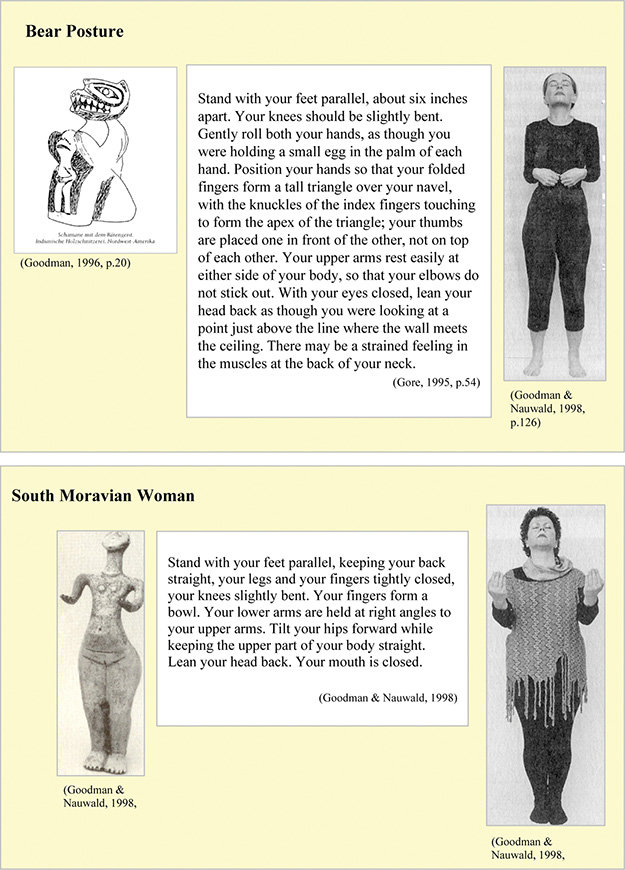
In spite of this factor, I learned that the holding of physical postures engages specific muscles group while simultaneously engaging the nervous systems. Either the parasympathetic nervous system (rest and digest response) is engaged with the slow rhythmic breathing or the sympathetic nervous system (fight or flight response) with a rapid rhythmic breathing cadence. Either of these processes can change the blood chemistry to promote healing on different levels. This physiological process can be seen in the other moving meditations practices of yoga, and its offspring of qigong and further spawn of tai chi. I have found (and personally practiced) all of these methods with either slow or fast breathing patterns can put the practitioner in either the meditative or trance state, depending upon background music/sounds, the individual and their intent. This is very much in line with Monaghan’s description of entrainment, where the practitioner’s heartbeat synchronizes with the beat of a drum or other percussion sound (Monaghan, 1999, pg.33). I have learned to practice qigong, tai chi and other martial arts exercises with music consisting of bells, chimes and other percussion instruments with this exact purpose of slowing (or increasing) the heart and breathing rate in order to enter into the meditative state of being.
Some of the postures explained seem simple enough, until one tries to hold the posture for 1 minute, 5 minutes, 15 minutes and maybe even longer. Often times people try a posture the first time for say, 15 minutes or so. But their body and more specifically their muscles and nervous system have not been conditioned much to hold the positions. So their body may begin to fatigue and tremble. Then the blood begins to shunt or pool in the muscles under tension and duress, which draws the blood and oxygen away from the brain which is farthest from the legs, where the blood is pooling. Then the person becomes a little light-headed or faint which leads them to believe they are having some type of weird or spiritual experience, where they probably are not but rather at the beginning steps of trial and error.
So my advice is to stay relaxed (especially in the neck, face and shoulders) in spite of the tension that will accompany the holding of the posture. Additionally, take the time to build up the length of holding the stationary positions or postures.
References:
Monaghan, Patricia; Viereck, Eleanor G. (1999) Meditation: The Complete Guide (pg. 33- 41). New World Library. Kindle Edition.
Goodman, Felicitas D. (1990) Where the Spirits Ride the Wind (p. 108). Indiana University Press. Kindle Edition.
__________


 United Martial Arts Association
Thank you!
LikeLike