From Mineral to Mind: The Awakening of Consciousness

There is a beautiful philosophical saying that has circulated for many years:

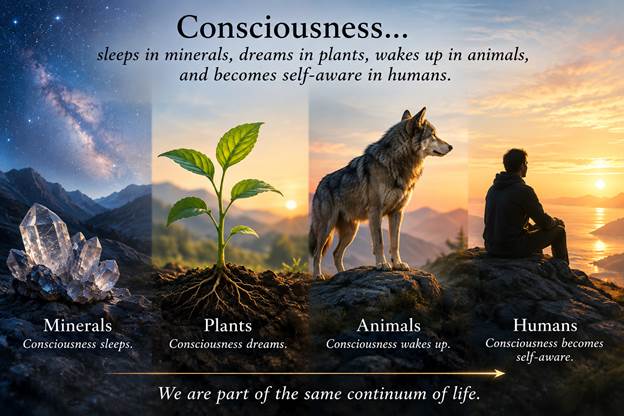
“Consciousness sleeps in minerals, dreams in plants, wakes up in animals, and becomes self-aware in humans.”
The quotation is frequently attributed to the 13th-century Persian poet and mystic Jalal al-Din Rumi, although the exact wording does not appear to be reliably traceable to his writings. Rumi did, however, express a remarkably similar idea in the Masnavi, describing a progression from mineral existence to plant, animal, and finally human life. In one well-known translation, he writes of having “died as a mineral” and becoming a plant, then passing from plant to animal and from animal to human existence (Schimmel, 1975).

Whether we interpret this progression spiritually, philosophically, symbolically, or simply poetically, there is something fascinating about the idea. It asks us to consider consciousness not merely as something we either possess or do not possess, but as something that may exist in different degrees and expressions.

I find this particularly interesting because it overlaps with many of the ideas I have encountered through holistic health, Taoism, martial arts, meditation, and the study of human behavior. The important question may not be whether a stone is literally conscious or whether a plant actually “dreams.” Those claims move us into philosophical territory that science has not established. The more practical question is what this metaphor might teach us about our own development.

Human beings may possess an extraordinary capacity for self-awareness but possessing that capacity does not necessarily mean that we are always using it.

The Long Continuum of Nature

Consider the mineral world first. A stone does not appear to possess consciousness in any way that modern science recognizes. Yet minerals provide much of the physical foundation from which biological life develops. Calcium strengthens our bones. Iron circulates within our blood. Sodium and potassium participate in nerve transmission. Magnesium contributes to hundreds of biochemical processes. The seemingly lifeless mineral world is quite literally incorporated into the living human body.

Plants represent another level of complexity. They grow, reproduce, respond to sunlight, gravity, temperature, moisture, chemical signals, injury, and changes in their environment. This does not mean that plants think as humans think. Researchers studying plant signaling specifically caution against casually equating sophisticated biological responsiveness with human-like consciousness (Taiz et al., 2019). Nevertheless, plants demonstrate that responsiveness to the environment existed long before brains and nervous systems appeared.

Animals bring us into territory that feels much more familiar. They perceive their surroundings, seek food, avoid threats, communicate, learn, remember, form social relationships, and display behaviors associated with fear, pleasure, attachment, curiosity, and play. The distinction between human beings and other animals is therefore not as simple as conscious versus unconscious. Contemporary research increasingly treats consciousness as a complicated biological phenomenon with different dimensions rather than a single switch that suddenly turns on in our species (Birch et al., 2020).

Humans do more than experience the world. We can become aware that we are experiencing it. We can observe our thoughts, question our motives, reconsider our behavior, imagine different futures, examine our past, and intentionally change the way we respond to circumstances.

That is where this old saying becomes particularly meaningful.

Becoming Aware That We Are Aware

Self-awareness gives us the unusual ability to turn our attention inward. I can feel anger, but I can also recognize, “I am becoming angry.” I can experience fear while simultaneously questioning whether the threat is real or imagined. I can notice tension developing in my shoulders, recognize that my breathing has become shallow, and consciously change my breathing or posture.

This ability to observe ourselves is one of the foundations of many contemplative traditions, but it is also increasingly important within modern psychology. Mindfulness practices, for example, cultivate awareness of thoughts, emotions, bodily sensations, and environmental experiences without automatically reacting to everything that arises (Kabat-Zinn, 2013).

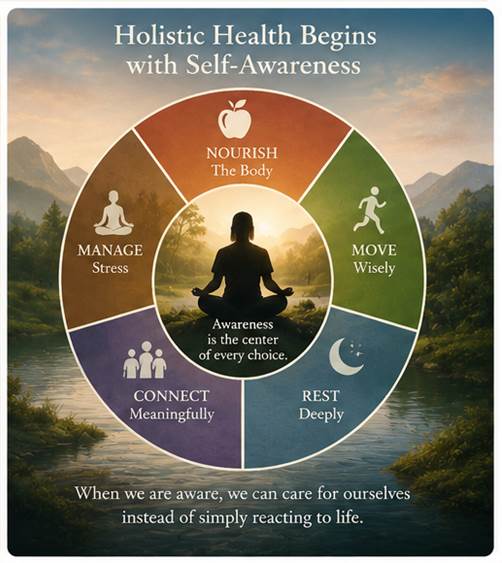
This is also one of the reasons I have long believed that self-awareness should be considered an important part of holistic health. We cannot make meaningful adjustments to something we never notice.

A person may repeatedly eat beyond hunger without recognizing the pattern. Another may carry unnecessary muscular tension throughout the day. Someone else may react defensively whenever a particular subject is mentioned without understanding why. We can become trapped in habits of posture, breathing, thinking, eating, sleeping, communicating, and reacting simply because they have become automatic.

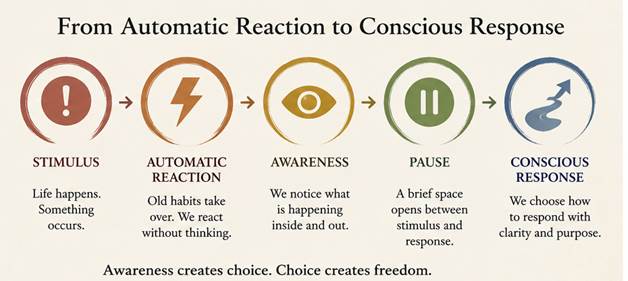
Awareness creates an opportunity between stimulus and response. It does not guarantee that we will make the best choice, but without awareness there may not even appear to be a choice.
The Martial Arts Laboratory

Martial arts training provides an excellent laboratory for developing this type of awareness.

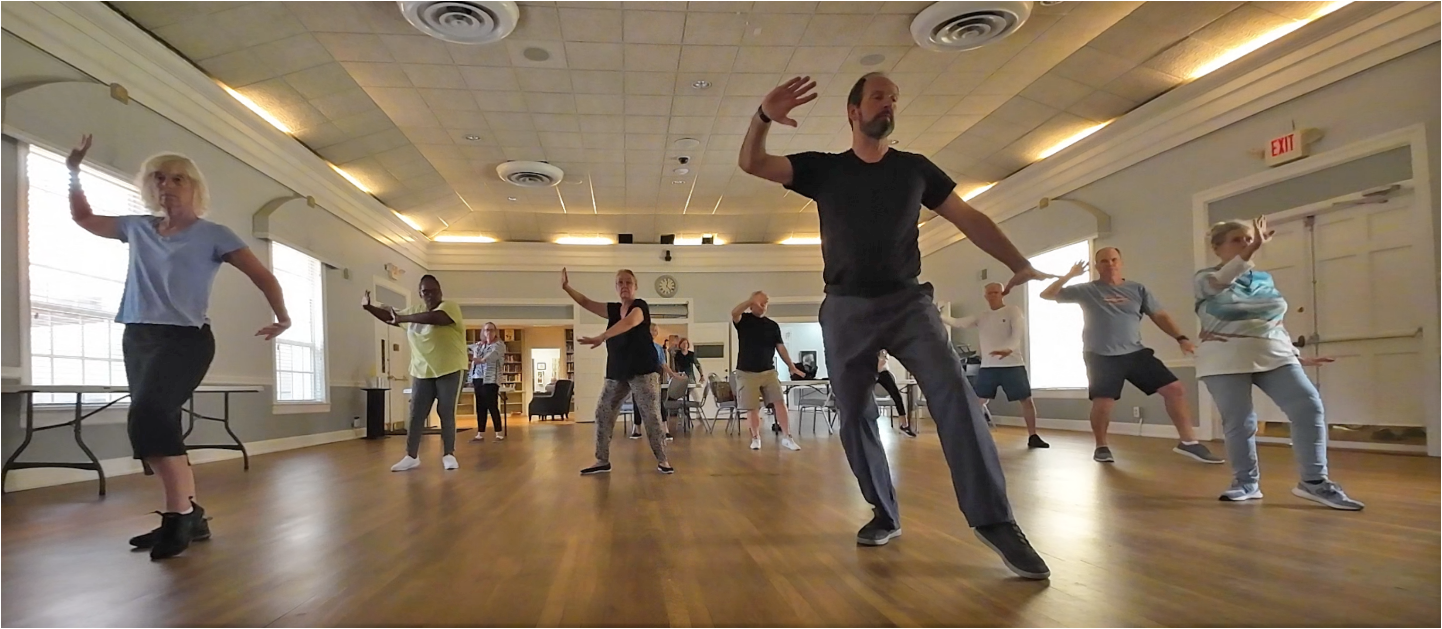
A beginner learning tai chi, qigong, BaguaZhang, yoga, or traditional martial arts frequently has little awareness of what the body is actually doing. The shoulders may rise unnecessarily. The knees may collapse inward. The breath may be held during effort. Weight may be distributed differently than the student believes. Muscles that do not need to participate may contract simply because the nervous system has not yet learned a more efficient strategy. A teacher can point these things out, but eventually the practitioner must learn to recognize them personally. Over time, external instruction becomes internal observation.

This is one reason slow movement can be so valuable. When movement slows down, we have an opportunity to notice details that disappear when everything is performed quickly. We begin to recognize where weight shifts, where unnecessary tension develops, how breathing changes, and how intention influences movement. Eventually we may notice emotional and mental reactions as well.

In that sense, training progresses from simply doing an exercise toward becoming aware of ourselves while doing it. The same process occurs outside the training hall.

From Reaction to Response

Much of life seems to happen automatically. Someone criticizes us and we become defensive. Traffic slows and irritation appears. We read something online and immediately feel compelled to respond. Someone challenges a belief we have held for decades and our first instinct may be to protect the belief rather than examine it.

These reactions are not necessarily signs of weakness. They are part of being human. Our nervous systems evolved to react rapidly when necessary. Automatic responses can protect us long before deliberate thought has time to evaluate a situation. The problem occurs when every situation is treated as though immediate reaction is necessary.

Self-awareness gives us another possibility. We can notice the reaction before becoming completely controlled by it.

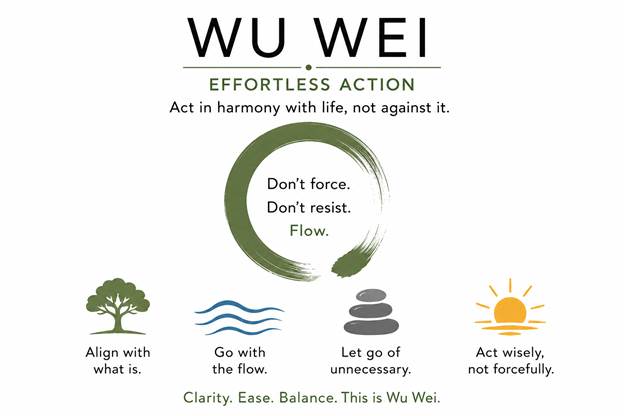
This connects naturally with Taoist philosophy. Taoism does not ask us to become passive or indifferent. Rather, it repeatedly encourages sensitivity to conditions and appropriate response. The principle of wu wei, often translated as effortless action or non-forcing, is not about doing nothing. It is about acting with circumstances rather than constantly fighting against them.

A skilled martial artist eventually learns something similar. Beginners often rely heavily upon muscular force because force is the most obvious tool available. With experience, timing, positioning, sensitivity, balance, structure, and awareness become increasingly important. Life often follows the same progression.
The Warrior, Scholar, and Sage

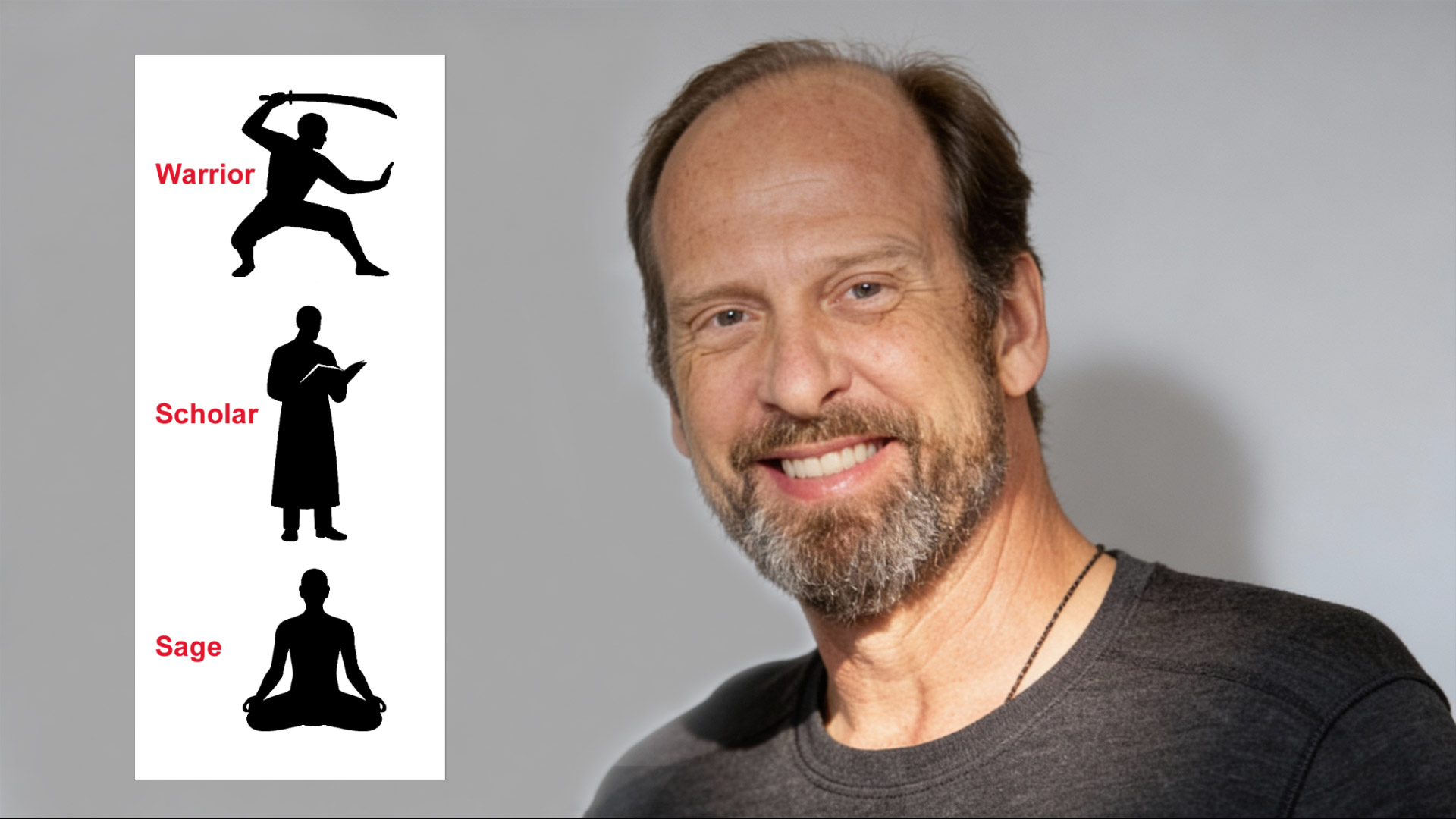
I also see an interesting relationship between this concept and the archetypes of the Warrior, Scholar, and Sage.

The Warrior develops the capacity to act. Discipline, perseverance, courage, physical development, and the willingness to face difficulty are important qualities. But action without awareness can become reckless.

The Scholar develops the capacity to understand. Study expands the world beyond personal experience. We begin comparing ideas, questioning assumptions, examining evidence, and recognizing that our own perspective is only one among many possibilities. Yet knowledge alone does not necessarily produce wisdom.

The Sage represents another development. Knowledge and experience begin to integrate. There may be less need to prove oneself and greater willingness to observe, listen, reconsider, and respond according to circumstances.

These are not rigid stages through which everyone progresses. A person can demonstrate tremendous wisdom in one situation and behave impulsively in another. Someone can possess extensive academic knowledge while remaining remarkably unaware of personal habits and biases. A highly trained martial artist can demonstrate extraordinary physical awareness while struggling with emotional awareness.

Human development is rarely a straight line. Perhaps consciousness does not simply “wake up” once and remain awake. Maybe we wake up repeatedly.
Consciousness and Holistic Health

This perspective has practical consequences for health and wellness.

Modern healthcare can provide remarkable interventions. Physicians can repair injuries, treat infections, replace joints, perform surgery, prescribe medications, and diagnose conditions that previous generations could barely understand. Yet much of everyday health still depends upon behaviors occurring outside the medical office.

How we eat, move, breathe, sleep, manage stress, maintain relationships, use substances, spend our time, and respond to warning signs all influence our well-being.

Self-awareness does not mean blaming ourselves whenever illness occurs. Genetics, environment, aging, accidents, infectious disease, socioeconomic conditions, and countless other factors affect health. Personal responsibility should never be confused with complete personal control. What self-awareness provides is participation. We become participants in our health rather than merely observers waiting for someone else to fix us.

This is where the ancient philosophical metaphor becomes surprisingly practical. The question is no longer whether consciousness literally sleeps inside a mineral or dreams within a plant. The question becomes whether we ourselves are moving through life awake.

Awakening Is an Ongoing Practice

After decades of my studying, research, practice and teaching, I have become increasingly interested in awareness rather than certainty. The more we learn, the more we often discover how much remains unknown.

That realization does not diminish knowledge. It gives knowledge perspective.

The greatest advantage of human self-awareness may therefore not be that we can declare ourselves the highest form of consciousness. It may be that we can question ourselves.

We can reconsider what we were taught. We can recognize when our bodies are asking us to change something. We can notice when pride is interfering with learning. We can discover that a belief that served us twenty years ago may no longer serve us today. We can recognize patterns inherited from families, teachers, organizations, cultures, and previous generations and decide which ones deserve to continue.

Perhaps this is one of the deeper meanings behind the old saying.

The mineral simply exists. The plant grows. The animal experiences and responds. The human being possesses the remarkable ability to experience life and then turn inward and ask, “What am I doing with this experience?” That question opens the door to self-awareness. And self-awareness opens the door to choice.

We may never completely understand consciousness. Philosophers, neuroscientists, psychologists, religious traditions, and contemplative practitioners continue to debate what consciousness actually is and how it arises. There is no need to pretend that an ancient poetic statement solves that mystery.

Its value may be much simpler. It reminds us that being alive and being aware of how we are living are not necessarily the same thing.

Perhaps awakening is not some mystical destination reserved for monks, sages, or enlightened masters. Perhaps it occurs in smaller moments throughout an ordinary life, when we become aware of something that was previously hidden from us and allow that awareness to influence what happens next.

In that sense, consciousness may indeed awaken within human beings. The challenge is staying awake long enough to learn from it.

References

Birch, J., Schnell, A. K., & Clayton, N. S. (2020). Dimensions of animal consciousness. Trends in Cognitive Sciences, 24(10), 789–801. https://doi.org/10.1016/j.tics.2020.07.007

Kabat-Zinn, J. (2013). Full catastrophe living: Using the wisdom of your body and mind to face stress, pain, and illness (Revised and updated ed.). Bantam Books.

Schimmel, A. (1975). Mystical dimensions of Islam. University of North Carolina Press.

Taiz, L., Alkon, D., Draguhn, A., Murphy, A., Blatt, M., Hawes, C., Thiel, G., & Robinson, D. G. (2019). Plants neither possess nor require consciousness. Trends in Plant Science, 25(7), 677–687. https://doi.org/10.1016/j.tplants.2019.05.008

What is the Point? We are all going to die anyway.

Over the years, some of the wiser mentors I have known have shared a simple idea with me that has remained in the back of my mind: we should strive to earn the life we live.

I do not interpret this as meaning that we somehow have to earn the right to exist, nor do I believe our worth should be measured by how much money we make, how productive we are, or how many accomplishments we can accumulate. I understand it more as an invitation to participate fully in the life we have been given. If we are fortunate enough to wake up to another day, perhaps there is something to be said for trying to make reasonable use of it.

Hopefully, over the course of a lifetime, we can build a life containing some combination of love, meaning, purpose, contribution, friendship, family, learning, service, and perhaps even a little wisdom. We certainly will not succeed every day. There will be periods when simply getting through a difficult time is accomplishment enough. There will also be days when we need to rest, step away, or allow someone else to help us. But when viewed across the longer arc of a life, I think there is something worthwhile about trying to leave the world, or at least our small corner of it, a little better because we were here.

What Is the Point?

Every so often, I encounter someone who expresses a very different perspective. They may say something along the lines of, “What is the point? We are all going to die anyway.” Technically, they are correct.

Every person reading these words will eventually die. So will I. Every generation before us has faced the same reality, and every generation after us will face it as well. No amount of exercise, money, medicine, education, spiritual practice, healthy eating, positive thinking, or modern technology has changed that basic fact. But to me, that is exactly the point.

If our time were unlimited, there might be much less urgency to do anything meaningful with it. We could always begin tomorrow. The book could be written someday. The old friend could be called eventually. We could apologize later, tell someone we love them another time, take better care of ourselves next year, or finally begin sharing what we have learned when the timing seems more convenient.

The problem is that we do not actually know how many tomorrows we will have.

None of us knows when our last breath will occur. I do not see that realization as necessarily depressing or morbid. In fact, I think it can be quite motivating. The awareness that our time is limited can help us separate what is important from what merely consumes our attention. Research in psychology has long suggested that awareness of mortality can influence how people think about meaning, identity, relationships, and values (Greenberg et al., 1986). Other research has found that having a sense of purpose is associated with important aspects of psychological and physical well-being across adulthood (Hill & Turiano, 2014).

The objective, then, is not to become preoccupied with death. It is to become more engaged with life.

What If All of This Actually Matters?

None of us possesses absolute certainty about the ultimate meaning of existence. Philosophers, scientists, theologians, mystics, and ordinary people have debated these questions for thousands of years. We continue to wonder why we are here, whether life has some larger purpose, what happens when consciousness ends, and whether meaning is something we discover or something we create for ourselves. I certainly do not claim to know the answers to those questions.

Somewhere along the way, however, I arrived at a practical conclusion that works for me. Why not err on the positive side? What if all of “this” actually matters?

Perhaps the encouragement we give another person matters. Maybe teaching someone an exercise that improves their balance or mobility can have a positive effect. Showing someone how to slow their breathing when they are overwhelmed may help that person considerably. Sharing an experience that prevents someone else from repeating one of our mistakes may matter considerably more than we realize at the time.

A conversation might change someone’s perspective. An article might reach someone we will never meet. A book could sit on a shelf for years before eventually being opened by the person who needs what is written inside it. A video that receives relatively little attention today might someday help someone halfway around the world.

We may never know. That does not mean it did not matter.

Purpose Does Not Have to Be Grand

I think one mistake we sometimes make is assuming that purpose has to involve something enormous. The phrase “life purpose” can conjure images of changing the world, becoming famous, creating a movement, building an empire, or somehow being remembered generations after we die. Most meaningful lives probably do not look anything like that.

Purpose is often remarkably ordinary. It can be found in raising children, caring for an aging parent, teaching a class, helping a neighbor, creating something useful, sharing knowledge, volunteering in the community, mentoring someone younger, or simply being available when another human being needs someone to listen to.

Psychiatrist Viktor Frankl wrote extensively about the human search for meaning, particularly through his experiences of extraordinary suffering. His work emphasized that meaning can be found through what we create and contribute, through what we experience and whom we love, and through the attitudes we adopt toward circumstances that cannot be changed (Frankl, 2006).

I have always appreciated that perspective because it places meaning within reach of ordinary people living ordinary lives. We do not necessarily have to save humanity to live meaningfully. Sometimes we simply help the people who happen to be within our reach.

Expanding the Circle

As I have gotten older, this idea has increasingly influenced how I choose to spend my time. It manifests itself in my desire to reach more people, teach more classes, offer more perspectives, and share more of what I have learned and experienced. It is also one of the reasons I continue writing articles and books and creating videos for people whom I may never have an opportunity to meet personally.

This is not because I believe I possess all the answers. Quite the opposite. The longer I live and continue learning, the more aware I become of how much there still is to understand.

But I have accumulated experiences. I have made mistakes, changed my mind, been taught by many people, watched ideas come and go, and seen things that I once believed to be true turn out to be incomplete, exaggerated, misunderstood, or simply incorrect. At the same time, I have watched seemingly simple lessons become much more meaningful as I grew older and finally accumulated enough life experience to understand them differently. At some point I began asking myself, why keep all of that to myself?

Teaching in person has always been meaningful to me because there is an immediate human connection. You can see whether someone understands what you are explaining. You can modify what you are doing, answer questions, demonstrate an exercise differently, laugh together, and watch people gradually improve. But there are obvious limitations. Any one of us can only teach so many classes, be in one room at a time, and personally interact with a limited number of people during the course of a day. Writing and modern technology extend that circle considerably.

An article can travel somewhere I cannot. A book can continue communicating an idea when I am somewhere else doing something entirely different. A video can demonstrate an exercise to someone who may never attend one of my classes. Something created today might remain available years from now.

The internet certainly has its problems, particularly in today’s cultural climate. We are surrounded by enormous amounts of information, misinformation, advertising, anger, entertainment, distraction, and increasingly shorter attention spans. Yet the same technology that spreads nonsense can also spread education, encouragement, experience, and useful ideas. The tool itself is not necessarily the problem. Much depends upon what we choose to do with it.

The Ripple Effect We Rarely See

One of the interesting things about teaching, helping, mentoring, parenting, writing, or simply interacting with other people is that we rarely get to see the full effect of what we do.

A teacher may say something that a student remembers twenty years later. A parent may offer advice that a child dismisses at twenty but suddenly understands at forty-five. Someone might read an article, think about one paragraph for several days, and quietly make a change in their life. A person might learn an exercise in a class and later teach it to a spouse, friend, child, or grandchild. The original teacher may never know any of this occurred.

This is worth remembering because we increasingly live in a world where influence is measured through visible numbers. We count attendance, sales, views, likes, subscribers, comments, followers, income, and recognition. Those measurements have their place, but they cannot possibly measure every form of human influence.

Research on generativity, a concept strongly associated with Erik Erikson’s theory of adult development, describes the human desire to contribute to and guide future generations. Generativity can take many forms, including parenting, mentoring, teaching, leadership, creativity, and community involvement (McAdams & de St. Aubin, 1992).

I find that concept increasingly meaningful as the years pass. At some point, the question can gradually shift from “What can I accumulate?” toward “What can I contribute?” That is a very different way of looking at one’s remaining time.

Earning the Day

Perhaps the idea of “earning the life we live” sounds too ambitious when considered across an entire lifetime. I sometimes find it more useful to reduce the scale and simply think about earning the day.

That does not require accomplishing something extraordinary every twenty-four hours. It might simply mean learning something, helping someone, taking reasonable care of ourselves, appreciating the people around us, creating something rather than merely consuming, or contributing in some small way to the lives of the people we encounter.

Obviously, every day will not look like this. There are days for rest and recovery. There are days when our own problems require most of our attention. There are times when we need other people far more than they need us. This is part of being human. But there is an important difference between allowing ourselves to rest and deciding that nothing matters because everything eventually ends.

A beautiful meal, a great conversation, a vacation, a class, a sunset, childhood and careers end. Relationships eventually end, whether through circumstances, separation, or death. Human life itself eventually ends. Something does not become meaningless simply because it is temporary. In fact, I would argue that its temporary nature may be exactly what gives it value.

If we had an unlimited number of sunsets, years with the people we love, opportunities to repair relationships, time to learn, and unlimited opportunities to say what needs to be said, perhaps we would appreciate these things far less.

Scarcity creates value in many areas of life. Time may be the greatest example of all.

Until the Last Breath

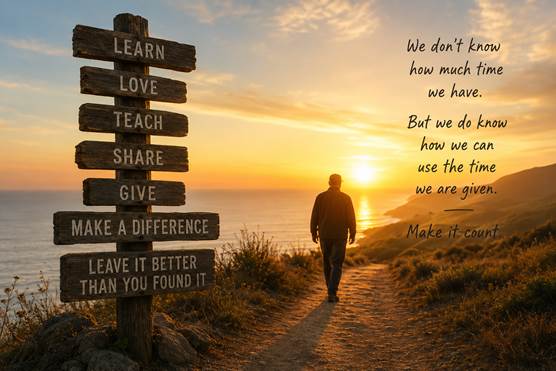
None of us knows how much time remains. Hopefully, there are many years ahead, but there are no guarantees. That reality encourages me to continue doing what I can while I can.

There are still classes I would like to teach, ideas I want to explore, articles I want to write, books I hope to complete, videos I would like to create, people I have yet to meet, and perspectives that I will probably continue changing as I learn more. There are also lessons accumulated over a lifetime that might be useful to someone else, even if I never know who that person is.

Will all of it matter? I cannot prove that it will. But neither can anyone prove that it will not.

Given those two possibilities, I choose to err on the positive side. I would rather live as though kindness, teaching, learning, sharing experiences, taking care of ourselves, helping other people, and loving people matters.

I would rather believe that something we create today might continue helping someone after we are no longer here to explain why we created it. Someday, like everyone else who has walked this earth, I will take my last breath. Between this breath and that final one lies whatever amount of life remains. I would prefer to use as much of it as reasonably possible.

Perhaps I will never know how far the ripples will travel. Perhaps none of us does. But I think there is something worthwhile about continuing to throw a few stones into the water. And perhaps that is part of what it means to earn the life we live.

References

Frankl, V. E. (2006). Man’s search for meaning. Beacon Press. (Original work published 1946)

Greenberg, J., Pyszczynski, T., & Solomon, S. (1986). The causes and consequences of a need for self-esteem: A terror management theory. In R. F. Baumeister (Ed.), Public self and private self (pp. 189–212). Springer.

Hill, P. L., & Turiano, N. A. (2014). Purpose in life as a predictor of mortality across adulthood. Psychological Science, 25(7), 1482–1486.

McAdams, D. P., & de St. Aubin, E. (1992). A theory of generativity and its assessment through self-report, behavioral acts, and narrative themes in autobiography. Journal of Personality and Social Psychology, 62(6), 1003–1015.

How Much of Ourselves Do We Surrender to Belong?

Moments of Enlightenment – When the Light Comes On

The word enlightenment carries a great deal of weight. For some people, it brings to mind Buddhist monks meditating for decades in monasteries, spiritual masters living apart from society, or philosophers and sages who have somehow reached a level of understanding beyond that of the average person. In our modern culture, however, the word is also used much more casually. Someone may describe becoming enlightened after discovering a new philosophy, surviving a difficult period of life, traveling to another culture, studying under a particular teacher, or suddenly seeing something from an entirely different perspective.

The problem is that enlightenment is not something that can easily be measured or verified. There is no blood test for enlightenment. There is no brain scan that can definitively determine that someone has crossed a particular threshold. There is no universally recognized certificate stating that a person has successfully completed the requirements and is now officially enlightened. Perhaps that is part of the problem with the way we sometimes think about it.

Over many years, I have been around individuals who appeared to possess considerably more wisdom, awareness, patience, or insight than others. Some were teachers. Some were martial artists. Some were involved in Eastern philosophy or contemplative practices. Others were simply people who had accumulated a great deal of life experience and, more importantly, had apparently learned something from those experiences. Interestingly, some of the wisest people I have encountered were also among the least likely to describe themselves as enlightened.

What several of these people shared with me over the years was a somewhat different way of looking at enlightenment. Rather than viewing it as a permanent destination that someone eventually reaches, they viewed enlightenment as something that can occur temporarily and repeatedly throughout one’s lifetime. I have come to appreciate this perspective more and more as I have grown older.

We often speak about enlightenment as though it were a place. Someone searches for enlightenment, reaches enlightenment, or becomes enlightened. The language itself suggests a destination. Once the traveler arrives, presumably the journey is complete. But human beings do not seem to function that way.

We can be remarkably insightful about one aspect of our lives and surprisingly unaware about another. We can understand something clearly today and become confused about it tomorrow. We can give excellent advice to someone else while failing to recognize the exact same problem occurring within ourselves. We can spend decades studying a subject and then suddenly realize that something we had believed for years was incomplete or perhaps even incorrect.

Perhaps enlightenment, then, is better understood not entirely as something we are, but as something we occasionally experience.

Psychologists have studied what are sometimes called insight experiences, those sudden moments when a previously confusing problem or situation becomes understandable. The familiar “Aha!” experience can involve a rapid restructuring of how we perceive something, producing the feeling that an answer has suddenly become obvious even though it had been hidden only moments before (Kounios & Beeman, 2014).

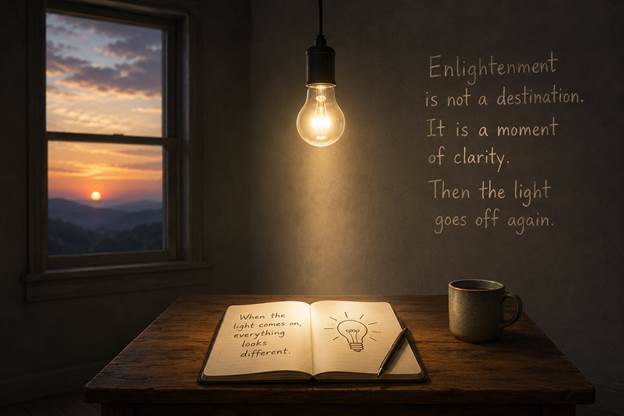
Most of us have experienced something similar, and I prefer the simple analogy of walking into a dark room and turning on a light. Before turning on the light, everything in the room was already there. The doors, windows, tables, chairs, and other objects existed whether we could see them or not. Turning on the light did not create anything. It simply allowed us to perceive what had previously been hidden by darkness.

Sometimes understanding works much the same way. Suddenly we see something that we did not see before. We might wonder how we could have missed something that now seems so obvious. The information may have been available to us for years, but for whatever reason we were not yet capable of seeing it from that particular perspective. We often call these “lightbulb moments.” Perhaps, at least temporarily, we might also call them moments of enlightenment.

There is another part of this analogy that I find equally important. The light does not necessarily stay on. Someone can have a profound realization during meditation, while practicing tai chi or qigong, walking through nature, recovering from an illness, traveling, losing someone they love, becoming a parent or grandparent, reading a book, talking with a friend, or simply sitting quietly and thinking. For a moment, something becomes remarkably clear. Then everyday life returns.

The bills still need to be paid. Someone cuts us off in traffic. Our body hurts. We become impatient with another person. We worry about tomorrow. Someone challenges one of our beliefs and we immediately become defensive. The supposedly enlightened human being suddenly looks remarkably human again. This does not necessarily invalidate the earlier experience. It may simply demonstrate that insight and wisdom are not always permanent states.

Even contemplative traditions that place great importance on awakening frequently emphasize continued practice rather than treating insight as permission to stop learning. Buddhist traditions themselves contain numerous interpretations of awakening and enlightenment, and they do not all describe the process in precisely the same way (Gethin, 1998). This alone should make us somewhat cautious about declaring exactly what enlightenment must look like.

Perhaps there is another possibility worth considering. As people become more curious, observant, reflective, and willing to question their own assumptions, these moments may begin occurring more frequently. Experience itself does not automatically produce wisdom. Someone can repeat the same mistake for forty years and simply become very experienced at making the same mistake. Reflection matters.

Psychological research distinguishes between merely accumulating experiences and developing wisdom through the way those experiences are interpreted. Wisdom has been associated with qualities such as reflection, compassion, emotional regulation, tolerance for uncertainty, and the ability to recognize multiple perspectives (Ardelt, 2003; Grossmann et al., 2020). Knowledge tells us things. Experience exposes us to things. Reflection helps us understand what those things might mean. Wisdom may gradually emerge from the interaction of all three.

This may explain why certain experiences that seemed insignificant when we were younger suddenly make sense decades later. The information did not necessarily change. We changed. Sometimes I think wisdom involves repeatedly walking through the same room and discovering another light switch.

There is also an interesting paradox that comes with all of this. The moment someone announces that they have become enlightened, I tend to become somewhat cautious. Claims of extraordinary wisdom or spiritual attainment can create authority. If other people accept that an individual possesses knowledge, awareness, or consciousness beyond their own, questioning that person can become increasingly difficult. This can be particularly relevant within spiritual communities, martial arts organizations, wellness movements, philosophical schools, and other groups built around respected or charismatic teachers.

A teacher may indeed possess extraordinary knowledge in certain areas. That does not mean that person possesses extraordinary knowledge in every area. Expertise is not omniscience. Wisdom is not infallibility. And enlightenment, however we choose to define it, should probably not provide immunity from reasonable questions.

There is even a psychological problem that can occur when we begin believing that we have finally figured everything out. Human beings remain vulnerable to confirmation bias, overconfidence, motivated reasoning, and numerous other cognitive tendencies that influence how we interpret information (Kahneman, 2011). Years of study do not necessarily make these tendencies disappear.

Ironically, believing ourselves to be permanently enlightened could become another obstacle preventing us from seeing what remains hidden. Perhaps one characteristic of wisdom is recognizing just how much remains unknown. This brings me back to another question that has always interested me. Who gets to decide what qualifies as enlightenment?

One person’s profound spiritual revelation may seem perfectly ordinary to someone else. A person may experience an overwhelming realization that everything in nature is interconnected. A biologist or ecologist might respond that ecosystems have demonstrated interdependence all along. Someone may suddenly realize that possessions do not create lasting happiness, while a philosopher may have reached that conclusion decades earlier. Someone else may discover through meditation that thoughts arise and disappear without necessarily requiring action, while a psychologist familiar with mindfulness may consider this a well-established observation. Does the fact that someone else already understands something make another person’s realization less meaningful? I do not think so.

Understanding is personal. Knowing something intellectually and realizing it through experience are not necessarily the same thing. We can tell someone for years that life is temporary. They understand the words. They may even agree with them. Then someone close to them dies, they survive a serious accident, their children grow up and leave home, they retire from a lifelong career, or they suddenly recognize their own aging in the mirror. The words have not changed. Their understanding has. The light came on.

This is perhaps why one person’s nirvana may be another person’s typical Tuesday afternoon. What is profound to one person may seem obvious to another because we are all arriving at these realizations from different starting points. We carry different experiences, different beliefs, different educations, different cultures, different hardships, and different levels of awareness. Perhaps we also make enlightenment unnecessarily exotic.

Maybe enlightenment does not always require mountaintops, monasteries, gurus, secret teachings, or decades of esoteric study. Perhaps some of our most meaningful moments of enlightenment occur while washing dishes, teaching a class, walking through the woods, talking with our children, practicing a familiar exercise, sitting beside someone who is dying, traveling through an unfamiliar country, or simply recognizing that something we believed for many years was incorrect. That last example may be particularly important. There is a certain freedom in being able to say, “I was wrong.”

That simple statement may represent a greater degree of awareness than defending an old belief simply because we have invested years of our lives in it. Real learning frequently requires revising our existing understanding rather than merely adding more information to what we already believe. Sometimes growth occurs because we discover something new. At other times, growth occurs because we finally become willing to let go of something old. Both can turn on another light.

After decades of studying martial arts, Eastern philosophy, mind-body practices, holistic health, psychology, and simply observing people, I have become increasingly comfortable with the possibility that enlightenment may not be an all-or-nothing condition. Perhaps we do not become enlightened once and remain that way forever. Perhaps we become enlightened for a few seconds. Maybe for several minutes. Occasionally perhaps for an afternoon, or during some particularly meaningful period of our lives. Then we return to being ordinary human beings again, carrying our habits, emotions, assumptions, strengths, weaknesses, and unfinished business along with us. Over time, however, perhaps the lights begin coming on more frequently.

Through practice, reflection, curiosity, humility, experience, and a willingness to reconsider what we think we already know, we may begin noticing things that were previously hidden from us. The room becomes brighter. Then we discover another room. And perhaps another after that. Eventually we may realize that there was never going to be a final room where all of the answers were waiting for us.

I find something encouraging about this way of looking at enlightenment. It makes enlightenment less of a trophy reserved for a select few and more of an ongoing human possibility. We do not need to prove that we have reached some ultimate state of consciousness. We do not need to convince others that we possess secret knowledge. We simply need to remain receptive enough to recognize those moments when something becomes clearer than it was before. Maybe that is enough.

The universe, nature, society, relationships, our bodies, and our own minds seem to provide endless opportunities for observation, learning, questioning, and reconsideration. Some of those opportunities are dramatic. Most are probably quite ordinary. Many may pass directly in front of us without our ever recognizing them.

The challenge may simply be remaining open enough to notice when another light comes on. And perhaps there is a final paradox in all of this. The more lights we turn on, the more clearly we may see just how much remains in the dark.

References

Ardelt, M. (2003). Empirical assessment of a three-dimensional wisdom scale. Research on Aging, 25(3), 275–324. https://doi.org/10.1177/0164027503025003004

Gethin, R. (1998). The foundations of Buddhism. Oxford University Press.

Grossmann, I., Weststrate, N. M., Ardelt, M., Brienza, J. P., Dong, M., Ferrari, M., Fournier, M. A., Hu, C. S., Nusbaum, H. C., & Vervaeke, J. (2020). The science of wisdom in a polarized world: Knowns and unknowns. Psychological Inquiry, 31(2), 103–133. https://doi.org/10.1080/1047840X.2020.1750917

Kahneman, D. (2011). Thinking, fast and slow. Farrar, Straus and Giroux.

Kounios, J., & Beeman, M. (2014). The cognitive neuroscience of insight. Annual Review of Psychology, 65, 71–93. https://doi.org/10.1146/annurev-psych-010213-115154

The Healer as a Teacher: Helping Others Learn to Heal Themselves

Over the years, my understanding of what it means to be a healer has changed considerably. When many people hear the word healer, they may picture someone who possesses a special ability to cure another person, remove their pain, correct their illness, or somehow make them whole again. In this model, the healer does the healing while the person in need receives it. One person is active, while the other is largely passive. That has never completely fit with how I have come to understand healing.

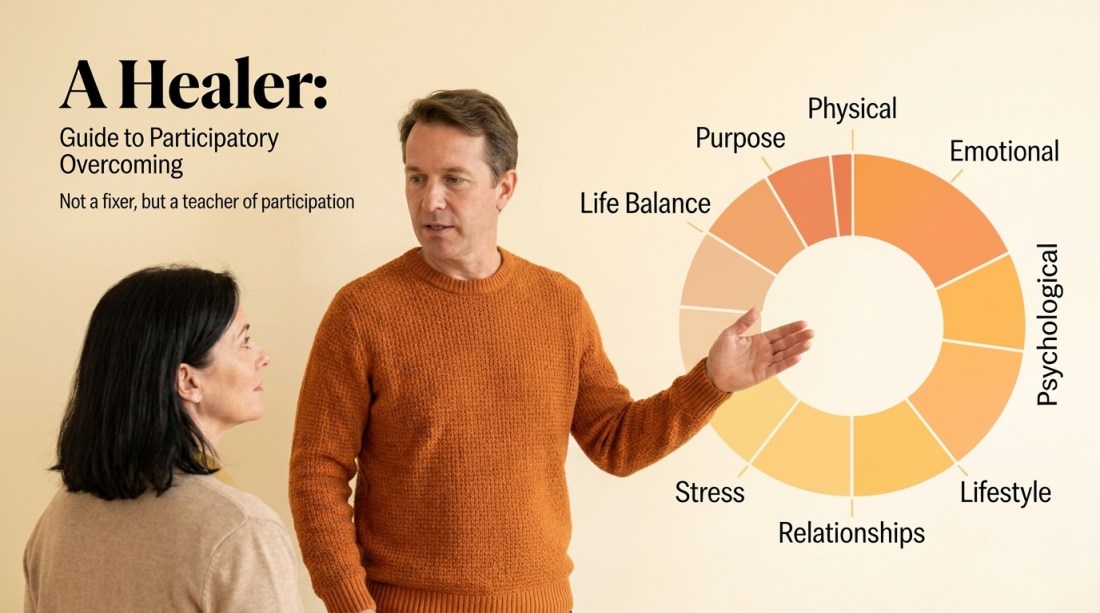
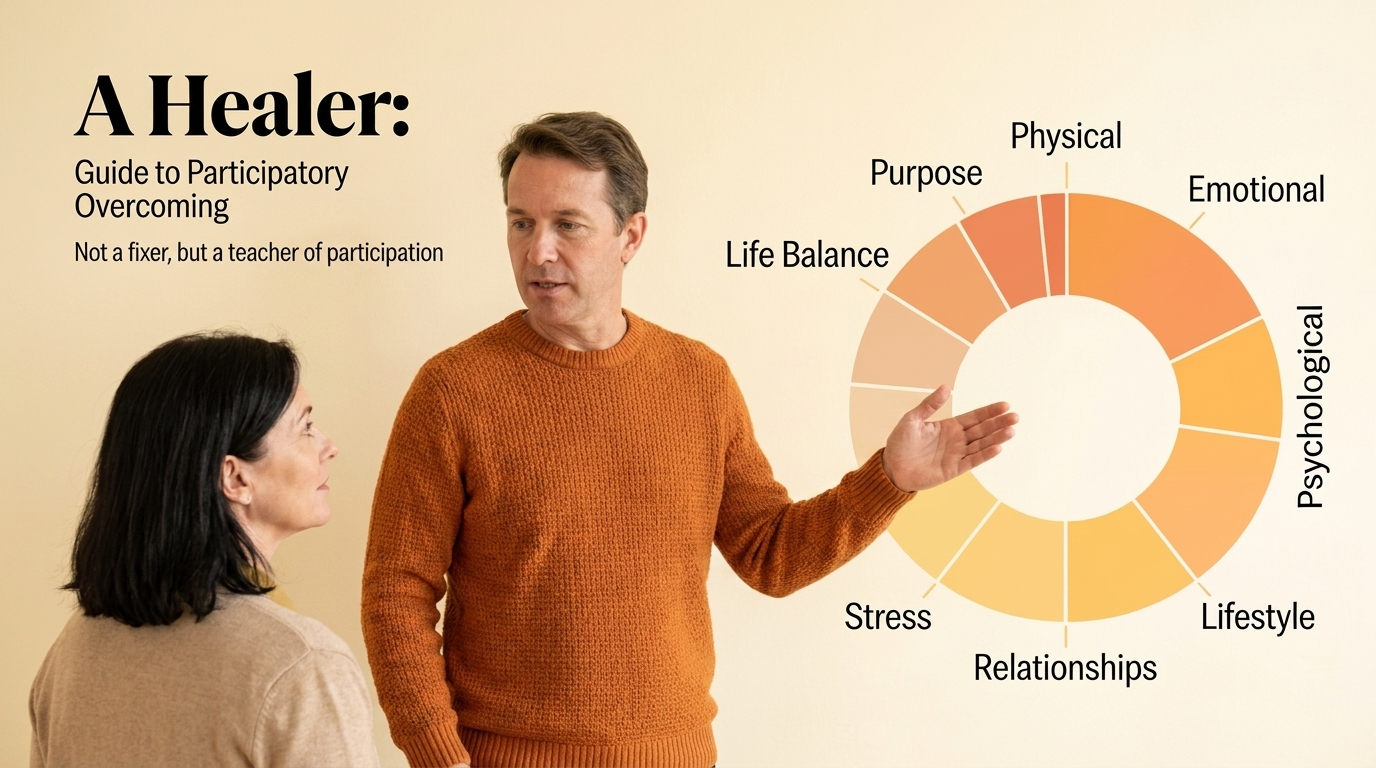
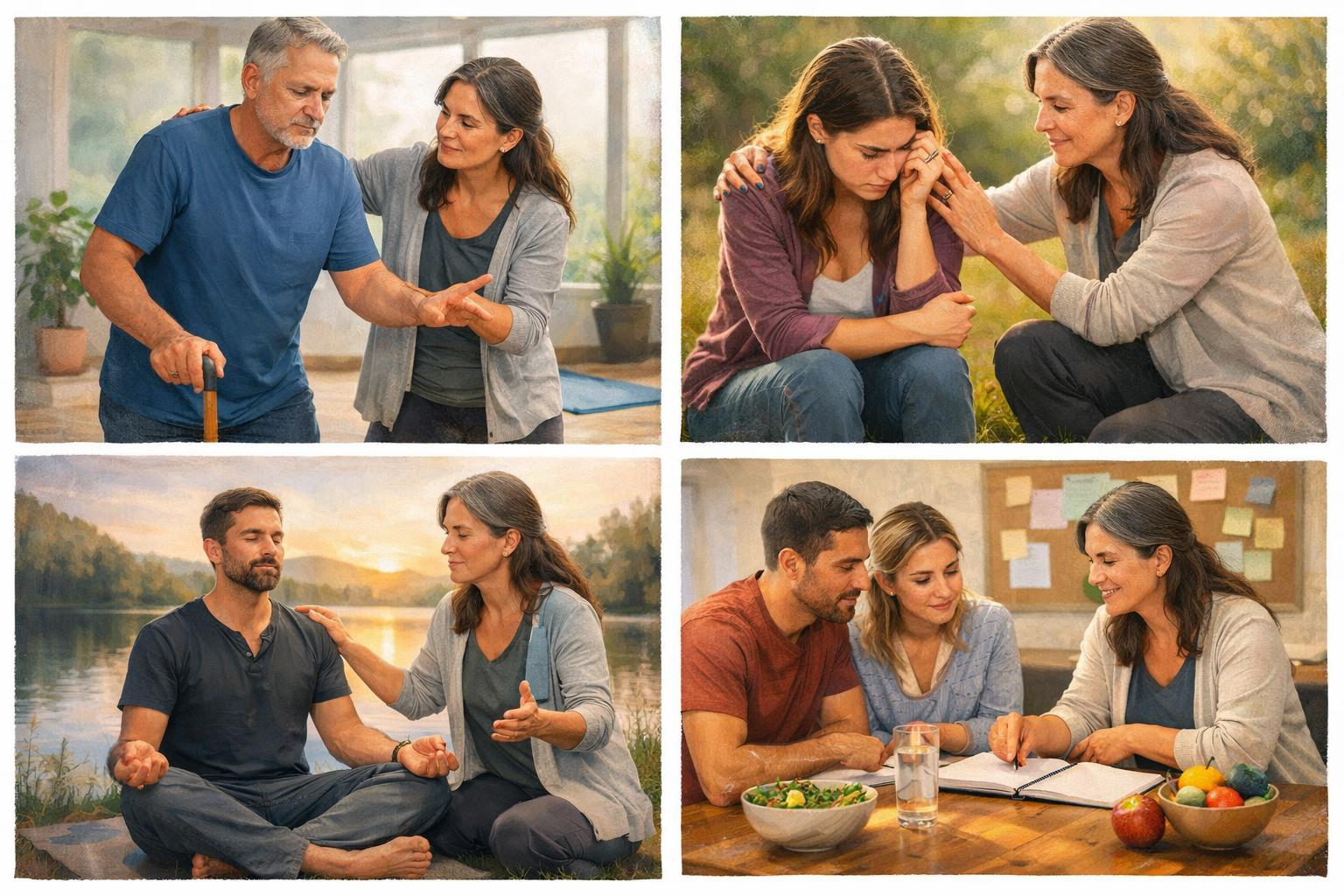
My definition of a healer is not necessarily someone who cures or fixes another person. Rather, I see a healer as someone who shows, helps, guides, or teaches another person how to participate more fully in overcoming whatever may be troubling them. Sometimes that trouble is physical. Sometimes it is emotional or psychological. Sometimes it involves lifestyle, relationships, stress, purpose, or simply the realization that the way we have been living is no longer working very well. This distinction may seem subtle, but I believe it is important.

A healer can provide knowledge, encouragement, perspective, techniques, and perhaps even treatment. But ultimately, much of the work of healing still takes place within the individual.

I often think of something as simple as preparing a meal. I can teach someone how to make a healthy meal. I can explain the ingredients, demonstrate how to prepare them, discuss why certain foods may be beneficial, and perhaps even stand beside that person while they cook. But at some point, they have to make the meal themselves. More importantly, I cannot eat the meal for them and somehow transfer the nutritional benefits into their body. Their body has to chew it, digest it, absorb it, and make use of what has been provided. Healing often works in much the same way.

A physician can explain why someone needs to exercise, but the physician cannot perform the exercise for the patient. A physical therapist can teach movements that may restore strength and mobility, but the therapist cannot make the muscles stronger without the patient’s participation. A counselor can help someone recognize unhealthy patterns of thought or behavior, but eventually that person must practice responding differently when those patterns appear in everyday life.

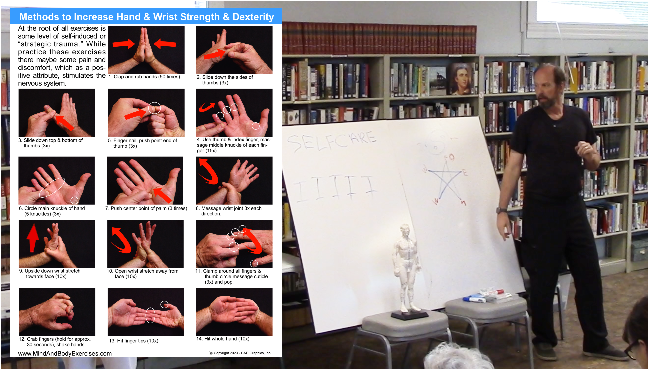
The same is true within many of the practices I have studied and taught over the years. I can teach someone tai chi, qigong, breathing exercises, meditation, stretching, strengthening, posture, relaxation, or other methods of self-care. I can explain the principles behind them and help correct mistakes. I can encourage someone when progress seems slow. But I cannot practice for them.

That is where I believe an important part of healing is sometimes overlooked.

We have become accustomed to thinking of health care as something that is primarily done to us. We go somewhere, receive something, and hopefully leave feeling better. Certainly, there are situations where this is exactly what is needed. If I break a bone, suffer a serious infection, require surgery, or experience a medical emergency, I am very grateful that trained professionals can intervene. There are times when another person’s expertise and intervention may literally save our lives.

But that is only one part of the much larger picture of health and healing.

There is also the enormous territory between being perfectly healthy and experiencing a medical emergency. This is where we live most of our lives. It includes how we sleep, breathe, move, eat, manage stress, maintain relationships, respond to setbacks, use our bodies, and care for ourselves day after day. No practitioner can completely control those things for another person.

This is why I tend to think of the healer as being closer to a teacher, guide, or facilitator than a repair technician. A good teacher does not simply give students answers. A good teacher helps students develop the ability to find answers themselves. In the same way, a good healer should ideally help people develop greater awareness and greater participation in their own well-being.

This does not mean blaming people for becoming sick or suggesting that every illness can be overcome through positive thinking, exercise, diet, or self-discipline. Biology is far more complicated than that. Genetics, injury, aging, infection, environment, socioeconomic circumstances, and simple chance can all affect our health. There are conditions that cannot simply be exercised, meditated, or breathed away. But recognizing those realities does not mean that personal agency disappears.

There is usually a difference between asking, Who is going to fix me? and asking, What can I do to participate in getting better?

That second question can change the relationship between the practitioner and the person seeking help.

Instead of saying, “Heal me,” we begin asking, “Teach me.”

Teach me what I can do.

Teach me what I may be doing that is making the situation worse.

Teach me what signs I should pay attention to.

Teach me how to move differently.

Teach me how to breathe differently.

Teach me how to strengthen what has become weak.

Teach me how to recognize when I need professional help and when I can safely help myself.

This type of relationship does not diminish the importance of physicians, therapists, counselors, teachers, coaches, or other practitioners. I believe it actually makes their knowledge more valuable because their expertise becomes something that can continue working through the individual long after an appointment, treatment, or class has ended.

This has always been one of the things that appeals to me about teaching mind-body practices. If I teach someone a simple breathing exercise that helps them calm themselves during stressful situations, they now possess a tool that can potentially be used for the rest of their life. If I teach an older adult how to improve balance and leg strength, that knowledge does not belong to me anymore. It belongs to them. If someone learns how to recognize unnecessary tension in their shoulders, change their posture, move more efficiently, or calm their breathing, they have gained something far more valuable than simply receiving temporary relief.

They have gained another degree of independence.

Perhaps this is one of the differences between treatment and healing. Treatment may sometimes be something we receive. Healing, however, often requires participation.

Even the word practice tells us something important. We practice tai chi. We practice qigong. We practice meditation, better eating habits, communicating with others, managing stress and becoming more aware of what our bodies and minds are telling us.

There is rarely a point where someone announces, “That’s it. I have mastered my health and never have to think about it again.” Life keeps changing, and so do we.

What worked for us at twenty may not work the same way at forty. What worked at forty may require modification at sixty, seventy, or eighty. Injuries happen. Responsibilities change. Stress comes and goes. Our bodies age. Our priorities shift. The person who understands how to participate in their own well-being is better equipped to adapt to these changes than someone who has always expected another person to provide the solution.

This is also why I am cautious about placing healers on pedestals. The idea that another person possesses some special knowledge or power that we cannot possibly understand can easily create dependency. Certainly, expertise matters. Someone who has spent decades studying medicine, physical therapy, psychology, nutrition, martial arts, traditional practices, or any other discipline should know considerably more about that subject than the average person.

But expertise should ideally empower others rather than make them permanently dependent upon the expert.

The best teachers I have encountered throughout my life did not seem interested in keeping knowledge locked away. They wanted students to understand it, test it, practice it, question it, and eventually make it their own. Their success was not measured by how helpless their students remained without them. It was measured, at least in part, by how capable their students became. I believe healing can follow a similar philosophy.

Perhaps one of the greatest things a healer can eventually hear is, “I know what to do now.” That does not mean the person will never need help again. None of us becomes completely independent. We all need teachers, physicians, friends, family members, mentors, and communities at different times throughout our lives. Independence and interdependence can exist together.

But there is an enormous difference between receiving help and surrendering responsibility. I can point toward the path. I can walk beside someone for part of the journey. I can share what I have learned from my own experience and from the teachers who came before me. I can offer tools, encouragement, and perspective. But eventually, each person has to take their own steps.

Just as I cannot eat your meal and digest it for you, I cannot exercise your muscles for you, breathe your breaths for you, change your habits for you, or live your life for you.

Perhaps what a true healer does is not say, “I will heal you.”

But someone who says, “Let me show you what you may be able to do for yourself.”

To me, that is not a lesser form of healing. It may be one of its most meaningful forms, because instead of simply helping someone feel better today, we may be helping them become more capable of caring for themselves tomorrow.