
Ayurveda, meaning the “knowledge of life”, has been practiced for over 3000 years. Perhaps modern society and culture can learn something about health and wellness from the ancients. Many of the basic concepts deal with balance of one’s mind, body and spirit in relation to an individual’s specific constitution. Just because something is considered healthy for one, doesn’t necessarily mean it is healthy for all. Open your mind to other perspectives that maybe there exist other options beyond pharmaceuticals, surgery and other invasive healthcare protocols.
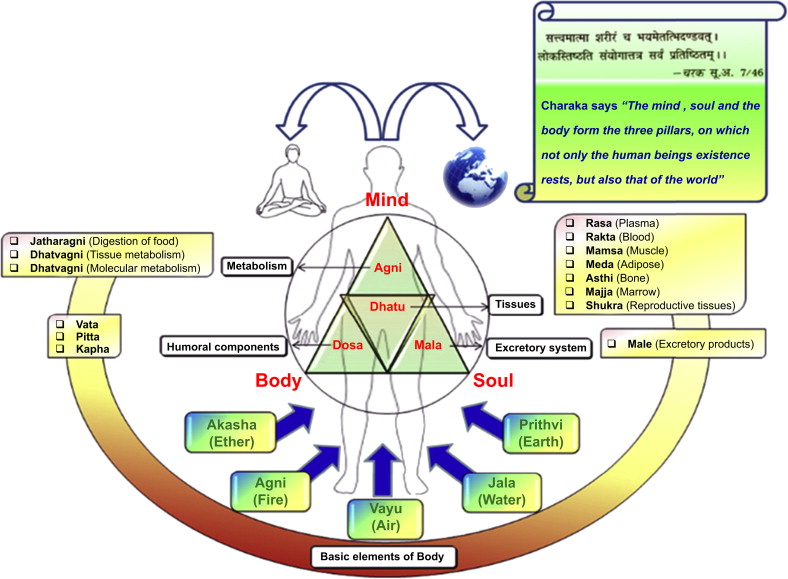
The 5 elements of ether, air, fire, water, earth manifesting from a state of nothingness consciousness or avyakta, to produce the universe and consequently establishing the basic principles behind Ayurveda science. The ancient rishis (sages or seers) believe that each element has its own unique properties, but maybe more important is the inner relationships of harmony that exist within each. The 5 elements consist of:
- Ether – came about from the subtle vibration o the soundless sound of Aum
- Air – came about from the ether moving
- Fire – the movement of air produced friction to generate heat producing fire
- Water – came about from the heat of fire dissolving elements to produce water
- Earth – water solidified to form the molecules of earth
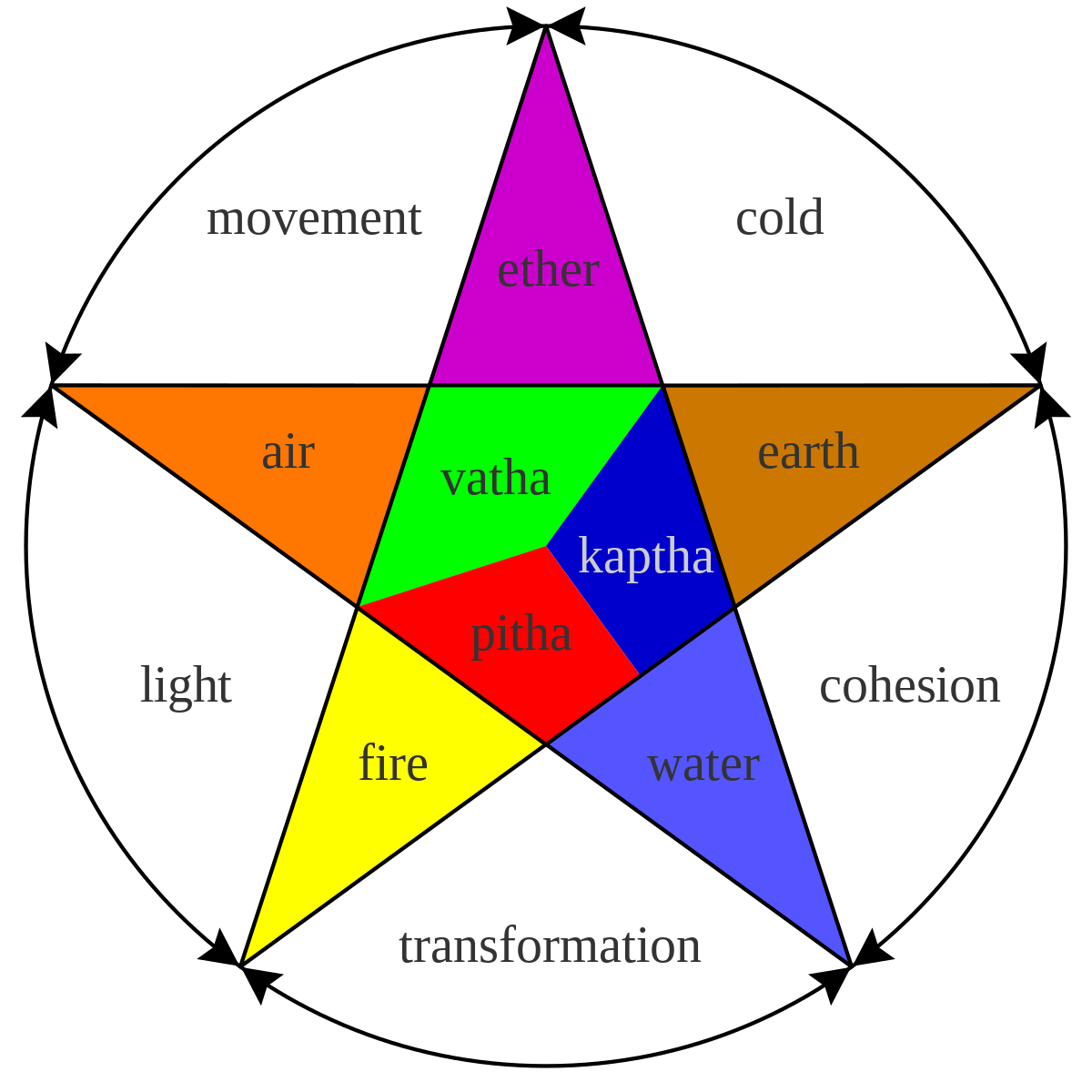
Each of the elements have corresponding traits or features such as senses, actions, organs and tastes, that again are unique to that element.
From the 5 elements, the Tridoshas or body type constitutions of Vata, Pitta and Kapha are manifested. Dosha means “impurity” or “mistake” but in this context refer more to organization of psychophysiological responses and physical changes within the human body. Each Dosha are comprised of all 5 of the elements and have interrelationships. However, two elements are dominant in each. The three Doshas and their elemental relationships are:
- Vata is associated with air and ether
- Pitta is associated with fire and water
- Kapha is water and earth
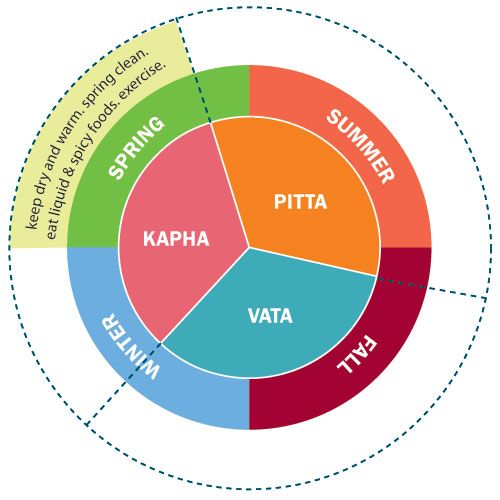
Within Ayurveda therapeutics, pharmacology and food preparation are 20 attributes or “Gunas” such as Guru (heavy), Laghu,(light), Shita (cold), Ushna (hot), etc. Ayurveda philosophy uses these 20 attributes as a therapeutic guide or diagnostic tool, in order to evaluate which quality is out of harmony within Vata, Pitta, or Kapha. These gunas are further categorized into 10 opposite pairs.
There are also various states within the combinations of Doshas, as no one is just comprised of one Dosha, but rather a balance of proportions of the three. This is referred to as one’s Prakruti, or the psychophysical makeup as well as functional habits of an individual. There are four categories that describe Prakruti:
- Janma Prakruti – also referred to as Karma Prakruti, is genetic so it does not change until the end.
- Deha Prakruti – can change by way of the actions of the mother’s lifestyle, diet, and environment. It is the current Prakruti.
- Dosha Prakruti – represents the ratio of each Dosha at the time of birth.
- Manas Prakruti.- defines the mental constitution and is subject to change. Manas Prakruti is further described in the three Gunas of sattva, rajas and tamas.
Manas Prakruti further breaks down and described in terms of the three gunas of sattva, rajas, and tamas where:
- Sattva – expresses qualities of the mind such as alertness, love, clarity, compassion, attentiveness
- Rajas – expresses qualities of selfishness, restlessness, and self-centeredness
- Tamas – qualities expressed are gloominess, sadness, dullness, laziness
The 3 Doshas can each be further elaborated upon to determine a more concise profile or constitution of the individual. All Doshas have personality and physical traits that can be perceived as positive as well as negative.
Vata comes from the Sanskrit word of “vah” with the meaning of carrying or moving. Vata reflects mobility that regulates bodily activities such as movement of food through the body and thoughts over a particular time. Vata is the commander of our life force or prana. When the vata exits the body, physical life ends. Vata individuals are often alert, quick to act and easily excited. There are many other attributes that can define the vata individual, but this is a very basic and general description.
Pitta comes from the Sanskrit word “tap” meaning heat and represents the fire element within the body. Pitta plays a role in metabolism, digestion, and body temperature. The Pitta individual has a strong capacity to concentrate, learn and understand. Consequently, they become very disciplined and great leaders.
Kapha’s meaning comes from the Sanskrit words of ka (water) and pha (flourish) or that which is flourished by water. Kapha’s elements are water and earth, composing the cells, tissues and organs of the human body. A Kapha type individual harbors a deep and stable faith, a calm and steady mind. This strong constitution possesses strength, love, knowledge, and longevity.
This is just a basic overview of some of the many aspects of Ayurveda philosophy.
References:
Lad,. (2001). Textbook of Ayurveda, Vol. 1: Fundamental Principles of Ayurveda (1st ed., Vol. 1). Ayurvedic Press.
_______________
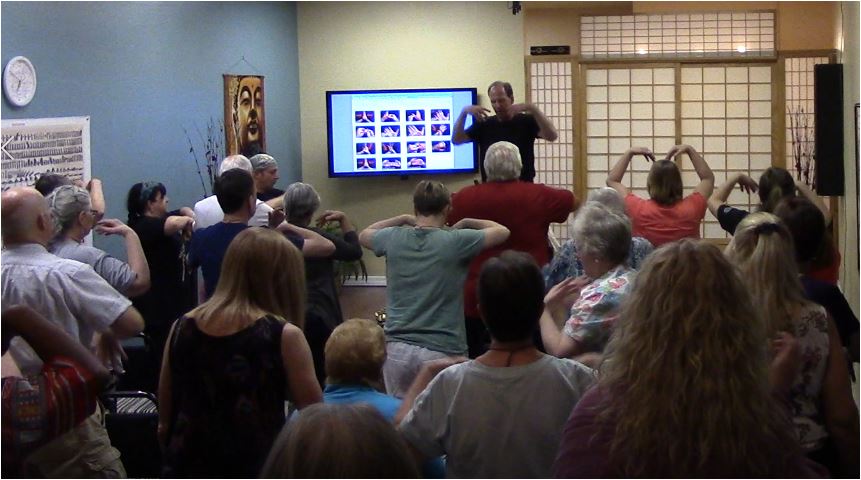
Qigong, tai chi, baguazhang, and yoga are not the only methods that can be used within this formula but have proven the test of time as methods to cultivate harmony of the mind, body and spirit. These exercise practices offer a wide spectrum of physical wellness benefits, stress relief as well as means of self-awareness. Not all teachers nor students practice these for the same goals.
I am currently offering wellness lectures and classes for group, small group & private instruction in Wekiva, Longwood and Winter Park.
For more info, contact Jim Moltzan at info@mindandbodyexercises.com, 407-234-0119 or through my site at http://www.mindandbodyexercises.com
http://www.Amazon.com/author/jimmoltzan

 United Martial Arts Association