
Sword Weights Across Cultures
In popular imagination, the Japanese katana has often been shrouded in mystery and myth. Some exaggerated claims suggest that katanas could weigh upwards of ninety pounds, evoking an image of superhuman warriors wielding massive blades. In reality, there is no credible evidence to support this notion. Historical records and surviving artifacts reveal that katanas were relatively lightweight, agile weapons designed for practical use in combat. The persistence of such myths underscores how martial traditions are often romanticized, distorting their true history.
The Katana: Function Over Fantasy
The standard katana, typically featuring a blade length of around 60-70 centimeters, weighed between 0.9–1.4 kilograms (2–3 pounds) (Katana Sword, n.d.; Minikatana, n.d.). Even longer examples rarely exceeded 1.6 kilograms (3.5 pounds). When mounted with fittings and scabbard, the total weight might approach 2.3 kilograms (5 pounds), but these were still highly functional weapons optimized for speed, precision, and cutting efficiency (Romance of Men, n.d.). Such weights align with the general purpose of the katana: a balance between sharpness, maneuverability, and endurance during prolonged use.
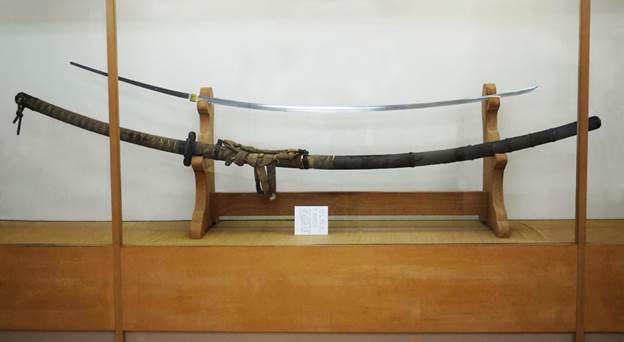
Oversized Japanese Blades: The Ōdachi
While katanas themselves were not massive, Japan did produce ōdachi (“great swords”), some of which reached extreme sizes. The famed Ōdachi Norimitsu, forged around 1446, measures over 3.7 meters in length and weighs approximately 14.5 kilograms (32 pounds) (Ōdachi, n.d.). Another ceremonial example, the Haja-no-Ontachi (“Great Evil-Crushing Blade”), tips the scale at around 75 kilograms (165 pounds). These were not battlefield weapons but symbolic or ritualistic creations, demonstrating the craftsmanship of swordsmiths and serving as offerings at shrines. The existence of such oversized blades may partly explain the confusion surrounding exaggerated katana weights.
Heavy Weapons in Other Cultures
Japan was not alone in producing impressive, heavy swords. Across cultures, larger ceremonial or specialized weapons also emerged:
- European zweihänder (two-hander): Used in the 16th century, these great swords could exceed 1.8 meters in length and weigh between 3–6 kilograms (7–14 pounds). They were sometimes wielded by elite mercenaries (Landsknechts) to disrupt pike formations (Oakeshott, 1997).
- Indian khanda: A broad, straight sword traditionally used in ritual and martial contexts. While typical examples were manageable in weight, some ceremonial versions were significantly heavier, designed for display rather than combat effectiveness (Rawson, 1968).
- Chinese zhanmadao: Literally “horse-cutting saber,” this large anti-cavalry weapon could measure over 1.5 meters and weigh several kilograms. Its purpose was more practical than ceremonial, meant to disable horses and cavalry charges (Collections Online, n.d.)
These examples reveal a recurring pattern: while functional swords remained within a reasonable weight range for human use, cultures occasionally produced oversized, impractical blades for ritual, ceremonial, or symbolic reasons.
Myths, Legends, and Wartime Folklore
The mystique surrounding legendary swords extends far beyond Japan. Myths often exaggerate both the physical properties of weapons and the feats supposedly accomplished with them, and few examples illustrate this better than those associated with World War II. One persistent rumor claim that Adolf Hitler once possessed a Japanese katana, said to have been a diplomatic gift forged by renowned swordsmiths in the 1930s. Some collectors even allege that such a sword surfaced decades later in private hands. However, no verifiable museum records, military inventories, or historical documents confirm the existence of a katana linked to Hitler, and surviving examples of his ceremonial weapons are all of European design (Military Trader, n.d.; UPI, 1984).
An even more fantastical legend suggests that Hitler personally used this sword to cut the barrel off a tank turret, a story that, while cinematic, collapses under scrutiny. Tank barrels and turrets are made of hardened steel and weigh several tons; disabling one would require explosives, heavy machinery, or catastrophic ammunition detonation, not a handheld blade. Historians and military engineers agree that there is no credible evidence supporting the story. It appears to be an example of wartime mythology, a dramatic tale perhaps born from propaganda, rumor, or the human tendency to elevate historical figures into near-mythic archetypes.
These myths underscore a larger truth: extraordinary claims about weapons, whether ninety-pound katanas or swords cutting through tanks, almost always emerge from legend rather than fact. They serve as reminders of how cultural fascination can blur the line between historical reality and heroic fantasy.
The myth of the ninety-pound katana highlights how martial artifacts can be distorted by legend. A typical katana weighed no more than a few pounds, emphasizing agility over brute force. Oversized blades, whether Japanese ōdachi, European zweihänder, or other cultural equivalents, did indeed exist, but their purpose was often ceremonial rather than practical. Understanding the true dimensions of these weapons allows us to appreciate them not as props of fantasy, but as carefully designed tools reflecting the martial philosophies of their cultures.
References:
Collections online. (n.d.). Royal Armouries. https://royalarmouries.org/collection/object/object-1887
Katana Sword. (n.d.). How heavy is a katana? Katana Sword. Retrieved from https://katana-sword.com/blogs/katana-blog/how-heavy-is-a-katana
Military Trader. (n.d.). Swords of the Third Reich: A collector’s guide to Nazi Germany edged weapons. Military Trader. Retrieved from https://www.militarytrader.com/militaria-collectibles/swords-of-the-third-reich
Minikatana. (n.d.). How heavy is a katana? The role of weight in the performance and aesthetics of Japanese swords. Minikatana. Retrieved from https://minikatana.com/blogs/main/how-heavy-is-a-katana-the-role-of-weight-in-the-performance-and-aesthetics-of-japanese-swords
Oakeshott, E. (1997). European weapons and armour: From the Renaissance to the Industrial Revolution. Boydell Press. https://archive.org/details/europeanweaponsa0000oake
Ōdachi. (n.d.). In Wikipedia. Retrieved September 9, 2025, from https://en.wikipedia.org/wiki/%C5%8Cdachi
Romance of Men. (n.d.). How heavy is a katana? Romance of Men. Retrieved from https://romanceofmen.com/blogs/katana-info/how-heavy-is-a-katana
Rawson, P. S. (1968). The Indian sword. Herbert Jenkins. https://archive.org/details/indiansword0000raws
UPI. (1984, December 27). Texans find Hitler’s sword. United Press International. Retrieved from https://www.upi.com/Archives/1984/12/27/Texans-find-Hitlers-sword/2899472971600



 United Martial Arts Association