
Our personal happiness has very much to do with having good health, adequate nutrition, positive social interactions, and other resources often not that of wealth, fame, or celebrity. Happiness comes from within an individual, as an inner state of awareness. We can cultivate our happiness. One way is to form a habit to practice deliberate mental exercises. Simple behavior tasks can take about 21 days of repletion to become a habit, whereas more complex or difficult behavior adjustments may take 66-88 days to master, depending upon the individual and their particular circumstances (Morris, 2022).

This first practice helps us to focus on what is most important in our life. Focus on your maximum net worth, what is most valuable to you – the people in your life, your health and well-being. When you are feeling depressed and your self-esteem is low, think of the people who care about you. This can help bring you back to place where your happiness comes from within and those around you. If you don’t have many or anyone in your life that you feel care about you, realize that you exist by means of something greater than you or anyone around or not around you. What do you think about upon waking up from your sleep? How long does it take for your mind to begin to wander after you wake up? How long do you allow your mind to wander before focusing in on what you need to do in order to get your day started. Now, try this exercise first thing when you wake up before even getting out of your bed. Think about five people in your life that you are grateful for. Lay with your eyes closed while performing this practice. Focus upon the first person in your life you want to be grateful for. Contemplate the various ways this person has impacted your life. Send your silent gratitude to this person. Then focus on a second person. Look deep into this person’s eyes and see the color of their irises. Then send this person your silent gratitude. Now focus upon a third person. Try to see your first memory of this person and then send your silent gratitude to them. Onto the fourth person and see this individual as being very content and joyful wherever that person is at right now. Send them your silent gratitude. Try to think back to a time when you were in grade school and try to see yourself as you were at that time. Draw from your memory of how you looked, the clothes you wore, the things that made you happy. Now send silent gratitude to your younger self. Finally, think about someone close to you who has passed away. See yourself embracing this individual and sending them your love. Send your silent gratitude to this individual. Open your eyes when you feel you are complete and satisfied. If you need a reminder to do this practice, take a Post-It note and write “gratitude” on it and place it to your bathroom mirror. Upon waking up, if you forget this exercise, you will eventually find yourself in the bathroom. See your Post-It reminder and go back to bed and start over. This is how you can make it a habit.
A second deliberate mental practice is to treat your loved ones as if you have not seen them for days. The saying of “familiarity breeds contempt” is directly relative to becoming so comfortable with one’s family, that they become bored and begin to look for faults and imperfections, in one another. For at least the first few minutes of encountering your loved ones, treat them with the same novelty that you would, if you were reunited a family member or friend that you have not seen in years – but do this on a daily basis. Become genuinely interested in what is of interest to them, while finding praise, rather than trying to judge or improve somebody’s shortcomings.
The third practice takes literally a few seconds. Look at the world in a way we want the world to look at us. When we meet a stranger, an acquaintance, a co-worker, a service provider, a doctor, a police officer, etc. and we look at one another, in an instant we choose whether to engage with them or not. Is this person trustworthy? Can I trust them with my safety, my health, my family, my house? We develop a judgmental awareness where we begin to make internal judgments about this person’s appearance and character. It takes a mere 30 milliseconds for us to decide if someone is trustworthy or not. 30 milliseconds, before we even begin to know who this person is. However, we all have so much in common in the way of having the same neural predispositions.
We all spend a lot of time with our minds wandering.
We all tend to focus on threats and imperfections.
We all carry negativity bias.
We all try to adapt to be positive.
When we see people and before our mind begins to judge others, try for the first few seconds, to embrace your heart with theirs and send them a silent “I wish you well.” “I wish hope upon you.” “I wish you healing and happiness.” This is how we can improve our world by silently wishing each other well. We don’t need to say it aloud but rather say internally as our private intention. What transpires is that our whole engagement with the world changes. Our threat perception goes down. Let’s not be naive and assume that everyone we encounter is free of executing violence and malfeasance towards others. Start in a time and location where it feels safe.
Once our attention is in our own control, we can take on the fourth practice where we re-frame life’s challenges into higher principles. The five principles of:
- gratitude
- compassion
- acceptance
- meaning
- forgiveness
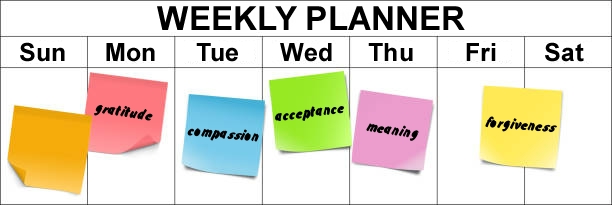
Take each day of the week and attach a theme to focus upon suing these principles.
Monday is the day for gratitude or what came before us and what will come after us.
Tuesday is the day for compassion and to be kind to others.
Wednesday is the day for acceptance. Will issues today really matter years from now?
Thursday is the day for seeking higher meaning and purpose.
Friday is the day for forgiveness; not necessarily to forget but to forgive and let go.
This is what we and our children need, to be grateful, to be compassionate, to be accepting, to live our life with meaning and have forgiveness, and by doing so we can create a better world for all of us and future generations.
Reference:
Morris, S. (2022, February 27). Two Problems Safety Professionals Need to Consider About Habit Formation. Safety Talk Ideas. https://www.safetytalkideas.com/safetyprofessional/habit-formation-workplace-safety/
_________________
I teach classes, seminars, and private instruction focusing on methods of wellness from Traditional Chinese Medicine, Tai Chi, Qigong, acupressure and exercises from martial arts for fitness and improved health. 407-234-0119.
More education products can be found at:
https://www.mindandbodyexercises.com/f82557669
I write often about topics that affect our health and well-being. Additionally, I teach and offer lecture about qigong, tai chi, baguazhang, and yoga.
For more info, contact Jim Moltzan at info@mindandbodyexercises.com, 407-234-0119 or through my site at http://www.mindandbodyexercises.com
www.Amazon.com/author/jimmoltzan

 United Martial Arts Association