
Integrating Concepts of Mushin, Wu Wei, Song, and More
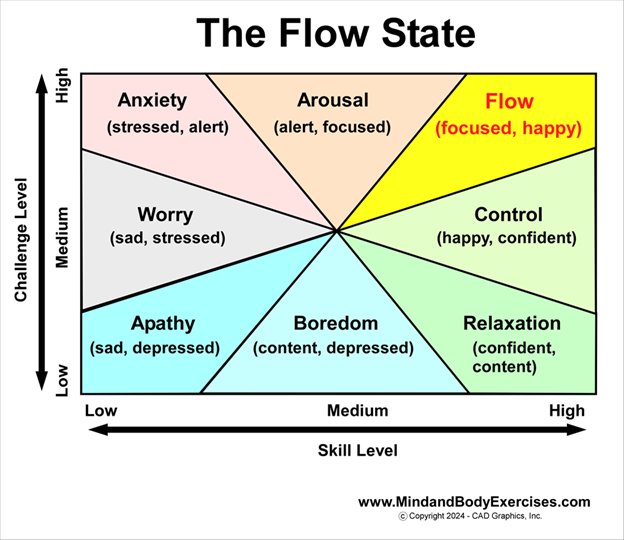
In Western psychology, being “in the zone” or in a “flow state” describes a mental state of deep absorption where time perception fades, awareness sharpens, and actions become effortless (Csikszentmihalyi, 1990). This state is not unique to modern science. In fact, many ancient practices such as martial arts, qigong, meditation, and the aesthetic traditions of the East, have long cultivated similar states using different terminology and methods.
While “flow” emphasizes optimal performance, many Eastern terms go deeper: they describe integration of body, mind, breath, and spirit, often in accord with the Dao or an underlying natural order. Let us explore these terms and their significance.
Martial Arts: Mushin and Zanshin
In Japanese martial arts, the state of flow is often described using the Zen-influenced term Mushin, meaning “no mind” or “empty mind.” It refers to a condition in which the practitioner acts without conscious deliberation, relying on trained reflexes and spontaneous awareness. The mind is free of distraction and fear; movements are clear and fluid (Herrigel, 1953).
Another related term is Zanshin, or “remaining mind.” This describes a calm, continuous state of alertness both during and after action, with a sustained, integrated awareness (Lowry, 1986).
Through rigorous training, repeated kata, sparring, and meditation, martial artists cultivate these states, allowing them to respond to changing situations naturally and without hesitation.

_______
Qigong and Tai Chi: Wu Wei, Song, Ziran, and Yi
In Chinese internal arts such as Tai Chi, Bagua Zhang, and other methods like Qigong, the flow state is cultivated through the integration of several core concepts:
- Wu Wei: Effortless action. Rooted in Daoist philosophy, Wu Wei refers to acting in harmony with nature, without forcing or striving (Laozi, trans. Legge, 1891). Movements arise spontaneously, guided by deep awareness and connection to the environment.
- Song: Relaxed yet structured looseness. Song is a key internal martial arts term meaning to release unnecessary tension while maintaining structural integrity. One does not collapse but rather cultivates a state of “alive relaxation” where Qi and movement can flow freely (Frantzis, 2006). True Song supports entering a flow state because body and mind are soft, open, and responsive.
- Ziran: Naturalness or spontaneity. An expression of advanced internal arts practice, where movement flows without contrivance or self-conscious control.
- Yi Nian and Yi: Single-pointed intent. In flow, the practitioner’s intention guides movement seamlessly, without overt mental effort.
Breath control, slow mindful repetition, and the cultivation of Song are critical methods for achieving this state in Qigong and Tai Chi. Over time, this leads to “moving meditation” as natural expression of flow.
Meditation and Zen: Dhyana, Samadhi, and Mo Nian
Meditative traditions in both Buddhism and Daoism have long described states equivalent to flow:
- Dhyana / Chan / Zen: The state of deep meditative absorption where thought activity diminishes and awareness becomes unified and clear (Suzuki, 1956).
- Samadhi: A condition of profound stillness and concentration where the practitioner merges with the object of focus, whether in seated meditation or in daily life. In Zen arts, this leads to flow in action.
- Mo Nian: Silent awareness, a state where the practitioner moves or acts without inner verbalization, essential for flow in both meditation and movement disciplines.
Meditative flow emerges through long-term attention training and breath practices that stabilize awareness and diminish ego identification.
Aesthetic and Cultural Practices: Qi Yun Sheng Dong and Shin-Gi-Tai
The flow state is not limited to combat or health practices. In Chinese painting, calligraphy, and Japanese tea ceremony, similar ideals appear:
- Qi Yun Sheng Dong: Spirit resonance giving life to the art. This describes the energetic liveliness and authenticity that arises when the artist enters a flow state through their medium (Cahill, 1994).
- Shin-Gi-Tai: Unity of heart-mind, technique, and body. A Japanese term often used in martial and aesthetic disciplines, referring to the seamless integration of inner intent, technical skill, and embodied expression (Lowry, 1986).
Artists achieve this state through decades of technical refinement coupled with deep mental stillness, allowing spontaneous creativity to arise.
Summary Table: Key Terms for Flow in Eastern Practices
| Domain | Term(s) | Nature of Flow Experience |
| Martial Arts | Mushin, Zanshin | Spontaneous action and sustained awareness in combat |
| Qigong / Tai Chi | Wu Wei, Song, Ziran, Yi Nian | Breath-body-mind integration; relaxed yet dynamic responsiveness |
| Meditation | Dhyana, Samadhi, Mo Nian | Unified attention; timeless presence |
| Arts & Aesthetics | Qi Yun Sheng Dong, Shin-Gi-Tai | Flow through artistic expression and technical mastery |
What modern science calls “flow” is deeply embedded in ancient mind-body disciplines. Concepts such as Mushin, Wu Wei, and especially Song describe not merely optimal performance, but the harmonization of self with nature and the present moment. Practitioners of martial arts, Qigong, and meditation seek not only to achieve flow for its benefits, but as a means of deep personal cultivation.
When body, breath, mind, and intention become one, Song releases tension, Yi guides movement, and Wu Wei allows action to arise naturally, the practitioner touches the essence of flow and embodies timeless wisdom.
References:
Cahill, J. (1994). The Lyric Journey: Poetic Painting in China and Japan. Harvard University Press.
Csikszentmihalyi, M. (1990). Flow: the psychology of optimal experience. ResearchGate. https://www.researchgate.net/publication/224927532_Flow_The_Psychology_of_Optimal_Experience
Frantzis, B. K. (2006). The Power of Internal Martial Arts and Chi: Combat and Energy Secrets of Ba Gua, Tai Chi, and Hsing-I. Blue Snake Books. https://archive.org/details/powerofinternalm0000fran
Herrigel, E. (1953). Zen in the Art of Archery (R. F. C. Hull, Trans.). Pantheon Books. https://archive.org/details/zeninartofarcher00herrrich/page/n9/mode/2up
Laozi. (1891). Tao Te Ching (J. Legge, Trans.). The Clarendon Press. https://archive.org/details/laozi_tao-te-ching
Lowry, D. (1986). Autumn Lightning: The Education of an American Samurai. Shambhala. https://archive.org/details/autumnlightninge0000lowr
Suzuki, D. T. (1956). Zen Buddhism: Selected Writings of D. T. Suzuki. Doubleday Anchor Books. https://archive.org/details/zenbuddhismselec00dais

 United Martial Arts Association