
Consciousness, Quantum Physics, and the Mind–Matter Debate
Masaru Emoto’s assertion that thoughts and emotions can influence the crystalline structure of water provoked wide interest across both scientific and metaphysical communities. Although his findings lack empirical verification, they echo long-standing philosophical and scientific debates about the relationship between consciousness and physical reality, a question that modern quantum theory has occasionally reignited.
The Conceptual Parallel: Observation and Reality in Quantum Physics
Quantum mechanics revolutionized classical physics by demonstrating that subatomic particles exist in probabilistic states until observed, a phenomenon encapsulated in the wave–particle duality and the observer effect. In the double-slit experiment, for example, electrons act as waves when unobserved but collapse into particle-like behavior when measured (Heisenberg, 1927; Bohr, 1935). This led some theorists and philosophers to speculate that conscious observation might play a role in shaping physical outcomes.
However, mainstream physicists interpret this differently. The “observer” in quantum mechanics generally refers to a measurement apparatus interacting with a quantum system, not necessarily a conscious mind (Rosenblum & Kuttner, 2011). Nonetheless, the philosophical ambiguity of the observer’s role created fertile ground for metaphysical interpretations suggesting that mind and matter may be intertwined.
From Quantum Observation to Emoto’s Conscious Water Hypothesis
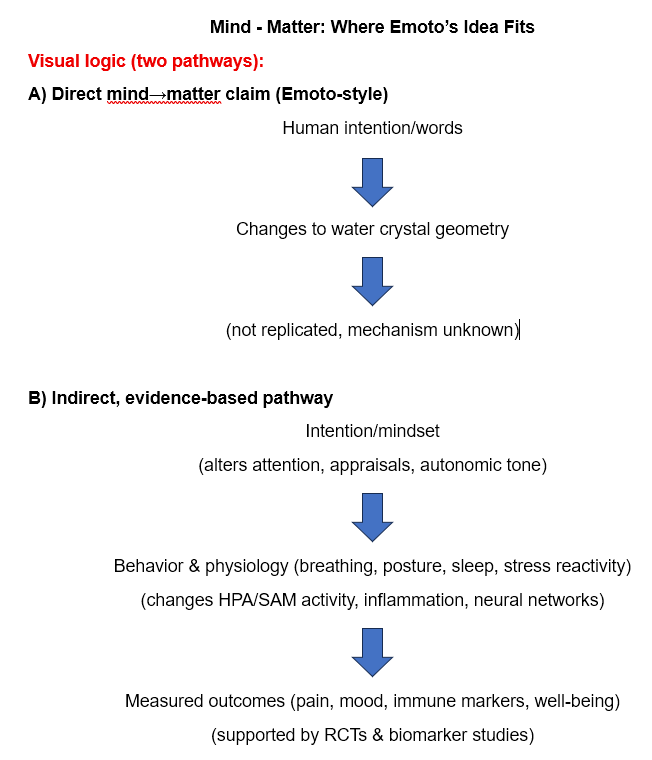
Emoto’s experiments symbolically extend this idea: if observation can influence quantum particles, perhaps human consciousness can influence the molecular structure of matter (Emoto, 2004). This notion aligns with quantum mysticism, a movement that seeks to bridge consciousness studies with quantum phenomena (Zohar, 1990).
Advocates argue that intention and emotion represent subtle forms of energy capable of resonating with molecular vibrations. This idea is philosophical rather than empirical, positing that reality itself might be participatory, a concept popularized by physicist John Archibald Wheeler’s “participatory anthropic principle,” which implies that the universe requires observers to exist in a determinate state (Wheeler, 1990).
Scientific and Philosophical Challenges
Despite poetic parallels, the application of quantum mechanics to macroscopic systems like water remains scientifically unsupported. The thermal and molecular motion within liquid water occurs at scales and energies far removed from quantum coherence effects. Quantum measurement phenomena occur in controlled, near-zero-temperature environments, not within warm biological or environmental systems (Tegmark, 2000).
Furthermore, studies in psychokinesis and distant intention, fields that attempt to experimentally test mind-matter interaction, show inconsistent and statistically weak results (Radin, 2006; Jahn & Dunne, 2011). While intriguing, these findings fall short of establishing causal evidence that consciousness can directly alter molecular geometry.
Philosophically, however, Emoto’s premise resonates with panpsychism and idealism, which propose that consciousness is a fundamental property of the universe rather than an emergent product of the brain (Strawson, 2006; Goff, 2019). Within these frameworks, Emoto’s water crystals might be interpreted as metaphors for the relational fabric between thought, emotion, and matter.
Integrative and Symbolic Interpretations
From a holistic perspective, Emoto’s work continues to inspire inquiry into the psychosomatic and energetic dimensions of human life. Even if his findings lack scientific validation, they serve as a symbolic model of how emotional and cognitive states influence environmental harmony, echoing principles in Taoist and Buddhist thought regarding the unity of mind and nature.
In this sense, Emoto’s “water consciousness” reflects a metaphoric truth: our internal states do shape the world we inhabit, psychologically, socially, and ecologically, even if not at the level of hydrogen bonding or crystal symmetry. His hypothesis can thus be viewed as a moral and ecological allegory for mindfulness, intention, and gratitude, consistent with holistic and spiritual paradigms.
Conclusion
While Masaru Emoto’s experimental methods do not meet scientific standards of reproducibility or objectivity, his ideas underscore a profound question that remains unresolved in modern physics and philosophy: what is the role of consciousness in the unfolding of reality? Quantum physics hints that observation and existence are interlinked, but the leap from subatomic measurement to human thought influencing matter remains metaphoric rather than mechanistic.
Nonetheless, Emoto’s message that consciousness, emotion, and intention matter, continues to resonate as an invitation toward greater harmony between human awareness and the physical world.
Comparison table
| Domain / Claim | Core idea | Evidence level | Typical methods | Representative sources | Key caveats |
| Emoto’s water hypothesis | Thoughts/words change water crystal geometry | Low (non-replicated; methodological issues) | Crystal “beauty” ratings; photographic selection | Emoto (2004); critiques: Ball (2008) | Lack of blinding, subjective scoring, no mechanism |
| Quantum measurement (mainstream) | Measurement disturbs quantum systems; “observer” = apparatus | High (foundational physics) | Double-slit, interferometry, decoherence theory | Heisenberg (1927); Bohr (1935); Tegmark (2000) | Does not require conscious mind; scaling to warm, wet systems is non-trivial |
| Quantum consciousness (interpretive) | Consciousness participates in “collapse” | Speculative | Conceptual analyses; small experimental programs | Rosenblum & Kuttner (2011); Wheeler (1990) | Philosophical; no consensus or robust empirical support |
| Mind–matter (parapsychology) | Intention can affect matter at a distance | Controversial/weak | RNG/PK, double-blind intention trials | Radin (2006) | Small effects; replication disputes |
| Placebo/nocebo psychobiology | Beliefs shape symptoms & physiology | High | Expectancy manipulations; analgesia paradigms | Colloca & Benedetti (2007, 2009) | Context-dependent; not “mind over molecules” per se |
| Mindfulness/meditation → brain/immune | Training attention/regulation alters networks & markers | Moderate–High | RCTs; EEG/fMRI; cytokines/antibodies | Davidson et al. (2003); Goyal et al. (2014); Hölzel et al. (2011) | Effects vary by dose, population, protocol |
| Stress-reduction & inflammation | Psychosocial stress ↔ inflammatory signaling | High | Cohort & intervention studies; IL-6, CRP | Black & Slavich (2016) | Causality clearer in RCTs than observational |
How to use this table:
- If you want credible, actionable routes by which mind influences body, focus on the indirect, evidence-based pathway: attention training, stress appraisal, breath/HRV regulation, sleep, social context → measurable neural and immune changes.
- Emoto’s claim remains a metaphor for intention and care. Treat it as symbolic, not mechanistic chemistry.

References:
Ball, P. (2008). H2O: A biography of water. Weidenfeld & Nicolson.
Black, D. S., & Slavich, G. M. (2016). Mindfulness meditation and the immune system: A systematic review of randomized controlled trials. Annals of the New York Academy of Sciences, 1373(1), 13–24. https://doi.org/10.1111/nyas.12998
Bohr, N. (1935). Can quantum-mechanical description of physical reality be considered complete? Physical Review, 48(8), 696–702. https://doi.org/10.1103/PhysRev.48.696
Carter, B. (2023, November 27). Exploring Water Studies, Dr. Masaru Emoto’s research, and homeopathy. https://peticare.co.nz/2023/11/27/exploring-the-interconnected-threads-of-water-studies-dr-masaru-emotos-research-and-homeopathy/?srsltid=AfmBOopgvuF-KVXBG0GoWNdx3LPFT7pBBXWI4lVVZ_QWjujR7lHjHSoF
Colloca, L., & Benedetti, F. (2007). Nocebo hyperalgesia: How anxiety is turned into pain. Current Opinion in Anesthesiology, 20(5), 435–439. https://doi.org/10.1097/ACO.0b013e3282b972fb
Colloca, L., & Benedetti, F. (2009). Placebo analgesia induced by social observational learning. Pain, 144(1-2), 28–34. https://doi.org/10.1016/j.pain.2009.01.033
Davidson, R. J., Kabat-Zinn, J., Schumacher, J., Rosenkranz, M., Muller, D., Santorelli, S. F., Urbanowski, F., Harrington, A., Bonus, K., & Sheridan, J. F. (2003). Alterations in brain and immune function produced by mindfulness meditation. Psychosomatic medicine, 65(4), 564–570. https://doi.org/10.1097/01.psy.0000077505.67574.e3
Emoto, M. (2004). The hidden messages in water. Beyond Words Publishing. https://archive.org/details/hiddenmessagesin00emot
Goff, P. (2019). Galileo’s error: Foundations for a new science of consciousness. Pantheon Books.
Goyal, M., Singh, S., Sibinga, E. M. S., et al. (2014). Meditation programs for psychological stress and well-being: A systematic review and meta-analysis. JAMA Internal Medicine, 174(3), 357–368. https://doi.org/10.1001/jamainternmed.2013.13018
Heisenberg, W. (1927). Über den anschaulichen Inhalt der quantentheoretischen Kinematik und Mechanik. Zeitschrift für Physik, 43(3–4), 172–198. https://doi.org/10.1007/BF01397280
Hölzel, B. K., Carmody, J., Vangel, M., et al. (2011). Mindfulness practice leads to increases in regional brain gray matter density. Psychiatry Research: Neuroimaging, 191(1), 36–43. https://doi.org/10.1016/j.pscychresns.2010.08.006
Jahn, R. G., & Dunne, B. J. (2011). Consciousness and the source of reality: The PEAR odyssey. ICRL Press. https://archive.org/details/consciousnesssou0000jahn
Radin, D. (2006). Entangled minds: Extrasensory experiences in a quantum reality. Simon & Schuster.
Rosenblum, B., & Kuttner, F. (2011). Quantum enigma: Physics encounters consciousness (2nd ed.). Oxford University Press.
Strawson, G. (2006). Realistic monism. In Journal of Consciousness Studies (Vol. 13, Issue No. 10-11, pp. 3–31). Imprint Academic. https://web.ics.purdue.edu/~drkelly/StrawsonRealisticPhysicalism2006.pdf
Tegmark, M. (2000). Importance of quantum decoherence in brain processes. Physical Review E, 61(4), 4194–4206. https://doi.org/10.1103/PhysRevE.61.4194
Wheeler, J. A. (1990). Information, physics, quantum: The search for links. In W. Zurek (Ed.), Complexity, entropy, and the physics of information (pp. 3–28). Addison-Wesley.
Zohar, D. (1990). The quantum self: Human nature and consciousness defined by the new physics. William Morrow. https://archive.org/details/quantumself00dana



 United Martial Arts Association