
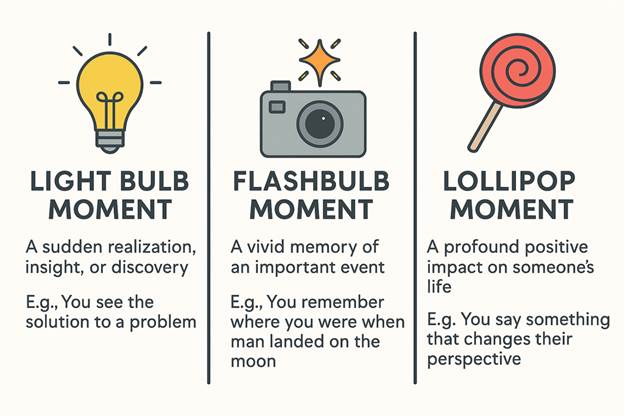
Human experiences are filled with defining moments that shape our understanding of ourselves and our relationships with others. Three metaphors that capture different yet equally transformative experiences are the light bulb moment, the flashbulb moment, and the lollipop moment. While all represent instances of change and meaning, their sources and impacts differ substantially. A light bulb moment represents a sudden spark of personal insight or discovery. A flashbulb moment captures the power of memory by anchoring us to a specific point in time during a significantly shared event. A lollipop moment, by contrast, highlights how a seemingly small act can have an unexpectedly profound impact on another person’s life. Examining these three concepts reveals not only how individuals grow through personal insight and memory but also how they shape one another’s lives through small, often unrecognized gestures.
Light Bulb Moments: Personal Realization
The term light bulb moment is commonly used to describe the sudden emergence of clarity, understanding, or inspiration. Rooted in imagery popularized by early cartoons, where a light bulb appeared above a character’s head to symbolize a new idea, the expression reflects how insight can feel instantaneous (Gladwell, 2005). These moments are often associated with cognitive restructuring, when a problem once perceived as insurmountable suddenly becomes solvable. Psychologists identify such experiences as insight learning, a process where new connections are drawn between previously unrelated concepts (Bowden et al., 2005).
For example, a student struggling with a mathematics problem may suddenly “see” the solution after hours of confusion. This type of realization brings both intellectual satisfaction and emotional reinforcement, often motivating individuals to continue exploring and learning. In a broader sense, light bulb moments underscore the human capacity for creativity and problem-solving, marking them as critical turning points in education, science, and personal growth.
Flashbulb Moments: Distinct Memories in Time
Alongside the concept of the light bulb moment, psychologists also describe what are known as flashbulb moments. Unlike the personal insight of a light bulb moment, a flashbulb moment refers to a vivid and enduring memory of where one was and what one was doing during a significant historical or emotional event. These memories are often tied to collective experiences, such as the 1969 moon landing, the terrorist attacks on September 11, 2001, or the explosion of the space shuttle Challenger in 1986.
Brown and Kulik (1977) first introduced the term, noting how individuals can recall with great detail their surroundings, emotions, and even conversations during such events. Although research shows that the accuracy of these memories may fade over time, the confidence in them remains strong (Talarico & Rubin, 2003). Flashbulb moments therefore highlight the powerful role of emotion and societal significance in shaping human memory, standing in contrast to the personal realization of a light bulb moment and the interpersonal influence of a lollipop moment.
Lollipop Moments: Impact on Others
By contrast, the lollipop moment emphasizes interpersonal influence rather than internal realization. The term was introduced by leadership educator Drew Dudley in his TEDx talk Everyday Leadership (2010). Dudley shared a story of how he casually handed a lollipop to a nervous new student during orientation, making a humorous remark that helped her feel more comfortable. What he considered an insignificant act turned out to be transformative, as the student later credited the gesture as a pivotal moment in her decision to remain in school and eventually meet her future spouse.
Lollipop moments illustrate how simple actions, often forgotten by the initiator, can have life-altering effects for others. Scholars of positive psychology highlight the importance of micro-moments of connection, such as kindness, encouragement, or recognition, in building resilience and well-being (Fredrickson, 2013). Unlike light bulb moments, which center on self-discovery, lollipop moments demonstrate the ripple effect of human interaction, where a small spark of generosity or empathy can catalyze growth, healing, or confidence in others.
Comparing the Three
Although light bulb, flashbulb, and lollipop moments are distinct, they are complementary in the landscape of human experience. Light bulb moments transform the self by providing clarity and insight, flashbulb moments connect us to shared historical and emotional contexts, and lollipop moments transform relationships by creating meaning for others. Each concept represents a unique dimension of human development: cognition, memory, and social connection.
Together, they remind us of the multidimensional nature of growth and meaning. Intellectual breakthroughs drive progress, emotionally charged memories bind us to the larger human story, and interpersonal kindness fosters community and belonging. Without light bulb moments, innovation and self-awareness would stagnate. Without flashbulb moments, our shared cultural narrative would lose its depth. Without lollipop moments, compassion and leadership would lose their everyday relevance. Recognizing all three encourages us to value the sudden spark of discovery, the unforgettable imprint of memory, and the subtle, transformative power of everyday kindness.
References:
Bowden, E. M., Jung-Beeman, M., Fleck, J., & Kounios, J. (2005). New approaches to demystifying insight. Trends in Cognitive Sciences, 9(7), 322–328. https://doi.org/10.1016/j.tics.2005.05.012
Brown, R., & Kulik, J. (1977). Flashbulb memories. Cognition, 5(1), 73–99. https://doi.org/10.1016/0010-0277(77)90018-X
designer. (2017, October 17). THE RIPPLE EFFECT – Embrace the challenge. https://embracethechallenge.org/the-ripple-effect/
Dudley, D. (2010). Everyday leadership [Video]. TEDxToronto. https://www.ted.com/talks/drew_dudley_everyday_leadership
Fredrickson, B. L. (2013). Love 2.0: Finding happiness and health in moments of connection. Hudson Street Press. https://archive.org/details/love20creatingha0000fred
Gladwell, M. (2005). Blink: The power of thinking without thinking. Little, Brown and Company. https://psycnet.apa.org/record/2006-01628-000
Talarico, J. M., & Rubin, D. C. (2003). Confidence, not consistency, characterizes flashbulb memories. Psychological Science, 14(5), 455–461. https://doi.org/10.1111/1467-9280.02453


 United Martial Arts Association