
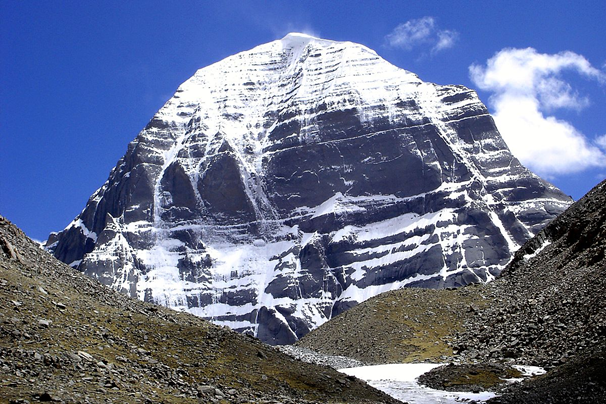
Mount Kailash, located in the remote western region of the Tibetan Plateau, is not merely a geological marvel but a profound emblem of spiritual, mental, and physical integration. Revered across Hinduism, Buddhism, Jainism, and Bon, it stands as a living symbol of the interconnectedness that lies at the heart of holistic health. Rather than a site of conquest, it is a place of pilgrimage where the journey is inward, and the elevation sought is that of consciousness.
Spiritual Significance and Energetic Alignment
In Hindu philosophy, Mount Kailash is believed to be the dwelling place of Lord Shiva, the meditating ascetic who governs transformation and stillness. This vision mirrors a core tenet of holistic wellness, where there exists the need to cultivate inner awareness and transcendent consciousness. Shiva’s presence on the mountaintop symbolizes the crown chakra (sahasrara), representing union with the divine and the unfolding of higher consciousness (Johari, 2000).
Tibetan Buddhists identify the mountain as Kang Rinpoche, a manifestation of Mount Meru, or the cosmic axis believed to connect the heavens, earth, and underworld (Snellgrove, 1987). This symbolic vertical axis represents the human energetic spine in yogic practice and suggests that full alignment (both physical and spiritual) must occur from base to crown, a principle echoed in breathwork, qigong, and tai chi traditions.
In both spiritual and energetic models, Mount Kailash embodies balance and integration not only of body systems but of opposing forces: conscious and unconscious, effort and surrender, yin and yang.
The Kora: Pilgrimage as Mind-Body Practice
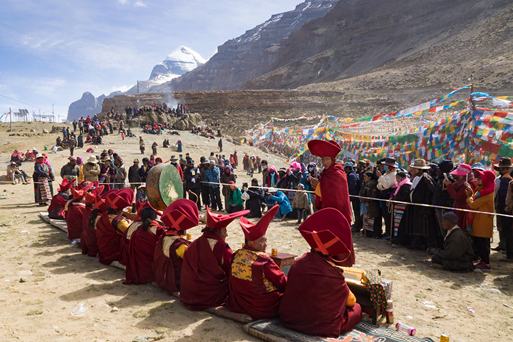
Pilgrims do not climb Mount Kailash. Instead, they perform a kora, which is a sacred circumambulation around the 52-kilometer base. This walking meditation reflects a form of dynamic mindfulness, an embodied spiritual practice that supports both mental clarity and physical endurance. It mirrors similar holistic practices such as walking meditation in Zen (Thich Nhat Hanh, 1991) and labyrinth walking in Western contemplative traditions.
One full kora is believed to absolve a lifetime of negative karma. Completing 108 cycles is said to lead to enlightenment. Regardless of belief system, this structured repetition and ritual movement demonstrate the psychophysiological benefits of contemplative physical exertion, a core aspect of holistic health (Bussing et al., 2012).
Psychosomatic Resonance and Symbolic Terrain
Mount Kailash’s position as the source of four major rivers (Indus, Sutlej, Brahmaputra, and Karnali) flowing in cardinal directions is symbolically rich. In traditional Chinese and Ayurvedic systems, water represents the flow of life force energy (qi or prana), and this geographical phenomenon reinforces Kailash’s status as a central energetic hub, a sacred “heart” of the world (Larre, de la Vallée, & Rochat de la Vallée, 1996).
The nearby lakes of Manasarovar (consciousness) and Rakshastal (unconscious or egoic forces) reflect archetypal and psychological dualities. Together, they offer a map of the inner self, where balance between light and shadow, awareness and instinct, becomes central to healing and integration (Jung, 1969).
Holistic Prohibition: Why Kailash Is Never Climbed
Unlike Everest, Kailash remains unclimbed by human feet, not due to physical danger but because of spiritual reverence. Ancient traditions prohibit accent, not as a denial of physical achievement, but as a call to humility, sacred restraint, and inner elevation. The modern holistic health movement increasingly acknowledges the power of respecting natural limits, recognizing that healing often arises not from forceful action but from honoring cycles, boundaries, and sacred stillness (Kabat-Zinn, 1990).
Myth, Energy, and Inner Ascent
Legends and esoteric traditions refer to Mount Kailash as a spiritual generator or vortex, a site of unexplained energetic phenomena. Though largely anecdotal, some studies of pilgrims’ experiences report states of heightened awareness, clarity, and emotional release, not unlike the effects of deep meditative states (Walach et al., 2005).
Holistically, Kailash becomes more than a destination. It is a mirror of the self, a metaphor for the inner path of transformation. The mountain teaches that healing, like the kora, requires movement around one’s core, integrating all aspects of being of mind, body, and spirit, until inner peace is restored.
Mount Kailash remains one of the Earth’s most revered sites, not because it has been conquered, but because it continues to conquer the ego. As a symbol of holistic integration, it reflects what modern wellness often seeks to rediscover: that true health is a sacred alignment, not just of body systems, but of the human spirit with the cosmos.
References:
Büssing, A., Michalsen, A., Khalsa, S. B. S., Telles, S., & Sherman, K. J. (2012). Effects of yoga on mental and physical health: A short summary of reviews. Evidence-Based Complementary and Alternative Medicine, 2012, 1–7. https://doi.org/10.1155/2012/165410
File:Kailash Mansarover.jpg – Wikimedia Commons. (2006, May 31). https://commons.wikimedia.org/wiki/File:Kailash_mansarover.jpg
Johari, H. (2000). Chakras: Energy centers of transformation. Destiny Books. https://archive.org/details/chakrasenergycen0000joha
Jung, C. G. (1969). Collected Works of C.G. Jung, Volume 9 (Part 1): Archetypes and the Collective Unconscious (G. ADLER & R. F. C. HULL, Eds.). Princeton University Press. http://www.jstor.org/stable/j.ctt5hhrnk
Kabat-Zinn, J. (1990). Full catastrophe living: Using the wisdom of your body and mind to face stress, pain, and illness. Delta. https://archive.org/details/fullcatastrophel00kaba
Larre, C., de la Vallée, E., & Rochat de la Vallée, E. (1996). The eight extraordinary meridians: Spirit of the vessels. Monkey Press.
Snellgrove, D. (1987). Indo-Tibetan Buddhism: Indian Buddhists and their Tibetan successors. Shambhala Publications. https://archive.org/details/indotibetanbuddh00snel/page/n7/mode/2up
Thich Nhat Hanh. (1991). Peace is every step: The path of mindfulness in everyday life. Bantam. https://archive.org/details/PeaceIsEveryStep-ThichNhatHanh
Walach, H., Buchheld, N., Buttenmüller, V., Kleinknecht, N., & Schmidt, S. (2005). Measuring mindfulness—The Freiburg Mindfulness Inventory (FMI). Personality and Individual Differences, 40(8), 1543–1555. https://doi.org/10.1016/j.paid.2005.11.025
Willaert, R. (n.d.). Mount Kailash – Saga Dawa Festival at Tarboche. Flickr. https://www.flickr.com/photos/rietje/19703962839
 United Martial Arts Association
