
The Eightfold Path in Buddhism and the Eight Keys of Wisdom both emphasize self-awareness, ethical living, and inner transformation, but they approach wisdom from different angles. Buddhism focuses on liberation from suffering and Taoism emphasizes harmony with the Tao (the Way). Below are summaries and correlations between them.

The Buddhist Eightfold Path is a core teaching of the Buddha, forming the practical aspect of the Four Noble Truths. It guides ethical conduct, mental discipline, and wisdom, leading to the cessation of suffering and enlightenment (nirvana).
The Eightfold Path consists of:
Wisdom (Prajñā / Panna)
- Right View (Sammā-diṭṭhi) – Understanding the Four Noble Truths and seeing reality as it is.
- Right Intention (Sammā-saṅkappa) – Cultivating thoughts of goodwill, and harmlessness, avoiding harmful desires and ill-will.
Ethical Conduct (Śīla / Sīla)
- Right Speech (Sammā-vācā) – Speaking truthfully, kindly, and avoiding lying, gossip, or harmful words
- Right Action (Sammā-kammanta) – Acting ethically by resisting from harming living beings, stealing, and engaging in improper sexual conduct.
- Right Livelihood (Sammā-ājīva) – Earning a living in a way that does not cause harm or exploit others.
Mental Discipline (Samādhi)
- Right Effort (Sammā-vāyāma) – Cultivating positive states of mind, preventing negative thoughts, and striving for self-improvement.
- Right Mindfulness (Sammā-sati) – Maintaining awareness of one’s body, feelings, thoughts, and phenomena through consistent mindfulness practice.
- Right Concentration (Sammā-samādhi) – Developing deep meditative states of focus to achieve insight and tranquility.
Like the Eightfold Path, The Eight Keys of Wisdom is a core teaching in ancient wisdom, drawing from Taoism, Buddhism, and Confucianism. It guides ethical conduct, mental discipline, and wisdom, leading to the cessation of suffering and enlightenment (nirvana).
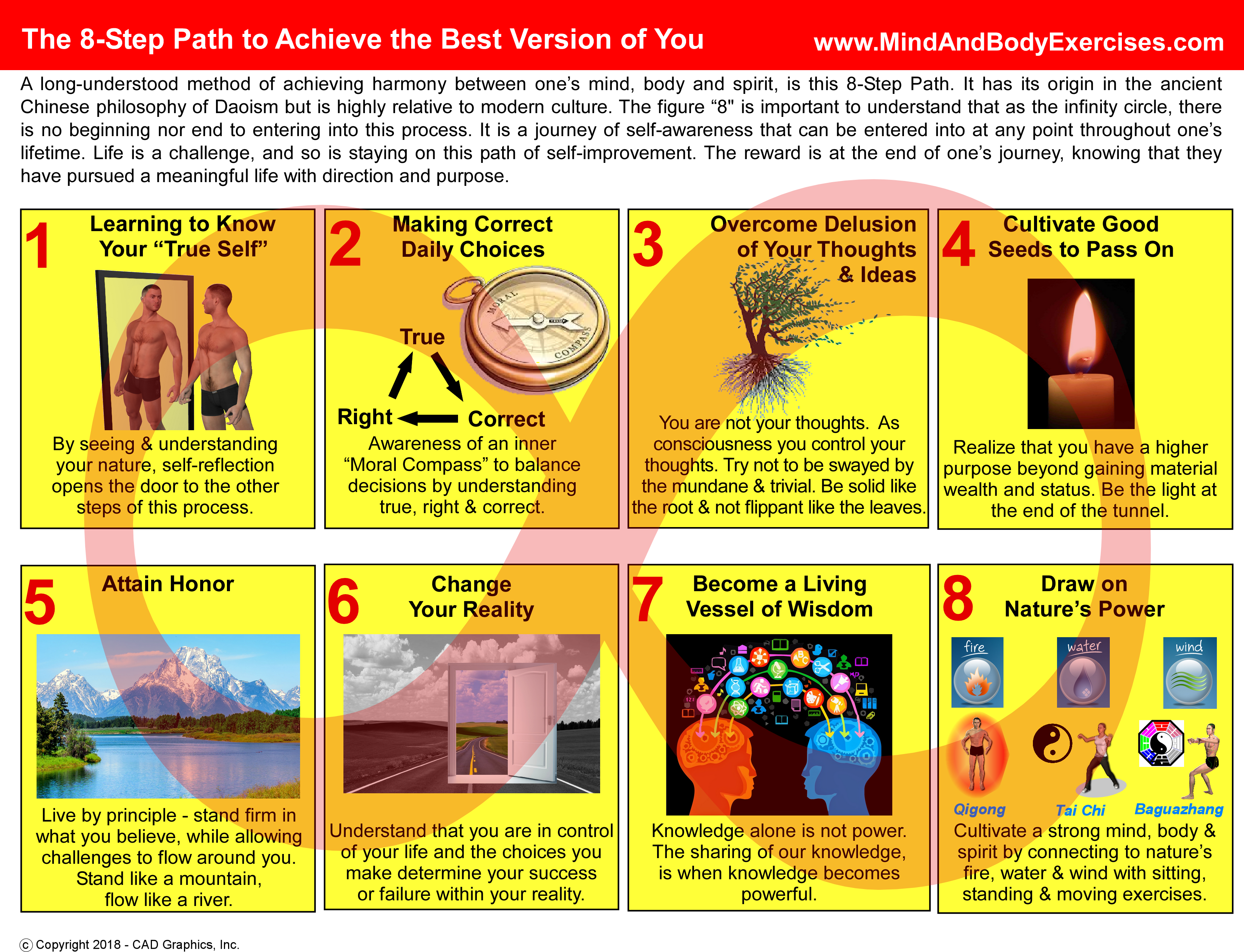
Eight Keys of Wisdom
- Reflection – See yourself as others see you
- Make correct choices (Hun & Po) – Discerning true, right, and correct. Dealing with the inner conflict
- Overcome your delusion – 5 agents, 7 distractions
- Turn on your light – See and be seen, plant good seeds
- Be the mountain – Attain honor rooted in principle
- Change your reality – Assume responsibility of your fate or destiny
- Become a vessel of wisdom – Practice what you preach, become a role model rather than a warning
- Water over fire – Draw from nature’s energies
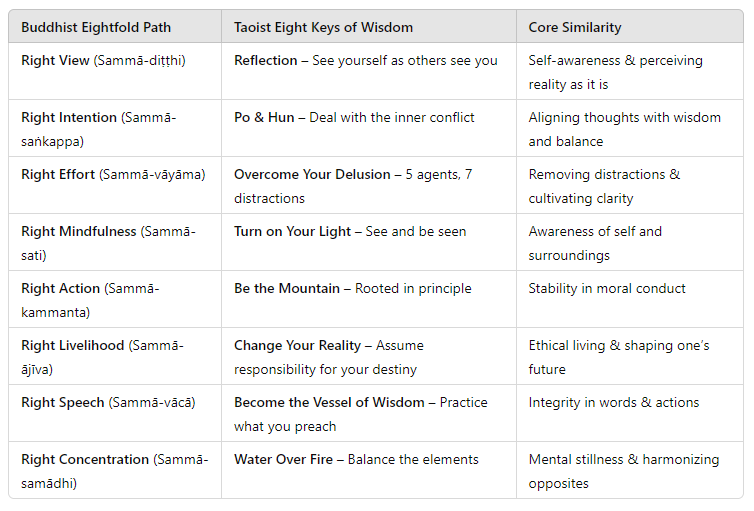
Correlations Between the Eightfold Path and 8 Keys of Wisdom
- Reflection – Right View (Sammā-diṭṭhi)
- Taoist Wisdom: See yourself as others see you.
- Buddhist Parallel: The Right View teaches seeing reality as it is, free from illusion. In Buddhism, self-awareness includes understanding how others perceive us and recognizing our attachments and biases.
- True, Right and Correct (Hun & Po) – Right Intention (Sammā-saṅkappa)
- Taoist Wisdom: Manage and cope with inner conflicts.
- Buddhist Parallel: Right Intention involves aligning thoughts with ethical and wholesome goals, reducing inner conflict between desire (Po) and higher wisdom (Hun). Both traditions emphasize balancing these opposing aspects of the psyche.
- Overcome Your Delusion – Right Effort (Sammā-vāyāma)
- Taoist Wisdom: 5 agents, 7 distractions (Five Elements & Emotional Imbalances).
- Buddhist Parallel: Right Effort means actively working to remove unwholesome states (such as greed, anger, and delusion) and cultivate wisdom. In Taoism, recognizing the interplay of the Five Elements and overcoming distractions aligns with maintaining mental clarity.
- Turn on Your Light – Right Mindfulness (Sammā-sati)
- Taoist Wisdom: See and be seen. Plant good seeds to leave a legacy of knowledge.
- Buddhist Parallel: Right Mindfulness is about clear awareness of one’s actions, emotions, and thoughts. “Turning on the light” in Taoism refers to conscious self-awareness, which aligns with the Buddhist practice of mindfulness meditation.
- Be the Mountain – Right Action (Sammā-kammanta)
- Taoist Wisdom: Achieve honor and respect by being rooted in principle.
- Buddhist Parallel: Right Action means living with integrity, abstaining from harm and unethical behavior. Being “the mountain” represents stability in virtue, just as Right Action is about unwavering moral conduct.
- Change Your Reality – Right Livelihood (Sammā-ājīva)
- Taoist Wisdom: Assume responsibility for your fate or destiny.
- Buddhist Parallel: Right Livelihood encourages earning a living ethically and shaping one’s future through right choices. Taoism’s view that we shape our destiny aligns with Buddhism’s emphasis on karma and responsibility for one’s path.
- Become the Vessel of Wisdom – Right Speech (Sammā-vācā)
- Taoist Wisdom: Practice what you preach. Strive to live as an example and not a warning to others.
- Buddhist Parallel: Right Speech teaches honest, compassionate communication. In Taoism, becoming a “vessel of wisdom” means embodying truth, much like Right Speech requires sincerity in words.
- Water Over Fire – Right Concentration (Sammā-samādhi)
- Taoist Wisdom: Balance the elements; maintain peace in chaos.
- Buddhist Parallel: Right Concentration cultivates mental stillness and deep meditative absorption, similar to Taoist teachings on harmonizing the forces of water (yin) and fire (yang) to maintain balance and clarity.
I teach and offer lectures about holistic health, physical fitness, stress management, human behavior, meditation, phytotherapy (herbs), music for healing, self-massage (acupressure), Daoyin (yoga), qigong, tai chi, and baguazhang.
Please contact me if you, your business, organization, or group, might be interested in hosting me to speak on a wide spectrum of topics relative to better health, fitness, and well-being.
I look forward to further sharing more of my message by partnering with hospitals, wellness centers, VA centers, schools on all levels, businesses, and individuals who see the value in building a stronger nation through building a healthier population.
I also have hundreds of FREE education video classes, lectures, and seminars available on my YouTube channel at:
https://www.youtube.com/c/MindandBodyExercises
Many of my publications can be found on Amazon at:
http://www.Amazon.com/author/jimmoltzan
My holistic health blog is available at:
https://mindandbodyexercises.wordpress.com/
http://www.MindAndBodyExercises.com
Mind and Body Exercises on Google: https://posts.gle/aD47Qo
Jim Moltzan
407-234-0119


 United Martial Arts Association