
Understanding the Evolution of Supreme Principles in Daoist Cosmology
In the study of Daoist philosophy and traditional Chinese thought, the term “Tai Chi” (太極) is widely recognized as referring to the Supreme Ultimate, a foundational principle in the universe from which all dualities (yin and yang) arise (Liao,1990).
Practitioners of Tai Chi Chuan may know the term as associated with martial arts, yet its roots are far deeper, embedded in cosmology, metaphysics, and classical Daoist thought.
But what if we go one step earlier, or even further back? What came before Tai Chi? And what of other similarly constructed terms such as “Tai Su” (太素) and “Tai Yu” (太宇)? Are they simply linguistic variants, or do they represent unique philosophical concepts in the evolution of universal principles?
Wuji (無極): The Limitless Void
In the beginning was Wuji, often translated as “non-ultimate” or “limitless.” Wuji represents pure potential being formless, timeless, and undivided. It is the Dao before manifestation (Robinet, 1997). In diagrams, Wuji is usually shown as an empty circle or a vast blank space, signifying the absence of polarity.

Tai Su (太素): The Supreme Simplicity
Emerging from Wuji is Tai Su, a term less commonly discussed but highly significant in classical Daoist texts.
- Tai (太) = supreme or great
- Su (素) = simple, elemental, unadorned, or fundamental substance
Tai Su is understood as the primordial essence or supreme simplicity. A state where differentiation is beginning to arise but not yet fully formed. It is the first stirring of substance, the bridge between the void and duality. In Huainanzi, Tai Su is mentioned as a precursor to cosmic formation (Le Blanc & Mathieu, 2008). In early Chinese alchemy and cosmology, it represents the primordial qi that has yet to divide into yin and yang (Pregadio, 2008).

Tai Chi (太極): The Supreme Ultimate
When differentiation occurs, Tai Chi comes into being. The term, often Romanized as Taiji, literally means “Supreme Ultimate.” This is the phase where the one becomes two: yin and yang emerge as complementary polarities (Liao,1990).
Tai Chi is typically symbolized by the Taijitu, the black-and-white “yin-yang” symbol, expressing balance, transformation, and interdependence. In this state, movement and stillness alternate, giving rise to all forms in the universe (Kirkland, 2004).

Tai Yu (太宇): The Supreme Universe
Tai Yu introduces a more spatial or structural aspect to cosmology.
- Yu (宇) refers to the universe, cosmic space, or even the eaves of a roof, or a poetic image of a sheltering order.
- Thus, Tai Yu translates to “Supreme Universe” or “Great Cosmos.”
While Tai Chi marks the origin of dynamic duality, Tai Yu is more about manifested order, and the structured universe as it exists with stars, planets, natural laws, and cycles (Graham, 1989). It is not a transitional phase but the result of the Tai Chi mechanism unfolding through space and time.
Cosmological Sequence Diagram
To visualize this progression, the accompanying diagram illustrates the unfolding of the cosmos:
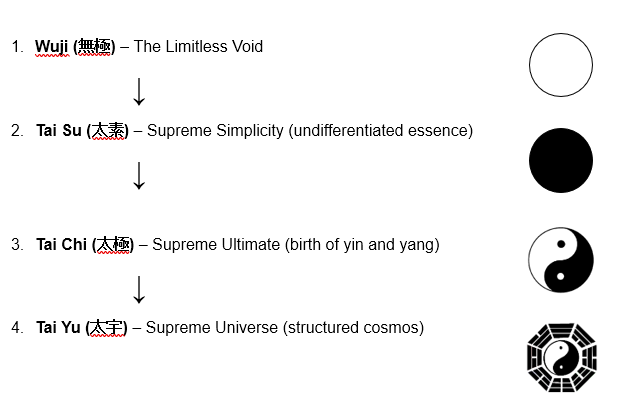
| Term | Translation | Symbol | Meaning |
| Wuji | Limitless Void | Empty circle (〇) | Undifferentiated nothingness |
| Tai Su | Supreme Simplicity | Solid black circle (●) | Primordial essence |
| Tai Chi | Supreme Ultimate | Yin-Yang (☯ / Taijitu) | Birth of duality |
| Tai Yu | Supreme Universe | Bagua or Heaven–Earth (八卦 / 天地) | Manifest cosmos; structured reality |
Cultural and Linguistic Notes: Korean Equivalents
In Korean, these terms are written in Hanja (Chinese characters used in Korean language):
- Tai Chi (太極) → Tae Guk (태극), as seen in the South Korean flag
- Tai Su (太素) → Tae So (태소) (rarely used in common language)
- Tai Yu (太宇) → Tae U (태우) (used in poetic or classical references)
While the philosophical usage remains mostly consistent with Chinese meanings, these terms are far less prevalent in Korean popular culture outside of Tae Guk.
Conclusion: A Philosophical Framework of Evolution
From non-being to primordial essence, and from dynamic polarity to cosmic order, this cosmological sequence illustrates how Daoist philosophy views the evolution of the universe not as a chaotic explosion, but as an elegant, cyclical, and ordered unfolding.
Whether you are a practitioner of martial arts, a student of Daoist metaphysics, or a philosopher of natural laws, understanding Wuji → Tai Su → Tai Chi → Tai Yu offers a powerful lens through which to view the origin of all things and your own place within the ever-unfolding Tao.
Important to note, in martial arts culture, Tai chi, Tai Su, Tai Yu, Tae Guk and Tai Chi Chung are all very different forms of mental, physical and spiritual practices. While some may share some similarities, anyone who has deeply studied and practiced these methods is aware of their varying nuances and complexities.
| Term | Characters | Translation | Philosophical Meaning |
| Wuji | 無極 | Non-Ultimate / Limitless | The primordial void; pure potential without polarity |
| Tai Su | 太素 | Supreme Simplicity / Primordial Essence | Undifferentiated, fundamental matter—precursor to form and duality |
| Tai Chi | 太極 | Supreme Ultimate | The origin of duality (yin and yang); dynamic balance |
| Tai Yu | 太宇 | Supreme Universe / Great Cosmos | The structured universe or cosmic order that emerges after duality |
References:
Blanc, C. L., & Mathieu, R. (2008). Approches critiques de la mythologie chinoise. https://doi.org/10.4000/books.pum.19027
Graham, A. C. (1989). Disputers of the Tao: Philosophical Argument in Ancient China. Open Court.
Kirkland, R. (2004). Taoism: The Enduring Tradition. Routledge.
Pregadio, F. (2008). The Encyclopedia of Taoism. Routledge.
Robinet, I. (1997). Taoism: Growth of a Religion. Stanford University Press.
Liao, W. (n.d.). T’ai chi classics. Shambhala. https://www.shambhala.com/t-ai-chi-classics.html


 United Martial Arts Association