
URI: The Language of Togetherness Across Cultures
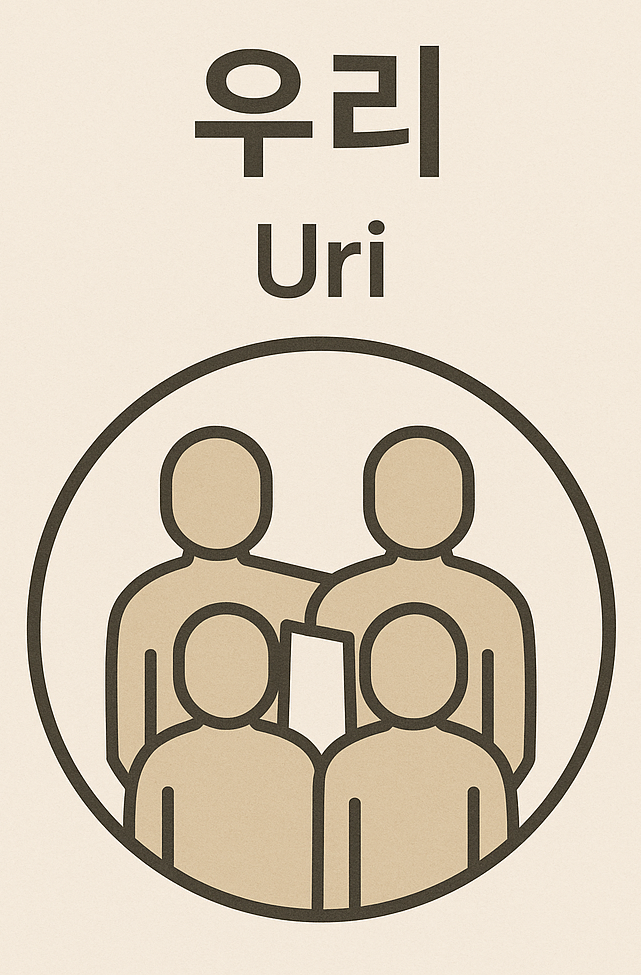
In Korean culture, one of the most powerful words is also one of the simplest: Uri, meaning “we” or “our.” But Uri is far more than a pronoun. It is a window into how Koreans understand relationships, group identity, and emotional belonging. Within traditional Korean martial arts circles, especially under the guidance of masters who emphasize discipline and loyalty, Uri is often used to describe the unshakable camaraderie and shared identity between students and instructors, forged through hardship, challenge, and growth.
Uri: More Than “We”
In English, “we” is often just a grammatical term, used to distinguish from “I” or “you.” But in Korean, Uri is embedded deeply in the language and mindset, often used even when referring to something that belongs to oneself:
- uri jip – our house, not my house
- uri eomma – our mom, not my mom
- uri hakgyo – our school, not my school
This reflects a collectivist worldview in which individuals see themselves as part of a larger whole, whether that’s a family, class, team, or nation (Kim & Choi, 1994).
In martial arts dojangs (training halls),Uri expresses more than membership; it expresses loyalty, mutual care, and emotional bonding. When a teacher speaks of “our students” or “our school,” it reinforces unity and shared responsibility.
Uri and Jeong: The Emotional Core
Complementing Uri is the concept of Jeong, a deep, enduring emotional bond that forms over time through shared life, hardship, and loyalty. Jeong isn’t easily expressed in words. It shows up in quiet sacrifice, remembered favors, unspoken forgiveness, and decades of unwavering care (Kim, 2025).
In the martial arts setting, Jeong may grow silently between a student and teacher over years of training, discipline, and shared struggle. It does not need to be spoken, it is understood.
So, while Uri reflects group identity, Jeong is the emotional glue within that group.
Related Cultural Concepts
Korea’s rich cultural emphasis on relational harmony and group belonging has echoes in neighboring traditions:
| Concept | Culture | Meaning |
| Uri (우리) | Korean | “We” / “Our” – shared identity and belonging |
| Jeong (정) | Korean | Emotional bond of affection and loyalty |
| Qíng (情) | Chinese | Sentiment, emotion in social and familial roles (Li, 2016) |
| Rénqíng (人情) | Chinese | Social etiquette, reciprocal human feelings (Yan, 1996) |
| Camaraderie | American/Western | Friendly solidarity from shared experiences |
| Brotherhood/Sisterhood | Universal | Loyalty forged through common hardship |
While these concepts vary, they all point to a human need for belonging, connection, and emotional safety, particularly in groups bound by purpose, like martial arts, military service, or community living.

Uri in the Dojang: A Warrior’s Bond
In martial arts, Uri reflects a mindset of shared struggle and mutual respect. It means:
- We endure hardship together
- We uphold the dignity of the group, not just the self
- We protect and support each other in and out of training
A Korean master might speak of Uri when referring to the lineage, the school’s mission, or the bond between instructors and students who have faced hardship side-by-side.
Even in moments of silence, when no words are spoken, Uri is felt, in a bowed head, a shared meal, or the gentle correction of a form done poorly but with heart.
Uri vs. Western Individualism
Western cultures often emphasize personal agency, independence, and distinct identity (“I did it,” “my house,” “my success”). In contrast, Uri reflects a Korean cultural mindset in which the group defines the individual, not the other way around.
This is not about erasing personal identity, but rather about honoring relationships as central to identity.
Conclusion: Uri as a Way of Life
In the end, Uri is more than a word. It is a cultural philosophy, one that holds that we are strongest together, that emotional ties matter, and that belonging is essential to the human experience. In a martial arts context, it is the thread that weaves through every bowed head, every shared hardship, every correction given with care.
As we compare Uri with concepts like Jeong, Qing, and camaraderie, we discover that while the language may differ, the longing for connection is universal. The Korean term Uri offers us a powerful lens through which to reexamine not just how we speak, but how we live, with and for each other.
References
Kim, J. K. (2025). Deconstructing the Marginalized Self: A Homiletical Theology of URI for the Korean American Protestant Church in the Multicultural American context. Religions, 16(2), 249. https://doi.org/10.3390/rel16020249
Kim, U., & Choi, S.-H. (1994). Individualism, collectivism, and child development: A Korean perspective. In P. M. Greenfield & R. R. Cocking (Eds.), Cross-cultural roots of minority child development (pp. 227–257). Lawrence Erlbaum Associates, Inc.
Li, J. (2023). Confucian affect (Qing 情) as the foundation for mutual care and moral elevation. https://philarchive.org/rec/LICAQM
Yan, Y. (1996). The Flow of Gifts: Reciprocity and Social Networks in a Chinese Village. Stanford University Press.


 United Martial Arts Association