
Three Martial Worlds, One Shared Philosophy
Across East Asia, the martial arts are far more than systems of combat. In their deepest form, they are paths of personal transformation that unify physical skill, mental discipline, and moral responsibility. While each culture frames this idea differently, the underlying message is consistent: mastery of technique is inseparable from mastery of self.
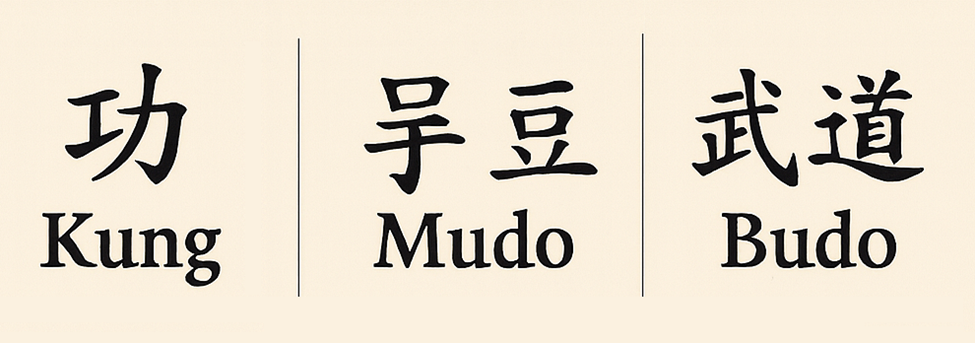
In China, this idea finds expression in the concept of Kung (功), the refined skill and capability gained through sustained effort, whether in martial arts or any other discipline. Kung is not simply physical power; it is the culmination of patient, deliberate cultivation of mind and body over years or decades.
In Korea, the term Mudo (무도), literally “The Martial Way,” places emphasis on the journey of training. It describes a life lived according to the values and discipline of martial practice, with skill as the natural outcome of a moral and dedicated path.
In Japan, Budo (武道), also “The Martial Way,” draws from Bushido, Zen, and Shinto traditions. It frames martial training as a lifelong spiritual and ethical endeavor, where combat proficiency is a vehicle for self-perfection and service to others.
While the terminology and historical contexts differ, Kung, Mudo, and Budo all hold to a shared truth: martial arts are not solely about defeating an opponent, but about shaping character, nurturing wisdom, and aligning one’s actions with a higher ethical standard.
Kung vs. Mudo vs. Budo
Kung (功) in the Chinese Context
In Kung Fu: History, Philosophy and Technique, (Chow, 1978) Kung (功) refers to skill acquired through hard, disciplined effort, especially in the martial arts.
In this context, it’s about the internal and external mastery that results from persistent training, including moral discipline, mental focus, and physical conditioning.
While it’s rooted in Chinese martial culture, it’s not limited to combat; Kung can apply to any art or craft perfected over years of dedicated practice.
It emphasizes process and cultivation, not just end results.
Mudo (무도) in the Korean Context
Mudo literally means “Martial Way” (武道) — mu (무, 武) = martial/military; do (도, 道) = path/way.
It is a broader ethical and philosophical concept, referring to martial practice as a path of personal development, much like Budo in Japan.
Mudo includes:
- Physical discipline (techniques, forms, application)
- Moral integrity (using skill responsibly, respect for life)
- Character development (patience, humility, perseverance)
In Korean martial traditions (Hapkido, Taekwondo, traditional sword arts), Mudo is both a lifestyle and a moral code.
Budo (武道) in the Japanese Context
Budo literally means “Martial Way” — bu (武) = martial/warrior; do (道) = path/way.
It represents the unification of martial training with moral character and spiritual refinement, drawing from the traditions of Bushido, Zen, and Shinto philosophy.
Budo includes:
- Mastery of martial technique (kenjutsu, judo, aikido, kendo, karate, and others)
- Ethical conduct (honor, integrity, respect for life)
- Personal growth and self-discipline as lifelong endeavors
In Japanese tradition, budo is as much about cultivating the spirit and serving society as it is about combat skill. It treats martial practice as a lifelong path toward self-perfection.
Where They Overlap
Kung, Mudo, and Budo each frame martial arts as a lifelong practice that refines mind, body, and spirit.
All three require ethical restraint, or the principle that skill is to be used justly, never recklessly.
All three value internal development as much as technical proficiency, seeing martial arts as a vehicle for character formation as well as self-defense.
In practice, a master of Kung, a practitioner living by Mudo, and a devotee of Budo would share similar daily disciplines, values, and moral outlooks.
Key Differences
- Kung emphasizes effort and skill mastery as the result of disciplined training.
- Mudo emphasizes the path and philosophy as a journey of living according to martial ethics.
- Budo emphasizes harmonizing martial skills with moral character as the way of the warrior in service to self and others.
Kung is what a practitioner has after years of training.
Mudo is how a practitioner lives while they train.
Budo is how a practitioner walks the path, using martial skill to perfect the self and serve a greater purpose.
The following chart explores the philosophical, linguistic, and cultural parallels between these three concepts, revealing their unique nuances and shared spirit.
Side-by-Side Cultural Comparison: Kung – Mudo – Budo
| Aspect | Kung (功, China) | Mudo (무도, Korea) | Budo (武道, Japan) |
| Literal Meaning | Achievement/skill through effort; “work” or “merit” | Martial Way (Mu = martial, Do = way/path) | Martial Way (Bu = martial/warrior, Do = way/path) |
| Cultural Root | Chinese martial arts & philosophy | Korean martial arts & Confucian/Buddhist/Taoist influence | Japanese martial arts & Zen/Shinto/Bushido influence |
| Core Focus | Mastery of skill through disciplined training; balance of internal (Yin) & external (Yang) | Moral/ethical cultivation through martial practice; path of personal growth | Self-perfection, discipline, and moral living through martial training |
| Scope | Can apply beyond martial arts to any discipline mastered over time | Primarily martial arts but also a life philosophy | Primarily martial arts but with deep ethical, spiritual, and cultural elements |
| Emphasis | The result of sustained effort and cultivation | The journey of training and living ethically | The way of the warrior — combining martial skill with spiritual growth |
| Internal vs External | Explicit balance of Yin/soft/internal and Yang/hard/external | Often integrated, with emphasis on discipline and form as gateways to internal growth | Often integrated, but with clear philosophical codification (e.g., Zen influence) |
| Ethical Foundation | Rooted in Taoist balance, Confucian ethics, and Shaolin moral discipline | Rooted in Confucian ethics and Korean cultural values | Rooted in Bushido, Zen, and Shinto moral codes |
| Symbolic Goal | Harmonizing mind, body, and spirit to achieve exceptional skill and moral integrity | Living the martial path as a means of becoming a better person | Walking the martial path to embody honor, discipline, and self-control |
| Training View | Skill as proof of effort; mastery is the culmination | Martial art as a continuous personal journey | Martial art as a lifelong path to enlightenment and service |
References:
“Kung Fu” in Chinese martial arts. (n.d.). Wikipedia. Retrieved from https://en.wikipedia.org/wiki/Chinese_martial_arts Wikipedia
Cynarski, W. J. (2022). New concepts of budo internalised as a philosophy of life. Philosophies (MDPI). MDPI
Japanese martial arts. (n.d.). Wikipedia. Retrieved from https://en.wikipedia.org/wiki/Japanese_martial_arts Wikipedia+1
Hirose, A. (2022). Budo (martial arts). mc craftsmanship. MASTER CRAFTSMANSHIP
Sasaki, T. (2008). Budo (the Martial Arts) as Japanese Culture – The outlook on the techniques and the outlook on the human being. ARCH BUDO. archbudo.com
Moenig, U., Kim, M., & Choi, H. M. (2023). Traditional martial arts versus martial sports: The philosophical and historical academic discourse. Revista de Artes Marciales Asiáticas (RAMA), 18(1), 41–58. ResearchGate
Holt, J. (2023). Physical philosophy: Martial arts as embodied wisdom. Philosophies (MDPI). MDPI


 United Martial Arts Association