
An Integrative Psychological, Spiritual, and Neuroscientific Perspective
This article examines the concept of ego dissolution from psychological, spiritual, and neuroscientific perspectives. It discusses Carl Jung’s theory of individuation and the ego-Self axis, Eastern spiritual traditions’ critique of ego as separateness, and recent empirical studies that illuminate what happens in the brain and consciousness when the ego dissolves. I argue that ego dissolution is not destruction of self but transformation of self-construal, leading to greater integration, well-being, and freedom from suffering.
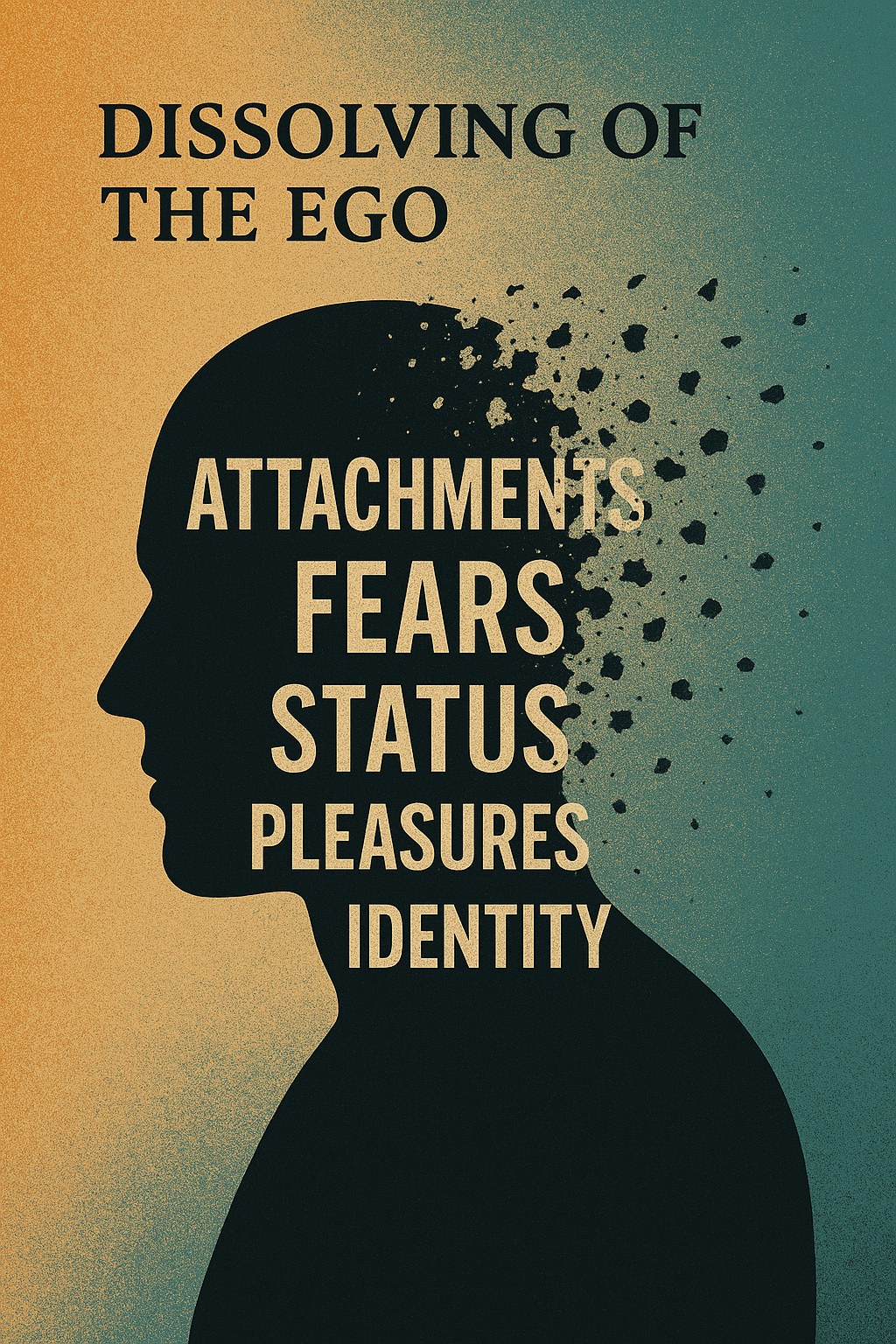
The ego is often construed as the individual’s sense of “I,” the center of identity that distinguishes self from others and external reality. While necessary for functioning, ego overidentification can lead to distress, separation, and suffering. The idea of ego dissolution, with its roots in spiritual traditions, refers to loosening this overidentification so that a person experiences a broader, more integrated, or nondual self-awareness. This essay draws on analytic psychology, Buddhist and Vedantic conceptualizations of self and no-self, and recent empirical work in neuroscience and psychology to explicate ego dissolution: what it is, how it is cultivated, and what effects it produces.
Jungian Psychology and Ego Dissolution
Carl Gustav Jung (1968/2014) distinguished between the ego, the conscious identity and the Self, which encompasses both conscious and unconscious aspects of the psyche. For Jung, psychological growth involves individuation, a process of integrating unconscious material (shadow, anima/animus, archetypes) into consciousness, thereby reducing rigid ego boundaries. Ego dissolution, in this framework, does not mean erasing identity but transforming it, allowing the ego to serve rather than dominate the psyche (Jung, 1968/2014).
Eastern Traditions: Ego, No-Self, and Liberation
Eastern spiritual traditions have long emphasized the illusory nature of the ego. In Buddhism, the doctrine of anatta (no-self) asserts that what is typically called the “self” is actually a collection of impermanent processes in the body, perception, sensation, volition, and consciousness, without enduring essence (Rahula, 1974). Similarly, Advaita Vedānta critiques ahamkara (ego-construct) as a distortion that veils realization of the true Self, or Atman, which is identical with Brahman (Deutsch, 1969). Practices such as meditation, chanting, and selfless service are designed to loosen egoic identification and reveal unity with all life.
Neuroscience and Empirical Psychology
Meditation and Neural Correlates of Ego Reduction
Neuroimaging studies show that meditation can attenuate activity in the default mode network (DMN), a brain system linked to self-referential processing (Brewer et al., 2011). Trautwein et al. (2024) demonstrated that suspension of self-experience in meditation is associated with reductions in beta-band power in the posterior medial cortex, indicating diminished self-related cognition. A meta-analysis of 78 neuroimaging studies similarly found overlapping brain regions, including the insula, anterior cingulate cortex, and frontopolar cortex, activated during various meditative states that reduce self-focus (Fox et al., 2016).
Psychedelics and Ego Dissolution
Psychedelics such as psilocybin and LSD also induce ego dissolution. Letheby and Gerrans (2017) argue that these substances temporarily disrupt the “self-model,” the brain’s predictive process of binding sensory, autobiographical, and emotional information into a coherent sense of self. Empirical studies confirm that ego dissolution under psychedelics correlates with decreased DMN connectivity and heightened subjective feelings of unity (Carhart-Harris et al., 2014). To quantify this phenomenon, Sleight et al. (2023) developed an Ego Dissolution Scale, validating it as a reliable measure for trait-like alterations of self-experience.
Comparing Meditation and Psychedelic States
While both meditation and psychedelics can reduce egoic self-construal, their phenomenology differs. Millière et al. (2018) note that meditation typically involves gradual training and control, whereas psychedelics often create abrupt, intense shifts. Both, however, highlight the malleability of self-experience and its neurobiological underpinnings.
Transformation, Effects, and Potential Benefits
Ego dissolution produces several psychological and existential benefits. Studies report decreases in anxiety, depression, and rumination, alongside increases in well-being, resilience, and emotional regulation (Griffiths et al., 2018). On the ethical level, reduced ego identification fosters empathy and compassion by dissolving boundaries between self and other (Lutz et al., 2008). Spiritually, ego dissolution facilitates experiences of interconnectedness and meaning beyond personal striving (Rahula, 1974).
However, challenges remain. Intense ego dissolution can provoke fear, disorientation, or existential anxiety. Furthermore, the risk of “spiritual ego” where one clings to superiority based on perceived enlightenment, demonstrates that ego can reassert itself even within spiritual practice (Wilber, 2000). Proper guidance and integration are essential for healthy outcomes.
The dissolving of the ego, whether framed through Jungian psychology, Buddhist philosophy, or contemporary neuroscience, is best understood not as annihilation but as transformation. It involves loosening rigid identifications, reducing self-referential dominance, and cultivating awareness of interconnectedness. While difficult and sometimes destabilizing, ego dissolution can lead to profound psychological healing, ethical growth, and spiritual insight.
References:
Brewer, J. A., Worhunsky, P. D., Gray, J. R., Tang, Y.-Y., Weber, J., & Kober, H. (2011). Meditation experience is associated with differences in default mode network activity and connectivity. Proceedings of the National Academy of Sciences, 108(50), 20254–20259. https://doi.org/10.1073/pnas.1112029108
Carhart-Harris, R. L., Leech, R., Hellyer, P. J., Shanahan, M., Feilding, A., Tagliazucchi, E., Chialvo, D. R., & Nutt, D. (2014). The entropic brain: A theory of conscious states informed by neuroimaging research with psychedelic drugs. Frontiers in Human Neuroscience, 8, 20. https://doi.org/10.3389/fnhum.2014.00020
Deutsch, E. (1969). Advaita Vedānta: A philosophical reconstruction. University of Hawaii Press. https://archive.org/details/advaitavedantaph0000deut/page/n5/mode/2up
Fox, K. C., Dixon, M. L., Nijeboer, S., Girn, M., Floman, J. L., Lifshitz, M., Ellamil, M., Sedlmeier, P., & Christoff, K. (2016). Functional neuroanatomy of meditation: A review and meta-analysis of 78 functional neuroimaging investigations. Neuroscience & Biobehavioral Reviews, 65, 208–228. https://doi.org/10.1016/j.neubiorev.2016.03.021
Griffiths, R. R., Johnson, M. W., Carducci, M. A., Umbricht, A., Richards, W. A., Richards, B. D., Cosimano, M. P., & Klinedinst, M. A. (2018). Psilocybin produces substantial and sustained decreases in depression and anxiety in patients with life-threatening cancer: A randomized double-blind trial. Journal of Psychopharmacology, 32(1), 49–69. https://doi.org/10.1177/0269881116675513
Jung, C.G. (1968). The Archetypes and the Collective Unconscious (R.F.C. Hull, Trans.; 2nd ed.). Routledge. https://doi.org/10.4324/9781315725642
Jung, C. G. (2014). Man and his symbols. Dell. (Original work published 1960). https://archive.org/details/B-001-004-443-ALL
Letheby, C., & Gerrans, P. (2017). Self unbound: Ego dissolution in psychedelic experience. Neuroscience of Consciousness, 2017(1), nix016. https://doi.org/10.1093/nc/nix016
Lutz, A., Brefczynski-Lewis, J., Johnstone, T., & Davidson, R. J. (2008). Regulation of the neural circuitry of emotion by compassion meditation: Effects of meditative expertise. PLoS ONE, 3(3), e1897. https://doi.org/10.1371/journal.pone.0001897
Millière, R., Carhart-Harris, R. L., Roseman, L., Trautwein, F.-M., & Berkovich-Ohana, A. (2018). Psychedelics, meditation, and self-consciousness. Frontiers in Psychology, 9, 1475. https://doi.org/10.3389/fpsyg.2018.01475
Rahula, W. (1974). What the Buddha taught (Rev. ed.). Grove Press. https://archive.org/details/whatbuddhataught00walp
Sleight, F. G., Lynn, S. J., Mattson, R. E., & McDonald, C. W. (2023). A novel ego dissolution scale: A construct validation study. Consciousness and Cognition, 109, 103474. https://doi.org/10.1016/j.concog.2023.103474
Trautwein, F.-M., Kettner, H., Giegling, I., Moosmann, M., Roseman, L., & Berkovich-Ohana, A. (2024). Neural correlates of suspended self-experience in meditation. Journal of Neuroscience, 44(26), e118223. https://doi.org/10.1523/JNEUROSCI.1182-23.2024
Wilber, K. (2000). Integral psychology: Consciousness, spirit, psychology, therapy. Shambhala. https://archive.org/details/integralpsycholo00wilb


 United Martial Arts Association