
The Tao of Inner Refinement in MuDo Practice
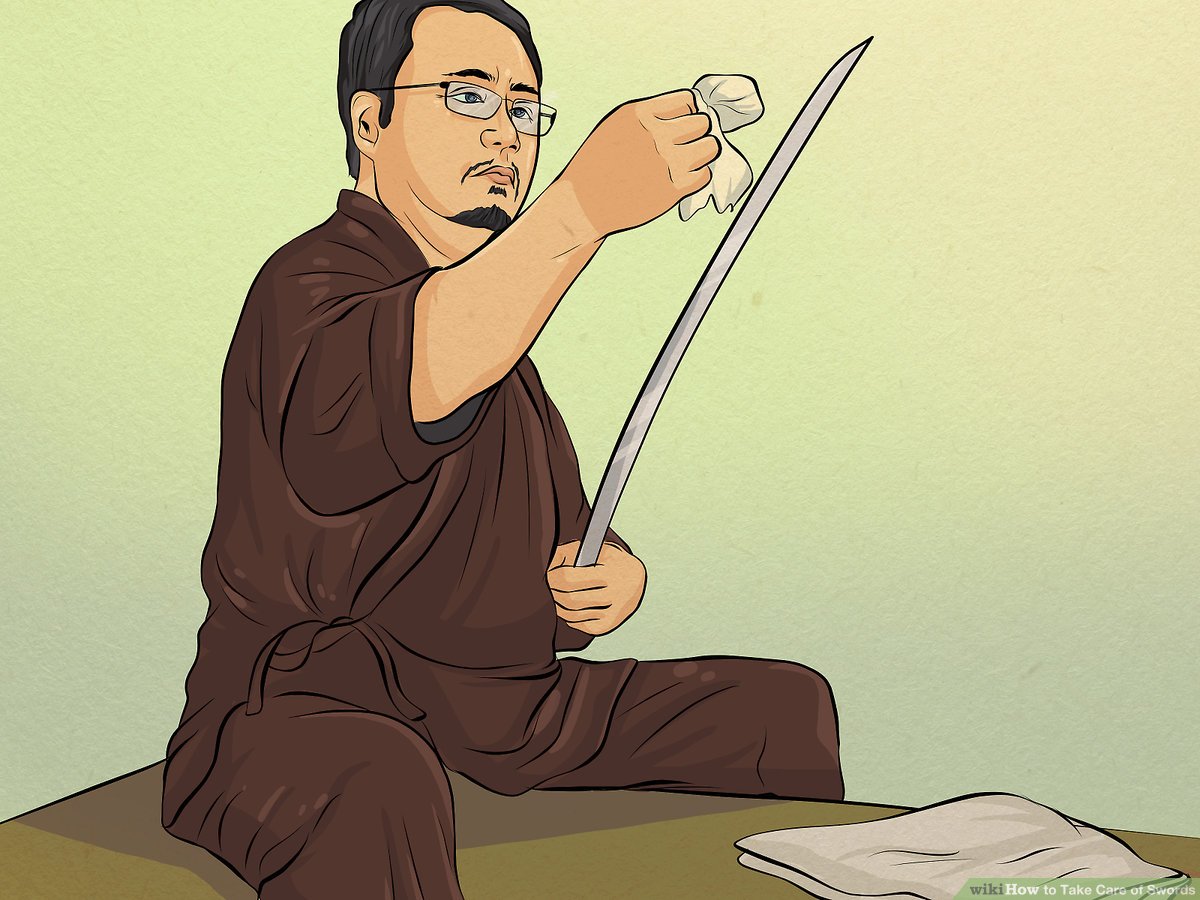
The phrase “polish the sword with the soul” is rooted in Taoist and Mu-Do (武道) traditions and expresses a universal ideal of continuous self-cultivation through disciplined practice and moral awareness. Like a sword that must be repeatedly sharpened to retain its edge, the human being must refine body, mind, and spirit to express the full potential of Dao (道) or The Way. This teaching transcends martial technique; it symbolizes the transformation of the practitioner into a vessel of harmony, wisdom, and integrity.
1. The Sword as the Symbol of Self and Spirit
In both Chinese and Korean philosophical systems, the sword (jian) is not merely a weapon but a metaphor for consciousness itself. The Taoist classic Zhuangzi likens the true swordsman to one whose blade never dulls because his mind is empty of attachment (Watson, 2013). Within Mudo, the sword embodies the shin (mind-heart), which when pure, reflects truth without distortion. The practitioner’s journey is to temper this “inner blade,” learning balance between yang (activity, assertion) and yin (stillness, receptivity), a theme central to traditional Taoist cosmology (Kohn, 2009).
In the Korean context, this teaching resonates with the ideal of Su-shin, meaning “cultivation of the body/self.” Confucius placed Su-shin at the foundation of social and cosmic harmony: “When the self is cultivated, the family is regulated; when the family is regulated, the state is in order” (Great Learning, trans. Legge, 1893). Thus, polishing the sword is both personal and social, in refining oneself to act justly in the world.
2. The Polishing Process: Friction as Transformation
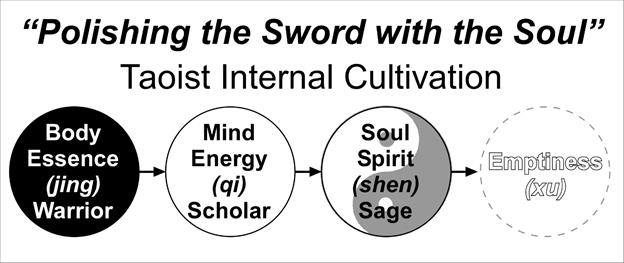
Polishing requires friction, an apt metaphor for life’s challenges, failures, and self-confrontations. In Taoist alchemy, this process is described through the San Bao or “Three Treasures” of jing (essence), qi (energy), and shen (spirit). Through disciplined practice, essence is refined into energy, energy into spirit, and spirit into emptiness (xu) (Chia, 2008). The polishing of the sword thus mirrors Neidan, or internal alchemy: the transformation of raw life energy into luminous awareness.
In Mudo philosophy, this transformation parallels the Way of the Warrior – Scholar- Sage, a triadic path uniting physical discipline, intellectual cultivation, and moral-spiritual awareness. The warrior’s physical training tempers jing; the scholar’s contemplation refines qi; and the sage’s insight elevates shen and ultimately leading to harmony between heaven, earth, and man. This mirrors Jung’s (1968) notion of individuation, where the conscious and unconscious are integrated into a unified Self through continual refinement of opposites.

3. The Soul as the Source of Mastery
To “polish with the soul” means to engage one’s innermost consciousness as the agent of refinement. The soul (hun) represents the luminous, yang aspect of spirit that animates purpose and creativity (Larre & de la Vallée, 1996). Without the engagement of the soul, practice becomes mechanical; a sword swung without intention. When the soul infuses the art, each motion reflects authenticity, compassion, and clarity.
Modern psychological parallels can be found in self-determination theory, where mastery arises from intrinsic motivation aligned with personal values (Ryan & Deci, 2017). The Mudo practitioner’s polishing, therefore, is not merely technical repetition but the alignment of inner motive and outer action, manifesting into a harmony of virtue (de) and expression (gong).
4. Integrative Reflection: The Sword as Mirror of the Way
In the broader context of Taoist cultivation, “polishing the sword with the soul” signifies a return to the Dao through continuous refinement. Each moment of training, contemplation, or service becomes a stroke of the whetstone against the blade of consciousness. The goal is not perfection, but rather clarity to remove the rust of ego and reveal the reflective surface of awareness.
As explored in prior discussions of the yin–yang dynamic, strength and vulnerability, action and stillness, are not opposites but mutually transformative forces (Kaptchuk, 2000). The act of polishing symbolizes this balance in assertive effort (yang) combined with humble introspection (yin). Ultimately, the soul becomes both the craftsman and the mirror, through which the practitioner perceives the infinite in the finite.
To polish the sword with the soul is to practice Mudo as a living Tao, where every strike, breath, and thought becomes an act of refinement. The practitioner becomes both the sword and the polisher: a self-reflective being who tempers strength with compassion, power with humility, and mastery with moral integrity. In this process, technique becomes transcendent, and the path of the warrior, scholar, and sage merges into one continuous motion of the soul returning to its source.
References:
Jung, C. G. (1968). The collected works of C. G. Jung: Vol. 9 (Part 2). Aion: Researches into the phenomenology of the self. Princeton University Press.
Kaptchuk, T. J. (2000). The web that has no weaver: Understanding Chinese medicine. McGraw-Hill.
Kohn, L. (2009). The Taoist experience: An anthology. State University of New York Press. https://archive.org/details/thetaoistexperienceliviakohn
Larre, C., & de la Vallée, E. (1996). The seven emotions: Psychology and health in ancient China. Monkey Press.
Legge, J. (1893). The Chinese classics: Vol. I. The Great Learning. Oxford University Press. https://archive.org/details/chineseclassics41legg/page/n5/mode/2up
Chia. M. (2008). Healing light of the Tao: Foundations of internal alchemy. Universal Tao Publications.
Ryan, R. M., & Deci, E. L. (2017). Self-determination theory: Basic psychological needs in motivation, development, and wellness. The Guilford Press. https://doi.org/10.1521/978.14625/28806
Watson, B. (2013). The complete works of Chuang Tzu. Columbia University Press.
wikiHow. (2025, February 7). How to Take Care of Swords (with Pictures) – wikiHow. wikiHow. https://www.wikihow.com/Take-Care-of-Swords


 United Martial Arts Association