
Human beings have an enduring need for meaning, belonging, and purpose. Throughout history, individuals have aligned themselves with ideologies, political parties, professional identities, institutions, movements, and charismatic leaders in hopes of achieving recognition, security, direction, and a sense of significance. While such affiliations can offer structure and community, they also carry a subtle risk: the displacement of personal authorship in favor of borrowed meaning.
Psychological and philosophical academia suggests that meaning derived primarily from external validation or group identity is inherently fragile. Viktor Frankl (2006) argued that meaning cannot be handed down by systems or authorities; it must be discovered and embodied through personal responsibility and lived values. When individuals outsource their sense of purpose to an ideology, organization, or leader, they may experience temporary fulfillment yet remain existentially dependent upon forces outside themselves.
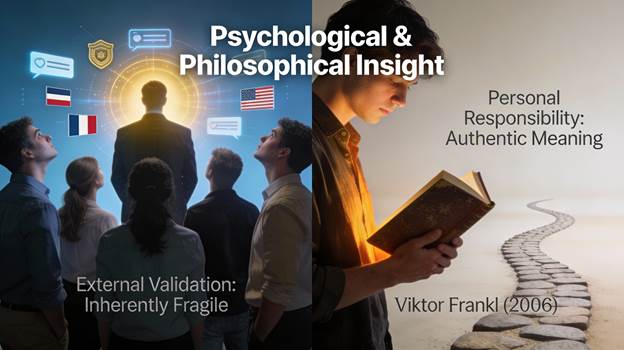
Modern culture increasingly reinforces identity through alignment. Social identity theory demonstrates that individuals often define themselves by the groups to which they belong, internalizing group values and narratives as personal identity markers (Tajfel & Turner, 1979). While this can foster cohesion, it can also suppress individuality and moral agency. Over time, allegiance may shift from being a conscious choice to an unquestioned loyalty, where dissent threatens belonging and conformity replaces reflection.
In such cases, people may spend years or entire lifetimes resources, contributing labor, emotional energy, and loyalty to systems that primarily expand the legacy, power, or recognition of others. Institutions grow. Leaders are remembered. Movements persist. Yet the individual contributor often fades into obscurity, having invested deeply in causes that did not meaningfully invest back in their personal development or well-being. Hannah Arendt (1958) warned that when individuals surrender judgment and responsibility to collective structures, they risk becoming functionaries rather than fully realized moral agents.
This raises a fundamental question: Whose legacy is being built?

At the end of life, few people aspire to be remembered for their affiliations. Rarely does one hope their memory will read “loyal employee,” “dedicated party member,” or “contributor to institutional success.” Instead, the identities most people cherish are relational and human: beloved parent, partner, friend, mentor. These roles are not bestowed by organizations; they are earned through presence, care, ethical consistency, and emotional availability over time.
Developmental psychology reinforces this distinction. Erikson (1982) described late adulthood as a period defined by the tension between integrity and despair, in which individuals reflect on whether their lives were meaningfully lived. Integrity emerges not from accumulated status, but from coherence between values, actions, and relationships. A life measured primarily by external achievement, devoid of authentic connection, often results in existential dissatisfaction rather than fulfillment.
Importantly, this is not an argument against service, cooperation, or contributing to causes larger than oneself. Meaningful work frequently involves collaboration, and healthy societies depend upon participation. However, there is a critical difference between serving a cause and surrendering one’s authorship to it. Self-determination theory emphasizes that psychological well-being depends on autonomy, competence, and relatedness, none of which thrive when individuals suppress their agency in pursuit of approval or belonging (Deci & Ryan, 2000).

True contribution strengthens both the individual and the collective. It arises when service is grounded in personal integrity rather than self-erasure, and when individuals retain moral discernment rather than deferring it to authority. Contribution that demands the forfeiture of identity, conscience, or critical thought ultimately diminishes the human spirit, even if it benefits external systems.
Legacy, therefore, is not a matter of scale or visibility. It is not defined by titles held, slogans defended, or institutions supported. Rather, it is reflected in the quiet, cumulative impact one has on the lives of others. Did one listen when it mattered? Act with courage when it was costly? Offer care without expectation of reward? Help others become more fully themselves rather than merely more productive or powerful?
Research on meaning in life consistently shows that fulfillment is most strongly associated with prosocial behavior, authenticity, and contribution to others’ well-being, not with status or ideological dominance (Martela & Steger, 2016). A life devoted solely to advancing systems, leaders, or abstract ideals may leave impressive structures behind, yet little trace of the individual soul that sustained them.
In a culture that frequently equates significance with visibility and success with alignment, choosing to root meaning in personal responsibility and human connection is a quiet act of resistance. It affirms substance over symbolism, depth over display, and conscience over conformity. When the final accounting arrives, most people do not wish to be remembered for what they stood behind, but for who they stood beside.
And in that measure, meaning is no longer borrowed, it is earned.
References
Arendt, H. (1958). The human condition (By The University of Chicago Press & The University of Chicago Press, Ltd.; 2nd ed., p. vii). The University of Chicago Press. https://www.dbu.edu/mitchell/modern-resources/_documents/arendt_the_human_condition.pdf
Deci, E. L., & Ryan, R. M. (2000). The “what” and “why” of goal pursuits: Human needs and the self-determination of behavior. Psychological Inquiry, 11(4), 227–268. https://doi.org/10.1207/S15327965PLI1104_01
Erikson, E. H. (1982). The life cycle completed. W. W. Norton & Company. https://archive.org/details/lifecyclecomplet0000erik_j3j4
Frankl, V. E. (2006). Man’s search for meaning (Rev. ed.). Beacon Press. (Original work published 1946) https://antilogicalism.com/wp-content/uploads/2017/07/mans-search-for-meaning.pdf
Martela, F., & Steger, M. F. (2016). The three meanings of meaning in life: Distinguishing coherence, purpose, and significance. The Journal of Positive Psychology, 11(5), 531–545. https://doi.org/10.1080/17439760.2015.1137623
Tajfel, H., & Turner, J. C. (1979). An integrative theory of intergroup conflict. In W. G. Austin & S. Worchel (Eds.), The social psychology of intergroup relations (pp. 33–47). Brooks/Cole.


 United Martial Arts Association