
In Tai Chi, the idea of “layers” refers to progressive stages of mastery that move from external physical form to refined internal and spiritual development. Although different schools such as Chen and Yang may use varying terminology, the underlying progression remains consistent: one begins with structure, refines internal mechanics, and ultimately reaches effortless integration of body, mind, and spirit.
This development can be understood through three primary layers, expanded technically into five levels of refinement, and supported practically through four pillars of training.
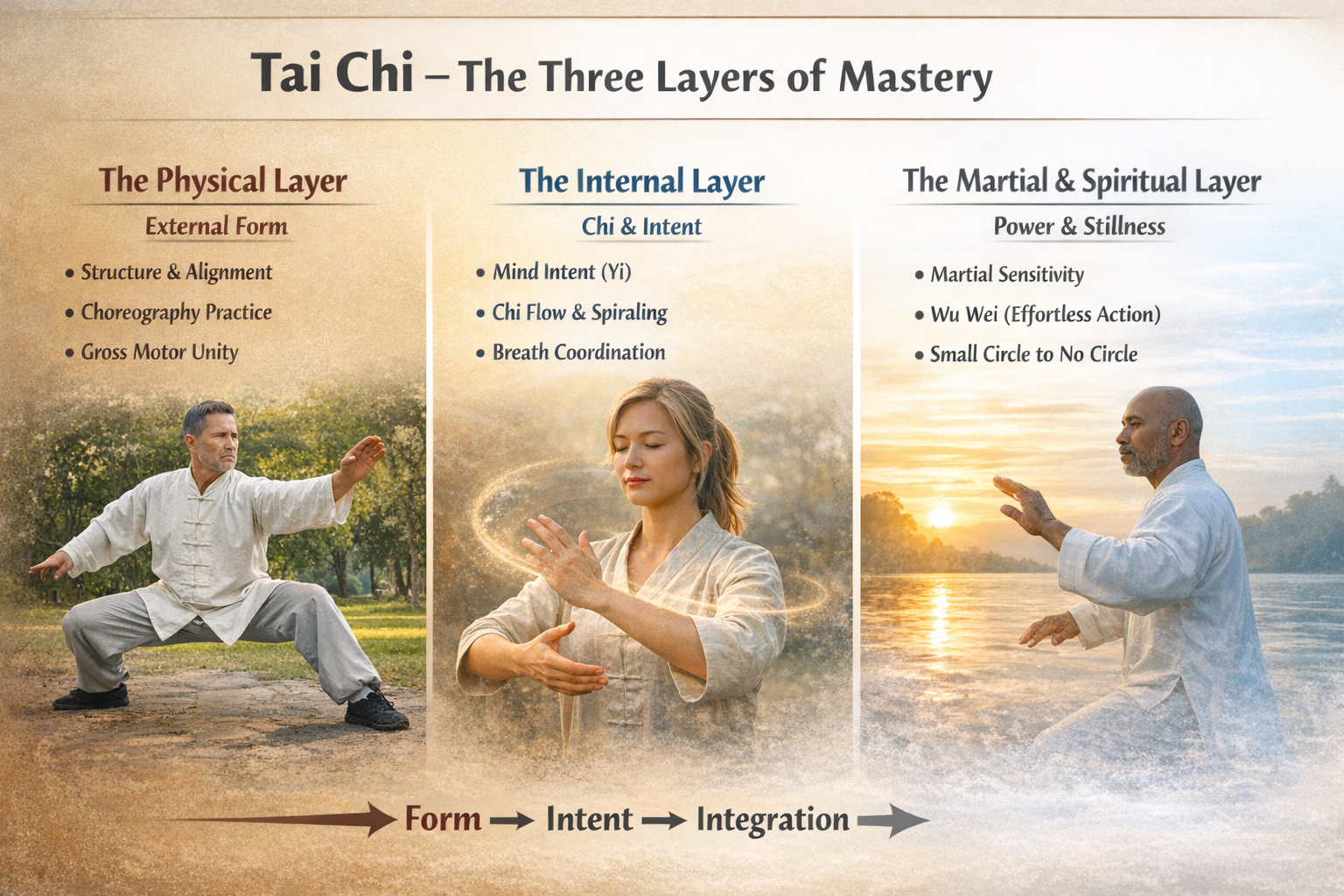
I. The Three Progressive Layers
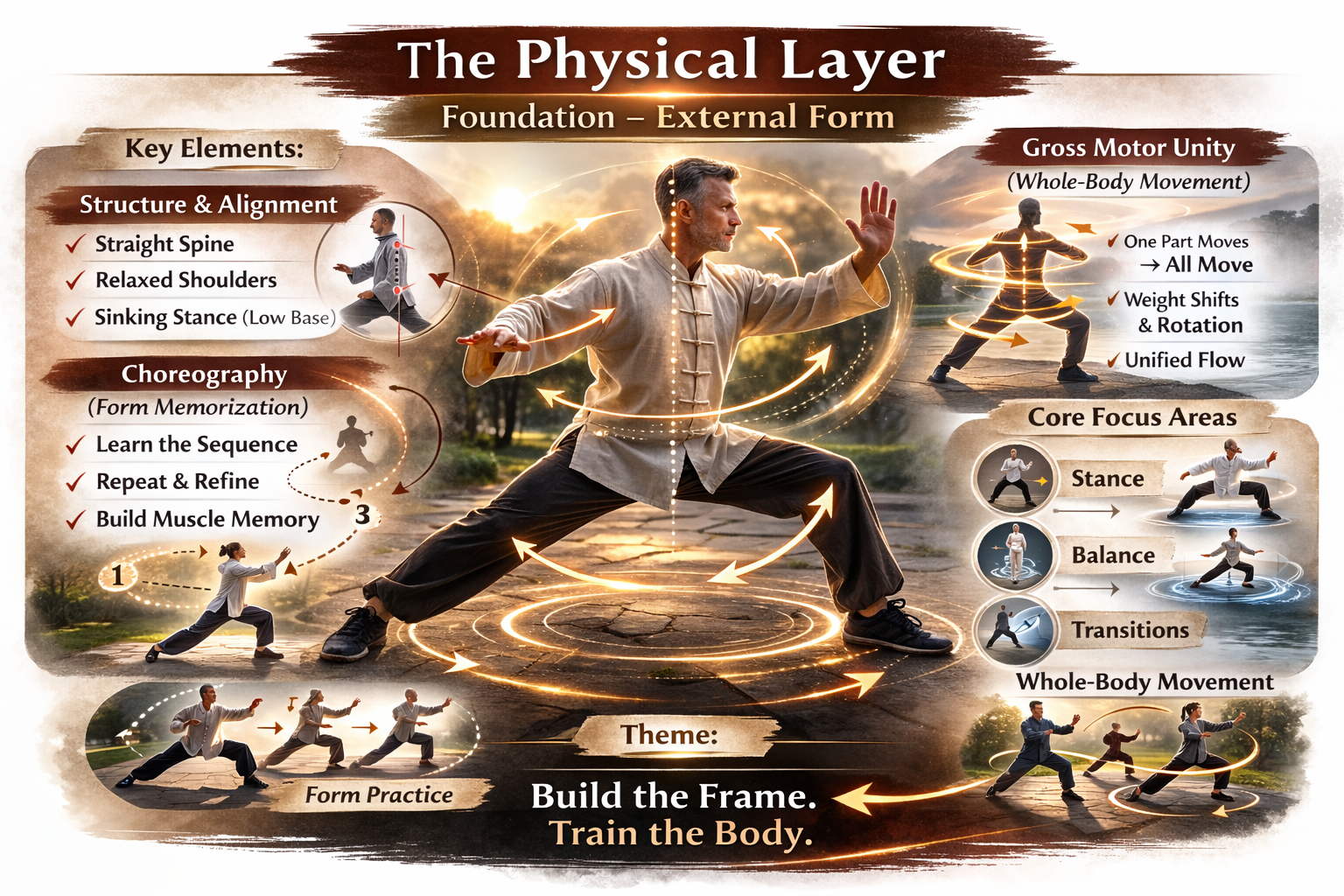
1. The Physical Layer – Foundation of External Form
Tai Chi begins with the body.
At this foundational stage, practice focuses on learning the “shape” of Tai Chi:
- Structure and Alignment: Correct stance work, upright spine, relaxed shoulders and elbows, proper weight distribution, and rooted balance.
- Choreography: Memorizing the form sequence until movements become smooth and consistent.
- Gross Motor Unity: Training the body to move as a coordinated whole—when one part moves, the entire body moves.
At this level, movements may appear mechanical or segmented. However, the goal is not aesthetic perfection but structural integrity. Without a stable physical frame, higher refinement is impossible.
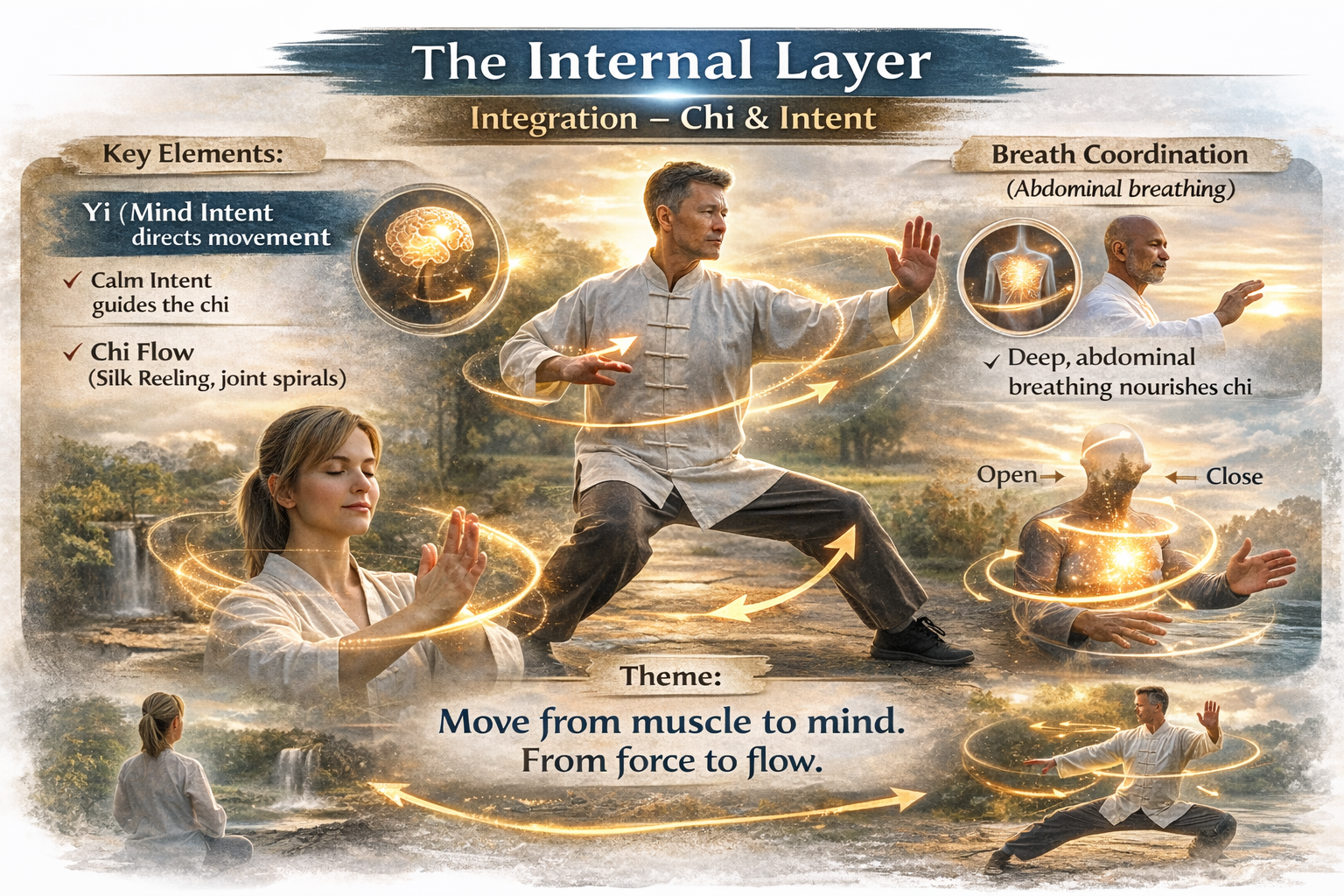
2. The Internal Layer – Integration of Mind and Energy
Once the external form becomes stable, attention shifts inward.
This stage emphasizes internal mechanics and the coordination of mind, breath, and movement:
- Mind Intent (Yi): Movement is directed by calm awareness rather than muscular force. The mind leads.
- Energy Flow (Chi): The practitioner begins to experience connectedness through the joints, often trained through spiraling or “silk-reeling” exercises.
- Breath Coordination: Deep abdominal breathing synchronizes with the opening and closing of postures, nourishing the body and calming the nervous system.
Here, fluidity replaces stiffness. Internal and external begin harmonizing. Softness starts overcoming force—not as theory, but as embodied understanding.
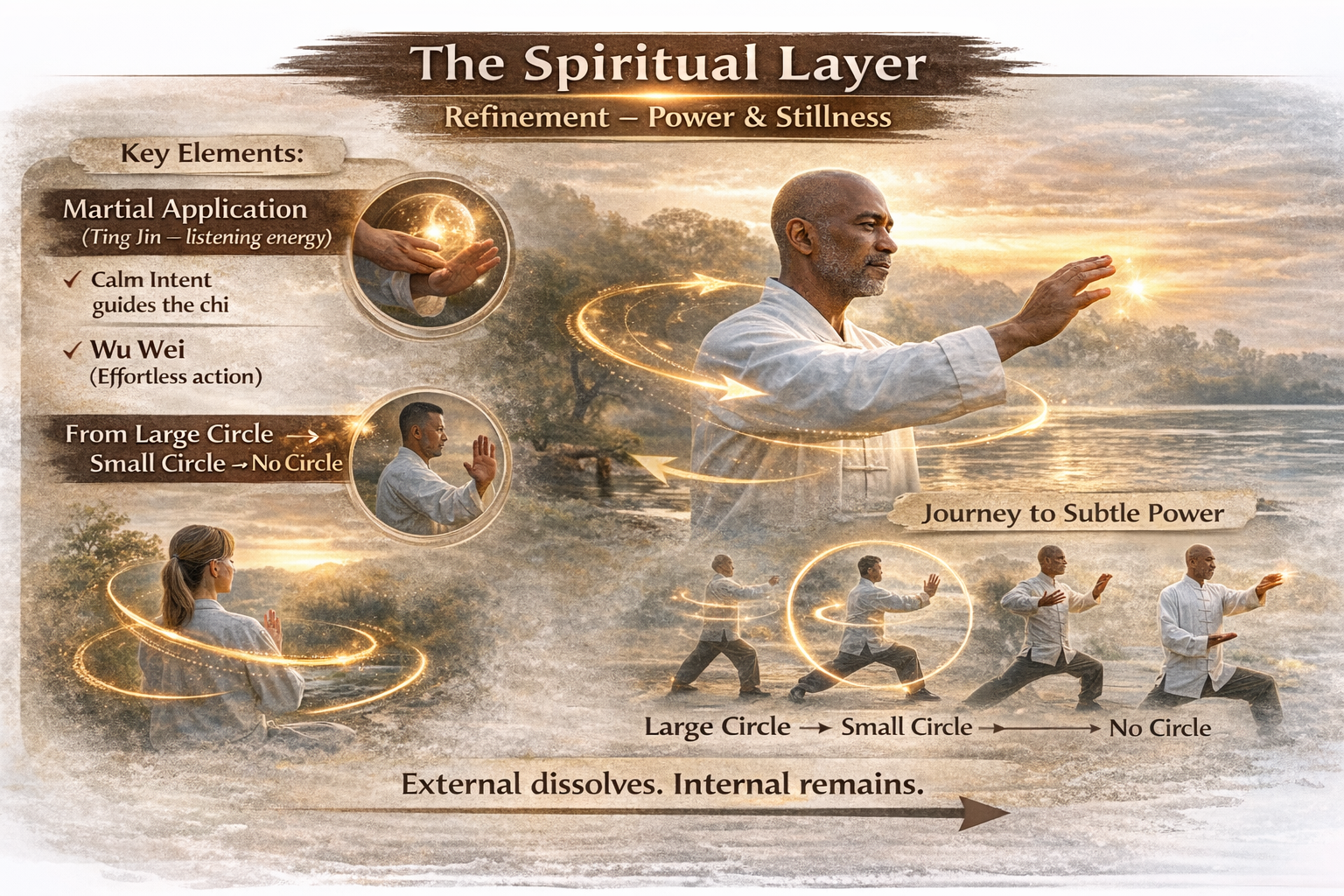
3. The Martial and Spiritual Layer – Refinement and Effortless Action
At advanced stages, physical skill merges with mental stillness.
- Martial Application: Understanding the hidden purpose behind each posture—deflection, redirection, neutralization, and issuing force. Sensitivity skills such as Ting Jin (“listening energy”) develop.
- Meditation in Motion: Movement becomes natural and unforced. The practitioner experiences Wu Wei—effortless action.
- Refinement of Circles: External movements progress from large circles to smaller and subtler expressions. Eventually, power becomes nearly invisible.
At this level, form dissolves into function. Internal changes are subtle yet profound. Yin and Yang are balanced not as philosophy, but as lived embodiment.
II. The Five Levels of Technical Development
Within this broader three-layer progression, many Chen lineage teachings describe a more detailed five-level refinement:
- Form and Posture – Learning external alignment. Movements may feel angular or disconnected.
- Chi Flow – Greater smoothness and continuity. Internal and external coordination begins.
- Refining the Circle – Transition from large to medium circles. Yi clearly leads Chi.
- Advanced Application – Small circles. Intrinsic power (Jing) becomes strong. Defense and attack unify.
- From Form to Formless – Mastery. Internal transformation is invisible; balance of Yin and Yang is complete.
These five levels do not replace the three layers—they simply provide finer technical distinctions within them.
III. The Four Pillars of Daily Practice
While layers and levels describe progression, Tai Chi training itself rests on four interrelated practice categories:
- Qigong – Breathing and energy cultivation exercises.
- Form Practice – The structured movement sequence.
- Pushing Hands – Partner drills that develop sensitivity and responsiveness.
- Application – Martial interpretation of each posture.
Rather than stages, these are ongoing dimensions of practice. All four reinforce one another and support growth through the progressive layers.
Integration: From Structure to Spirit
Tai Chi mastery is not achieved by abandoning earlier stages but by integrating them.
The body provides structure.
The mind provides direction.
The spirit provides refinement.
The journey moves from:
- External form
- To internal coordination
- To effortless unity
Large movements become small.
Visible circles become subtle spirals.
Force becomes softness.
Effort becomes natural.
Ultimately, Tai Chi evolves from something one does into something one is.
 United Martial Arts Association