
There can only be one truth about a particular thing. A tree is a tree. It does not become something else because someone prefers it to be different. It has roots, a trunk, branches, and leaves. It grows according to its nature.
Truth, in that sense, is singular.
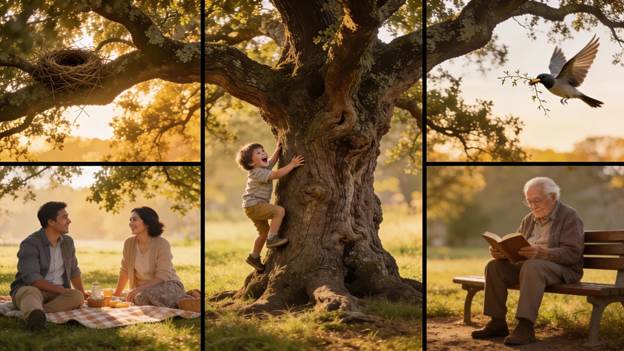
Yet there are countless ways to experience that truth. One person sees shade. Another sees lumber. A child sees a playground. A farmer sees fruit. A bird sees shelter. An artist sees beauty. The tree remains what it is, but its meaning expands through relationship.
However, there is another layer we must not ignore.
Not all trees are healthy.
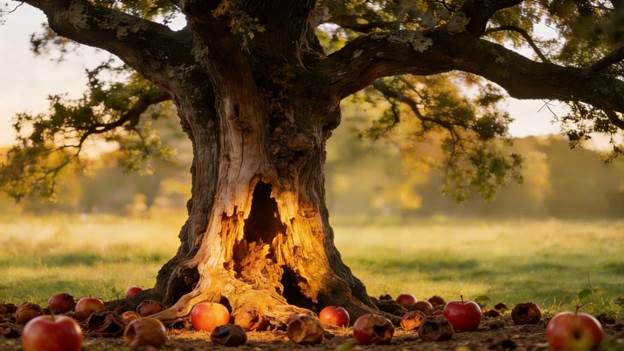
From a distance, a tree may appear strong with an upright trunk, full canopy, green leaves. Yet beneath the surface, its roots may be rotting. Insects may be boring into its core. Disease may be spreading through its vascular system. It may produce some healthy fruit and some spoiled fruit at the same time.
What appears stable may, in fact, be compromised. This complicates the simplicity at seeking truth, but only at face value.
The truth of the tree includes both its visible form and its hidden condition. Its outward strength does not automatically equal inward integrity. The shade it provides may still be real. The fruit it produces may still nourish. But the structural truth of the tree might be deteriorating. And if the roots are compromised long enough, collapse becomes inevitable.
This is where discernment enters the conversation.
Experience alone is not enough.
Observation alone is not enough.
Surface-level impressions are not enough.
We must look deeper. A person may experience comfort beneath a tree that is slowly dying. That comfort is real, but temporary. Someone may harvest fruit without realizing that decay has already begun in the roots. Another may lean against the trunk, unaware that termites are hollowing it from within.
The tree remains a tree. But the condition of the tree matters. This is true of ideas. It is true of institutions, leaders, relationships, and it is true of ourselves.
Something may look strong on the outside while its foundation is unstable. This thing may produce good results occasionally while carrying hidden corruption. This entity may offer shade while preparing to fall.
Truth is singular; however, truth is also layered. There is the truth of identity — what a particular thing is. And there is the truth of condition — how healthy or diseased it is. Wisdom requires that we examine both.
In human life, this means we must not confuse appearance with integrity. A smiling face does not guarantee emotional health. A successful career does not guarantee moral grounding. A large organization does not guarantee structural soundness. A belief system that produces some good fruit may still carry internal rot.
Discernment asks:
What do the roots look like?
What nourishes this system?
Is the fruit consistently healthy, or only occasionally?
Is there hidden decay beneath visible strength?
The tree teaches us again. We may approach it for shade, for fruit, for beauty, and those experiences are valid. But maturity asks us to step back and assess the whole. To look beneath the bark. To examine the roots. To recognize that outward form and inward health are not always identical.

Reality does not change because we ignore decay. Collapse does not wait for consensus. And yet, even here, the metaphor holds hope.
A diseased tree can sometimes be pruned. Infestation can sometimes be treated.
Roots can sometimes be strengthened. But only if the condition is acknowledged.
One truth. Many experiences. And beneath them all, is the responsibility to look deeper.
The tree is what it is…. But not all as it may seem, … at first glance. To find truth, we might need to look at many perspectives.
 United Martial Arts Association