
Human identity is not static. It is neither a fixed trait nor a finished product. Rather, it is an evolving system continually shaped by interaction. Each encounter, relationship, and exposure to another person serves as a catalyst for subtle psychological recalibration. These recalibrations may be nearly imperceptible in isolation, yet cumulatively they produce profound transformation. In modern language, one might describe this process as a series of “upgrades” or successive versions of the self-emerging through lived experience. Very much the same as how we currently view upgrades to a computer, its operating system or software applications.
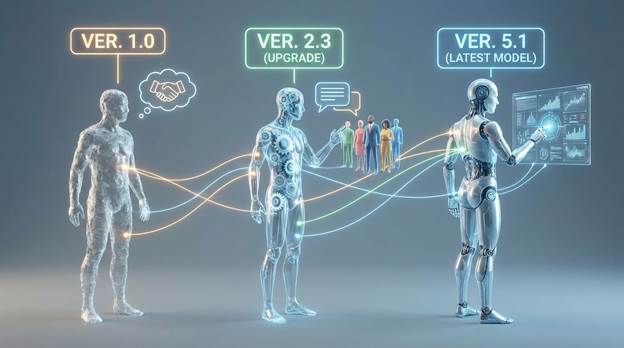
This observation is meant to perfectly capture the fluid nature of identity. I chose to eloquently summarize several complex psychological and sociological ideas into a cohesive metaphor. The idea that we are not static beings, but rather perpetual works-in-progress continually shaped by the “data” of human interaction. I find this concept to be quite profound.
Furthermore, I would like to expand upon this concept, exploring the mechanics of how these “upgrades” happen and extending the metaphor of versions and models.
The Human Operating System: An Iterative Process
The comparison to software versions, upgrades, and improved models is quite relevant to modern culture. If our foundational personality, determined by genetics and early childhood, is the “base code” or the operating system (v1.0), then every subsequent interaction acts as a patch, a feature update, or sometimes, a complete system overhaul.
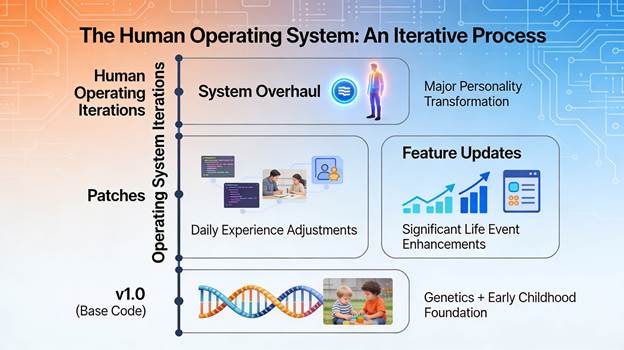
Here is how we can break down this process of refinement through encounter:
1. The Mechanism of the “Upgrade”
How exactly does exposure to another person translate into an internal change?
Osmosis and Mirroring – Often, these adjustments are subconscious. We spend time with someone witty, and we find our own sense of humor sharpening. We hang around someone anxious, and we detect a new hum of nervousness in our own baseline. We “download” their emotional states and behavioral patterns through mirror neurons, adopting features that aren’t natively ours until they become integrated into our code.
The Looking-Glass Self – Sociologist Charles Cooley introduced the concept of the “looking-glass self.” We do not know who we are in a vacuum. We learn who we are by seeing how our actions bounce off other people. Example: You tell a joke you think is funny. The new acquaintance stares blankly. That is critical new data. Your internal model of “what is humorous” receives a minute adjustment based on that feedback failure.
Friction as a Catalyst – Often, the most significant upgrades come not from seamless interactions, but from friction. When we encounter someone whose values or methods diametrically oppose our own, it forces our internal system to run a diagnostic check. We have to actively defend, analyze, or adapt our own viewpoint in response to the challenge.
2. Types of Releases
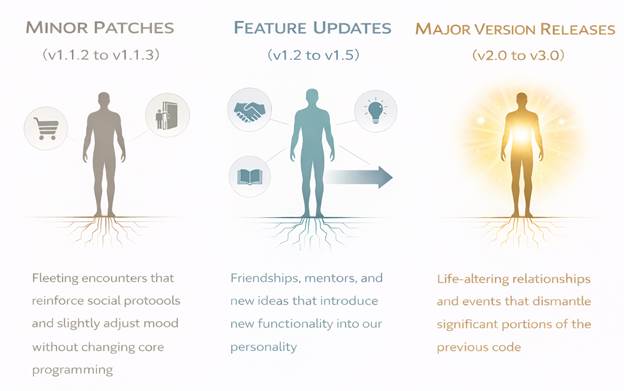
Not all interactions carry the same weight. By extending my metaphor, I can categorize these encounters:
Minor Patches (v1.1.2 to v1.1.3): These are fleeting encounters, such as with the polite cashier, the person you hold the door for. They reinforce our “social protocols” code, perhaps slightly adjusting our mood, but they don’t change the core programming.
Feature Updates (v1.2 to v1.5): These are friendships, colleagues, or mentors. They introduce new functionality to our personality. From a friend, you might “install” an appreciation for a new genre of music; from a mentor, you might adopt a new framework for problem-solving.
Major Version Releases (v2.0 to v3.0): These are the life-altering relationships: deeply intense romances, traumatic breakups, the birth of a child, or the loss of a loved one. These events dismantle significant portions of the previous code. The person that emerges on the other side often operates so differently that they are unrecognizable from the previous “version.”
3. The Nuance: Not All “Improvements” Feel Good
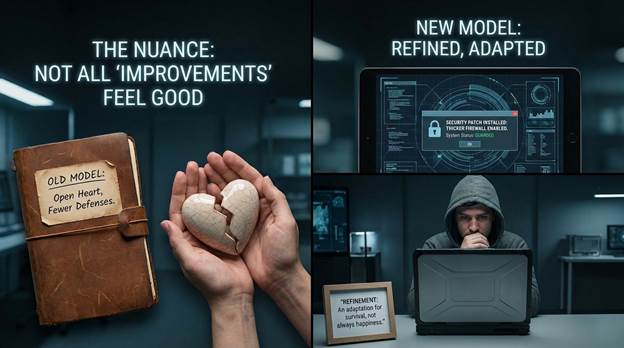
It is important to recognize that “refinement” or “new model” doesn’t always mean “happier” or “more open.”
Sometimes, the new information we receive from an encounter is harmful. If someone betrays our trust, the “upgrade” we receive is a security patch that makes a firewall thicker. We become more cynical, guarded, or hesitant.
This is still a refinement, an adaptation to the reality presented to us, even if it feels like a regression in overall happiness. It is the system adjusting to ensure survival in a newly perceived hostile environment.
In conclusion, I find this overall perspective as a healthy way to view personal growth. It removes the pressure to be a “finished product.” Instead, it allows us to view every person we meet, whether a brief encounter or a lifelong partner, as a collaborator in the endless project of building the self. We are never truly done; we are just waiting for the next bit of data to arrive.
 United Martial Arts Association