
Kintsugi as a Metaphor for Rebirth, Resilience, and Post Traumatic Growth
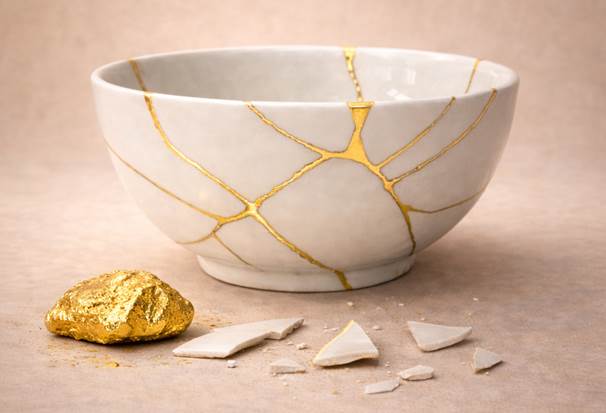
Across cultures and eras, humans have sought metaphors capable of explaining how suffering can coexist with strength, and how rupture can give rise to renewal. One of the most enduring and elegant metaphors for this process is Kintsugi, the Japanese art of repairing broken pottery with lacquer mixed with powdered gold. Rather than concealing fractures, Kintsugi highlights them, transforming damage into a defining feature of the object’s beauty and value. This practice offers a powerful symbolic lens through which to examine rebirth, resilience, and post traumatic growth (PTG).
Unlike narratives that portray healing as a return to an unbroken state, Kintsugi asserts that transformation occurs because of breakage, not in spite of it. When applied to human development, this metaphor challenges deficit-based models of trauma recovery and invites a reframing of adversity as a potential catalyst for meaning, integration, and psychological maturation (Tedeschi & Calhoun, 2004).
Kintsugi and the Philosophy of Visible Repair
At its core, Kintsugi is rooted in wabi-sabi, a Japanese aesthetic philosophy that honors impermanence, imperfection, and incompleteness. Rather than valuing symmetry or flawlessness, wabi-sabi recognizes authenticity as emerging through wear, age, and use. In Kintsugi, the repaired object does not attempt to mimic its former state. The break is acknowledged, traced, and sealed with care.
This philosophical orientation mirrors contemporary trauma psychology, which increasingly recognizes that healing does not involve erasing traumatic experience, but integrating it into a broader and more coherent life narrative (Joseph & Linley, 2006). The repaired vessel becomes stronger at the site of repair, not because it avoided damage, but because it was attended to with intention, patience, and skill.
The Cracked Stone as a Universal Symbol
The image of a cracked stone revealing gold extends the Kintsugi metaphor beyond pottery into the natural and existential realm. Stone is typically associated with permanence, durability, and resistance. When stone fractures, it violates expectations of stability, much as trauma disrupts assumptions about safety, identity, and predictability (Janoff-Bulman, 1992). Yet within geological processes, fractures often expose veins of mineral wealth. Pressure, heat, and tectonic stress are precisely the forces that allow gold to form and surface.
This parallel aligns closely with hormetic models of adaptation, in which controlled stress promotes strength and refinement, while unregulated stress overwhelms biological and psychological systems (Mattson, 2008). In both geology and human development, transformation requires force, but also time, containment, and structure.
Trauma as Rupture of Meaning
Psychological trauma is not defined solely by exposure to stress or adversity, but by the shattering of meaning structures that organize perception and identity (Park, 2010). Core beliefs about fairness, safety, autonomy, and continuity are disrupted. This rupture is often experienced as fragmentation, emotional dysregulation, and loss of coherence.
From a Kintsugi perspective, trauma represents the moment of breakage. However, breakage alone does not determine outcome. Without repair, cracks propagate. With skillful integration, they become lines of strength. Post traumatic growth does not deny pain or minimize suffering. Instead, it acknowledges that the reconstruction of meaning can lead to new values, deeper relationships, and an expanded sense of purpose (Tedeschi & Calhoun, 2004).
Gold as Meaning, Not Positivity
In Kintsugi, gold does not symbolize denial or forced optimism. It represents investment. Gold is rare, costly, and deliberately applied. Similarly, psychological integration requires effort, reflection, and often guidance. Meaning is not automatically extracted from trauma. It is forged through conscious engagement with suffering, supported by regulation, social connection, and narrative reconstruction (Park, 2010).
This distinction is critical. Superficial positivity can invalidate lived experience and impede recovery. The gold of Kintsugi does not erase the crack. It honors it. In PTG research, growth is associated with deliberate meaning making, not with avoidance or suppression of distress (Joseph & Linley, 2006).
Resilience Versus Post Traumatic Growth
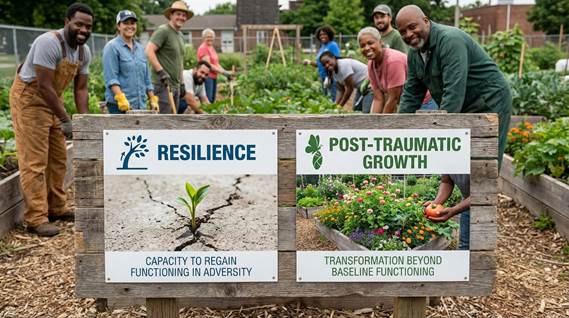
Resilience and post traumatic growth are often conflated, but they represent distinct processes. Resilience refers to the capacity to maintain or regain functioning in the face of adversity. Post traumatic growth refers to transformation beyond baseline functioning (Southwick et al., 2014).
In metaphorical terms, resilience preserves the vessel. Post traumatic growth reshapes it. The cracked stone repaired with gold does not return to its prior state. It becomes something new, marked by experience and enriched by integration. This distinction reframes trauma recovery as a developmental process rather than a corrective one.
The Role of Time and Patience
Kintsugi is not a rapid repair. The process requires drying, curing, and careful layering. Similarly, psychological integration unfolds over time. Neurobiological recovery, emotional regulation, and identity reconstruction are gradual processes shaped by repetition and consistency (van der Kolk, 2014).
Time alone does not heal trauma. However, time combined with regulated exposure, embodied practices, and supportive relationships allows the nervous system to recalibrate and the mind to reorganize experience (Porges, 2011). The cracked stone does not reveal gold immediately. It does so through sustained engagement with pressure and care.
Embodiment and the Materiality of Healing
Kintsugi is a tactile art. It involves hands, materials, and physical presence. This embodied dimension parallels somatic approaches to trauma recovery, which recognize that traumatic memory is stored not only cognitively but physiologically (van der Kolk, 2014). Repair occurs not solely through insight, but through restoring a sense of safety, agency, and bodily coherence.
Practices that involve posture, breath, movement, and sensory awareness serve as modern equivalents of the craftsman’s work. They provide structure to contain experience and facilitate integration, allowing psychological gold to be laid into somatic cracks.
Rebirth as Integration, Not Replacement
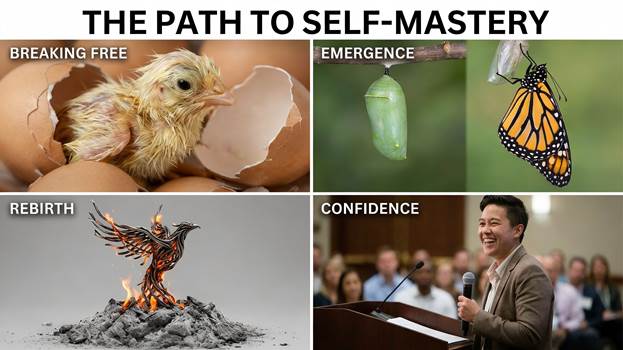
The concept of rebirth is often misunderstood as starting over. The Kintsugi metaphor rejects this notion. Rebirth does not mean discarding the past but incorporating it into a renewed whole. The vessel remembers its fracture. The stone retains its fault lines.
Post traumatic growth reflects this integrated rebirth. Individuals report increased appreciation for life, clarified priorities, enhanced relational depth, and a more grounded sense of self (Tedeschi & Calhoun, 2004). These outcomes do not emerge despite trauma, but through its conscious integration.

Cultural and Ethical Implications
The Kintsugi metaphor carries ethical weight. It challenges cultures that stigmatize vulnerability or equate worth with flawlessness. By highlighting repair rather than concealment, it affirms the dignity of lived experience and reframes suffering as a potential source of wisdom.
In therapeutic, educational, and communal contexts, this metaphor supports trauma-informed approaches that emphasize agency, respect, and long-term development rather than symptom suppression. It invites systems to ask not how to hide cracks, but how to support meaningful repair.
The cracked stone revealing gold offers a profound metaphor for rebirth, resilience, and post traumatic growth. It affirms that damage does not negate value, that fracture does not preclude strength, and that transformation is not a return to innocence but a movement toward integration.
Kintsugi teaches that what has been broken can become more meaningful, not because suffering is desirable, but because repair, when undertaken with care and intention, reveals capacities that would otherwise remain hidden. In this sense, post traumatic growth is not an exception to human development. It is one of its deepest expressions.
References:
Janoff-Bulman, R. (1992). Shattered assumptions: Toward a new psychology of trauma. Free Press.
Joseph, S., & Linley, P. A. (2006). Growth following adversity: Theoretical perspectives and implications for clinical practice. Clinical Psychology Review, 26(8), 1041–1053. https://doi.org/10.1016/j.cpr.2005.12.006
Mattson, M. P. (2008). Hormesis defined. Ageing Research Reviews, 7(1), 1–7. https://doi.org/10.1016/j.arr.2007.08.007
Park, C. L. (2010). Making sense of the meaning literature: An integrative review of meaning making and its effects on adjustment to stressful life events. Psychological Bulletin, 136(2), 257–301. https://doi.org/10.1037/a0018301
Porges, S. W. (2011). The polyvagal theory: Neurophysiological foundations of emotions, attachment, communication, and self regulation. W. W. Norton.
Southwick, S. M., Bonanno, G. A., Masten, A. S., Panter-Brick, C., & Yehuda, R. (2014). Resilience definitions, theory, and challenges. European Journal of Psychotraumatology, 5, 25338. https://doi.org/10.3402/ejpt.v5.25338
Tedeschi, R. G., & Calhoun, L. G. (2004). Post traumatic growth: Conceptual foundations and empirical evidence. Psychological Inquiry, 15(1), 1–18. https://doi.org/10.1207/s15327965pli1501_01
van der Kolk, B. A. (2014). The body keeps the score: Brain, mind, and body in the healing of trauma. Viking.
 United Martial Arts Association