
For centuries, Chinese culture has been shaped by a triad of the philosophical systems of Confucianism, Taoism, and Buddhism. Though distinct in their teachings, they are often seen as complementary threads that weave together a balanced and meaningful life. Each offers a unique focus: Confucianism emphasizes harmony in society, Taoism seeks unity with nature, and Buddhism turns inward to liberate the self from suffering (Yao, 2000).
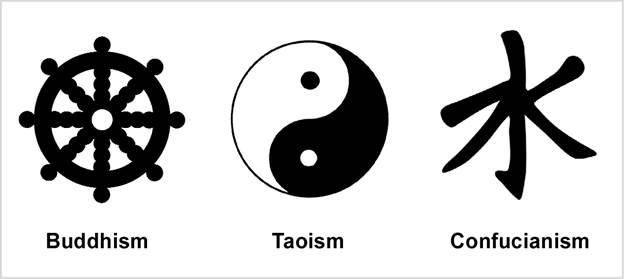
Confucianism: The Order of Society
Founded by Confucius (Kong Fuzi) around the 5th century BCE, Confucianism centers on ethics, duty, and the cultivation of virtuous behavior within a structured society. It promotes familial piety (xiao), respect for hierarchy, and the importance of education and ritual (li) (Sontag, 1974). A Confucian life is guided by the roles of the parent, child, ruler, subject, and the fulfillment of these roles builds a just and orderly world. It teaches that virtue in leadership trickles down to the moral development of the people (Yao, 2000).
Taoism: Flowing with Nature
Rooted in the Tao Te Ching by Laozi, Taoism (or Daoism) champions spontaneity, simplicity, and harmony with the Tao, or the ineffable force that flows through all things (Laozi, trans. Mitchell, 1988). Rather than striving to control or fix the world, the Taoist seeks to align with the natural order through non-resistance (wu wei), letting go of ego, and observing the rhythms of nature. Taoism speaks to the middle-aged soul, or one who questions structure and seeks authenticity and fluidity in life (Kirkland, 2004).
Buddhism: Awakening the Inner Self
Brought to China from India around the 1st century CE, Buddhism introduced a new inwardness, emphasizing meditation, compassion, and release from suffering through the Eightfold Path (Harvey, 2013). The Buddhist focus is not on society or external alignment but on awakening. It teaches that all phenomena are impermanent, and that liberation comes not from control or flow, but from transcending attachment entirely (Mitchell, 2002). In this way, Buddhism serves the aging soul by contemplating, detaching, and seeking ultimate freedom.
Integration: A Balanced Life
In traditional Chinese thought, these three paths were not meant to compete but to complete one another. A person might live as:
- a Confucian in the office
- a Taoist in the garden
- a Buddhist in solitude (Yao, 2000).
Together, they offer a map to live wisely with integrity in society, harmony in nature, and peace within the soul.
References
Sontag, F. (1974). Herbert Fingarette. Confucius—the Secular as Sacred. (Harper and Row, New York, 1972.). Religious Studies, 10(2), 245–246. https://doi.org/10.1017/s0034412500007514
Harvey, P. (2012). An introduction to Buddhism. https://doi.org/10.1017/cbo9781139050531
Taoism: the Enduring tradition. (n.d.). Routledge & CRC Press. https://www.routledge.com/Taoism-The-Enduring-Tradition/Kirkland/p/book/9780415263221?utm_source=cjaffiliates&utm_medium=affiliates&cjevent=eeb2c6c93e3c11f083ff00cf0a82b820
Mitchell, S. (1988). Tao Te Ching. In HARPERPERENNIAL MODERNCLASSICS. HARPERPERENNIAL MODERNCLASSICS. https://ia800904.us.archive.org/20/items/taoteching-Stephen-Mitchell-translation-v9deoq/taoteching-Stephen-Mitchell-translation-v9deoq_text.pdf
Mitchell, D. W. (2002). Buddhism: Introducing the Buddhist experience. Oxford University Press.
Yao, X. (2000). An introduction to confucianism. https://doi.org/10.1017/cbo9780511800887


 United Martial Arts Association