Just Because We Can Be Offended, Doesn’t Mean We Have to Be

Cultivating Emotional Sovereignty in a Reactive Culture

In contemporary society, offense has become both a currency and a contagion. Social media platforms amplify outrage, news cycles thrive on indignation, and personal identity is increasingly intertwined with ideological positioning. In such an environment, the mere possibility of being offended is often treated as justification for emotional reactivity. Yet the capacity to feel offended does not obligate us to live offended. The distinction between stimulus and response, between what happens to us and how we choose to interpret and embody that experience, lies at the heart of psychological maturity, emotional resilience, and personal sovereignty.

The statement “Just because we can be offended doesn’t mean we have to be offended” is not a call to emotional suppression or moral indifference. Rather, it reflects a deeper philosophy of self-regulation, discernment, and conscious agency. It invites individuals to reclaim authorship over their internal states rather than surrendering that authority to external forces.

Offense as a Psychological Reflex

Offense is not merely a moral judgment; it is a psychological reaction shaped by cognition, emotion, identity, and conditioning. From a cognitive perspective, offense arises from appraisal processes, our interpretations of meaning, intent, and threat (Lazarus, 1991). When a statement, behavior, or symbol is perceived as violating one’s values or identity, the nervous system often responds defensively, activating the stress response.

Neuroscientifically, perceived social threat activates the same brain regions associated with physical danger, including the amygdala and anterior cingulate cortex (Eisenberger et al., 2003). The body reacts as though under attack, even when the “threat” is symbolic or ideological. In this sense, offense is not merely an opinion, but rather it is a somatic experience.

However, cognitive-behavioral research demonstrates that emotional reactions are not caused directly by events, but by our interpretations of those events (Beck, 1976; Ellis, 1962). Two people can encounter the same stimulus and respond in radically different ways. One becomes enraged; the other remains curious. One feels attacked; the other feels unmoved. The difference lies not in the event, but in the meaning assigned to it.

The Illusion of Emotional Obligation

Modern culture increasingly frames emotional reactions as moral imperatives. If something is offensive, one is expected to be offended. If one is not offended, one may be accused of apathy, complicity, or ignorance. This creates a form of emotional coercion in which outrage becomes a social requirement rather than a personal choice.

Yet emotional autonomy is a cornerstone of psychological well-being. Self-determination theory emphasizes that autonomy, or the ability to regulate one’s own internal states and behavior, is essential for mental health and resilience (Deci & Ryan, 2000). When individuals surrender their emotional regulation to external narratives, they become psychologically reactive rather than self-directed.

Viktor Frankl (1959), writing from the extreme conditions of Nazi concentration camps, articulated this principle with profound clarity:

Offense collapses that space. It replaces reflection with reflex. It trades discernment for reaction.

Identity, Ego, and the Architecture of Offense

Offense is often less about the external stimulus and more about the internal structure of identity. When beliefs become fused with the ego, disagreement feels like annihilation. When narratives become moral absolutes, questioning feels like betrayal.

Social identity theory explains how individuals derive self-concept from group membership, which can intensify defensiveness when group values are challenged (Tajfel & Turner, 1979). In such contexts, offense becomes a mechanism for protecting identity boundaries.

However, psychological flexibility, or the ability to hold beliefs lightly and remain open to new perspectives, is strongly associated with well-being and adaptive functioning (Kashdan & Rottenberg, 2010). Rigid identity structures create fragile egos. Fragile egos seek offense.

The Stoic philosophers understood this dynamic long before modern psychology. Epictetus wrote:

In Taoist philosophy, offense is seen as an expression of imbalance, a disturbance of inner harmony caused by attachment to form, opinion, and self-image (Laozi, trans. 2003). The Tao Te Ching repeatedly emphasizes softness, yielding, and non-contention as expressions of true strength.

The Cost of Chronic Offense

Living in a constant state of offense is physiologically and psychologically costly. Chronic emotional reactivity sustains activation of the hypothalamic-pituitary-adrenal (HPA) axis, elevating cortisol levels and contributing to inflammation, anxiety, cardiovascular strain, and immune dysregulation (McEwen, 2007).

Psychologically, habitual offense fosters rumination, polarization, and cognitive rigidity. It narrows perception, reduces empathy, and erodes social cohesion. Over time, it becomes a form of self-imposed imprisonment or leaned helplessness, a mental posture of perpetual conflict.

From a social perspective, outrage culture rewards emotional escalation rather than thoughtful dialogue. Nuance is punished. Complexity is flattened. The loudest voices dominate, while reflective voices retreat.

Yet human flourishing depends not on ideological purity, but on psychological resilience, moral humility, and relational intelligence.

Emotional Sovereignty and the Practice of Non-Offense

To choose not to be offended is not to abandon values. It is to embody them with maturity.

Emotional sovereignty means reclaiming authority over one’s internal state. It means recognizing that while we cannot control what others say or do, we can control how we metabolize those experiences.

Mindfulness research consistently demonstrates that cultivating present-moment awareness reduces emotional reactivity and increases cognitive flexibility (Kabat-Zinn, 2003; Tang et al., 2015). When individuals observe their reactions without immediately identifying with them, the emotional charge dissipates.

In Taoist internal cultivation practices, emotional regulation is viewed as an essential aspect of health. Excessive anger is believed to disturb liver qi, excessive fear weakens kidney essence, and excessive rumination burdens the spleen (Kaptchuk, 2000). Emotional moderation is not merely ethical, it is physiological.

Similarly, in classical Stoicism, the goal is not emotional numbness, but emotional mastery. One learns to respond rather than react, to act from reason rather than impulse, and to maintain inner stability amid external chaos.

Choosing Power Over Fragility

To be easily offended is to live at the mercy of others. To be unoffendable is to live from inner authority.

This does not mean tolerating injustice or abandoning moral clarity. It means engaging with the world from a position of grounded strength rather than reactive fragility. It means speaking when speech is necessary, acting when action is required, and walking away when engagement serves no constructive purpose.

In a culture addicted to outrage, non-offense is a radical act of sovereignty.

The capacity to feel offended is part of being human. The wisdom to choose not to be offended is part of becoming whole.

References

Beck, A. T. (1976). Cognitive therapy and the emotional disorders. International Universities Press. https://psycnet.apa.org/record/1976-28303-000

Deci, E. L., & Ryan, R. M. (2000). The “what” and “why” of goal pursuits: Human needs and the self-determination of behavior. Psychological Inquiry, 11(4), 227–268. https://doi.org/10.1207/S15327965PLI1104_01

Eisenberger, N. I., Lieberman, M. D., & Williams, K. D. (2003). Does rejection hurt? An fMRI study of social exclusion. Science, 302(5643), 290–292. https://doi.org/10.1126/science.1089134

Ellis, A. (1962). Reason and emotion in psychotherapy. Lyle Stuart. https://psycnet.apa.org/record/1963-01437-000

Epictetus. (2008). The Enchiridion (N. P. White, Trans.). Hackett Publishing. https://archive.org/details/epictetus-the-enchiridion

Frankl, V. E. (1959). Man’s search for meaning. Beacon Press. https://antilogicalism.com/wp-content/uploads/2017/07/mans-search-for-meaning.pdf

Kabat-Zinn, J. (2003). Mindfulness-based interventions in context: Past, present, and future. Clinical Psychology: Science and Practice, 10(2), 144–156. https://doi.org/10.1093/clipsy/bpg016

Kaptchuk, T. J. (2000). The web that has no weaver: Understanding Chinese medicine (2nd ed.). McGraw-Hill.

Kashdan, T. B., & Rottenberg, J. (2010). Psychological flexibility as a fundamental aspect of health. Clinical Psychology Review, 30(7), 865–878. https://doi.org/10.1016/j.cpr.2010.03.001

Laozi. (2003). Tao Te Ching (D. C. Lau, Trans.). Penguin Classics.

Lazarus, R. S. (1991). Emotion and adaptation. https://doi.org/10.1093/oso/9780195069945.001.0001

McEwen, B. S. (2007). Physiology and neurobiology of stress and adaptation: Central role of the brain. Physiological Reviews, 87(3), 873–904. https://doi.org/10.1152/physrev.00041.2006

Tajfel, H., & Turner, J. C. (1979). An integrative theory of intergroup conflict. In W. G. Austin & S. Worchel (Eds.), The social psychology of intergroup relations (pp. 33–47). Brooks/Cole.

Tang, Y.-Y., Hölzel, B. K., & Posner, M. I. (2015). The neuroscience of mindfulness meditation. Nature Reviews Neuroscience, 16(4), 213–225. https://doi.org/10.1038/nrn3916

Post-traumatic Growth: Essays to Cultivate Healing, Integration, and Meaning

Trauma rarely arrives by invitation. For most people, it enters life unexpectedly, through loss, betrayal, illness, accidents, violence, neglect, coercion, or prolonged stress. Very few individuals seek out traumatic experiences, and just as rarely do most people consciously intend to harm or traumatize others. And yet, despite intent, all actions carry consequences. Words spoken in anger, choices made in fear, systems built on imbalance, and moments of inattention can send ripple effects outward for years, sometimes for generations. Trauma often lives in these ripples.

Long after the original event has passed, many people continue to feel unsettled inside, anxious, guarded, emotionally numb, reactive, ashamed, or unsure of who they have become. These experiences are not signs of weakness or personal failure. They are the natural imprint of overwhelming stress on the nervous system, identity, and relational trust. Trauma changes how the body responds to threat, how the mind interprets reality, how the self is organized, and how relationships are navigated.

My book Post-traumatic Growth – Essays to Cultivate Healing, Integration, and Meaning was written for those who have survived difficult experiences and now find themselves asking deeper questions, not only how to cope, but how to truly grow beyond survival. The gradual cultivation of healing and growth does not mean that trauma was good, necessary, deserved, or spiritually justified. It does not minimize suffering or attempt to frame pain as a gift. Rather, it acknowledges a well-documented truth: human beings possess a powerful capacity to adapt, integrate, mature, and rebuild their lives when safety, awareness, and agency are gradually restored.

For decades, my work has focused on the relationship between stress physiology, emotional regulation, behavior, identity, and resilience. Again and again, I have seen that trauma recovery is not only psychological. It is neurological. It is relational. It is embodied. Insight alone is not enough. Healing requires the reorganization of the nervous system, the development of emotional maturity, the rebuilding of boundaries, the restoration of agency, and the reconstruction of meaning.

This book follows the full arc of transformation. It begins with how trauma disrupts regulation, perception, and identity. It then moves into the practical foundations of recovery by using breath, posture, emotional regulation, and stress resilience. From there, it addresses the deeper psychological work of boundaries, meaning-making, emotional maturity, and agency. Finally, it turns outward toward contribution, service, and the lifelong process of integration and wholeness.

If you are reading this, it is likely because some part of your life has been shaped by adversity, sudden or prolonged, visible or hidden. This book does not offer shortcuts. It offers something more enduring: a grounded path toward rebuilding stability, identity, agency, and meaning over time. These essays are not meant to be rushed or consumed linearly, but revisited as one’s capacity for regulation, reflection, and integration deepens. Growth does not erase the past. It allows you to live no longer defined by it.

All on the Same River – Aging, Suffering, and the Quiet Call to Connect

Now in my sixties, I find myself reflecting on observations that began much earlier in life. Since my teenage years, I have paid close attention to how people behave, how they relate to themselves, and how they interact with others. Over time, certain patterns become difficult to ignore. Pain and suffering, both physical and psychological, are not rare events that suddenly appear in old age. They are present throughout life. I witnessed them early on among relatives, friends, and associates struggling with health issues, emotional burdens, addiction, isolation, and loss.

What strikes me most now is that, as I enter what society often calls the “golden years,” I see many of the very same issues playing out again. They are now appearing not only in those around me, but also within my own body, my own relationships, and my own reflections. Aging does not introduce suffering so much as it reveals what has been quietly accumulating all along.

A metaphor that often comes to mind is that of individual boats floating on a river. Each of us is in our own vessel, shaped by our experiences, injuries, beliefs, habits, and fears. And yet we are all on the same river. We know where it leads. The waterfall at the end is not a secret. Mortality is not the surprise. What is surprising is how passively many of us drift toward it, aware of the direction, yet doing little to slow, redirect, or meaningfully engage with the journey itself.

Through decades of study and practice in martial arts, fitness, wellness, and character development, I have seen that much physical pain and mental suffering are not inevitable in the way we often assume. Aging brings change, yes, but deterioration is frequently accelerated by inactivity, isolation, and disengagement. This is where frustration sometimes arises for me. Not because people suffer, but because so many appear unwilling or unable to consider ways of reducing that suffering, even when those ways are accessible and humane.

To engage in practices that promote health, connection, or growth quietly implies that something can be done. Psychological research helps explain why this implication can feel empowering to some and threatening to others. Self-efficacy theory emphasizes the importance of a person’s belief in their ability to influence outcomes through their own actions (Bandura, 1997). When individuals no longer believe that their efforts will make a difference, withdrawal, avoidance, and resignation become understandable responses. From this perspective, resistance to change is not stubbornness or apathy, but a protective response to the fear that trying will only confirm one’s limitations.

This resistance is rarely about a dislike of movement, wellness, or community. More often, it reflects years of diminished confidence, repeated disappointment, or environments that subtly reinforce helplessness. When effort feels futile, suffering becomes something to endure rather than address. Familiar discomfort can begin to feel safer than uncertain improvement.

At the same time, I recognize a tension within myself. When I speak openly about movement, connection, and intentional living, I worry about coming across as preachy, mystical, or overly insistent. I am not a pastor. I am not promoting religion, nor am I suggesting that people join a cult or subscribe to a belief system. I am not even saying that everyone should practice tai chi, qigong, or martial arts. When I refrain from speaking, however, I feel that I am withholding something valuable. I feel that I am not fully honoring the experiences, insights, and responsibilities that come with a lifetime of observation and practice.

This tension is not about convincing or converting others. It is about witnessing. With time, some people naturally step into the role of observer, elder, or quiet guide. Not because they have all the answers, but because they have watched patterns repeat long enough to recognize their consequences. The challenge is learning how to share those observations without turning them into judgements or prescriptions.

One thing I have come to believe deeply is that human beings are not meant to regulate, heal, or make meaning entirely on their own. Loneliness is not simply an emotional state. It is a physiological stressor that affects mood, immune function, and overall health. Prolonged inactivity is not merely a lack of motivation. It contributes to neurological, metabolic, and emotional decline. These are not moral failings. They are relational failures, often reinforced by cultural norms that normalize isolation and passivity, especially in later life.

As people grow older, many intuitively sense the importance of connection, yet they often seek it in indirect or diluted ways. Simply getting out of the house becomes a strategy in itself. Some look for brief interactions at grocery stores, shopping malls, parks, or other public places. Others join social gatherings at churches, recreation centers, or community programs, playing chess, cards, or other games. Many find comfort and companionship in caring for pets, which offer unconditional presence and emotional soothing. These choices are understandable, and they can provide genuine relief from isolation.

However, an important question remains. While these activities offer contact, do they consistently provide the depth of connection and sense of purpose that many people seek as they age? Casual interactions, routine social exposure, or even well-intentioned group activities can still leave an underlying sense of emptiness if they lack shared meaning, mutual growth, or authentic engagement. Being around people is not the same as being with people in a way that nourishes identity, contribution, and belonging.

From a psychological perspective, this distinction matters. Self-determination theory emphasizes that relatedness is not simply about proximity to others, but about experiencing connection that feels mutual, valued, and purposeful (Deci & Ryan, 2000). Likewise, self-efficacy is strengthened not merely through activity, but through participation that allows individuals to feel useful, capable, and seen (Bandura, 1997). Without these elements, social contact can become another form of distraction rather than a source of restoration.

Meaningful connection often emerges where people share interests, challenges, values, or practices that invite participation rather than passive attendance. Whether through movement, learning, service, discussion, or creative expression, deeper connection tends to form when individuals feel they are contributing to something larger than themselves, while still being accepted as they are. In this way, connection becomes not just a buffer against loneliness, but a pathway toward purpose, resilience, and continued growth later in life.

Self-determination theory offers further insight into this pattern by identifying three basic psychological needs that support motivation and well-being: autonomy, competence, and relatedness (Deci & Ryan, 2000). When people feel they have little choice over their circumstances, when they no longer feel capable in their bodies or minds, and when meaningful social connection fades, motivation naturally erodes. In such conditions, disengagement is not a character flaw. It is an adaptive response to unmet psychological needs.

I see far too many people sitting alone in front of their televisions, day after day, in physical pain from lack of movement and mental suffering from loneliness. Many of them do not describe themselves as lonely. They describe themselves as introverted, tired, bored, anxious, or resigned. Yet beneath these labels is often a quiet grief and a sense of disconnection that no amount of passive entertainment can resolve.

Life is remarkably short. This truth is easy to intellectualize and difficult to feel until much later than we would like. By the time many people recognize the cost of years spent disengaged, rebuilding strength, relationships, and purpose, it all feels overwhelming. And so, the river carries them onward.

Despite our separate boats, we are not truly alone on this river. We move together, influenced by the same currents of aging, cultural distraction, and social fragmentation. This is why individual solutions, while important, are not sufficient on their own. Exercise matters, but so does shared experience. Reflection matters, but so does conversation. Discipline matters, but so does belonging. Environments that emphasize choice, encouragement, and shared participation help restore both self-efficacy and intrinsic motivation by allowing people to experience small successes within supportive social contexts (Bandura, 1997; Deci & Ryan, 2000).

When I speak about wellness, connection, and engagement, I try to do so from observation rather than instruction. I speak from my own struggles, not from a place of authority. I talk about what has helped me manage pain, stress, and meaning, rather than what others should do. I ask questions instead of offering conclusions. I trust that those who are ready will hear what resonates and leave the rest.

I have also come to accept a sobering but liberating truth. Not everyone wants to reduce their suffering. And that is not something I can change. But those who do want to suffer less are often quietly searching for examples, not sermons. They are looking for people who embody coherence, engagement, and a willingness to remain active in life, physically and relationally.

Perhaps the most honest role I can play is not that of teacher or promoter, but of a participant. Someone who keeps paddling, not frantically, but deliberately. Someone who remains available, curious, and open to connection. Someone who extends invitations rather than demands. Whether that invitation takes the form of a class, a walk, a conversation, or a shared interest matters less than the spirit in which it is offered.

If tai chi or qigong resonates, wonderful. If not, there are countless other ways to engage. Art, music, volunteering, discussion groups, gardening, learning, mentoring, movement of any kind. What matters is not the activity itself, but the willingness to participate in life rather than observe it from the sidelines.

We are all on the same river. The current is real. The waterfall is inevitable. But how we travel, whom we travel with, and whether we choose to paddle at all remain within our influence. If sharing that perspective helps even a few people lift their eyes from the screen, move their bodies, or reach out to another human being, then speaking is not preaching. It is simply responding, honestly, to what a lifetime of observation has revealed.

As we age, the question often shifts from how to stay occupied to how to stay meaningfully engaged, with ourselves, with others, and with life itself.

If these reflections resonate with you, you are not alone. Meaningful connection often begins simply by reaching out. I welcome conversations about creating small, supportive gatherings, whether through discussion, movement, shared practice, or reflection, that explore mind, body, and consciousness as integrated aspects of human life. Sometimes the most important step is just finding others willing to paddle alongside us.

References:

Bandura, A. (1997). Self-efficacy: The exercise of control. W. H. Freeman and Company.

Deci, E. L., & Ryan, R. M. (2000). The “what” and “why” of goal pursuits: Human needs and the self-determination of behavior. Psychological Inquiry, 11(4), 227–268. https://doi.org/10.1207/S15327965PLI1104_01

Still Looking for Gifts for Others?

Maybe consider giving a gift of knowledge.

Remember the Indiana Jones films, when Indiana discovers his father’s diary containing clues to the Holy Grail? The book itself was knowledge. Wisdom came from applying that knowledge through experience. Without knowledge and lived practice, wisdom is difficult to cultivate.

For over 40 years, I have been on my own search for a “Holy Grail” of health, wellness, fitness, and self-awareness. Along that journey, I have created a series of books and study guides that visually and conceptually map what I believe to be the essential components of a healthy, balanced, and meaningful life.

My books are comprehensive, deeply researched, and feature original, full-color illustrations designed to make complex ideas clear and accessible. Each volume reflects decades of firsthand learning, practice, teaching, and illustration across disciplines including holistic health, fitness, psychology, Traditional Chinese Medicine, qigong, martial arts, and yoga philosophy. These are not mass-market publications. They are intentionally crafted for thoughtful readers, practitioners, and lifelong learners who value depth, clarity, and authenticity.

To date, I have published 39 books and study guides on Amazon. Some are primarily visual references that distill complex systems into clear graphic formats. Others explore theories of human development, psychology, movement, breathwork, rehabilitation, longevity, and overall quality of life. Many include practical exercise sets designed to support recovery, resilience, and long-term well-being.

These works represent the summation of more than four decades of training, education, teaching, and public speaking. Much of the qigong and breathing work draws from Chinese Kung Fu and Korean Dong Han medical qigong lineages, alongside extensive study with Traditional Chinese Medicine practitioners and martial arts masters. My background also includes acupressure, acupuncture principles, moxibustion, herbal preparation, and medical qigong, as well as formal academic training culminating in a Bachelor of Science degree in Holistic Health.

Similar in concept to Quick Study or PermaCharts, these guides are designed to “cut to the chase,” minimizing the time spent searching through dense textbooks while preserving the essential root knowledge of each subject. This format serves both beginners seeking a solid foundation and experienced practitioners looking for concise, high-quality reference materials.

If you are looking for a meaningful gift, one that supports health, awareness, and lifelong learning, these books are intended to be resources that grow with the reader over time.

My titles are available on Amazon at: https://www.amazon.com/author/jimmoltzan

My titles are available on Amazon at: https://www.amazon.com/author/jimmoltzan

Book 1 – Alternative Exercises

Book 2 – Core Training

Book 3 – Strength Training

Book 4 – Combo of 1-3

Book 5 – Energizing Your Inner Strength

Book 6 – Methods to Achieve Better Wellness

Book 7 – Coaching & Instructor Training Guide

Book 8 – The 5 Elements & the Cycles of Change

Book 9 – Opening the 9 Gates & Filling 8 Vessels-Intro Set 1

Book 10 – Opening the 9 Gates & Filling 8 Vessels-sets 1 to 8

Book 11 – Meridians, Reflexology & Acupressure

Book 12 – Herbal Extracts, Dit Da Jow & Iron Palm Liniments

Book 13 – Deep Breathing Benefits for the Blood, Oxygen & Qi

Book 14 – Reflexology for Stroke Side Effects:

Book 15 – Iron Body & Iron Palm

Book 17 – Fascial Train Stretches & Chronic Pain Management

Book 18 – BaguaZhang

Book 19 – Tai Chi Fundamentals

Book 20 – Qigong (breath-work)

Book 21 – Wind & Water Make Fire

Book 22 – Back Pain Management

Book 23 – Journey Around the Sun-2nd Edition

Book 24 – Graphic Reference Book

Book 25 – Pulling Back the Curtain

Book 26 – Whole Health Wisdom: Navigating Holistic Wellness

Book 27 – The Wellness Chronicles (volume 1) 

Book 28 – The Wellness Chronicles (volume 2)

Book 29 – The Wellness Chronicles (volume 3)

Book 30 – The Wellness Chronicles (complete edition, volumes 1-3)

Book 31 – Warrior, Scholar, Sage

Book 32 – The Wellness Chronicles (volume 4)

Book 33 – The Wellness Chronicles (volume 5)

Book 34 – Blindfolded Discipline

Book 35 – The Path of Integrity

Book 36 – Spiritual Enlightenment Across Traditions

Book 37 – Mudo Principles: Teachings from the Warrior, Scholar, and Sage

Book 38 – Hermeticism: Its Relevance to the Teachings of the Warrior, Scholar and Sage

Book 39 – Post-traumatic Growth


As Above, So Within – The Hermetic Thread of the Warrior, Scholar & Sage

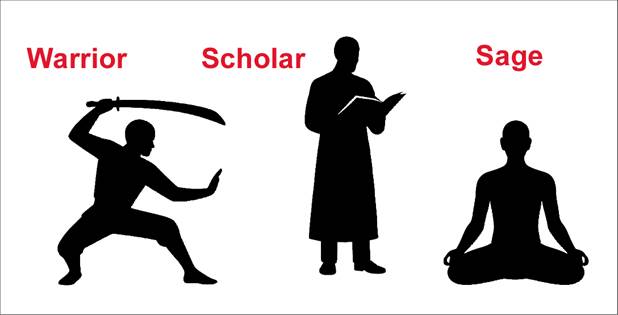
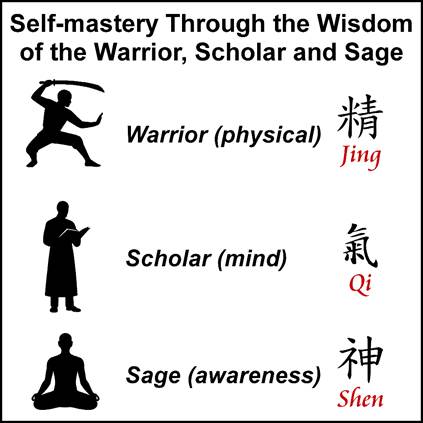
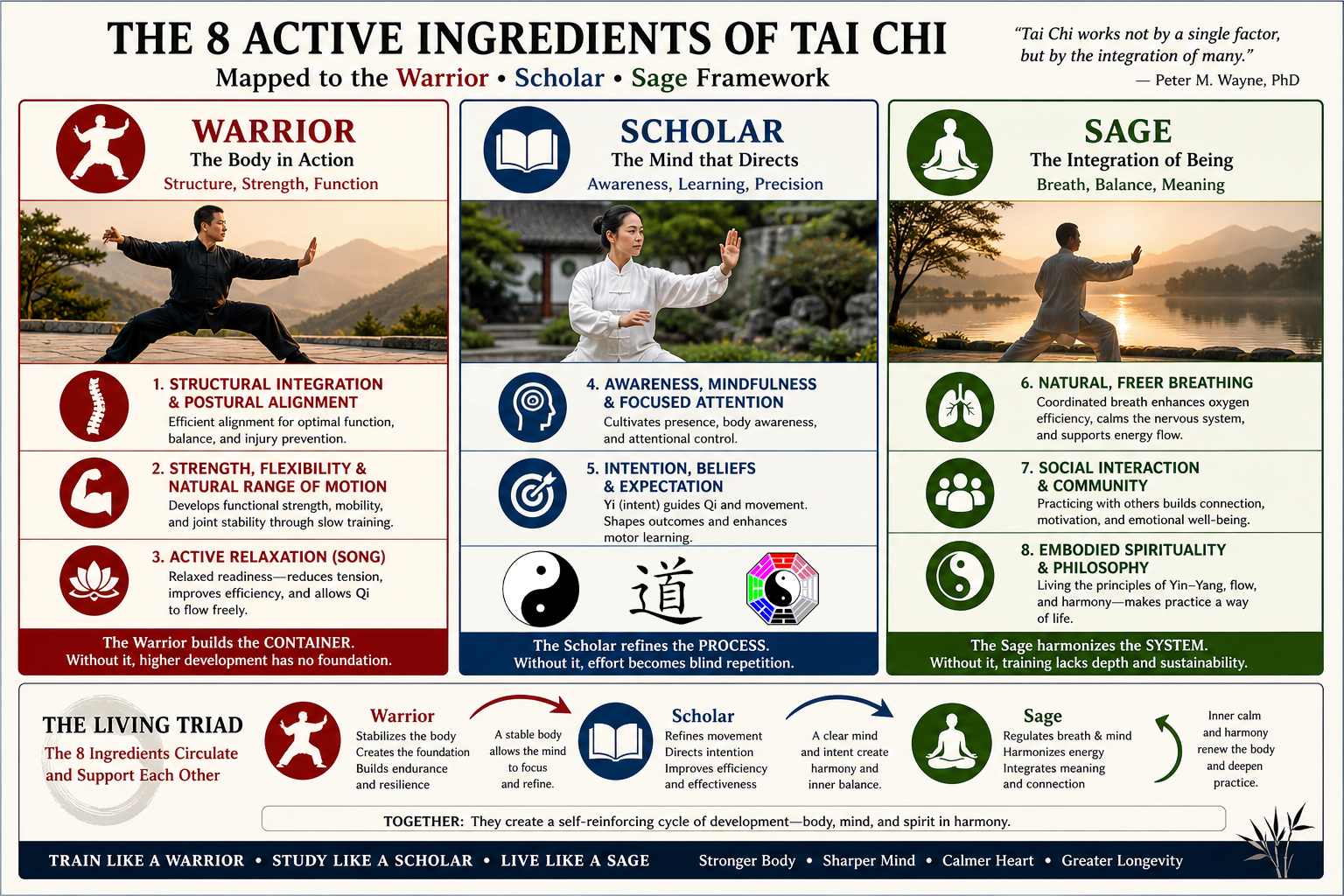
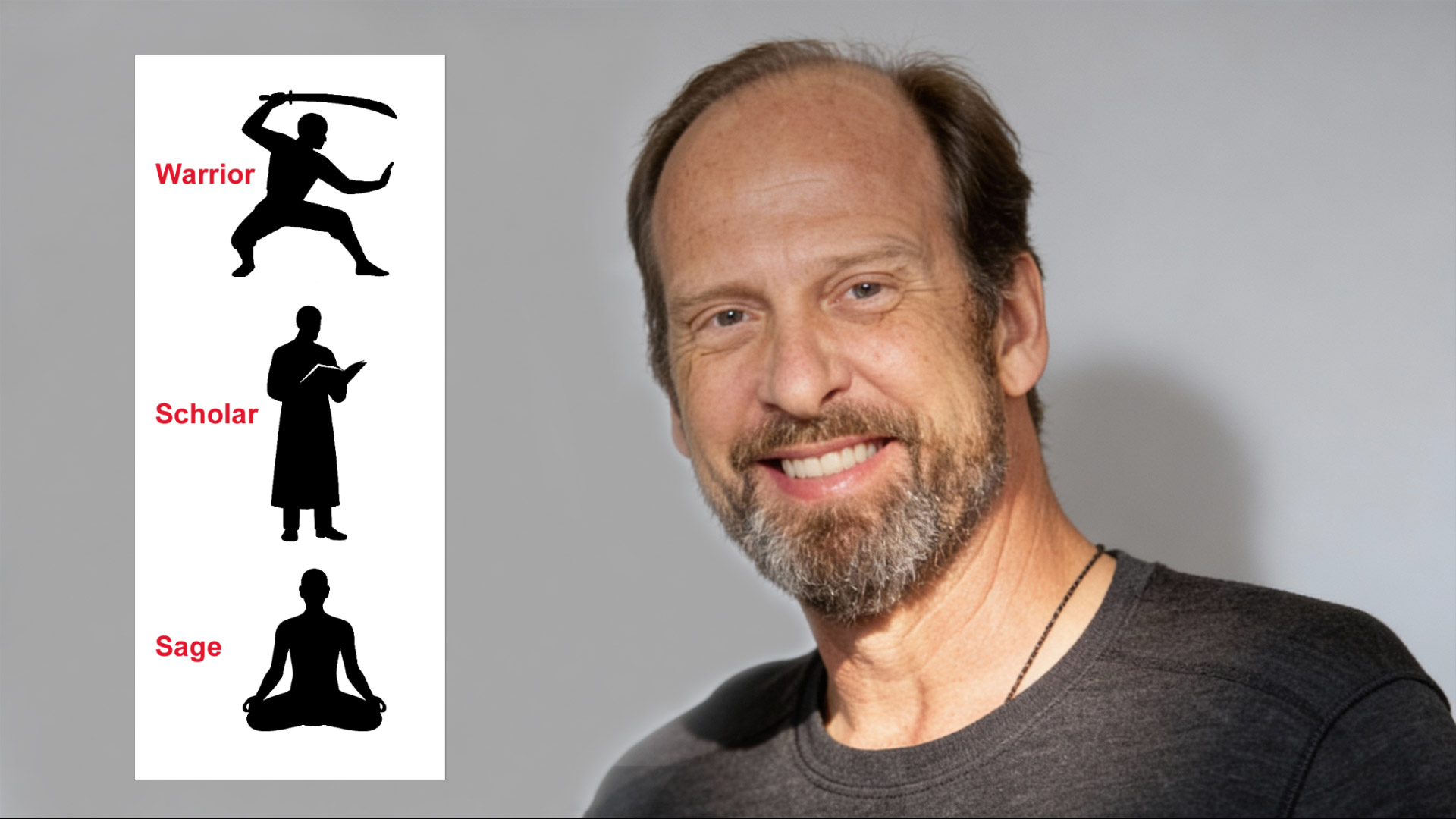
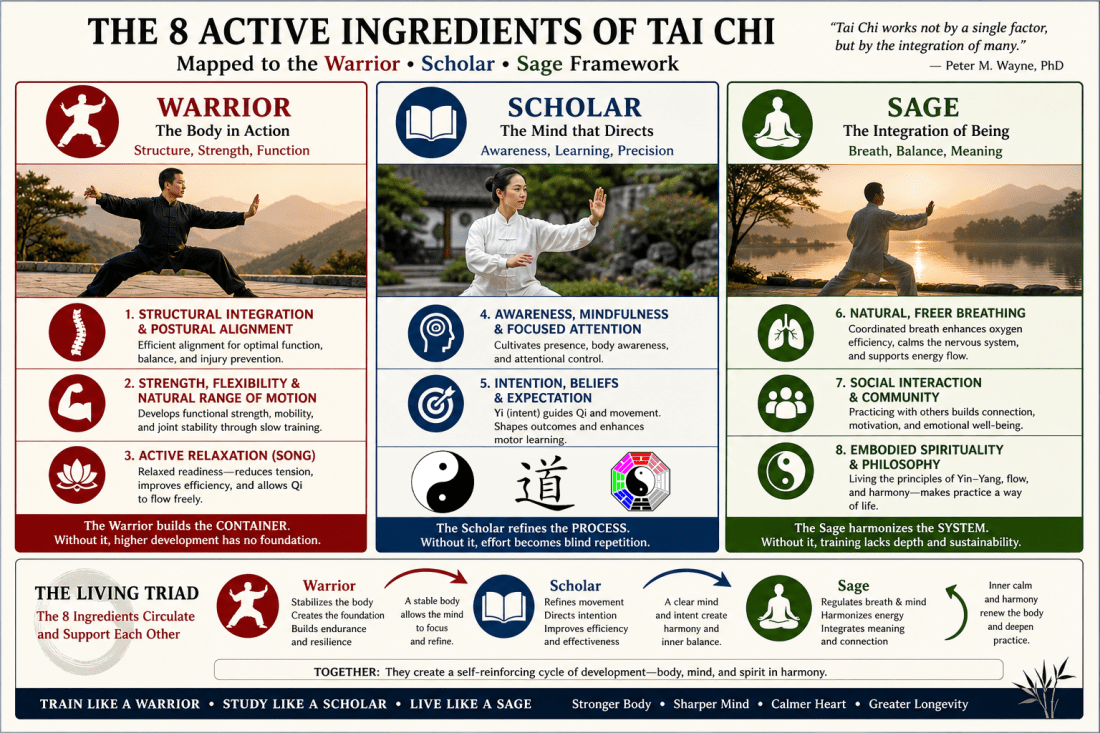
Every comprehensive system of human transformation contains a bridge, one that links the physical body to the invisible dimensions of mind and spirit. In the Eastern traditions this bridge is expressed through Jing (essence), Qi (vital energy), and Shen (consciousness). In the developmental framework I teach, it appears as the Warrior, Scholar, and Sage. In the Western esoteric lineage, the same bridge is known as Hermeticism, a philosophical and spiritual system attributed to Hermes Trismegistus, the “Thrice-Great” master of physical, intellectual, and spiritual wisdom.

These are not parallel systems by coincidence. They are structurally identical expressions of the same universal process of human refinement, or the ascent from embodiment to insight, and from insight to integrated wisdom. Across cultures and centuries, the language changes, but the architecture remains.

Hermeticism arises from Hellenistic Egypt, a fusion of Greek philosophy, Egyptian spirituality, early science, medicine, astronomy, and metaphysics (Copenhaver, 1992; Fowden, 1993). Its core message is simple but profound: reality is mental, patterned, cyclical, lawful, and capable of conscious transformation. The most famous Hermetic maxim from the Emerald Tablet expresses this truth succinctly:

This is not merely poetic symbolism. It is a functional statement of psychospiritual law: what is refined in the body shapes the mind; what is clarified in the mind refines the spirit; what is awakened in the spirit returns to illuminate the body.

The Eight Hermetic Principles and Their Living Expression

Hermetic philosophy is traditionally organized into eight fundamental principles (seven classical principles plus the unifying axiom of Integration & Moral Alignment). These principles are not abstract metaphysics; they describe how transformation actually happens in daily life.

Below is a brief, applied summary of each.

1. Mentalism – “All is Mind.”

Reality originates in consciousness.

Example:
Thought hygiene, attention control, emotional regulation, and metacognition all reflect the fact that perception shapes experience. In practice, this is where the Scholar refines Qi through disciplined awareness.

2. Correspondence – “As above, so below; as within, so without.”

Patterns repeat across all levels of existence.

Example:
Organ–emotion relationships, archetypal symbolism, and synchronicity reflect this principle. The Sage expresses it through Shen-based integration and purpose.

3. Vibration – “Nothing rests; everything moves.”

All things exist in motion and frequency.

Example:
Breath rhythm, posture, nervous system tone, and muscular tension all shape consciousness. This is the foundational work of the Warrior, refining Jing through somatic calibration.

4. Polarity – “Opposites are identical in nature, differing only in degree.”

All dualities exist on a spectrum.

Example:
Fear and courage, stress and resilience, pain and growth are not opposites but transformations of the same continuum. This principle governs emotional alchemy and shadow integration.

5. Rhythm – “Everything flows in and out.”

Nature moves in cycles.

Example:
Circadian rhythms, seasonal cycles, recovery cycles in training, and emotional tides all operate under rhythmic law. Ignoring rhythm leads to burnout; honoring it leads to longevity.

6. Cause and Effect – “Every cause has its effect.”

Nothing is random.

Example:
Consistent practice compounds. Discipline produces capacity. Neglect produces decay. This principle governs training progression, psychological habit formation, and destiny itself.

7. Gender – “Masculine and feminine principles exist in everything.”

All creation arises from active and receptive forces.

Example:
Stillness and motion, force and yielding, analysis and intuition are necessary partners. In internal alchemy this corresponds to Kan and Li, or the inner marriage of fire and water.

8. The Unifying Principle – Integration & Moral Alignment

(Implicit throughout the Hermetic texts)

This is the alchemical ascent itself:
Matter → Energy → Consciousness → Unity
Warrior → Scholar → Sage
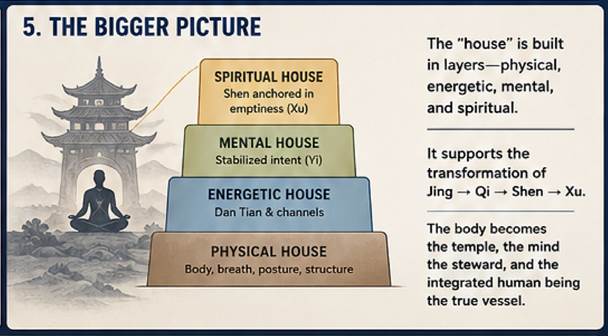
Jing → Qi → Shen

It describes the return of the fragmented human being to wholeness.

Hermeticism and Eastern Internal Alchemy: One Process, Two Languages

Western Hermeticism and Daoist Neidan (internal alchemy) describe the same three-stage refinement:

  1. Refining Jing (Warrior) – stability, grounding, structure, breath, stance
  2. Refining Qi (Scholar) – insight, emotional regulation, meaning
  3. Refining Shen (Sage) – awareness, wisdom, unity, purpose

In Hermetic terms this mirrors:

  • Earth → Air → Fire → Ether
  • Body → Mind → Spirit → Divine Mind
  • Alchemy → Knowledge → Illumination → Union

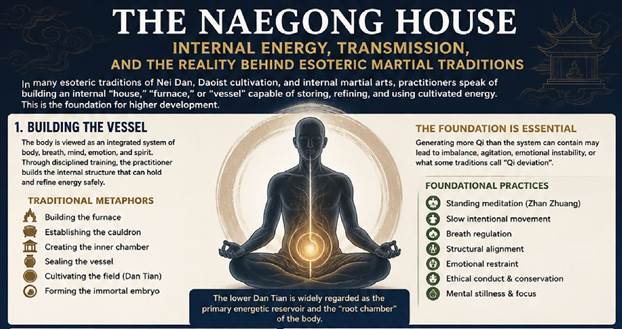
The training of the body becomes the furnace of consciousness. The mind becomes the instrument of refinement. The spirit becomes the field of meaning.

Jung and Psychology as Modern Hermetic Science

Carl Jung recognized Western and Eastern alchemy as symbolic maps of individuation, or the integration of the unconscious and conscious psyche (Jung, 1968). He interpreted alchemical stages as:

  • Shadow purification
  • Integration of opposites
  • Inner marriage (coniunctio)
  • Emergence of the unified Self

This is precisely the Warrior–Scholar–Sage progression expressed in psychological language.

Why Hermeticism Matters Now

Modern culture suffers from a dangerous fragmentation:

  • The Warrior has been reduced to stress and survival
  • The Scholar to data without wisdom
  • The Sage to abstraction without embodiment

Hermeticism restores their unity as a single ascending current of human evolution. It re-establishes the coherence between:

  • Body and breath
  • Thought and emotion
  • Discipline and compassion
  • Knowledge and service
  • Identity and purpose

This blog summary introduces the deeper work now fully developed in my newest release:

Book 38 – Hermeticism: Its Relevance to the Teachings of the Warrior, Scholar & Sage

This volume stands at the architectural center of my entire body of work. It reveals:

  • How the Warrior becomes the Scholar
  • How the Scholar becomes the Sage
  • How the Sage returns to unity
  • And how all three operate simultaneously as a single living process

It is not a theoretical book. It is a map of transformation, as it seeks to integrate Hermetic law, Eastern internal alchemy, Jungian psychology, nervous system science, breathwork, ethics, and the meaning-making process of human life.

Hermeticism is not something to believe. It is something to practice, embody, and become.

Available on Amazon at: https://a.co/d/fbD2mU0

References:

Copenhaver, B. P. (1992). Hermetica: The Greek Corpus Hermeticum and the Latin Asclepius. Cambridge University Press.

Faivre, A. (1994). Access to Western Esotericism. SUNY Press.

Fowden, G. (1993). The Egyptian Hermes: A historical approach to the late pagan mind. Princeton University Press. https://archive.org/details/egyptianhermeshi0000fowd

Jung, C. G. (1968). Alchemical studies (R. F. C. Hull, Trans.). Princeton University Press. https://www.jungiananalysts.org.uk/wp-content/uploads/2018/07/C.-G.-Jung-Collected-Works-Volume-13_-Alchemical-Studies.pdf

Mahé, J.-P. (1998). The treatise on the “Emerald Tablet.” Journal of the Warburg and Courtauld Institutes, 61, 1–20.

Principe, L. M. (2013). The Secrets of Alchemy. University of Chicago Press.