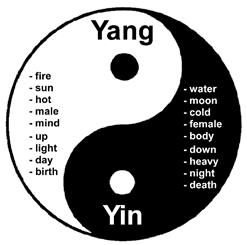
The imagery of a tree weathering storms above ground while simultaneously strengthening its roots beneath the surface provides a powerful metaphor for human resilience. Life constantly subjects individuals to adversity, uncertainty, and change. Just as trees draw stability from their roots, people must cultivate internal foundations to withstand external pressures. These dynamics reflect the yin and yang principles of Chinese philosophy, where opposite yet complementary forces that interdependently shape reality. When understood in the context of growth and adversity, yin and yang illuminate how challenges (yang) and stability (yin) work together to fortify mental, physical, and spiritual strength.
Yin and Yang as Complementary Forces
Yin and yang are not simply dualistic opposites but relational principles that continuously transform into one another (Kaptchuk, 2000). Yin is receptive, stable, and grounding; yang is active, dynamic, and externalized. Neither exists without the other, and harmony arises not from erasing difference but from balancing tension. In the metaphor of the tree, the visible branches and leaves represent yang—the active engagement with the external world, constantly subjected to storms, sunlight, and seasonal shifts. The hidden roots signify yin, where the anchoring forces of nourishment, quiet strength, and unseen support.
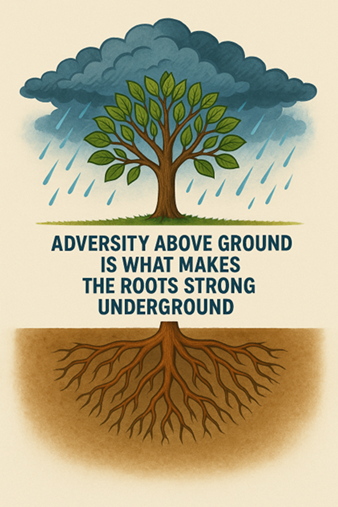
When adversity strikes in the form of wind, rain, or drought, it is yang energy acting upon the tree. The roots (yin) deepen and spread wider to stabilize the organism. Conversely, without challenges above, the roots may remain shallow, leaving the tree vulnerable. Thus, adversity is not purely destructive but also transformative; it catalyzes deeper grounding.
Adversity Above, Strength Below
The first principle drawn from this imagery is that “adversity above ground is what makes the roots strong underground.” Life’s trials in financial strain, illness, loss, or conflict, may appear threatening, yet they stimulate inner development. Just as a tree in calm, predictable weather may not develop robust roots, a life without challenge risks stagnation. From the perspective of yin and yang, adversity (yang force) presses downward, demanding a yin response: resilience, adaptability, and inward fortification (Tu, 1985).
On a mental level, difficulties sharpen focus and resourcefulness, teaching individuals to cultivate clarity of thought and emotional regulation. On a physical level, the stresses of training, work, or hardship encourage the body to adapt, build endurance, and strengthen its foundation (Richardson, 2002). Spiritually, adversity invites deeper faith, humility, and alignment with one’s values are roots that anchor the soul when outer circumstances shift unpredictably.
Roots as the Foundation for Growth
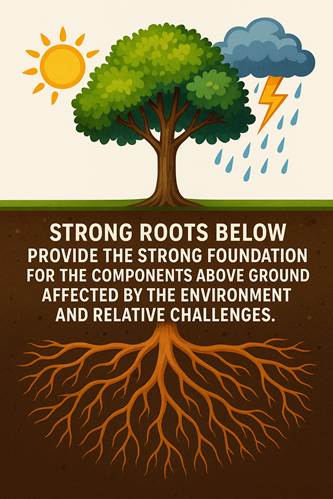
The converse principle is equally important: “strong roots below provide the foundation for the components above ground that are affected by the environment and relative challenges.” While adversity shapes the roots, it is the roots themselves that ultimately determine survival and flourishing. In human terms, a stable foundation consists of healthy habits, meaningful relationships, moral values, and spiritual grounding. These yin qualities sustain the visible expressions of life found in work, creativity, relationships, and contributions to society, all of which are yang in nature.
In the absence of deep roots, challenges above ground can overwhelm, breaking branches or toppling the tree. But when the roots are established, adversity becomes an opportunity for growth rather than destruction. Thus, yin and yang are not sequential stages but reciprocal forces: adversity deepens roots, and roots stabilize against adversity (Loy, 2010).
Integration: Navigating Life Through Yin and Yang
By embracing adversity as an inevitable part of existence, individuals learn to transform outer storms into inner strength. The yin and yang of challenge and foundation guide the development of three key dimensions of life:
- Mental strength: Cultivating resilience, self-awareness, and perspective transforms stress into wisdom. Yin provides reflective stillness, while yang provides active problem-solving.
- Physical vitality: Exercise, endurance, and even illness become forces that shape the body toward balance. Yin represents rest, restoration, and nourishment; yang represents effort, motion, and exertion.
- Spiritual grounding: Faith, values, and awareness serve as roots that hold steady during turbulent times. Yin manifests as humility, surrender, and depth; yang as expression, compassion, and service in the world.
Together, these dimensions demonstrate that adversity is not merely an obstacle but a teacher. By balancing yin’s grounding with yang’s challenges, an individual becomes whole, strong yet flexible, rooted yet reaching.
The tree’s relationship between its roots and branches embodies the yin–yang principle in natural form. Adversity above and strength below are not opposites but interdependent realities that shape resilience. Strong roots prepare the tree for storms; storms demand that roots grow deeper. Likewise, human beings thrive not by avoiding hardship but by embracing it as an opportunity to deepen foundations. Mental clarity, physical endurance, and spiritual awareness all emerge through this dynamic interplay. By recognizing adversity as yang energy that strengthens yin roots, and roots as yin energy that stabilizes yang expression, individuals can navigate life’s challenges with greater wisdom, balance, and strength.
| Aspect | Yin (Root / Foundation / Internal) | Yang (Branch / Expression / External) |
| Symbolic Representation | Deep roots beneath the surface | Branches and leaves above the ground |
| Function | Grounding, nourishing, stabilizing | Acting, expressing, adapting |
| Role in Growth | Provides foundation and strength to withstand external forces | Provides challenges and stimulation to deepen internal strength |
| Relationship | Receptive, inward, cultivating | Active, outward, dynamic |
| Metaphor in Tree Analogy | Strong roots anchor the tree | Storms, wind, sun shape the branches |
| Adversity Interaction | Responds and adapts to adversity by deepening and strengthening | Presents adversity that provokes internal adaptation |
| Mental Dimension | Reflection, contemplation, patience, emotional regulation | Problem-solving, action, cognitive engagement |
| Physical Dimension | Rest, recovery, nourishment, structure | Movement, exertion, physical challenges |
| Spiritual Dimension | Faith, values, humility, depth | Service, compassion, moral action |
| Growth Dynamics | Builds resilience and provides stability for future challenges | Stimulates adaptation and triggers growth responses |
| Balance Principle | Without roots, branches cannot survive adversity | Without storms, roots do not grow deeper |
| Nature of Change | Slow, steady, foundational | Rapid, catalytic, transformative |
| Human Expression | Enduring strength, internal resources, potential energy | External manifestation, action, kinetic energy |
| Direction of Energy | Inward (centripetal), storing and consolidating | Outward (centrifugal), expanding and projecting |
| Temporal Aspect | Long-term cultivation and endurance | Short-term action and response |
| Outcome When Balanced | Steadiness, resilience, capacity to grow | Adaptability, flexibility, ability to thrive |
References:
Kaptchuk, T. J. (2000). The Web That Has No Weaver: Understanding Chinese Medicine. Chicago Review Press.
Loy, D. R. (2010). Nonduality: A study in comparative philosophy. Humanity Books. https://archive.org/details/nondualitystudyi0000loyd
Richardson, G. E. (2002). The metatheory of resilience and resiliency. Journal of Clinical Psychology, 58(3), 307–321. https://doi.org/10.1002/jclp.10020
Tu, W. (1985). Confucian thought: Selfhood as creative transformation. State University of New York Press. https://archive.org/details/confucianthought0000tuwe