
The historical narrative of martial arts in China is deeply interwoven with spiritual cultivation, particularly through the legendary influence of Bodhidharma (Damo), the Indian monk credited with introducing Chan (Zen) Buddhism to the Shaolin Temple. His teachings are widely regarded as the seed of Shaolin martial arts, combining meditative discipline with physical conditioning through systems such as the YiJin Jing (Muscle-Tendon Changing Classic) and the 18 Luohan Hands. These practices, over centuries, evolved into the sophisticated combat and wellness system now known as Shaolin Kung Fu.
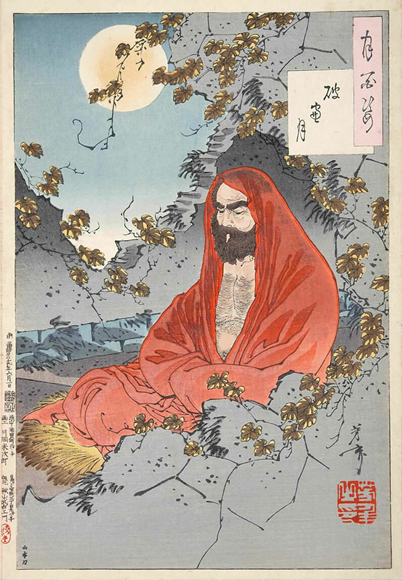
Bodhidharma’s Contributions
Bodhidharma’s arrival at the Shaolin Monastery in roughly the 5th or 6th century CE introduced transformative practices focused on both internal and external cultivation. He is traditionally credited with teaching three major systems:
Chan meditation – promoted inner stillness and enlightenment through direct experience and introspection (Red Pine, 1987)
YiJin Jing (Muscle and Tendon Changing) and Xisui Jing (Marrow Cleansing Classic). Which the two were physical regimens aimed at strengthening the body, improving Qi circulation, and preparing monks for long periods of seated meditation (Shahar, 2008).
YiJin Jing: Conditioning the Body for Higher Purpose
The YiJin Jing consists of dynamic tension exercises that train the musculature, tendons, and fascia, preparing the body not only for martial use but also for maintaining vitality and structural integrity. These exercises, according to tradition, were prescribed by Bodhidharma to enhance the monks’ endurance and resistance to fatigue and essential for rigorous spiritual practices (Henning, 1999). Movements from YiJin Jing later evolved into practical combat sequences, emphasizing controlled breathing, rooted stances, and explosive force, characteristics now central to Shaolin martial arts.
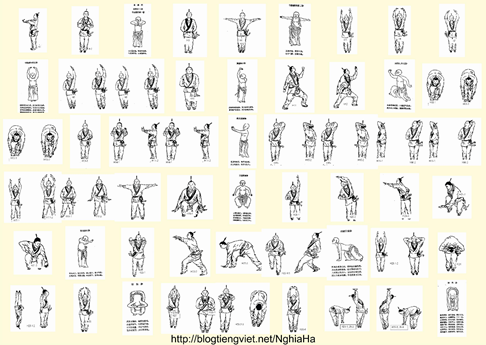
18 Luohan Hands: The Proto-Forms of Shaolin Kung Fu
The 18 Luohan Hands are a set of Qigong-like movements, traditionally considered the earliest structured exercises linking health cultivation and martial efficacy. These forms included basic palm strikes, circular motions, and integrated breath control. These elements would later become foundational for Shaolin fighting systems. Over time, they were elaborated into more complex forms such as Luohanquan (Arhat Fist), a style known for its precise, direct strikes and meditative underpinnings (Shahar, 2008).

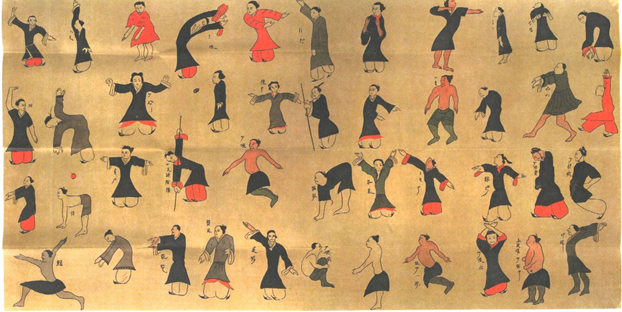
13 Luohan Qigong: Bridging Internal and External
A related tradition, 13 Luohan Qigong, comprises a sequence of exercises that further integrates internal energy development with martial readiness. Each of the 13 movements targets specific energetic pathways and anatomical functions. For instance, “Luohan Draws the Bow” emphasizes lung expansion and Qi projection, while “Luohan Stands on One Leg” cultivates balance and stability. These movements not only reinforce martial mechanics but also nurture internal harmony, resonating with Taoist and Buddhist philosophies on health and enlightenment (Yang, 2010).
The Synthesis into Shaolin Martial Arts
The transition from static Qigong forms to combative martial art forms at Shaolin was catalyzed by the necessity of self-defense and discipline. The YiJin Jing provided the physiological robustness and tendon strength required for explosive movement, while the 18 Luohan Hands offered the basic motor patterns and coordination that could be adapted into fighting techniques. By combining these with Chan Buddhist principles and eventually incorporating external influences such as Chinese military tactics and folk styles, Shaolin monks developed a comprehensive martial system.
This system expanded into various forms and weapons styles, each integrating internal power (Nei Dan), structural integrity, and mental discipline. Notably, Luohanquan emerged as a canonical representation of these origins, continuing the legacy of the original Luohan exercises through its focus on both spirit and technique (Wong, 1996).
Conclusion
The legacy of Bodhidharma at Shaolin Temple is not only spiritual but deeply physical. Through systems such as YiJin Jing, 18 Luohan Hands, and 13 Luohan Qigong, he set in motion a lineage that would unite body, mind, and spirit into one of the world’s most enduring martial traditions. Today, practitioners of Shaolin arts continue to embody these principles, integrating ancient wisdom with modern discipline in the pursuit of balance, strength, and self-realization.
References:
Henning, S. E. (1999). Academia encounters the Chinese martial arts. China Review International, 6(2), 319–332. https://www.jstor.org/stable/23732172
Pine, R. (1987). THE ZEN TEACHING of Bodhidharma. In North Point Press (First). North Point Press. https://selfdefinition.org/zen/Zen-Teaching-of-Bodhidharma-trans-Red-Pine-clearscan.pdf
Shahar, M. (2008). The Shaolin Monastery: History, Religion, and the Chinese Martial Arts. University of Hawai‘i Press. http://www.jstor.org. https://www.jstor.org/stable/j.ctvvmxs5
Wong, Kiew Kit. (1996). The Art of Shaolin Kung Fu: The Secrets of Kung Fu for Self-Defense, Health, and Enlightenment. Tuttle Publishing.
Yang, Jwing-Ming. (2010). Qigong Meditation: Embryonic Breathing. YMAA Publication Center. https://ymaa.com/articles/qigong-meditation/embryonic-breathing


 United Martial Arts Association