The Grace of Endings

A Reflection on Relationships, Impermanence, and the Wisdom of Final Chapters

I have lived long enough, to see many of my personal relationships come to an end. Relationships with family, friends and neighbors. Also, in the workplace, or with casual acquaintances and even with most beloved pets. There is no way to escape the fact that all of our relationships,… good, bad or otherwise… will eventually wind down and consequently, … cease to exist.
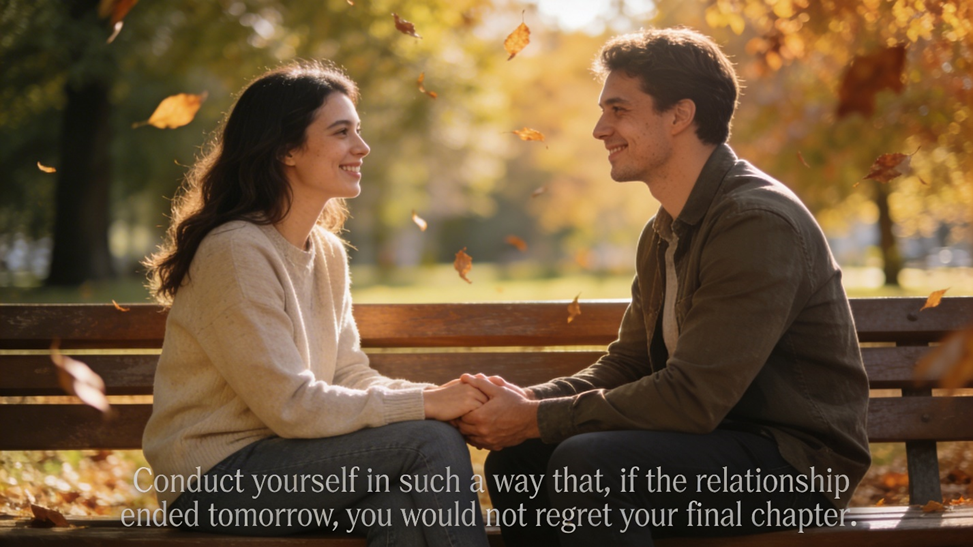
Some relationships ended gently, like the fading of a season. Some ended abruptly, with sharp edges and unfinished words. Others dissolved so slowly that I did not recognize their ending until much later. Some lasted for only seconds as meaningful encounters, while others have lasted for decades, ranging from superficial to those with much depth and connection.

A few were taken from me through death, reminding me that time is not something we negotiate.

If there is one truth I now accept without resistance, it is this: every relationship ends. The only uncertainty is how.

All Relationships End — But Not All Endings Are Equal

A relationship can end in many ways:

  • Physical separation
  • Emotional drifting
  • Conflict or betrayal
  • Mutual completion
  • Growth in different directions
  • Death

The ending is inevitable. The quality of the ending, however, is not. Two relationships can last the same number of years. One ends with resentment, bitterness, and silence. The other ends in gratitude, dignity, and respect. Same duration, but very different legacies. And legacy is what remains when presence is gone.

When I was younger, I assumed continuity. Friendships felt permanent. Partnerships felt anchored. Mentorships felt enduring. Even conflict seemed temporary. I moved through life with the quiet belief that what was present would remain.

Age has corrected that assumption.

In both Buddhism and Taoism, impermanence is not considered tragic; it is considered structural. Everything that arises eventually passes. Seasons change. Roles evolve. Bodies age. The river moves forward regardless of how tightly we grip the bank.

Relationships are no exception. This realization is not cynical. However, it is clarifying.
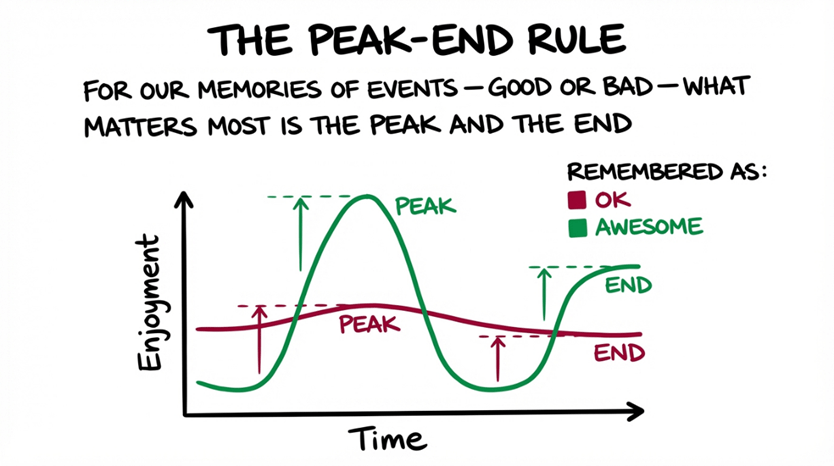
What I have come to understand is that while every relationship will end, not every ending carries the same weight. The way something concludes often determines how it is remembered. Behavioral science supports this idea through what is known as the peak–end rule, a concept associated with Daniel Kahneman. Human beings tend to remember experiences not by averaging every moment, but by recalling emotional peaks and how the experience ended.

In my own life, I have seen this play out repeatedly. Some relationships ended in mutual respect. Those I remember with gratitude, even if sadness accompanied the goodbye. Other endings were strained or unresolved. In those cases, the final chapter colored the memory of the entire story. Not because the good years disappeared, but because the emotional signature shifted.

The ending becomes a lens. Over time, I stopped asking whether a relationship lasted “long enough.” Instead, I began asking whether I conducted myself well when it mattered most. Did I speak truthfully but without cruelty? Did I take responsibility for my part? Did I protect confidence even when I was hurt? Did I leave with dignity?

Ending well does not mean avoiding hard conversations. It does not mean suppressing disappointment or pretending harm did not occur. It means refusing to allow bitterness to become part of one’s identity. It means honoring what was real, even if it cannot continue.

Not All Endings Are Mutual

Here is where the idea becomes more nuanced.

Sometimes:

  • One person wants to leave.
  • One person is hurt.
  • One person feels betrayed.

The closing of a relationship is not always evenly distributed. One may feel relief while the other feels loss. One may feel clarity while the other feels confusion.

We cannot control how another person chooses to exit. But we can control whether we exit with integrity.

Not all of my endings were graceful. I have spoken too quickly at times. I have clung when I should have released. I have walked away when I should have stayed. But even the painful endings became teachers. Each one revealed something about attachment, ego, expectation, and fear.
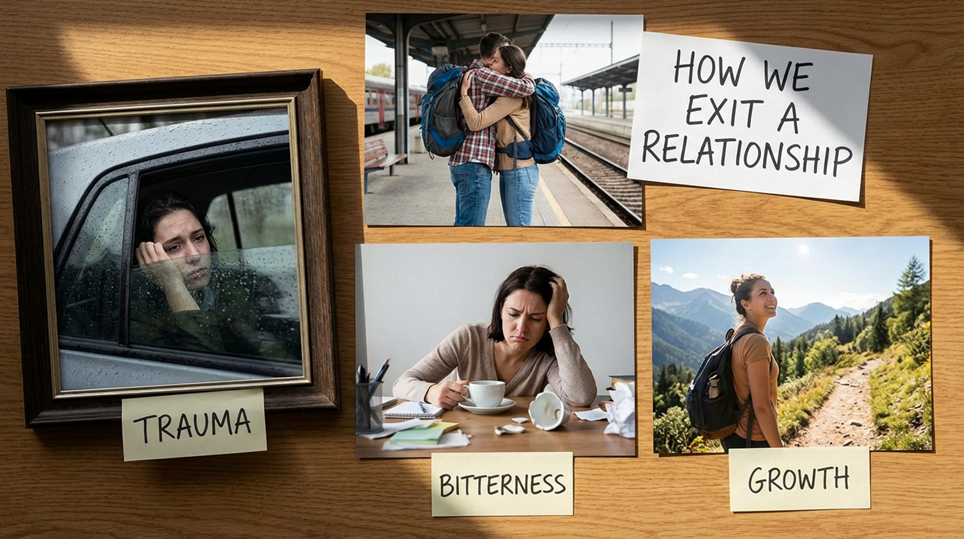
Not all relationships are meant to last.

Some are teachers.
Some are mirrors.
Some are initiations.
Some are seasonal.

But how we exit determines whether the experience becomes:

  • Trauma
  • Bitterness
  • Or growth

Each one forced me to refine who I was.

If I have gained anything from the relationships that have ended — well or poorly — it is perspective.

Now, as I enter what many call the golden years of life, I do not assume longevity in any relationship. I try to be present. I strive to be responsible. I presume that any conversation could be the last meaningful exchange. That awareness changes how I speak. It softens unnecessary conflict and reduces trivial ego battles. It encourages gratitude.

It also deepens intentionality.

When we recognize that every relationship has a final chapter, we begin to live differently in the earlier ones. We may express appreciation more freely. We may forgive more quickly. We can choose our words more carefully. We can protect what matters and release what does not.

Relationships do not truly end when contact stops. They continue within us. They shape habits, perspectives, and character. Some leave behind wisdom. Some leave behind warnings. Some leave behind quiet gratitude. All leave impressions.

The quality of the ending influences the emotional afterlife of the relationship.

If I could offer anything to those who are younger, it would not be advice on how to make every relationship last forever. That is not within our control. Instead, I would suggest this:

Conduct yourself in such a way that, if the relationship ended tomorrow, you would not regret your final chapter.

Try not to weaponize vulnerability. Try not to humiliate in anger. Do not rewrite history to protect pride. Do not allow ego to eclipse shared humanity.

You cannot control how others leave. But you can control how you do.

In the end, our legacy is not built upon how long relationships lasted, but upon how we treated others within them. Especially when they were ending. Dignity under pressure is remembered. Respect in conflict is remembered. Gratitude in goodbye is remembered.

Every relationship will one day close. That is not a morbid thought, but rather a refining one.

Knowing this has not made me withdraw. It has made me more attentive, careful. and grateful. More willing to release without resentment.

The final chapter will come for every connection I still hold. When it does, I hope the memory left behind is steady, respectful, and honest. Not perfect, but principled.

If endings are inevitable, then grace becomes essential. And perhaps that is one of the quiet purposes of aging: to understand that relationships are not possessions to secure, but gifts to steward right up until their final page.
One Truth, Many Experiences — And the Need for Discernment

There can only be one truth about a particular thing. A tree is a tree. It does not become something else because someone prefers it to be different. It has roots, a trunk, branches, and leaves. It grows according to its nature.

Truth, in that sense, is singular.

Yet there are countless ways to experience that truth. One person sees shade. Another sees lumber. A child sees a playground. A farmer sees fruit. A bird sees shelter. An artist sees beauty. The tree remains what it is, but its meaning expands through relationship.

However, there is another layer we must not ignore.

Not all trees are healthy.

From a distance, a tree may appear strong with an upright trunk, full canopy, green leaves. Yet beneath the surface, its roots may be rotting. Insects may be boring into its core. Disease may be spreading through its vascular system. It may produce some healthy fruit and some spoiled fruit at the same time.

What appears stable may, in fact, be compromised. This complicates the simplicity at seeking truth, but only at face value.

The truth of the tree includes both its visible form and its hidden condition. Its outward strength does not automatically equal inward integrity. The shade it provides may still be real. The fruit it produces may still nourish. But the structural truth of the tree might be deteriorating. And if the roots are compromised long enough, collapse becomes inevitable.

This is where discernment enters the conversation.

Experience alone is not enough.
Observation alone is not enough.
Surface-level impressions are not enough.

We must look deeper. A person may experience comfort beneath a tree that is slowly dying. That comfort is real, but temporary. Someone may harvest fruit without realizing that decay has already begun in the roots. Another may lean against the trunk, unaware that termites are hollowing it from within.

The tree remains a tree. But the condition of the tree matters. This is true of ideas. It is true of institutions, leaders, relationships, and it is true of ourselves.

Something may look strong on the outside while its foundation is unstable. This thing may produce good results occasionally while carrying hidden corruption. This entity may offer shade while preparing to fall.

Truth is singular; however, truth is also layered. There is the truth of identity — what a particular thing is. And there is the truth of condition — how healthy or diseased it is. Wisdom requires that we examine both.

In human life, this means we must not confuse appearance with integrity. A smiling face does not guarantee emotional health. A successful career does not guarantee moral grounding. A large organization does not guarantee structural soundness. A belief system that produces some good fruit may still carry internal rot.

Discernment asks:
What do the roots look like?
What nourishes this system?
Is the fruit consistently healthy, or only occasionally?
Is there hidden decay beneath visible strength?

The tree teaches us again. We may approach it for shade, for fruit, for beauty, and those experiences are valid. But maturity asks us to step back and assess the whole. To look beneath the bark. To examine the roots. To recognize that outward form and inward health are not always identical.

Reality does not change because we ignore decay. Collapse does not wait for consensus. And yet, even here, the metaphor holds hope.

A diseased tree can sometimes be pruned. Infestation can sometimes be treated.
Roots can sometimes be strengthened. But only if the condition is acknowledged.

One truth. Many experiences. And beneath them all, is the responsibility to look deeper.

The tree is what it is…. But not all as it may seem, … at first glance. To find truth, we might need to look at many perspectives.

Bounded Choice Through the Lens of the Warrior–Scholar–Sage

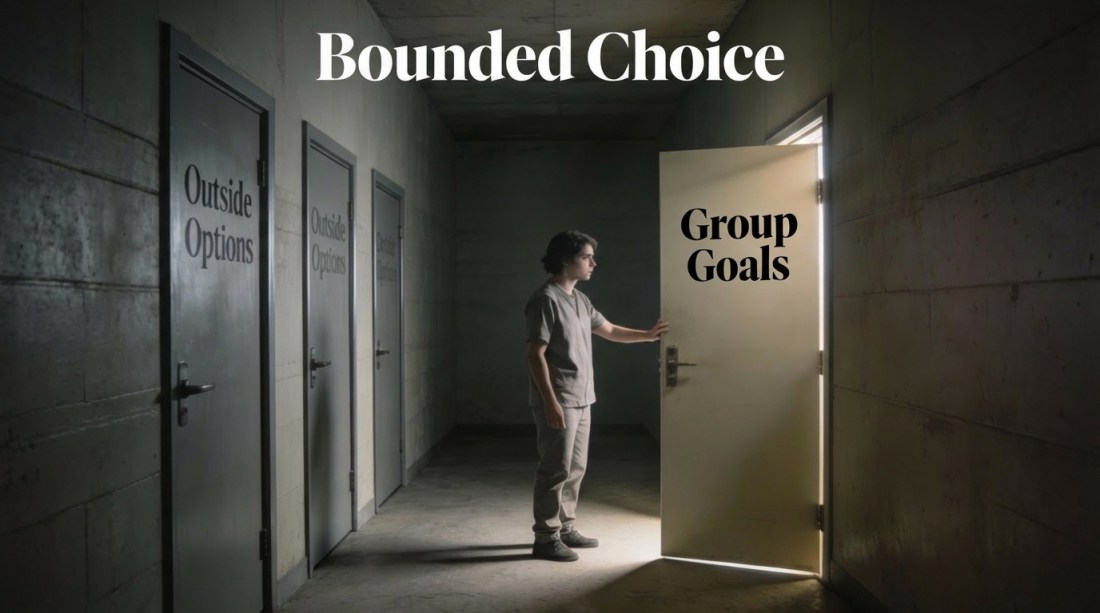
Human freedom is not merely the ability to select between options. True freedom depends upon whether those options are real, informed, and unconstrained by coercion. A person may appear to be choosing voluntarily while operating inside a closed psychological system that has already defined what is acceptable, moral, and permissible. This phenomenon is known as bounded choice, a condition in which individuals experience subjective freedom within an objectively restricted framework (Lalich, 2004).

In high-control groups, authoritarian systems, abusive relationships, ideological movements, and coercive institutions, bounded choice becomes the invisible architecture of compliance. Individuals come to believe they are freely choosing loyalty, sacrifice, obedience, and submission, while the system quietly eliminates all meaningful alternatives.

The Warrior: Defender of Autonomy

The Warrior represents sovereignty, courage, and the capacity to protect one’s psychological and moral boundaries.

In bounded choice systems, the Warrior is systematically dismantled. Authority is reframed as virtue. Obedience is reframed as strength. Submission is reframed as discipline. The individual is taught that questioning leadership is weakness, and independence is ego.

Lalich (2004) describes how charismatic, high-demand groups construct a totalistic moral universe in which only one path is considered righteous. Members are told they are choosing their own devotion, but the cost of choosing otherwise is framed as spiritual failure, betrayal, or existential collapse.

Zimbardo (2007) demonstrates how situational power and systemic authority can override personal conscience, causing individuals to surrender moral agency in favor of role-based obedience. In such environments, compliance is not demanded, it is normalized.

The Warrior awakens when a person realizes:

The Scholar: Seeker of Truth

The Scholar represents inquiry, critical thinking, historical awareness, and intellectual independence. Bounded choice systems operate by controlling information. They:

  • Restrict outside sources
  • Rewrite history
  • Redefine language
  • Frame dissent as ignorance
  • Portray outsiders as corrupt or dangerous

This creates what Lifton (1961) termed a closed belief system, in which ideology replaces objective reality and critical thought is reframed as disloyalty.

Hassan (2015) explains that coercive influence systems depend upon behavioral, informational, thought, and emotional control (the BITE model). By shaping perception and emotional responses, the system creates the illusion of voluntary participation while quietly eliminating informed consent.

The Scholar recognizes that freedom requires:

  • Access to multiple perspectives
  • The ability to compare narratives
  • The right to question doctrine
  • The freedom to revise beliefs

Truth does not fear scrutiny. Only control does.

The Sage: Guardian of Wisdom

The Sage represents integration, ethical clarity, and long-range vision. Bounded choice systems collapse complexity into absolutism. They offer:

  • Simple answers to complex problems
  • Moral superiority over outsiders
  • A grand mission narrative
  • A sense of chosen identity

This creates what Lalich (2004) identifies as identity fusion, where the individual’s self-concept becomes inseparable from the group. Leaving the group is experienced not merely as separation, but as existential annihilation.

Zimbardo (2007) further explains that prolonged immersion in authoritarian systems reshapes moral perception, producing what he terms the “banality of wrongdoing,” where harmful actions become psychologically normalized.

The Sage recognizes that wisdom requires:

  • Moral nuance
  • Emotional maturity
  • Tolerance for ambiguity
  • Personal conscience

No institution, ideology, or leader owns truth.

The Architecture of Bounded Choice

Bounded choice is sustained through five interlocking mechanisms:

  1. Moral Absolutism – One worldview is declared universally correct (Lifton, 1961)
  2. Fear Conditioning – Leaving is framed as catastrophic (Lalich, 2004)
  3. Identity Fusion – Selfhood becomes dependent on group membership (Lalich, 2004)
  4. Information Control – External perspectives are discredited (Hassan, 2015)
  5. Redefinition of Freedom – Obedience becomes virtue (Zimbardo, 2007)

Over time, members no longer perceive alternatives as real options. They believe they are choosing freely, while their psychological perimeter has already been engineered.

As Lalich (2004) explains, bounded choice is not passive victimhood. It is coerced agency, a system that exploits the human need for meaning, belonging, and certainty.

Open Choice: The Landscape of Authentic Freedom

Open choice systems cultivate:

  • Informed consent
  • Psychological safety
  • Moral autonomy
  • Freedom of exit
  • Freedom of inquiry
  • Respect for dissent
  • Multiplicity of perspectives

They strengthen rather than replace the individual’s conscience (Hassan, 2015; Lifton, 1961).

Where bounded choice collapses the self into the system, open choice strengthens the self within society.

Bounded choice is one of the most sophisticated mechanisms of human control ever developed. It does not remove choice, it weaponizes it. It converts obedience into virtue, submission into identity, and captivity into meaning (Lalich, 2004; Zimbardo, 2007).

The Warrior–Scholar–Sage stands as a timeless archetype of liberation: strong enough to resist coercion, wise enough to discern truth, and grounded enough to live by conscience rather than command.

Freedom is not given by institutions, but rather it is cultivated by individuals.

When you write your autobiography someday, will you be the lead character, a supporting actor, or merely an extra in someone else’s story? Will your life reflect the building of your own legacy, or the quiet reinforcement of someone else’s shadow?

The Warrior defends autonomy, the Scholar seeks truth, and the Sage lives by conscience. To live freely is not simply to choose, but to choose consciously to ensure that the life being lived is truly one’s own.

References

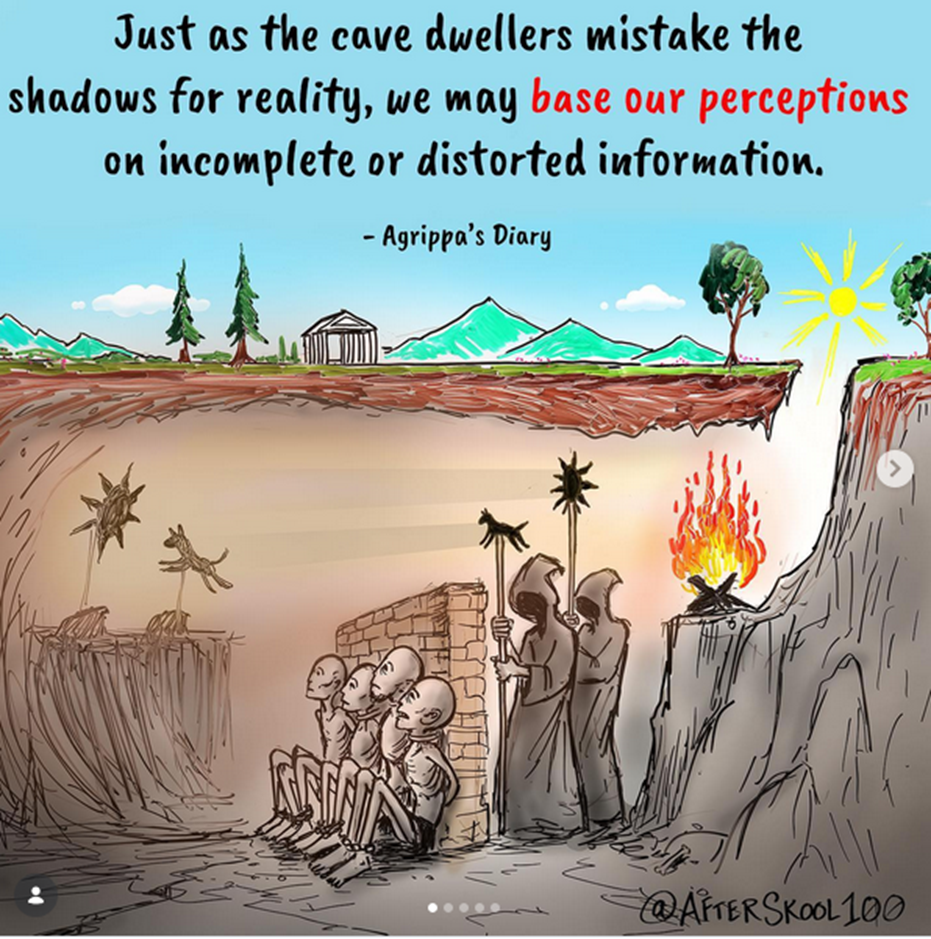
After Skool. (2023, September 19). The profound meaning of Plato’s allegory of the cave [Video]. YouTube. https://www.youtube.com/watch?v=4nHj3gL_JN0

Hassan, S. (2015). Combating cult mind control (Updated ed.). Freedom of Mind Press.

Lalich, J. (2004). Bounded ChoiceTrue believers and charismatic cults. https://doi.org/10.1525/california/9780520231948.001.0001

Lifton, R. J. (1961). Thought reform and the psychology of totalism: A study of “brainwashing” in China. W. W. Norton & Company.

Zimbardo, P. G. (2007). The Lucifer effect: Understanding how good people turn evil. Random House. https://psycnet.apa.org/record/2007-04177-000

The Progressive Layers of Tai Chi Practice

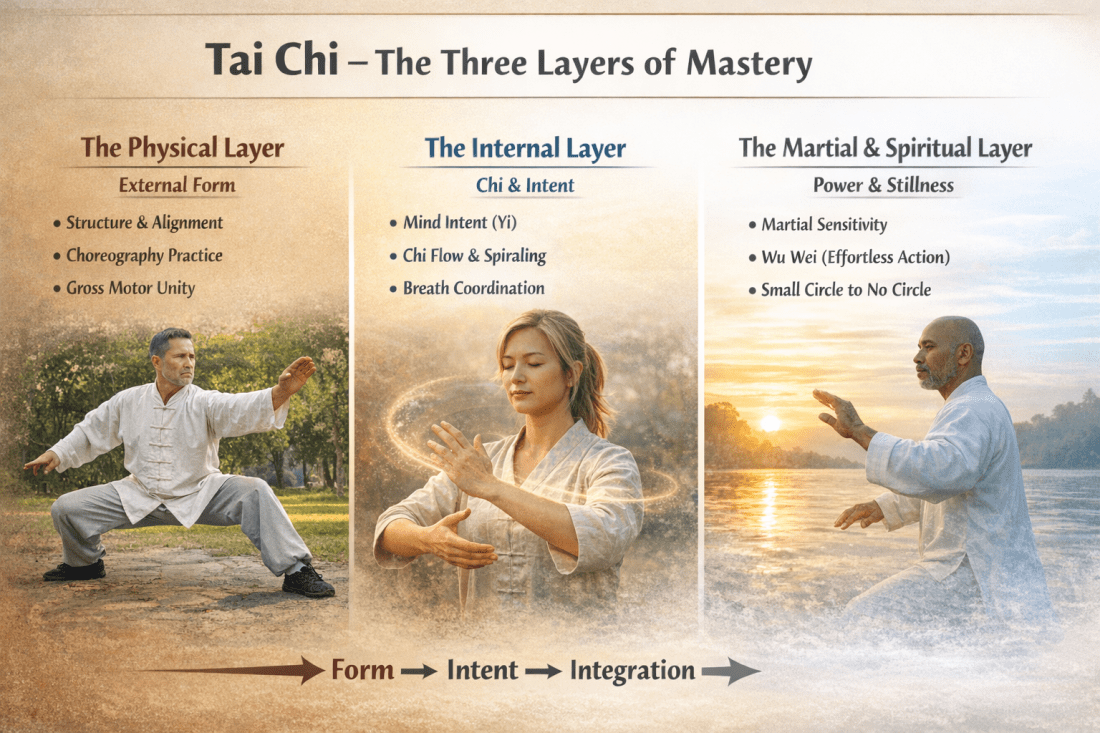
In Tai Chi, the idea of “layers” refers to progressive stages of mastery that move from external physical form to refined internal and spiritual development. Although different schools such as Chen and Yang may use varying terminology, the underlying progression remains consistent: one begins with structure, refines internal mechanics, and ultimately reaches effortless integration of body, mind, and spirit.

This development can be understood through three primary layers, expanded technically into five levels of refinement, and supported practically through four pillars of training.


I. The Three Progressive Layers

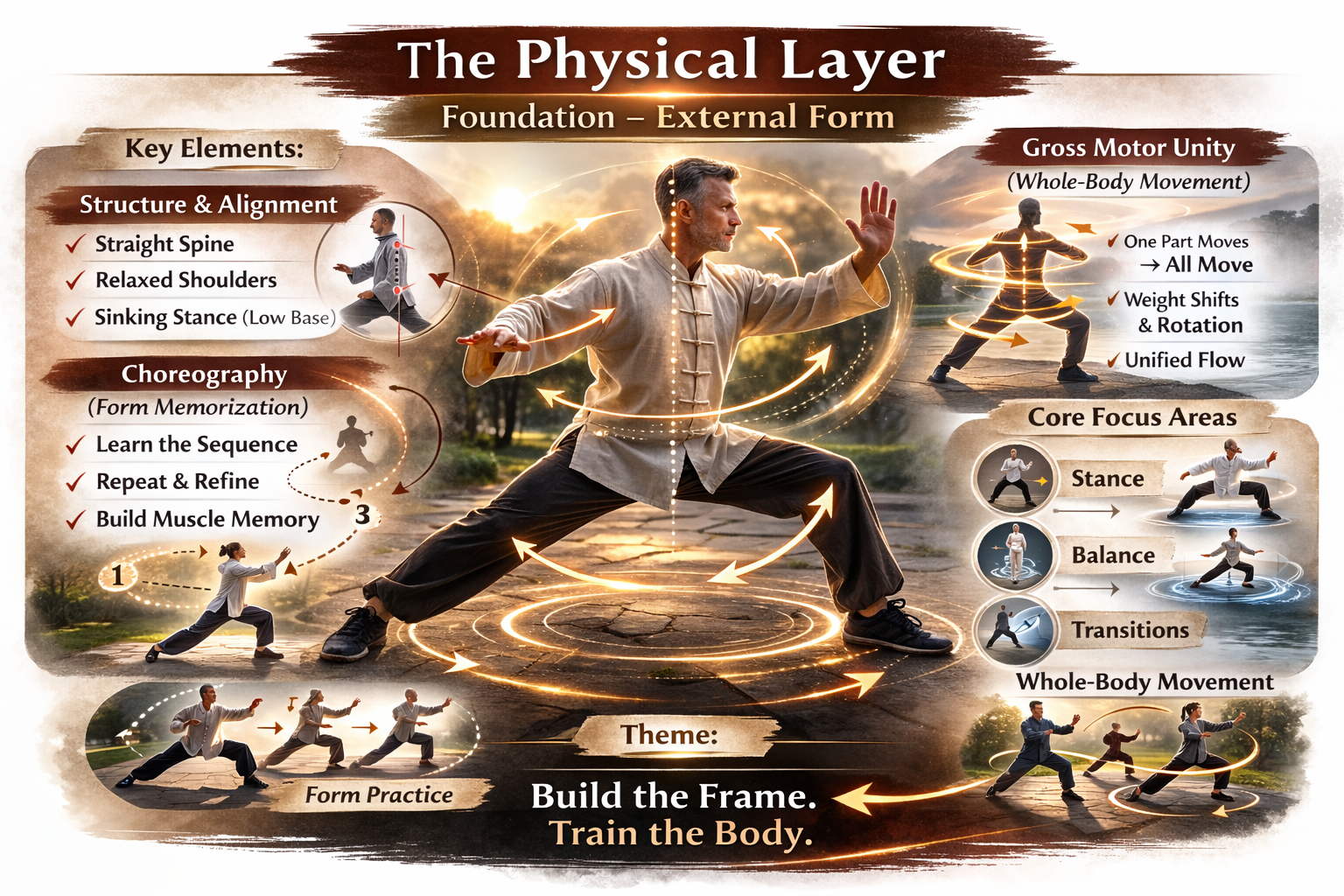
1. The Physical Layer – Foundation of External Form

Tai Chi begins with the body.

At this foundational stage, practice focuses on learning the “shape” of Tai Chi:

  • Structure and Alignment: Correct stance work, upright spine, relaxed shoulders and elbows, proper weight distribution, and rooted balance.
  • Choreography: Memorizing the form sequence until movements become smooth and consistent.
  • Gross Motor Unity: Training the body to move as a coordinated whole—when one part moves, the entire body moves.

At this level, movements may appear mechanical or segmented. However, the goal is not aesthetic perfection but structural integrity. Without a stable physical frame, higher refinement is impossible.


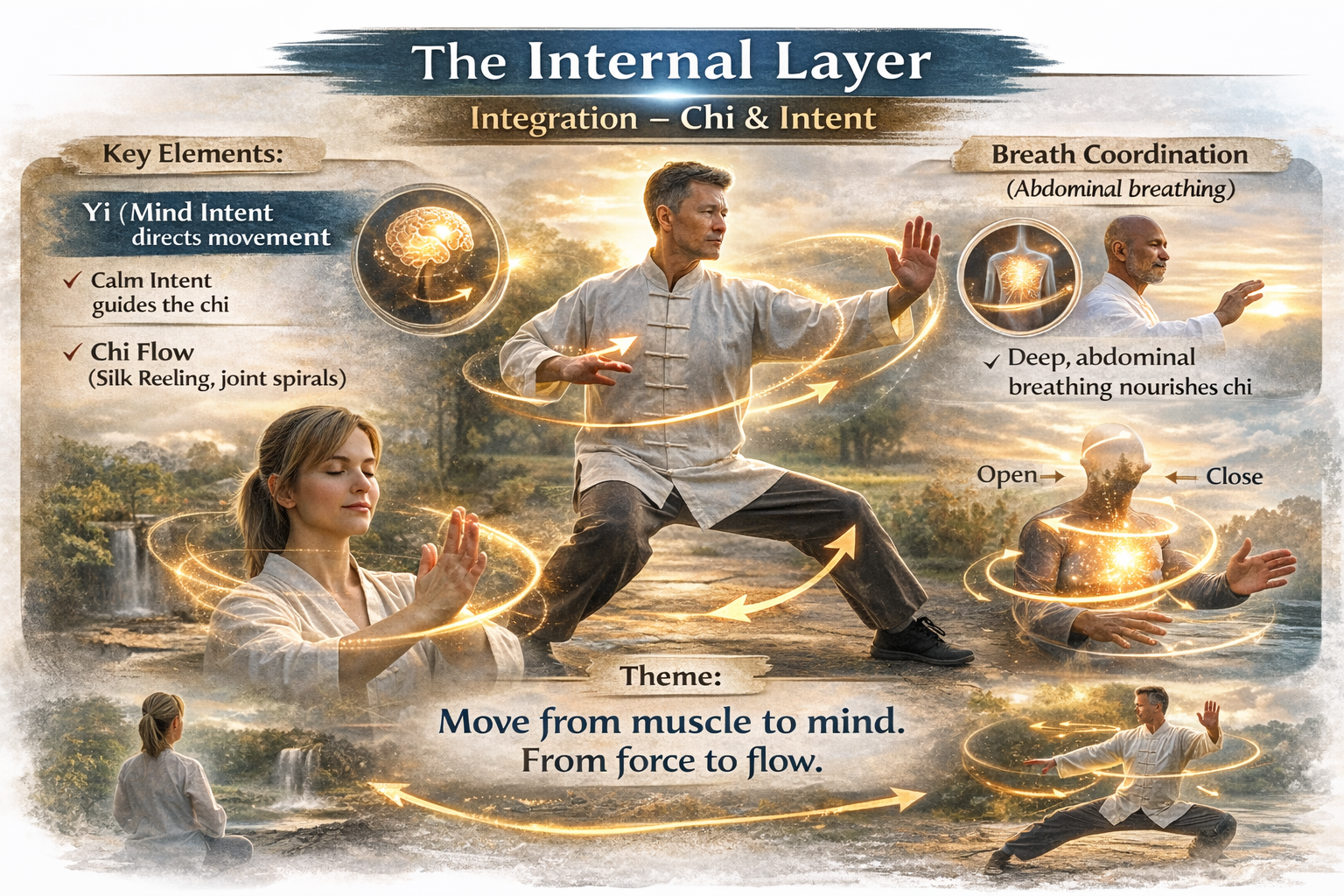
2. The Internal Layer – Integration of Mind and Energy

Once the external form becomes stable, attention shifts inward.

This stage emphasizes internal mechanics and the coordination of mind, breath, and movement:

  • Mind Intent (Yi): Movement is directed by calm awareness rather than muscular force. The mind leads.
  • Energy Flow (Chi): The practitioner begins to experience connectedness through the joints, often trained through spiraling or “silk-reeling” exercises.
  • Breath Coordination: Deep abdominal breathing synchronizes with the opening and closing of postures, nourishing the body and calming the nervous system.

Here, fluidity replaces stiffness. Internal and external begin harmonizing. Softness starts overcoming force—not as theory, but as embodied understanding.


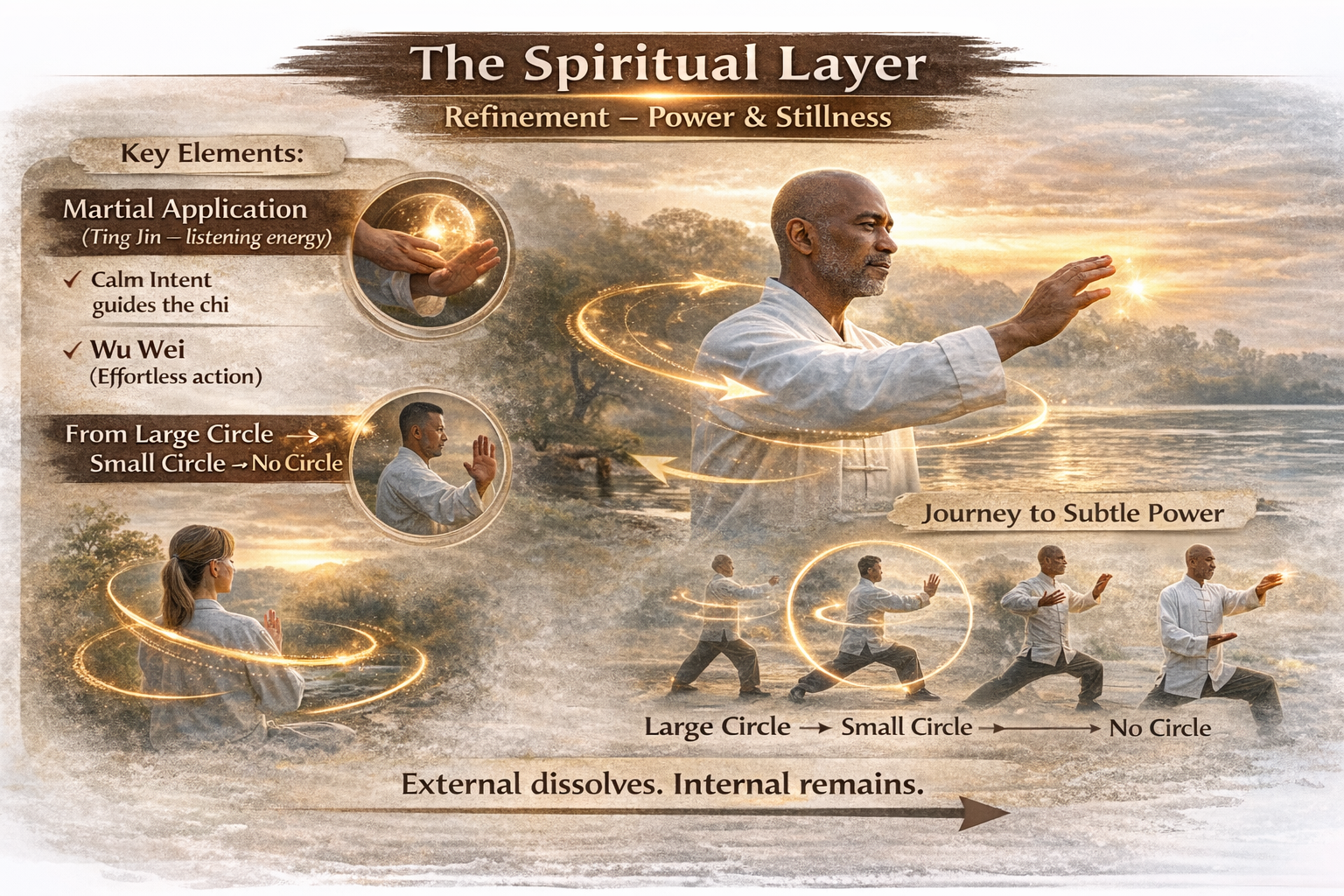
3. The Martial and Spiritual Layer – Refinement and Effortless Action

At advanced stages, physical skill merges with mental stillness.

  • Martial Application: Understanding the hidden purpose behind each posture—deflection, redirection, neutralization, and issuing force. Sensitivity skills such as Ting Jin (“listening energy”) develop.
  • Meditation in Motion: Movement becomes natural and unforced. The practitioner experiences Wu Wei—effortless action.
  • Refinement of Circles: External movements progress from large circles to smaller and subtler expressions. Eventually, power becomes nearly invisible.

At this level, form dissolves into function. Internal changes are subtle yet profound. Yin and Yang are balanced not as philosophy, but as lived embodiment.


II. The Five Levels of Technical Development

Within this broader three-layer progression, many Chen lineage teachings describe a more detailed five-level refinement:

  1. Form and Posture – Learning external alignment. Movements may feel angular or disconnected.
  2. Chi Flow – Greater smoothness and continuity. Internal and external coordination begins.
  3. Refining the Circle – Transition from large to medium circles. Yi clearly leads Chi.
  4. Advanced Application – Small circles. Intrinsic power (Jing) becomes strong. Defense and attack unify.
  5. From Form to Formless – Mastery. Internal transformation is invisible; balance of Yin and Yang is complete.

These five levels do not replace the three layers—they simply provide finer technical distinctions within them.


III. The Four Pillars of Daily Practice

While layers and levels describe progression, Tai Chi training itself rests on four interrelated practice categories:

  • Qigong – Breathing and energy cultivation exercises.
  • Form Practice – The structured movement sequence.
  • Pushing Hands – Partner drills that develop sensitivity and responsiveness.
  • Application – Martial interpretation of each posture.

Rather than stages, these are ongoing dimensions of practice. All four reinforce one another and support growth through the progressive layers.


Integration: From Structure to Spirit

Tai Chi mastery is not achieved by abandoning earlier stages but by integrating them.

The body provides structure.
The mind provides direction.
The spirit provides refinement.

The journey moves from:

  • External form
  • To internal coordination
  • To effortless unity

Large movements become small.
Visible circles become subtle spirals.
Force becomes softness.
Effort becomes natural.

Ultimately, Tai Chi evolves from something one does into something one is.


When to Do and When Not to Do

A Warrior–Scholar–Sage Perspective on Discernment, Discipline, and Rest

Modern culture equates productivity with virtue. We are conditioned to believe that constant motion is synonymous with progress and that rest is a form of weakness. Yet across classical Eastern philosophy, martial traditions, and contemplative lineages, wisdom has never been measured by how much one does, but by knowing when to act and when not to act. This discernment lies at the heart of the Warrior–Scholar–Sage archetype and is expressed through the timeless triad of True, Right, and Correct.

To live well is not merely to be busy, but to be aligned. The true path is not found through endless activity, but through refined awareness and the capacity to recognize what deserves our energy and what must be released.

The Warrior: Mastery of Discipline and Restraint

The Warrior represents Right action. Not impulsive action, not reactive behavior, but action rooted in clarity, purpose, and timing. In classical martial traditions, discipline is not merely physical conditioning but cultivated judgment. The greatest warrior is not one who fights constantly, but one who knows when not to fight.

Sun Tzu reminds us that victory is achieved not by brute force, but by superior strategy and restraint:

“He will win who knows when to fight and when not to fight.”
(The Art of War; Sun Tzu, trans. Griffith, 1971)

The Warrior’s training develops self-command, or the ability to resist distraction, ego-driven urgency, and emotional reactivity. This mastery is reflected in the modern principle of the “not-to-do list,” which removes time-wasters, unnecessary meetings, and low-impact obligations that drain vitality and clarity. Just as a martial artist conserves energy for decisive moments, the modern Warrior must learn to say “no” to what is trivial in order to say “yes” to what is meaningful.

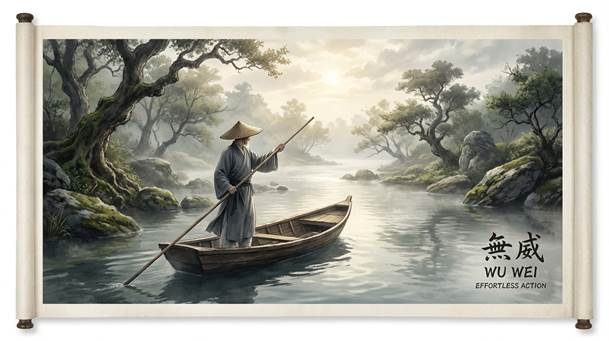
In Taoist philosophy, this principle is expressed as wu wei, or effortless action through alignment rather than force. Wu wei does not mean passivity; it means acting only when action is harmonious with circumstance (Lao Tzu, trans. Mitchell, 1988). The Warrior does not struggle against the current of life; he moves with it.

The Scholar: Clarity of Mind and Discernment of Truth

The Scholar represents True understanding. Before action, perception must come. Before movement, awareness must come. The Scholar refines cognition, attention, and reflection so that effort is guided by wisdom rather than compulsion.

In Eastern philosophy, clarity is cultivated through stillness. The Tao Te Ching teaches:

“To the mind that is still, the whole universe surrenders.”
(Lao Tzu, trans. Mitchell, 1988)

This stillness is not emptiness but receptivity. It is the mental discipline that allows one to distinguish signal from noise, value from distraction, essence from excess. The Scholar understands that perpetual stimulation fragments attention and erodes creativity. Neuroscience now confirms that insight, problem-solving, and emotional regulation depend upon cycles of focused engagement and deliberate rest (Raichle, 2015; Kaplan & Berman, 2010).

Modern productivity research echoes ancient wisdom: deep work requires boundaries. Without reflection, we confuse urgency with importance. Without rest, we confuse movement with meaning. The Scholar therefore cultivates the discipline of reflection, journaling, meditation, and contemplative study, practices that refine perception and illuminate what is true.

The Sage: Alignment with Natural Law

The Sage embodies what is Correct, not merely in a moral sense, but in accordance with natural rhythm and universal order. The Sage recognizes that life unfolds in cycles: effort and restoration, engagement and withdrawal, expansion and contraction.

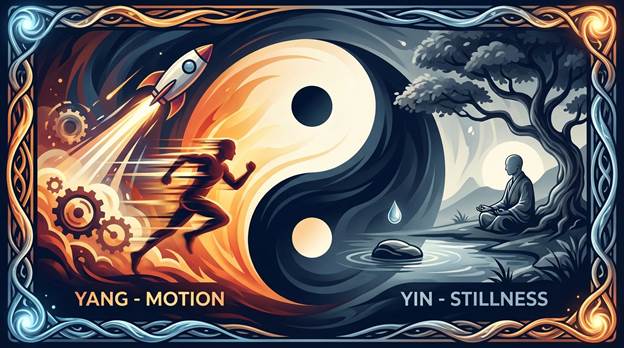
Traditional Chinese philosophy expresses this through the doctrine of yin and yang, complementary forces in perpetual transformation (Kaptchuk, 2000). Activity without rest becomes exhaustion. Rest without purpose becomes stagnation. Health, creativity, and wisdom arise from dynamic balance.

The Sage understands that overextension leads to collapse and that excessive control produces resistance. In Buddhism, this is reflected in the Middle Way, the path between indulgence and deprivation (Rahula, 1974). In Confucian ethics, it is expressed through li, proper conduct arising from situational appropriateness rather than rigid rules (Ames & Rosemont, 1998).

To the Sage, knowing when not to act is as powerful as knowing when to act. Stillness is not absence. Silence is not emptiness. Withdrawal is not retreating. These are strategic expressions of wisdom.

The Integrated Path: Living the True, Right, and Correct Life

When the Warrior, Scholar, and Sage are integrated, life becomes a practice of intelligent engagement. The individual learns to:

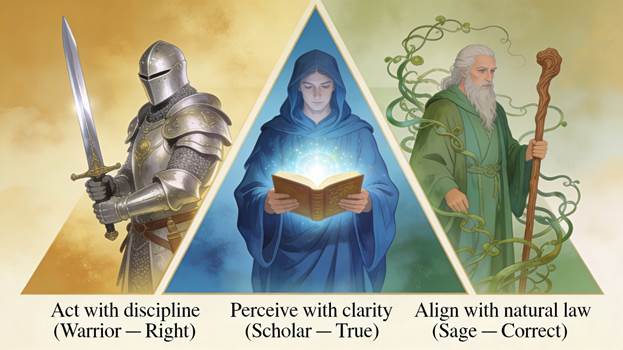
  • Act with discipline (Warrior — Right)
  • Perceive with clarity (Scholar — True)
  • Align with natural law (Sage — Correct)

This triadic harmony produces a life of purposeful effort rather than frantic striving. It teaches us to push forward when the moment calls for courage and endurance and to withdraw when reflection, restoration, or re-calibration is required.

The ancient sages understood what modern neuroscience now confirms: burnout is not a failure of character but a failure of rhythm. Creativity does not arise from constant stimulation but from alternating cycles of tension and release. Wisdom does not emerge from accumulation but from discernment.

To live well is not to do more. It is to do what matters and to release what does not.

The highest form of productivity is not busyness. It is alignment.

The highest form of discipline is not force. It is restraint.

And the highest form of wisdom is knowing, with clarity and courage, and when to do and when not to do.

References

Ames, R. T., & Rosemont, H. (1998). The analects of Confucius: A philosophical translation. Ballantine Books.

Griffith, S. B. (Trans.). (1971). Sun Tzu: The art of war. Oxford University Press.

Kaplan, S., & Berman, M. G. (2010). Directed attention as a common resource for executive functioning and self-regulation. Perspectives on Psychological Science, 5(1), 43–57. https://doi.org/10.1177/1745691609356784

Kaptchuk, T. J. (2000). The web that has no weaver: Understanding Chinese medicine (2nd ed.). McGraw-Hill.

Lao Tzu. (1988). Tao Te Ching (S. Mitchell, Trans.). HarperCollins.

Rahula, W. (1974). What the Buddha taught (2nd ed.). Grove Press.

Raichle, M. E. (2015). The brain’s default mode network. Annual Review of Neuroscience, 38, 433–447. https://doi.org/10.1146/annurev-neuro-071013-014030