A Holistic Look at Diet, Disease, and the Modern Health Paradox
An estimated nearly half of American adults live with hypertension, a condition strongly associated with cardiovascular disease, stroke, and premature mortality (Centers for Disease Control and Prevention (High Blood Pressure Facts, 2025). At the same time, the modern food environment is saturated with sodium-rich, highly processed products, many of which dominate grocery shelves and restaurant menus.
This raises an important and uncomfortable question:
How did the very system designed to nourish us become one that so often contributes to chronic disease?
From a holistic perspective, this is not merely a nutritional issue, but rather it is a systemic imbalance involving food production, economic incentives, behavioral conditioning, and healthcare practices.
The Sodium Landscape and Hypertension
Sodium is essential for human physiology, playing a critical role in nerve conduction, muscle contraction, and fluid balance. However, excess sodium intake is a well-established contributor to elevated blood pressure, particularly in salt-sensitive individuals (He & MacGregor, 2009).
The challenge is not sodium itself, but its pervasive presence in the modern diet, particularly through ultra-processed foods. Approximately 70% of sodium intake in the U.S. comes from packaged and restaurant foods, rather than from salt added at home (High Blood Pressure Facts, 2025).
This creates a situation where individuals may unknowingly consume excessive sodium, even when attempting to make reasonable dietary choices.
Ultra-Processed Foods: The Hidden Driver
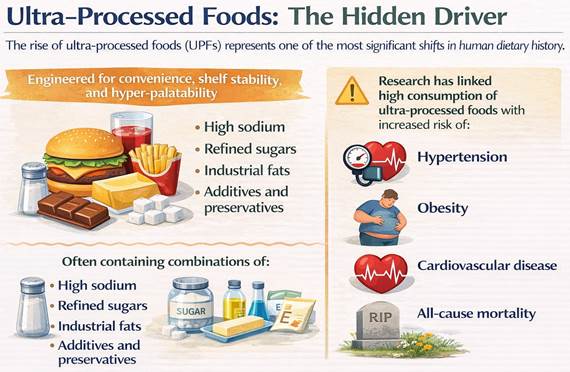
The rise of ultra-processed foods (UPFs) represents one of the most significant shifts in human dietary history. These foods are engineered for convenience, shelf stability, and hyper-palatability, often containing combinations of:
- High sodium
- Refined sugars
- Industrial fats
- Additives and preservatives
Research has linked high consumption of ultra-processed foods with increased risk of:
- Hypertension
- Obesity
- Cardiovascular disease
- All-cause mortality
(Monteiro et al., 2019; Srour et al., 2019)
Importantly, these foods are not inherently harmful because of a single ingredient, but because of their cumulative physiological impact and displacement of whole foods.
The Food–Healthcare Feedback Loop
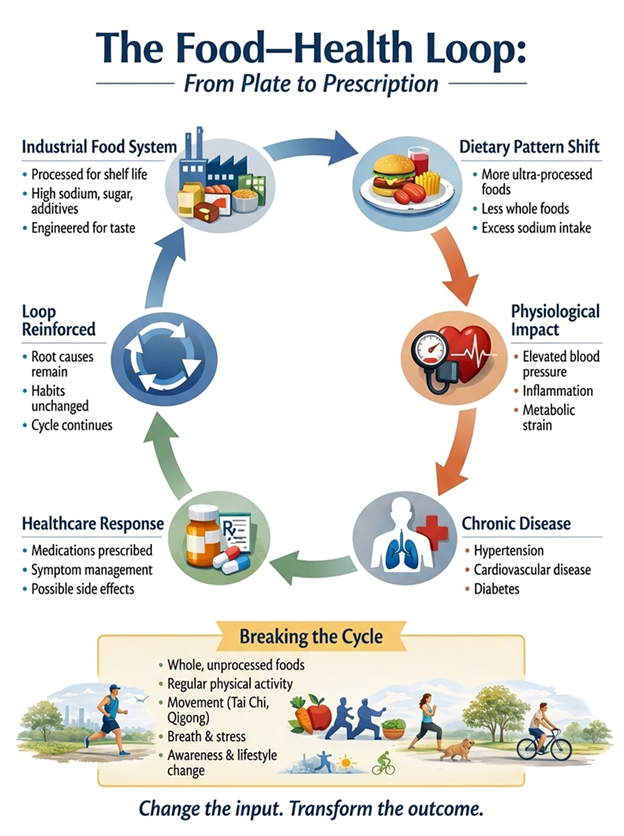
A growing concern among both professionals and the public is the emergence of what can be described as a “food–healthcare feedback loop.”
The Pattern
- Industrial food systems prioritize scale, profit, and shelf life
- Diets shift toward processed, nutrient-poor foods
- Chronic diseases (e.g., hypertension, diabetes) increase
- Healthcare systems respond with pharmaceutical management
- Root causes of diet and lifestyle remain insufficiently addressed
This is not necessarily the result of coordinated intent, but rather misaligned incentives across systems.
Healthcare systems are largely structured around disease management, while food systems are driven by economic efficiency and consumer demand.
A Holistic Interpretation
From a holistic and Traditional Chinese Medicine (TCM) perspective, the modern dietary pattern reflects a deeper imbalance:
- Excessive intake of salty, greasy, and processed foods contributes to internal disharmony
- Chronic stress and overstimulation elevate internal tension (analogous to sympathetic dominance)
- Insufficient restorative practices weaken the body’s regulatory systems
In TCM frameworks, hypertension may be interpreted through patterns such as:
- Liver yang rising
- Phlegm-damp accumulation
- Kidney deficiency
While the language differs, these interpretations parallel modern understandings of:
- Nervous system dysregulation
- Inflammation
- Metabolic dysfunction
Reframing the Narrative: Beyond “Food as Poison”
It is tempting to conclude that “food is either medicine or poison.” While compelling, this binary oversimplifies a complex reality.
A more precise and functional understanding is:
The health impact of food is determined by dose, quality, context, and pattern over time.
Even sodium, often vilified, is essential in appropriate amounts. Likewise, not all processed foods are harmful, and not all natural foods are beneficial in excess.
The true issue lies in chronic overexposure to low-quality dietary patterns combined with underexposure to protective lifestyle behaviors.
Personal Agency Within a Systemic Problem
While systemic reform is important, meaningful change often begins at the individual level. Evidence consistently supports the effectiveness of lifestyle interventions in reducing blood pressure and improving overall health (Appel et al., 1997).
Key strategies include:
- Emphasizing whole, minimally processed foods
- Reducing reliance on packaged and restaurant meals
- Increasing potassium-rich foods (e.g., vegetables, fruits)
- Engaging in regular physical activity
- Practicing stress management techniques (e.g., breathwork, meditation)
These approaches align closely with traditional practices such as tai chi, qigong, and mindful movement, methods that address both physiological and psychological dimensions of health.
In conclusion, the modern food and healthcare systems are not functioning in harmony with long-term human health. Like a body out of balance, they reflect patterns of excess, deficiency, and misalignment, contributing to the widespread rise in chronic disease. The widespread prevalence of hypertension reflects not a single cause, but a convergence of dietary, behavioral, and systemic factors.
Yet within this complexity lies opportunity. By returning to fundamental principles of consuming whole foods, mindful consumption, movement, and self-regulation, individuals can reclaim a significant degree of control over their health outcomes.
In this sense, food is neither inherently medicine nor poison. It becomes one or the other through the patterns we create and sustain over time.
References
Appel, L. J., Moore, T. J., Obarzanek, E., Vollmer, W. M., Svetkey, L. P., Sacks, F. M., … Karanja, N. (1997). A clinical trial of the effects of dietary patterns on blood pressure. New England Journal of Medicine, 336(16), 1117–1124. https://doi.org/10.1056/NEJM199704173361601
He, F. J., & MacGregor, G. A. (2009). A comprehensive review on salt and health. Journal of Human Hypertension, 23(6), 363–384. https://doi.org/10.1038/jhh.2008.144
High blood pressure facts. (2025, January 28). High Blood Pressure. https://www.cdc.gov/high-blood-pressure/data-research/facts-stats/?CDC_AAref_Val=https://www.cdc.gov/bloodpressure/facts.htm
Monteiro, C. A., Cannon, G., Levy, R. B., Moubarac, J.-C., Louzada, M. L. C., Rauber, F., … Jaime, P. C. (2019). Ultra-processed foods: What they are and how to identify them. Public Health Nutrition, 22(5), 936–941. https://doi.org/10.1017/S1368980018003762
Srour, B., Fezeu, L. K., Kesse-Guyot, E., Allès, B., Méjean, C., Andrianasolo, R. M., … Touvier, M. (2019). Ultra-processed food intake and risk of cardiovascular disease. BMJ, 365, l1451. https://doi.org/10.1136/bmj.l1451