The Eternal Now – Consciousness Momentarily Residing in Form

The Paradox of Presence

The statement above points to one of the most profound realizations of human existence, that time, identity, and consciousness are not separate phenomena but reflections of a single continuum of awareness. Philosophically, this view resonates with both Eastern metaphysics and Western phenomenology: that reality unfolds perpetually in the now, and that what we call “self” is consciousness temporarily clothed in matter. The phrase invites a dismantling of the illusion of separation between past and future, self and other, body and spirit. What remains when all temporal and spatial distinctions dissolve is pure presence where consciousness experiencing itself through form (Tolle, 1999; Advaita Vedānta, as cited in Deutsch, 1980).
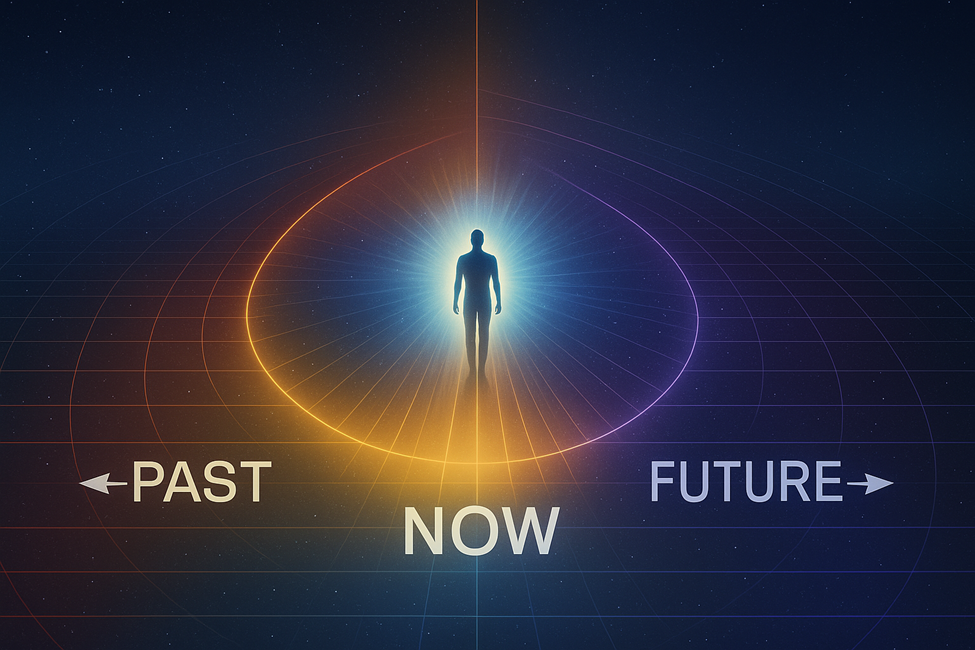
The Illusion of Time and the Continuum of Now

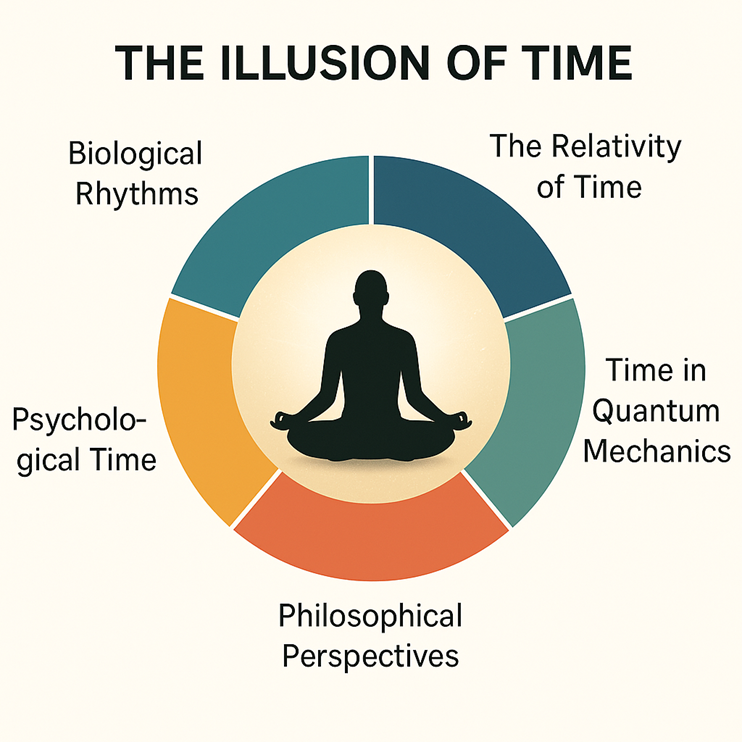
Human cognition evolved to perceive time linearly: a succession of moments divided into past, present, and future. Yet, physics and mysticism alike challenge this perception. Einstein (1955) remarked that the distinction between past, present, and future is a “stubbornly persistent illusion.” From a quantum or relativistic standpoint, all events exist simultaneously in a spacetime continuum. Similarly, Buddhist philosophy teaches that impermanence does not imply temporal fragmentation but the constant flux of a timeless now where each moment birthing the next without true separation (Nagarjuna, as translated in Garfield, 1995).

To say “it has always been now” is to step outside the psychological construct of time and into the living awareness that precedes it. In this state, “now” is not a fleeting instant but an eternal dimension as the background of all experience. Every thought, sensation, and memory arises within this unbroken field of presence. Awareness never departs; only the forms within it shift and fade like clouds across an unchanging sky.
The Self as Eternal Witness

“It has always been you” is not a statement of personal identity but of essential consciousness where we are the observer behind all experiences. In Advaita and Taoist traditions, the self is not the personality but the awareness that perceives both body and mind. This is the “Atman” that is identical with “Brahman,” or the “original face before you were born,” as Zen expresses it (Suzuki, 1956). The conscious witness is silent, unbounded, and ever-present and is the same essence that animates all beings.
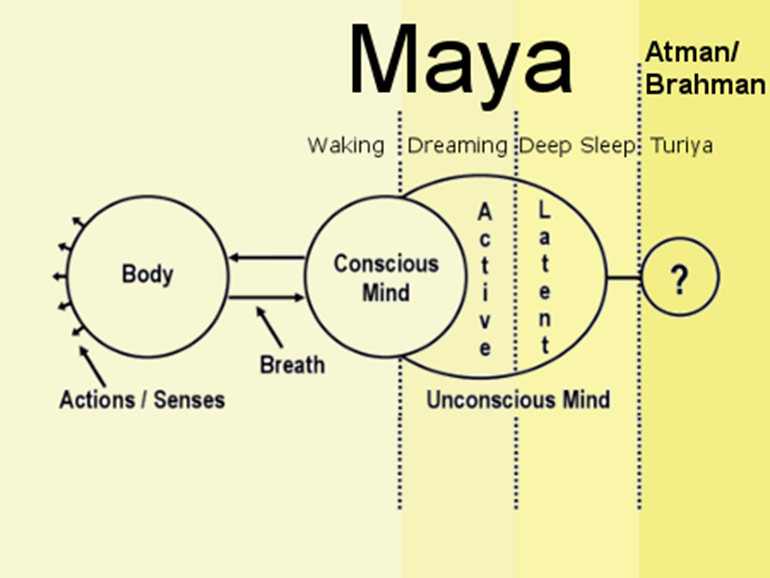
 (Van Es, 2019)

In Western phenomenology, Husserl and later Sartre described consciousness as “intentionality”: a self-revealing light in which objects appear (Husserl, 1931). That same light is the “you” in the aphorism and not the egoic self but the perceiving essence. When the individual realizes this, the boundary between “me” and “world” dissolves, revealing that both are movements within the same consciousness. As Alan Watts (1966) observed, “You are an aperture through which the universe is looking at and exploring itself.”

The Eternal Return of Being

“You have always been here” expresses the nonlocal and non-temporal quality of consciousness. While the body appears and vanishes in linear time, awareness, as the ground of all perception and has no beginning or end. In Taoist cosmology, the Tao is “formless yet ever-generative,” present before the birth of heaven and earth (Lao Tzu, trans. Mitchell, 1988). Similarly, Christian mysticism speaks of the “Kingdom of Heaven within,” pointing toward an eternal reality accessible through direct awareness rather than belief.

From the standpoint of experiential practices such as meditation, qigong, or contemplative stillness, one discovers that consciousness is not in the body; rather, the body is in consciousness. This reversal reveals that the witness has never left the moment or the universe it perceives. The “here” of consciousness is not a coordinate but a state of being.

Form as Temporary Expression of the Infinite

The final phrase, “the eternal consciousness momentarily residing in form,” brings the insight full circle. It affirms embodiment without attachment in that awareness chooses, or perhaps naturally manifests, as form to know itself. Matter, from this view, is crystallized consciousness; each organism is a unique configuration through which the universal intelligence experiences itself. The Tao manifests as “the ten thousand things,” yet remains unchanged in essence.

From a scientific lens, the body is a temporary aggregation of atoms forged in stars, recycled endlessly through the cosmos. The same elements that compose the body once burned in ancient suns and will again form new worlds (Greene, 2004). To realize this is to understand that life and death are merely transitions in the ongoing dance of energy where consciousness momentarily taking shape to perceive its own reflection.

The Practice of Remembering the Eternal

Philosophical insight becomes transformation only through direct realization. Meditation, breathwork, and mindful presence are methods of reuniting awareness with its source. When the mind ceases its incessant narrative of past and future, one awakens to what has never moved or the now. This awakening does not erase individuality but illuminates it with depth and humility. To live from this awareness is to act without resistance, to see oneself as both participant and witness in the cosmic unfolding.

Conclusion: The Still Point of Being

“It has always been now, it has always been you, you have always been here” points to the truth that existence is not a journey toward some future awakening but the continuous revelation of what already is. Consciousness is eternal, form is transient, and the realization of this unity is liberation. In this recognition, all striving dissolves, not into nihilism, but into reverence. The eternal consciousness does not seek permanence in form; it celebrates the impermanence through which it comes to know itself.

To awaken to this is to stand still at the center of the ever-turning wheel of time and recognize: you were never elsewhere, and you have never been anyone else.

References:

Deutsch, E. (1980). Advaita Vedānta: A Philosophical Reconstruction. University of Hawaii Press.

Einstein, A. (1955). Letter to Michele Besso. In The Born–Einstein Letters. Macmillan. https://archive.org/details/5760562-Einstein-letter-to-Besso-1951

Garfield, J. L. (1995). The Fundamental Wisdom of the Middle Way: Nāgārjuna’s Mūlamadhyamakakārikā. Oxford University Press. https://doi.org/10.1093/oso/9780195103175.001.0001

Greene, B. (2004). The Fabric of the Cosmos: Space, Time, and the Texture of Reality. Alfred A. Knopf. https://archive.org/details/fabricofcosmossp0000gree

Husserl, E. (1931). Ideas: General Introduction to Pure Phenomenology (W. R. Boyce Gibson, Trans.). Allen & Unwin.

Lao Tzu. (1988). Tao Te Ching (S. Mitchell, Trans.). Harper & Row. https://ia600209.us.archive.org/16/items/taoteching-Stephen-Mitchell-translation-v9deoq/taoteching-Stephen-Mitchell-translation-v9deoq_text.pdf

Suzuki, D. T. (1956). Zen Buddhism: Selected Writings. Doubleday. https://archive.org/details/zenbuddhism0000dtsu

Tolle, E. (1999). The Power of Now: A Guide to Spiritual Enlightenment. New World Library.

Van Es, D. (2019, November 14). One Yoga — TripuraShakti. Tripurashakti. https://www.tripurashakti.com/one-yoga/one-yoga

Watts, A. (1966). The Book: On the Taboo Against Knowing Who You Are. Pantheon Books. https://archive.org/details/bookontabooagain00watt
“Polishing the Sword with the Soul”

The Tao of Inner Refinement in MuDo Practice

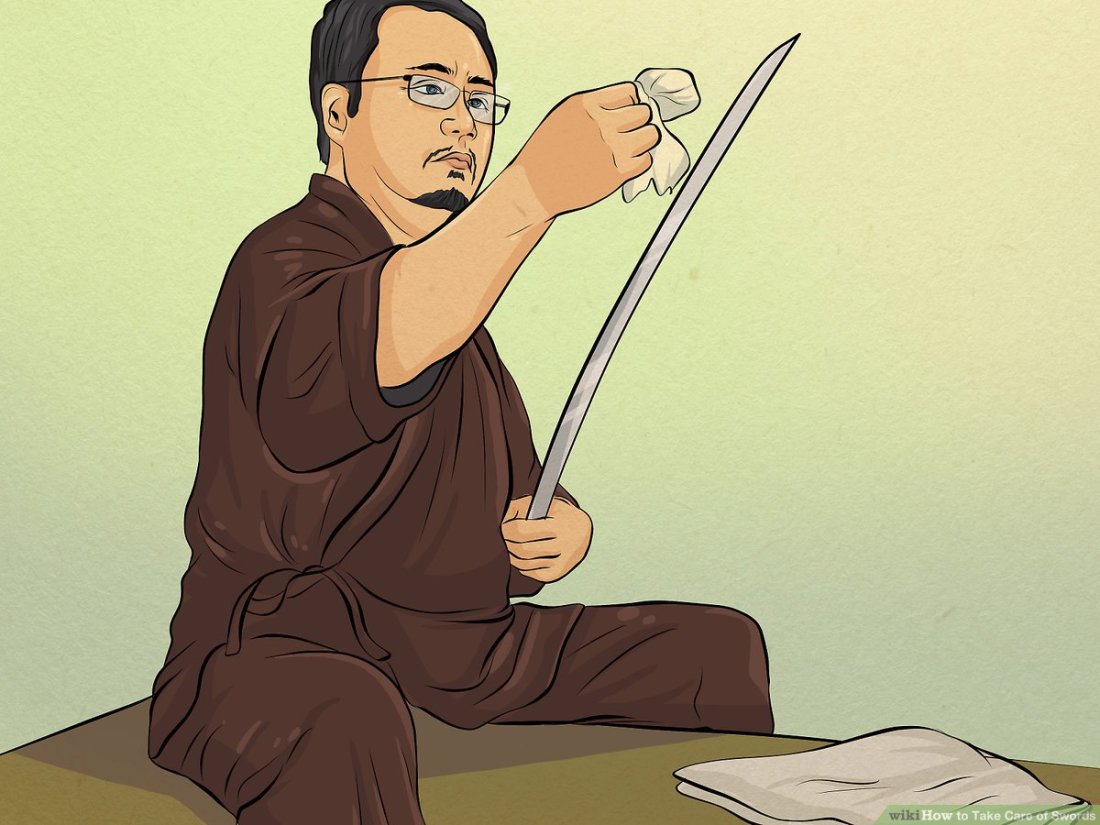
(wikiHow, 2025)

The phrase “polish the sword with the soul” is rooted in Taoist and Mu-Do (武道) traditions and expresses a universal ideal of continuous self-cultivation through disciplined practice and moral awareness. Like a sword that must be repeatedly sharpened to retain its edge, the human being must refine body, mind, and spirit to express the full potential of Dao (道) or The Way. This teaching transcends martial technique; it symbolizes the transformation of the practitioner into a vessel of harmony, wisdom, and integrity.

1. The Sword as the Symbol of Self and Spirit

In both Chinese and Korean philosophical systems, the sword (jian) is not merely a weapon but a metaphor for consciousness itself. The Taoist classic Zhuangzi likens the true swordsman to one whose blade never dulls because his mind is empty of attachment (Watson, 2013). Within Mudo, the sword embodies the shin (mind-heart), which when pure, reflects truth without distortion. The practitioner’s journey is to temper this “inner blade,” learning balance between yang (activity, assertion) and yin (stillness, receptivity), a theme central to traditional Taoist cosmology (Kohn, 2009).

In the Korean context, this teaching resonates with the ideal of Su-shin, meaning “cultivation of the body/self.” Confucius placed Su-shin at the foundation of social and cosmic harmony: “When the self is cultivated, the family is regulated; when the family is regulated, the state is in order” (Great Learning, trans. Legge, 1893). Thus, polishing the sword is both personal and social, in refining oneself to act justly in the world.

2. The Polishing Process: Friction as Transformation

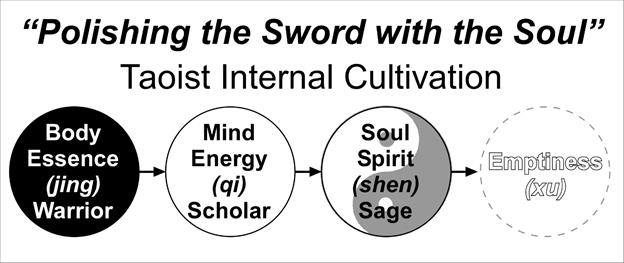
Polishing requires friction, an apt metaphor for life’s challenges, failures, and self-confrontations. In Taoist alchemy, this process is described through the San Bao or “Three Treasures” of jing (essence), qi (energy), and shen (spirit). Through disciplined practice, essence is refined into energy, energy into spirit, and spirit into emptiness (xu) (Chia, 2008). The polishing of the sword thus mirrors Neidan, or internal alchemy: the transformation of raw life energy into luminous awareness.

In Mudo philosophy, this transformation parallels the Way of the Warrior – Scholar- Sage, a triadic path uniting physical discipline, intellectual cultivation, and moral-spiritual awareness. The warrior’s physical training tempers jing; the scholar’s contemplation refines qi; and the sage’s insight elevates shen and ultimately leading to harmony between heaven, earth, and man. This mirrors Jung’s (1968) notion of individuation, where the conscious and unconscious are integrated into a unified Self through continual refinement of opposites.

3. The Soul as the Source of Mastery

To “polish with the soul” means to engage one’s innermost consciousness as the agent of refinement. The soul (hun) represents the luminous, yang aspect of spirit that animates purpose and creativity (Larre & de la Vallée, 1996). Without the engagement of the soul, practice becomes mechanical; a sword swung without intention. When the soul infuses the art, each motion reflects authenticity, compassion, and clarity.

Modern psychological parallels can be found in self-determination theory, where mastery arises from intrinsic motivation aligned with personal values (Ryan & Deci, 2017). The Mudo practitioner’s polishing, therefore, is not merely technical repetition but the alignment of inner motive and outer action, manifesting into a harmony of virtue (de) and expression (gong).

4. Integrative Reflection: The Sword as Mirror of the Way

In the broader context of Taoist cultivation, “polishing the sword with the soul” signifies a return to the Dao through continuous refinement. Each moment of training, contemplation, or service becomes a stroke of the whetstone against the blade of consciousness. The goal is not perfection, but rather clarity to remove the rust of ego and reveal the reflective surface of awareness.

As explored in prior discussions of the yin–yang dynamic, strength and vulnerability, action and stillness, are not opposites but mutually transformative forces (Kaptchuk, 2000). The act of polishing symbolizes this balance in assertive effort (yang) combined with humble introspection (yin). Ultimately, the soul becomes both the craftsman and the mirror, through which the practitioner perceives the infinite in the finite.

To polish the sword with the soul is to practice Mudo as a living Tao, where every strike, breath, and thought becomes an act of refinement. The practitioner becomes both the sword and the polisher: a self-reflective being who tempers strength with compassion, power with humility, and mastery with moral integrity. In this process, technique becomes transcendent, and the path of the warrior, scholar, and sage merges into one continuous motion of the soul returning to its source.

References:

Jung, C. G. (1968). The collected works of C. G. Jung: Vol. 9 (Part 2). Aion: Researches into the phenomenology of the self. Princeton University Press.

Kaptchuk, T. J. (2000). The web that has no weaver: Understanding Chinese medicine. McGraw-Hill.

Kohn, L. (2009). The Taoist experience: An anthology. State University of New York Press. https://archive.org/details/thetaoistexperienceliviakohn

Larre, C., & de la Vallée, E. (1996). The seven emotions: Psychology and health in ancient China. Monkey Press.

Legge, J. (1893). The Chinese classics: Vol. I. The Great Learning. Oxford University Press. https://archive.org/details/chineseclassics41legg/page/n5/mode/2up

Chia. M. (2008). Healing light of the Tao: Foundations of internal alchemy. Universal Tao Publications.

Ryan, R. M., & Deci, E. L. (2017). Self-determination theory: Basic psychological needs in motivation, development, and wellness. The Guilford Press. https://doi.org/10.1521/978.14625/28806

Watson, B. (2013). The complete works of Chuang Tzu. Columbia University Press.

wikiHow. (2025, February 7). How to Take Care of Swords (with Pictures) – wikiHow. wikiHow. https://www.wikihow.com/Take-Care-of-Swords

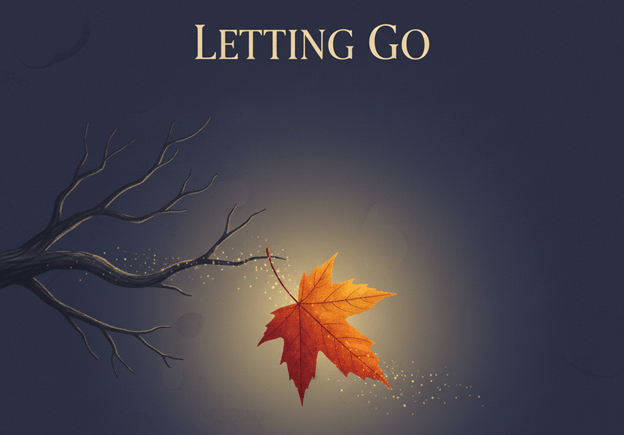
The Fall Season of Letting Go – Clarity and Change

As we transition from the active season of Fall into the quiet of Winter, it’s time to intentionally slow down and embrace one of life’s most powerful lessons:

Nature shows us plainly that everything cycles. This time of year, the leaves fall, trees look bare, and the world seems to contract. But this “decay” isn’t an ending; it’s a profound process of renewal. The earth is being fertilized, getting ready for the next spring. Right now, though, our job is to observe the letting go. Fall teaches us the hardest truth for the human mind:

Winter then brings stillness. It’s the moment for gathering energy, conserving resources, and resting. It is the great silence that precedes a new start.

The Practice of Essentialism

As the days get shorter and we naturally feel more inward, it’s the perfect time for introspection (looking within). This is your chance to reflect, declutter your life (mentally and physically), and focus only on what is essential.

Your Breath is Your Control Switch

We continue to use the breath not just for physical health, but as a direct way to manage the mind. It doesn’t matter if you take a few deep breaths or hundreds. What matters is the results of stopping the mental chatter (inner dialogue) and your internal state becomes still enough to see clearly.

Think of the breath as the doorway to your subconscious mind. You will either feed the subconscious unconsciously (with shallow, stressed breathing that reinforces survival-mode stress) or consciously (with deep, slow, intentional breaths). As soon as you breathe consciously, your entire system shifts toward calm and regulation.

This is how we manage the “Instinctual Mind.”  This part of your brain is designed to run the body and excel at survival, but it floods your subconscious with anxiety and chaotic signals. To regulate this instinctual part, you must regulate your breath. To regulate your breath, you regulate your mind.

Reflective Meditation: Reprocessing the Past

This time of year, is ideal for reviewing your life story. You can look back at significant life stages (e.g., grade school, adolescence, young adult, adulthood, etc.) or focus on a recent, emotionally charged event that changed your outlook, whether it was a trauma, a betrayal, a regret, or a success.

Try to tap into an experience that has lodged itself inside you, creating a kind of emotional stagnation that prevents you from moving forward.

The Method:

  1. Get Still: Sit down, breathe consciously, and calm your mind.
  2. Be the Witness: As a neutral observer, revisit the difficult moment.
  3. Gain Clarity: Your goal is not to rewrite the past, but to re-experience it through the lens of your current wisdom. You may realize things like:
    • You may have been young and/or naïve at the time
    • You weren’t at your best then, and that’s okay.
    • They weren’t attacking you; they were simply reacting out of their own suffering.
    • You may realize you were collateral damage to someone else’s unprocessed pain.

The point isn’t to judge the past, but rather it’s to release the story you’ve been carrying about it. Letting go of that unnecessary narrative is the highest medicine this season offers.

Reframing to Free Your Future

You revisit the moment, see it clearly, and analyze it from the perspective of the witness, not the wounded self. You breathe into the memory, letting the emotions reorganize. This is a process that unfolds over time, not in one session. Eventually, the energy tied up in the event loosens. You emotionally “digest” the experience, the stagnation dissolves, and your vital energy is free to move forward again.

The Ultimate Check-in: Meeting Your Younger Self

Once you’ve built stability in this practice, try this powerful exercise:

  1. Form Your Current Self: Clearly visualize the you of today as in your body, clothes, expression, and presence. This is your “Authentic Self.”
  2. Visit the Past: Send this Authentic Self back to meet a younger version of you, say, the a time in your youth or young adulthood, or at a crucial decision point.
  3. Just Sit: You don’t have to “heal” anything. Simply sit across from that past self, like two friends at a restaurant, and see: Would my younger self see me as an inspiration… or a warning… by who I have become?

This is the most honest mirror you’ll ever find. Your younger self knows your true, unburdened potential and remembers the promise you made to your own being. The question is: Have you kept that promise?

This honest self-assessment is the “Blade of Clarity.” It cuts away delusion and reveals the truth.

Finding Your Inner Compass

The world is constantly changing as is your circumstances, relationships, finances, and other people’s opinions are always in flux. Everything external moves.

But a mountain does not move. Its surface changes with weather and time, but its core profile, its Inner Compass or Unmoving Center,remains the same. In this philosophy,

If you don’t locate this unmoving center, you will constantly chase experiences, objects, and relationships that don’t align with your Highest Self.

  • The Mountain is your continuity.
  • It is your loyalty to your highest version.
  • It is the promise you keep to your future and past self.

Fall/Clarity gives you the insight to locate the mountain. Winter/Stillness gives you the stability to sit on it. Spring/Growth gives you the momentum to move from it.

We are nearing the end of this Season of Clarity, the cutting away, the letting go of old stories, the regulation of mind and breath, the reclaiming of your internal state, the reflection upon who you were, and the commitment to who you can still become.

Stay grounded, be clear, and remain loyal to yourself; your mountain.

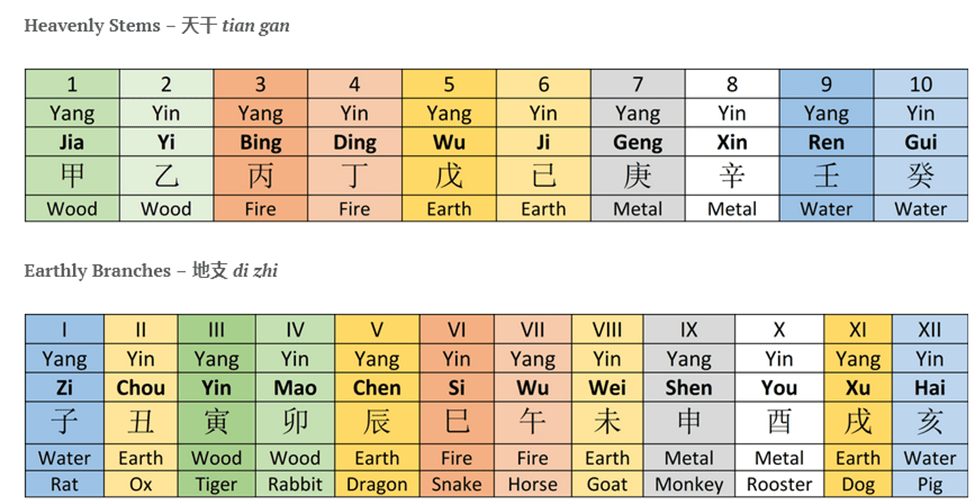
Understanding the Korean Lunisolar Calendar and Mystical Time Cycles

NumberStemElementPolarityDirection
1갑 (Gap)WoodYangEast
2을 (Eul)WoodYinEast
3병 (Byeong)FireYangSouth
4정 (Jeong)FireYinSouth
5무 (Mu)EarthYangCenter
6기 (Gi)EarthYinCenter
7경 (Gyeong)MetalYangWest
8신 (Sin)MetalYinWest
9임 (Im)WaterYangNorth
10계 (Gye)WaterYinNorth

BranchAnimalElementDirection
자 (Ja)RatWaterNorth
축 (Chuk)OxEarthNNE
인 (In)TigerWoodNE
묘 (Myo)RabbitWoodEast
진 (Jin)DragonEarthESE
사 (Sa)SnakeFireSE
오 (O)HorseFireSouth
미 (Mi)GoatEarthSSW
신 (Sin)MonkeyMetalSW
유 (Yu)RoosterMetalWest
술 (Sul)DogEarthWNW
해 (Hae)PigWaterNW

References

Heavenly stems and earthly branches. (n.d.). https://www.hko.gov.hk/en/gts/time/stemsandbranches.htm?utm_source=chatgpt.com

Kim, C. (2018). Korean shamanism. In Routledge eBooks. https://doi.org/10.4324/9781315198156

Lee, J. Y. (1981). Korean Shamanistic rituals. In Leo Laeyendecker & Jacques Waardenburg (Eds.), Religion and Society (Vol. 12). Mouton Publishers. https://api.pageplace.de/preview/DT0400.9783110811377_A33483020/preview-9783110811377_A33483020.pdf?utm_source=chatgpt.com

Yoon, H. (Ed.). (2017). P’ungsu: A Study of Geomancy in Korea. State University of New York Press. https://doi.org/10.2307/jj.18254509

Wu, S. (2005). Chinese Astrology: Exploring the Eastern Zodiac. Tuttle Publishing. https://archive.org/details/chineseastrology0000wush

The Student Becomes the Master, and the Master Becomes the Student

Across human history, the progression from student to master has symbolized growth, transformation, and the unfolding of wisdom. This dynamic relationship is not a simple ascent from ignorance to knowledge but a cyclical process of continual renewal. The journey encompasses humility, discipline, and self-realization, leading to a profound paradox: when the student attains mastery, the master must again become a student. This recursive pattern reflects the principles of Eastern philosophy, particularly Taoist and Confucian thought and aligns with modern educational theories emphasizing lifelong learning and self-reflection.

The Student’s Path Toward Mastery

The journey begins with a recognition of one’s limitations and a willingness to learn. Confucius emphasized humility and perseverance as the foundations of wisdom, observing that “to learn without thinking is labor lost; to think without learning is perilous” (Analects 2:15; Confucius, trans. 1997). In this early stage, the student relies on imitation and structured practice. The discipline of repetition is common to both martial and academic traditions, laying the groundwork for understanding.

According to Dreyfus and Dreyfus’s (1980) model of skill acquisition, learners progress through stages from novice to expert, eventually developing intuition born of experience. In martial arts or philosophy, this phase marks the transition from external technique (jing) to internal essence (shen). As the student refines skill through practice and reflection, understanding becomes embodied knowledge, not merely intellectual comprehension.

Taoist philosophy describes this evolution as harmony between wu wei (effortless action) and ziran (naturalness), where mastery manifests as unselfconscious expression (Laozi, trans. 1963). The master no longer performs from memory but from presence. This state of integration unites form and spirit, leading to authentic mastery.

The Master’s Return to Studenthood

True mastery dissolves the illusion of finality. As Zen teachings remind us, “In the beginner’s mind there are many possibilities, but in the expert’s there are few” (Suzuki, 1970, p. 21). The master who clings to certainty ceases to evolve. Thus, mastery demands a return to humility, with a willingness to once again become the student.

In this reversal, the teacher learns from experience, from new disciplines, and from students themselves. This concept parallels Schön’s (1992) model of reflective practice, wherein professionals continually re-examine their assumptions and adapt to changing circumstances. The act of teaching becomes itself a form of learning; the master refines understanding through articulating, demonstrating, and witnessing the struggles of learners.

Taoism and Zen Buddhism alike emphasize the cyclical nature of wisdom: knowledge transforms into unknowing, fullness returns to emptiness, and mastery flows back into inquiry (Watts, 1957). The wise master recognizes that wisdom is inexhaustible, and therefore, every conclusion opens new questions.

The Yin–Yang of Learning and Teaching

The relationship between student and master reflects the balance of yin and yang. The student, receptive and absorptive, represents yin, the principle of stillness and potential. The master, expressive and guiding, represents yang, the principle of activity and realization. Yet within each is the seed of the other. When yin and yang harmonize, growth continues.

In Confucian tradition, learning (xue) and reflection (si) are inseparable (Confucius, trans. 1997). Similarly, in martial philosophy, the practitioner cycles between discipline and spontaneity, form and formlessness. The process ensures that wisdom remains fluid rather than rigid, evolving with each generation. As the master learns anew from teaching, the lineage of knowledge remains living and dynamic in a continuous circle rather than a vertical hierarchy.

Conclusion

The transformation from student to master and back to student encapsulates the eternal rhythm of growth. Both roles coexist within the same individual, manifesting as phases in an endless cycle of becoming. Mastery is not the termination of learning but its most refined form. A state of perpetual openness and renewal.

As modern educators and ancient sages alike affirm, the essence of wisdom lies in humility. The student becomes the master by integrating knowledge into being. The master becomes the student by recognizing that learning never ends. Thus, the truest path of mastery is circular, infinite, and alive reflecting the natural flow of the Tao itself.

References:

Confucius. (1997). The Analects of Confucius (A. Waley, Trans.). Vintage Classics. https://archive.org/details/theanalectsconfucius

Dreyfus, S., & Dreyfus, H. L. (1980). A Five-Stage model of the mental activities involved in directed skill acquisition. ResearchGate. https://www.researchgate.net/publication/235125013_A_Five-Stage_Model_of_the_Mental_Activities_Involved_in_Directed_Skill_Acquisition

Laozi. (1963). Tao Te Ching (D. C. Lau, Trans.). Penguin Books. https://archive.org/details/taoteching0000laoz/page/n9/mode/2up

Schön, D.A. (1992). The Reflective Practitioner: How Professionals Think in Action (1st ed.). Routledge. https://doi.org/10.4324/9781315237473

Suzuki, S. (1970). Zen mind, beginner’s mind. Weatherhill. https://archive.org/details/ZenMindBeginnersMind-ShunruyuSuzuki

Watts, A. (1957). The way of Zen. Pantheon Books. https://archive.org/details/wayofzen0000alan/page/n5/mode/2up