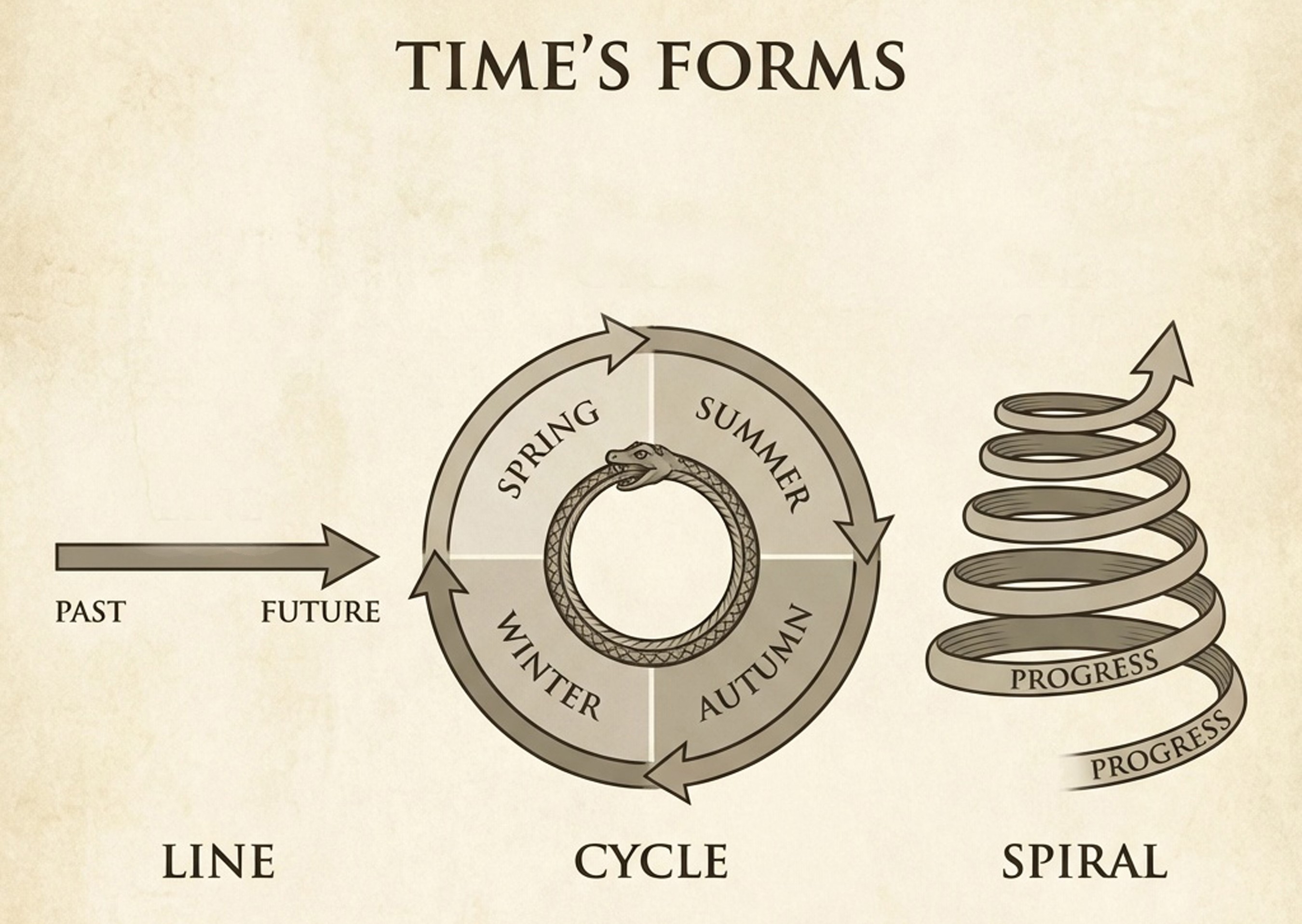

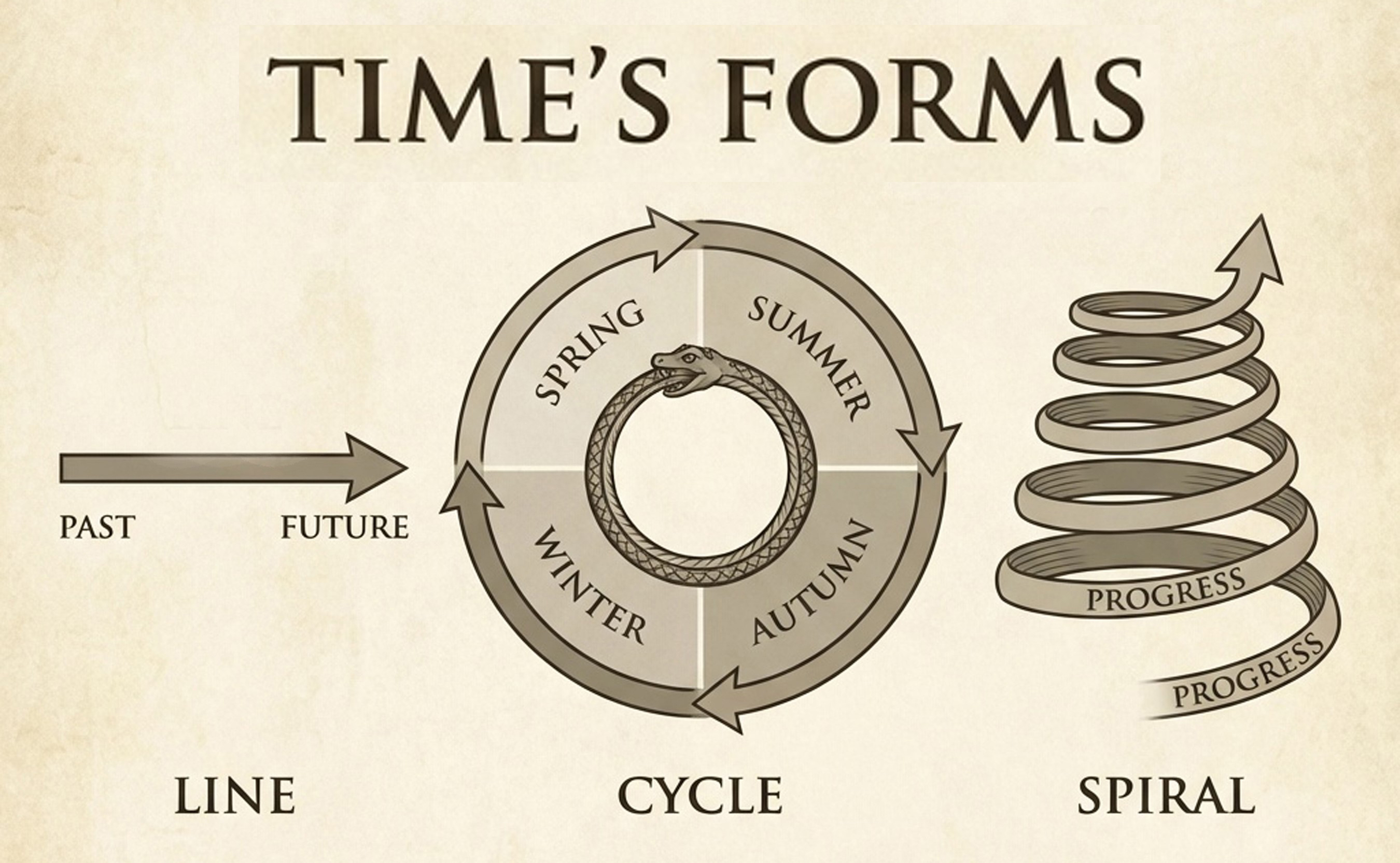
Human beings have long attempted to understand the nature of time, whether it flows as a straight line, repeats in cycles, or unfolds in a multidimensional pattern that transcends simple geometry. In Western scientific thought, time is generally described as linear, moving from past to future along an irreversible path shaped by entropy. In contrast, many spiritual, philosophical, and cosmological traditions propose a cyclical or spiral nature of time, suggesting that events, patterns, and developmental processes recur, yet do so at progressively different states of complexity or awareness. Contemporary neuroscience, psychology, cosmology, and systems theory increasingly support a hybrid view: time may appear linear to conscious perception, operate cyclically in biological and cosmic rhythms, and unfold in a spiral structure in terms of human growth and the evolution of systems. This essay integrates scientific, philosophical, and esoteric perspectives to show that time is not exclusively linear or cyclical; rather, it behaves as both, a dynamic spiral that unites forward motion with recurrent patterns.
Linear Time: Direction, Causality, and Human Perception
The most straightforward model of time is linear: a sequence of moments extending from a defined past into an open future. Physicists often rely on this model to describe causality, entropy, and the “arrow of time,” the direction in which disorder or entropy increases in closed systems (Carroll, 2010). From this standpoint, time’s linearity is a consequence of thermodynamic laws, which dictate that systems naturally evolve from ordered states toward greater randomness. This thermodynamic arrow establishes an irreversible progression from past to present to future (Price, 1996).
Human perception reinforces this linear model. Cognitive scientists note that our subjective experience of time is constructed through temporal sequencing, or the ability to arrange events in a coherent narrative (Eagleman, 2009). Memory also structures time linearly: we recall past events but cannot access future ones. Developmental psychology further reinforces linearity through observable life stages of infancy, adolescence, adulthood, and aging, each building upon previous phases (Baltes, Lindenberger, & Staudinger, 2006). Because of this subjective and biological structure, humans tend to equate time with unidirectional progress.
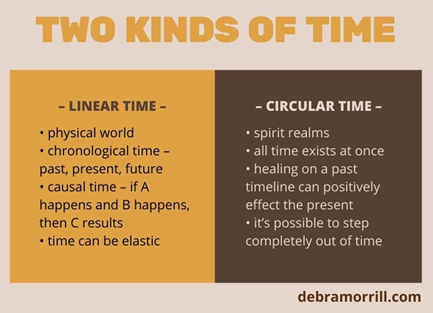
Yet, although linear time is practical for navigation, memory, and survival, it does not fully capture the repetitive, rhythmic, or transformational aspects found in nature or human consciousness. For this reason, linear time is best viewed as one dimension of a larger temporal structure.
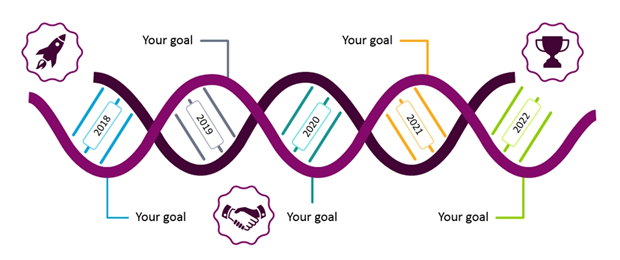
Cyclical Time: Biological Rhythms, Cosmic Patterns, and Ancient Traditions
Cyclical models of time are found across ancient and modern systems. Many cultures including Hindu, Taoist, Mayan, and Indigenous traditions—describe time as repeating cycles of creation, decay, and renewal (Eliade, 1954). Cycles are embedded everywhere in the natural world: the phases of the moon, the oscillation of the seasons, tidal rhythms, hormonal cycles, and circadian patterns all express a temporal circularity that is intrinsic to life (Foster & Kreitzman, 2014).
Biology offers some of the most compelling evidence for cyclical temporality. The human circadian rhythm, governed by the suprachiasmatic nucleus, follows a daily 24-hour cycle that regulates sleep, hormone release, cellular repair, and cognitive functioning (Hastings, Maywood, & Brancaccio, 2019). These processes repeat with remarkable precision, yet each cycle subtly differs based on environmental cues and internal conditions. Similarly, the brain undergoes rhythmic oscillations during wakefulness and sleep, replaying and reorganizing memories in repeated neural cycles (Buzsáki, 2006).
Cyclical time is also central to psychology. Emotional narratives, behavioral patterns, and relationship dynamics often repeat, albeit in varying intensities or contexts. Carl Jung argued that archetypes and symbols recur throughout history and individual development, reflecting cyclical patterns in the collective unconscious (Jung, 1959). In Taoist philosophy, the interplay of yin and yang illustrates cycles of expansion and contraction, activity and rest, growth and decay, each phase necessary for the next (Kohn, 2001). These traditions echo the idea that cycles do not merely repeat but evolve as they recur.
Although cycles appear circular, life does not return to the exact same point. Instead, patterns reemerge within a dynamic system that is constantly changing. This suggests that time may not be strictly circular but may instead follow a spiral trajectory.
Spiral Time: A Synthesis of Linearity and Cyclicality
A spiral model of time integrates the linear and cyclical frameworks into a more accurate representation of temporal reality. A spiral advances forward (like a line) while simultaneously looping through recurring phases (like a cycle). This pattern describes many natural systems, including galaxies, weather formations, and biological structures such as DNA, which is itself a double helix—a spiral encoding the evolution of life (Watson & Berry, 2003).
Spiral time also aligns with developmental and psychological models in which human beings revisit earlier stages but with greater depth, insight, or capacity. In transformative learning theory, individuals repeatedly encounter challenges that mirror previous experiences, yet their responses become more sophisticated as consciousness evolves (Mezirow, 2000). Similarly, trauma recovery often follows a spiral pattern in which emotions resurface periodically but with increasing resilience and understanding, a process known as post-traumatic growth (Calhoun & Tedeschi, 2014).
In Taoist internal alchemy (Nei Dan), spiritual development is explicitly described as cyclical refinement along an ascending path. Practitioners repeat meditative, energetic, and behavioral cycles to refine jing (essence), qi (vital energy), and shen (spirit or consciousness), not in perfect loops but in spiraling transformations that gradually elevate awareness (Larre & Rochat de la Vallée, 1996).
Likewise, in cosmology, some theoretical models propose that cosmic evolution may involve oscillatory processes occurring along an expanding trajectory, an interplay of expansion, contraction, and entropy-driven change that resembles a spiral rather than a straight line or a closed loop (Steinhardt & Turok, 2002).
Thus, the spiral becomes a unifying symbol for the multidimensional nature of time: forward motion built upon recurring yet transforming cycles.
The Human Experience of Time as Spiral Evolution
Human consciousness experiences time in a way that closely matches the spiral model. While daily rhythms repeat, no two days are identical. We revisit emotional and psychological patterns, but with new insights. Practices such as meditation, qigong, tai chi, and introspection also reveal the spiral nature of personal development. Repetition is not redundancy; it is refinement.
In martial arts, the practitioner endlessly repeats foundational forms, but each iteration deepens physical mastery, energetic sensitivity, and mental focus. Over years of practice, the same movement is performed thousands of times, yet with evolving meaning and embodiment. This is the essence of spiral time: returning to familiar territory but from a higher vantage point.
Likewise, personal growth follows a spiral trajectory. Challenges resurface, but each cycle presents an opportunity to integrate previous lessons, leading to new capacities, perspectives, and states of consciousness. The spiral is not only a temporal model but a developmental one that mirrors the complexity of human life.
Time cannot be adequately captured by a single geometric metaphor. Although scientific models emphasize linearity through entropy and causality, the rhythms of the natural world and the recurrences within human psychology demonstrate cyclical qualities. Yet neither framework alone is sufficient. A more holistic perspective recognizes that time advances while simultaneously repeating patterns, creating a structure that is best understood as a spiral, with a synthesis of forward progression and cyclical recurrence.
This spiral model aligns with biological rhythms, cosmological theories, psychological development, and spiritual traditions such as Taoist internal alchemy. It also describes the lived experience of human growth, in which individuals revisit patterns with increasing depth and awareness. Ultimately, time is not merely a straight line we travel or a circle we repeat; it is a spiral we ascend, evolving through iterative cycles of experience, learning, and transformation.
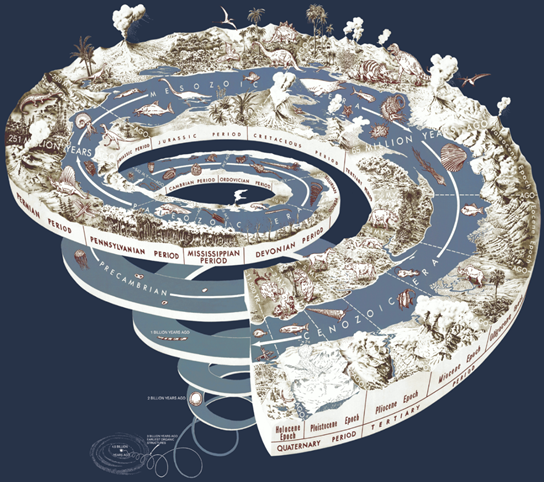
(Historical Infographics: Into the Depth of Time, 2021)
References:
Baltes, P. B., Lindenberger, U., & Staudinger, U. M. (2006). Life-span theory in developmental psychology. In R. M. Lerner & W. Damon (Eds.), Handbook of child psychology: Vol. 1. Theoretical models of human development (6th ed., pp. 569–664). Wiley.
Buzsáki, G. (2006). Rhythms of the brain. Oxford University Press.
Calhoun, L. G., & Tedeschi, R. G. (2014). Handbook of posttraumatic growth: Research and practice. Psychology Press.
Carroll, S. (2010). From eternity to here: The quest for the ultimate theory of time. Dutton.
Eagleman, D. (2009). Brain time: The temporal dimension of consciousness. In M. Gazzaniga (Ed.), The cognitive neurosciences (4th ed., pp. 659–666). MIT Press.
Eliade, M. (1954). The myth of the eternal return: Cosmos and history. Princeton University Press.
Foster, R., & Kreitzman, L. (2014). The rhythms of life: The biological clocks that control the daily lives of every living thing. Yale University Press.
Hastings, M.H., Maywood, E.S. & Brancaccio, M. Generation of circadian rhythms in the suprachiasmatic nucleus. Nat Rev Neurosci 19, 453–469 (2018). https://doi.org/10.1038/s41583-018-0026-z
Historical infographics: Into the depth of time. (2021, July 25). https://sandrarendgen.wordpress.com/2017/10/30/data-trails-the-geological-time-spiral-1975/
Jung, C. G. (1959). The archetypes and the collective unconscious. Princeton University Press.
Kohn, L. (2001). Daoism and Chinese culture (2nd ed.). Three Pines Press.
Larre, C., & Rochat de la Vallée, E. (1996). The seven emotions: Psychology and health in ancient China. Monkey Press.
Mezirow, J. (2000). Learning as transformation: Critical perspectives on a theory in progress. Jossey-Bass.
Morrill, D. (2022). The difference between linear time and circular time | Debra Morrill. https://debramorrill.com/the-difference-between-linear-time-and-circular-time
Price, H. (1996). Time’s arrow and Archimedes’ point. Oxford University Press.
Steinhardt, P. J., & Turok, N. (2002). A cyclic model of the universe. Science, 296(5572), 1436–1439. https://doi.org/10.1126/science.1070462
Watson, J. D., & Berry, A. (2003). DNA: The secret of life. Knopf.