A Holistic Perspective on Letting Go for Health, Clarity, and Growth
The Weight of What We’ve Already Paid
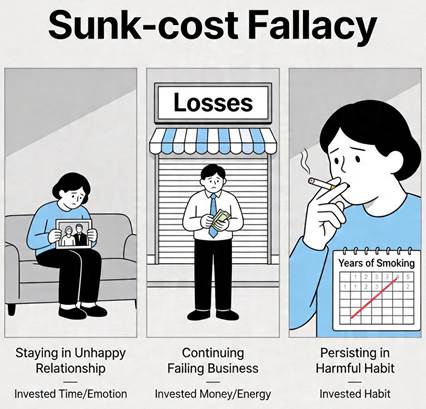
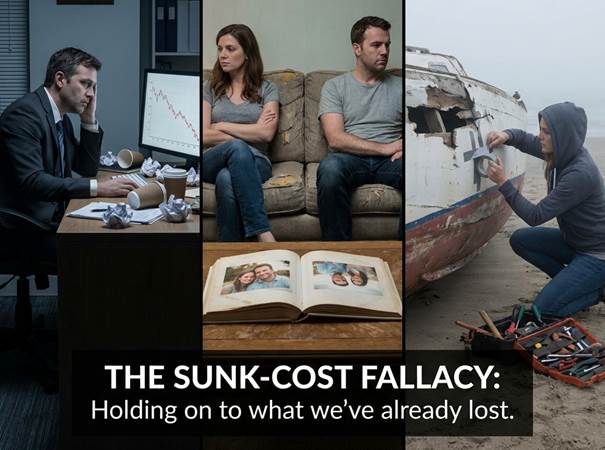
In the realm of human behavior, few psychological traps are as quietly influential and as damaging as the sunk-cost fallacy. At its core, this bias compels us to continue investing time, energy, money, or emotion into something simply because we have already invested so much.
We stay in the relationship too long.
We continue the failing business venture.
We persist in habits that no longer serve us.
Not because it is wise, but because we feel we cannot afford to waste what we’ve already given.
From a holistic health perspective, this is not merely a cognitive error. It is a mind–body–spirit imbalance as a disruption in our ability to perceive reality clearly, regulate emotion, and act in alignment with our well-being.
Understanding the Sunk-Cost Fallacy
The sunk-cost fallacy arises when past investments distort present decision-making. Rationally, what has already been spent, whether time, money, or effort, cannot be recovered. Therefore, it should not influence future choices.
Yet psychologically, it does. Why?
Because humans are not purely rational beings. We are emotional, identity-driven, and meaning-seeking. We attach value not only to outcomes, but to effort, sacrifice, and narrative.
To walk away can feel like:
- Admitting failure
- Wasting time or resources
- Losing identity or status
- Breaking emotional bonds
So instead, we double down.
The Physiological and Emotional Cost
From the lens of holistic health, this bias is not just “mental,” but rather it is deeply embodied.
When we remain committed to something that is no longer aligned:
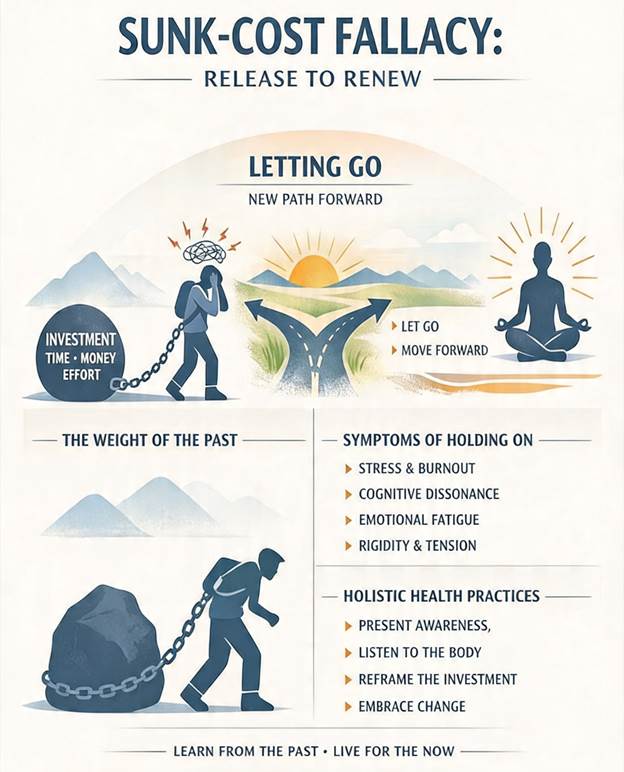
- Chronic stress increases (elevated cortisol, sympathetic dominance)
- Cognitive dissonance arises (mental tension between belief and reality)
- Emotional fatigue accumulates (resentment, frustration, burnout)
- Behavioral rigidity develops (inability to pivot or adapt)
Over time, this manifests physically:
- Poor sleep
- Elevated blood pressure
- Reduced immune resilience
- Muscular tension and postural collapse
The body, in its wisdom, often signals what the mind refuses to acknowledge.
A Yin–Yang Perspective: When Persistence Becomes Pathology
In Eastern philosophy, persistence is often seen as a virtue where yang energy equals effort, drive, forward motion.
But when yang is not balanced by yin, as in reflection, receptivity, stillness, it becomes excessive.
The sunk-cost fallacy represents excessive yang trapped by stagnant yin:
- Too much doing, not enough observing
- Too much force, not enough flow
- Too much attachment, not enough release
True wisdom lies in knowing when to persist and when to withdraw.
Just as in martial arts, pushing forward blindly leads to imbalance. The skilled practitioner yields, redirects, and adapts.
The Identity Trap: “I’ve Come This Far…”
Perhaps the most powerful driver of the sunk-cost fallacy is identity.
“I’ve spent 20 years building this.”
“I’ve invested too much to quit now.”
“This is who I am.”
But here is the deeper question:
Are you continuing because it is right… or because it is familiar?
In the Warrior–Scholar–Sage framework:
- The Warrior may push forward out of discipline
- The Scholar may justify the decision intellectually
- The Sage steps back and asks: Is this aligned with truth?
Only the Sage sees clearly enough to release what no longer serves.
Holistic Health Implications: Where This Shows Up
This bias is pervasive across all domains of life:
Physical Health
- Continuing ineffective exercise routines
- Ignoring pain signals (“I’ve always trained this way”)
- Persisting in diets that are not working
Mental Health
- Staying in toxic thought patterns
- Clinging to outdated beliefs or worldviews
- Overcommitting to stress-inducing responsibilities
Emotional & Relational Health
- Remaining in unhealthy relationships
- Maintaining one-sided friendships
- Avoiding necessary endings
Spiritual Health
- Attachment to rigid doctrines
- Mistaking loyalty for growth
- Confusing suffering with purpose
Breaking Free: A Practice of Release
Letting go is not weakness. It is refinement.
Consider these practices:
1. Reframe the Investment
Instead of seeing past effort as “wasted,” view it as tuition paid for wisdom.
Nothing is lost if something is learned.
2. Return to Present-Moment Awareness
Ask:
- If I were starting fresh today, would I choose this again?
- Is this serving my current well-being?
3. Listen to the Body
The body rarely lies.
- Tightness, fatigue, resistance → signals of misalignment
- Ease, clarity, energy → signals of alignment
4. Practice Strategic Withdrawal
In martial arts and life, retreat is not defeat. It is repositioning.
5. Embrace Impermanence
All things change.
Clinging to what was prevents you from stepping into what can be.
A Closing Reflection: The Freedom of Letting Go
Imagine carrying a heavy pack on a long journey.
Inside are items you once needed—tools, supplies, perhaps even comforts. But over time, they have become unnecessary weight.
The sunk-cost fallacy whispers:
“You’ve carried this this far… you can’t put it down now.”
But wisdom responds:
“I carried it because I needed it then. I release it because I no longer need it now.”
Holistic health is not just about what we build—it is about what we are willing to release.
Because sometimes, the greatest act of strength…
is letting go.
References
Arkes, H. R., & Blumer, C. (1985). The psychology of sunk cost. Organizational Behavior and Human Decision Processes, 35(1), 124–140. https://doi.org/10.1016/0749-5978(85)90049-4
Kahneman, D. (2011). Thinking, fast and slow. Farrar, Straus and Giroux.
Festinger, L. (1957). A theory of cognitive dissonance. Stanford University Press. https://archive.org/details/theoryofcognitiv0000fest/page/n5/mode/2up
Sapolsky, R. M. (2004). Why zebras don’t get ulcers (3rd ed.). Holt Paperbacks.
Hayes, S. C., Strosahl, K. D., & Wilson, K. G. (2012). Acceptance and commitment therapy: The process and practice of mindful change (2nd ed.). Guilford Press. https://psycnet.apa.org/record/2012-00755-000