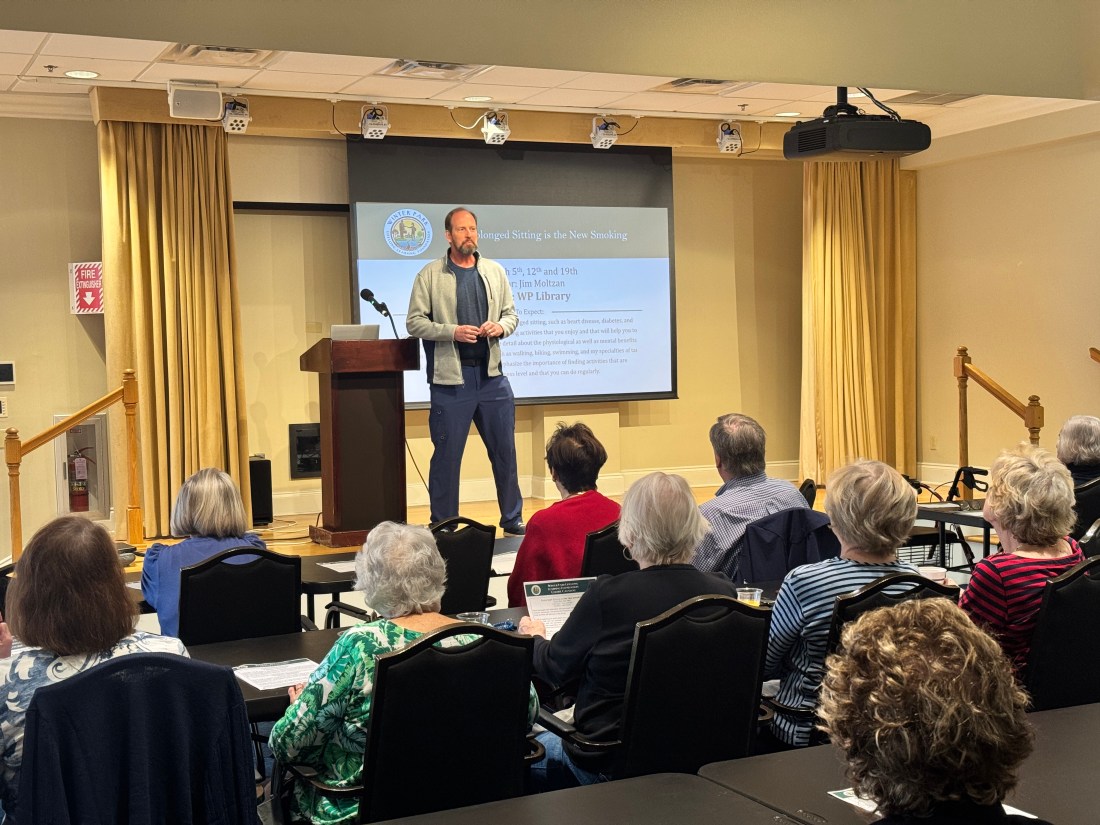
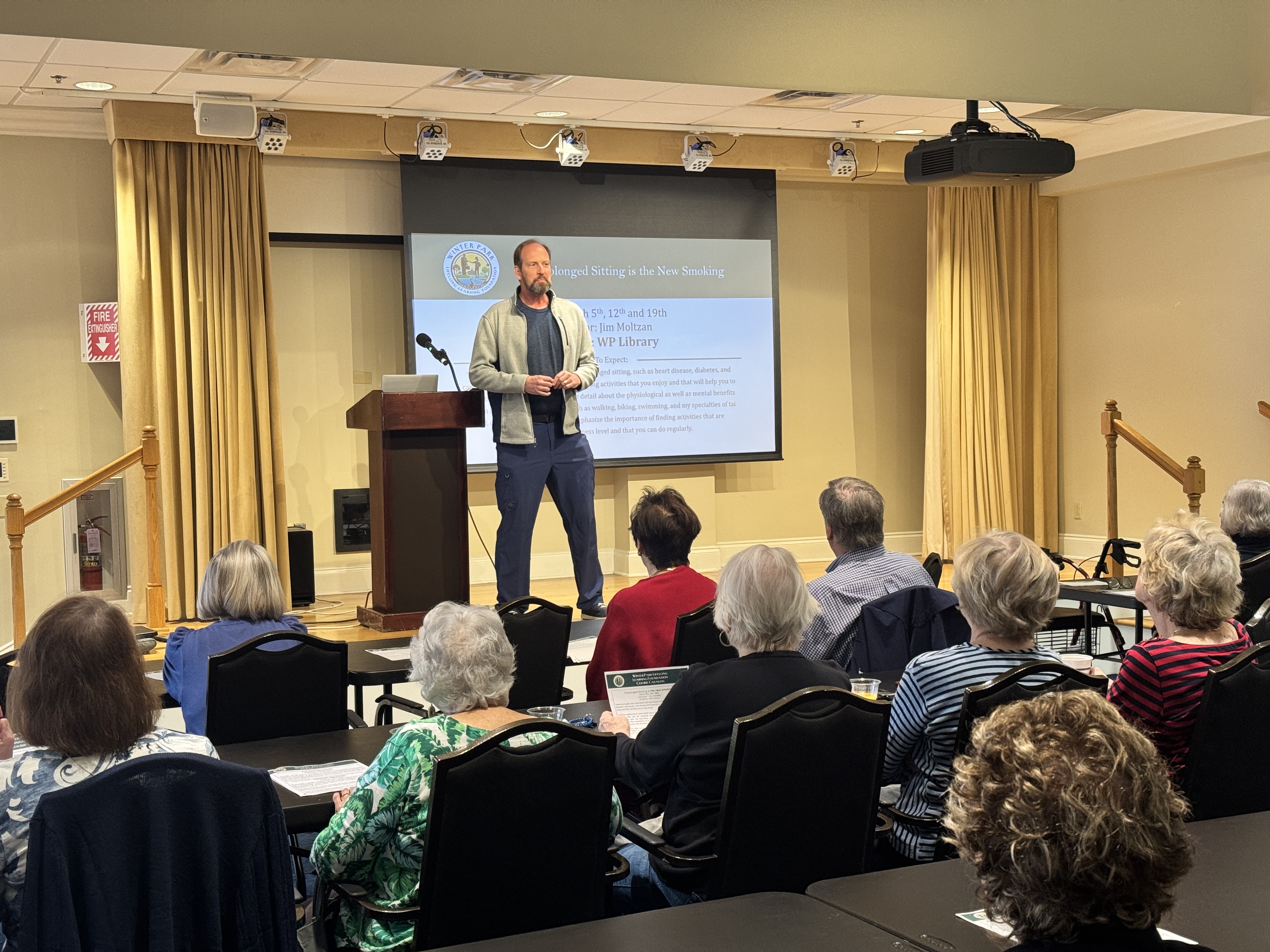
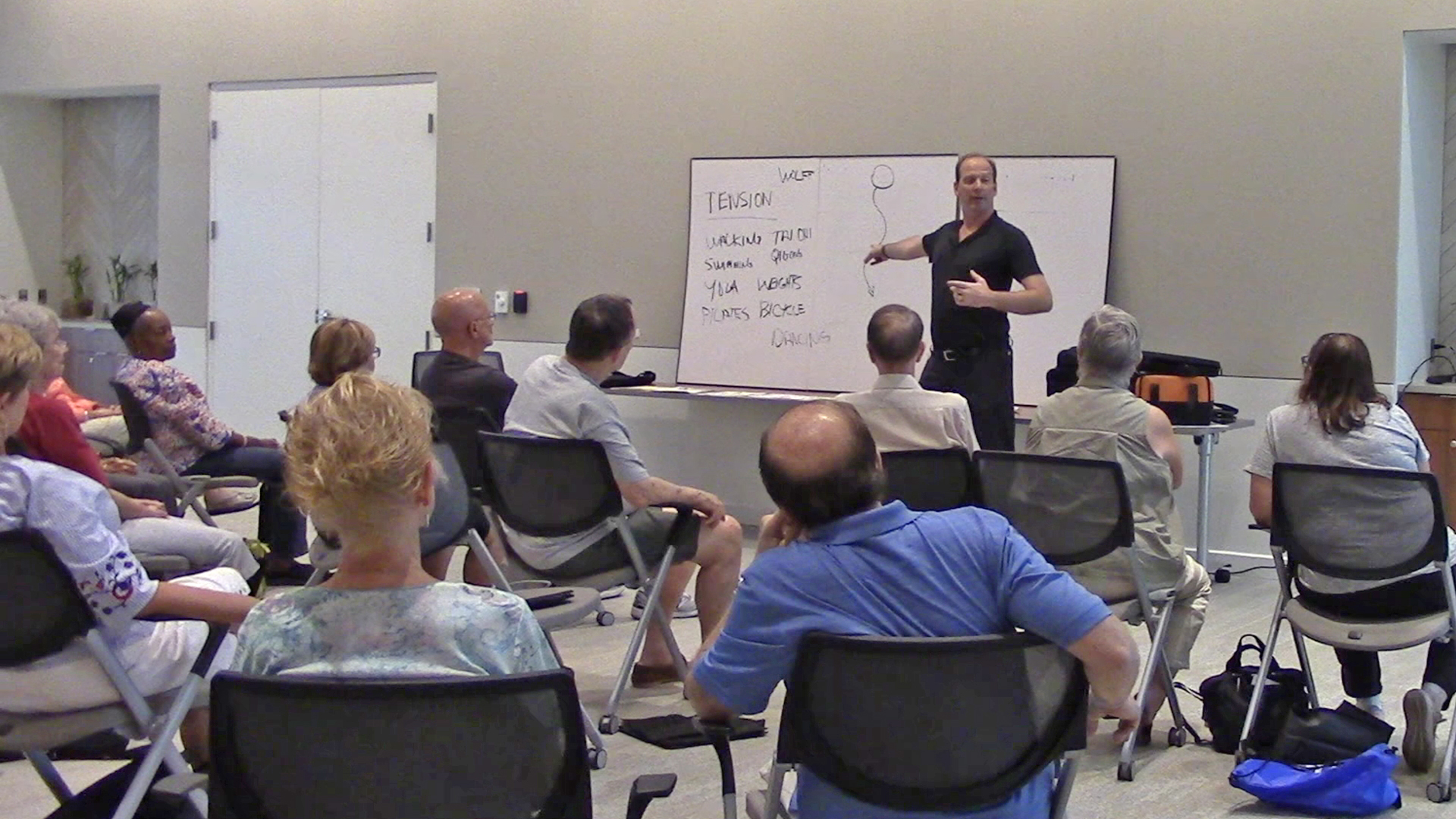
I spoke this week for a few minutes at The Mayflower at Winter Park, along with The Winter Park Lifelong Learning Foundation, regarding my upcoming course in March on:
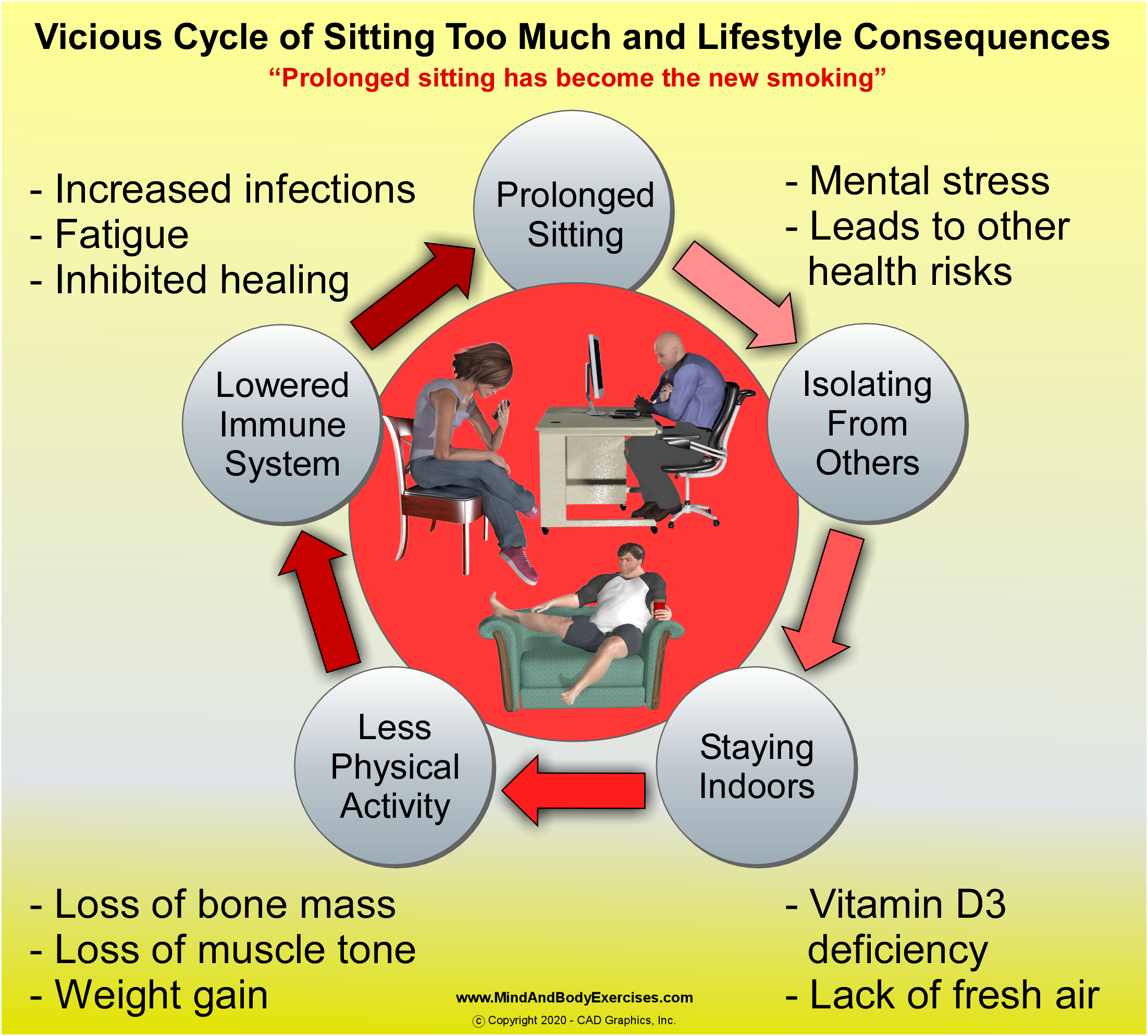
“Prolonged Sitting is the New Smoking”
Three sessions that build upon the first, starting on March 5th, 12th, 19th (10:30-11:45am)
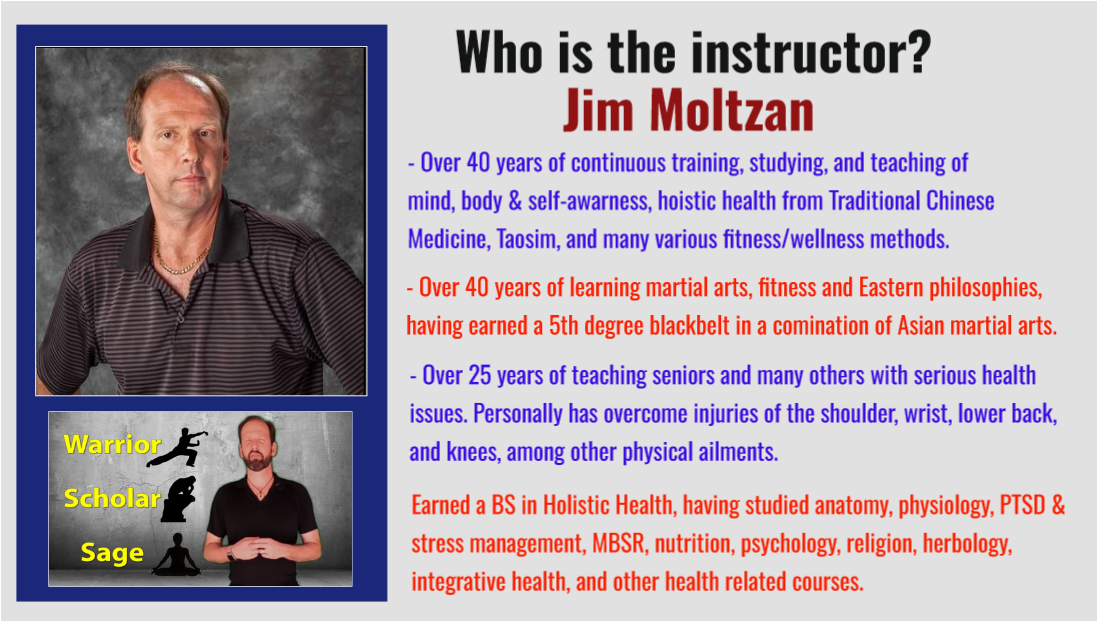
Instructor – Jim Moltzan, BS degree in holistic health
Location – WP Library near the Winter Park Village on 17-92.
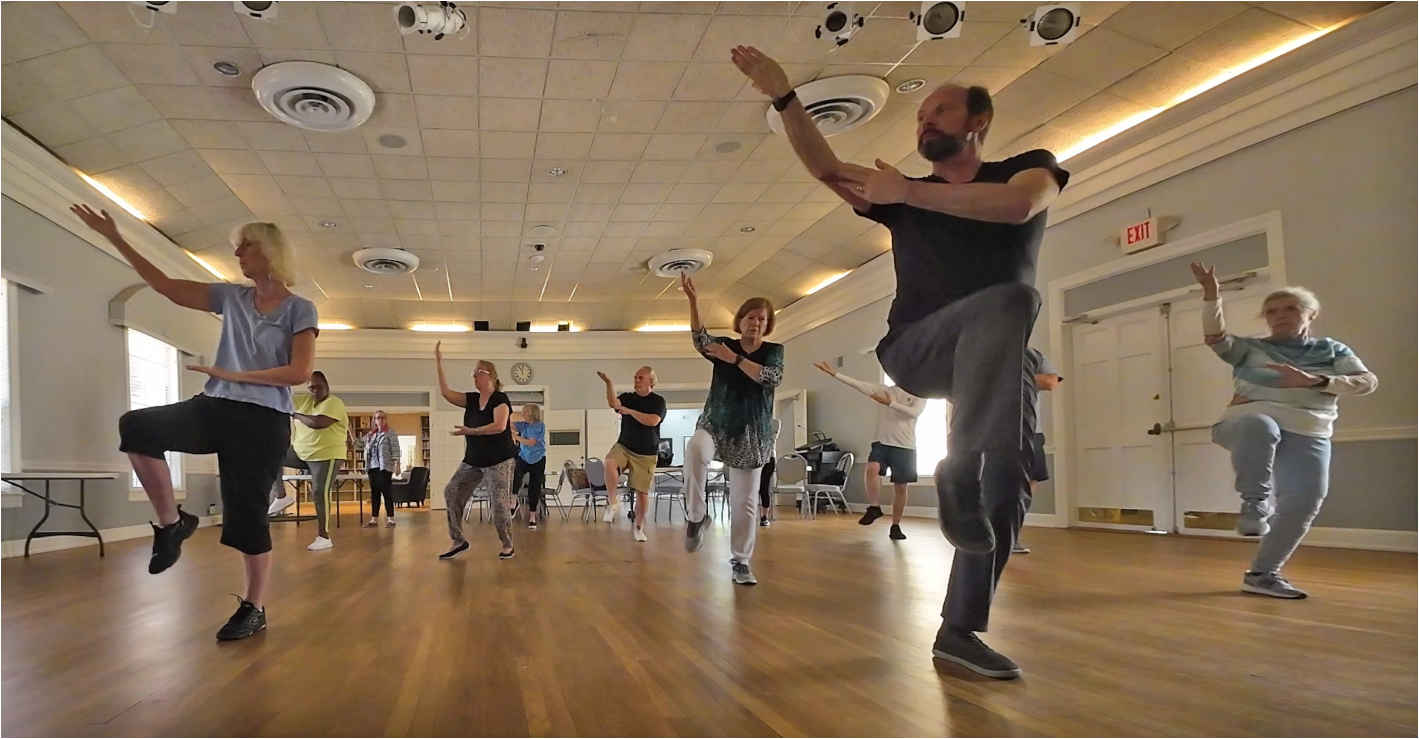
At each session, I will discuss the physical, mental, and spiritual (self-awareness) aspects of remaining in a seated position for extended periods. Each session will also include about a 1/2-hour of instruction in qigong, tai chi, or other methods that can help to get the body moving, engage one’s mind, and offer for some, meaning and purpose to get out of that chair on a daily basis.
__________
A $35.00 registration is required to attend all three sessions, which goes toward supporting college scholarships through the Lifelong Learning Foundation: https://winterparklifelong.org/register-courses
I teach and offer lectures about holistic health, physical fitness, stress management, human behavior, meditation, phytotherapy (herbs), music for healing, self-massage (acupressure), Daoyin (yoga), qigong, tai chi, and baguazhang.
Please contact me if you, your business, organization, or group, might be interested in hosting me to speak on a wide spectrum of topics relative to better health, fitness, and well-being.
I look forward to further sharing more of my message by partnering with hospitals, wellness centers, VA centers, schools on all levels, businesses, and individuals who see the value in building a stronger nation through building a healthier population.
I also have hundreds of FREE education video classes, lectures, and seminars available on my YouTube channel at:
The Good Book says it’s better to give than to receive I do my best to do my part Nothin’ in my pockets, I got nothin’ up my sleeve I keep my magic in my heart Keep up your spirit, keep up your faith, baby I am counting on you You know what you’ve got to do
(Triumph – 80’s rock band)
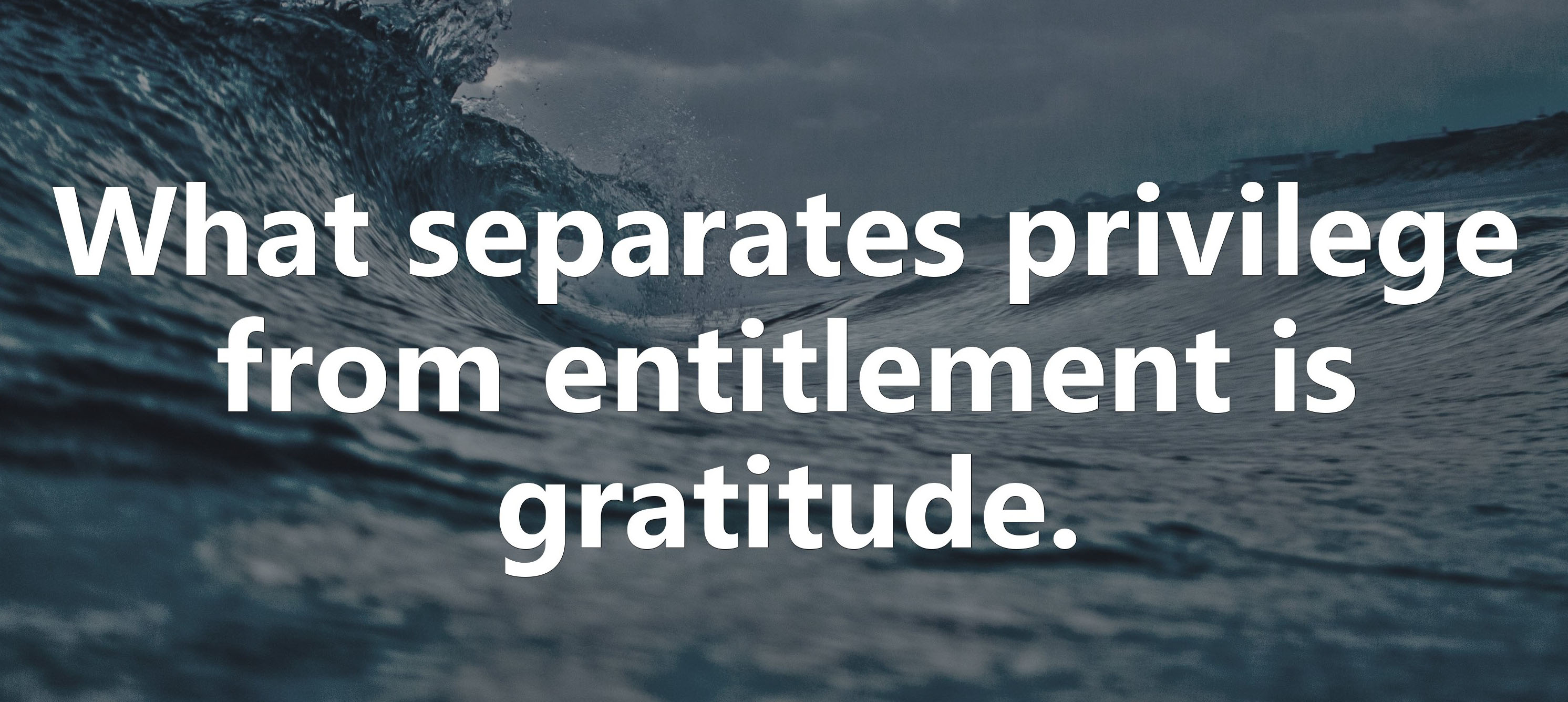
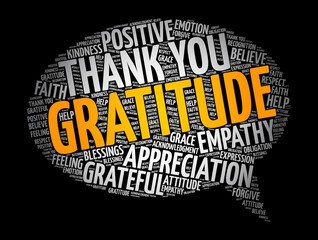
What is up with more recent generations, who often don’t say thank you or express appreciation for others’ paying bills, buying groceries, preparing meals, dining out, creating education opportunities, and many other instances where in the past, people did so? Has this been the new norm for a while now and I just missed the memo? Maybe the email got lost in my AOL spam folder. Perhaps I am behind the times.
I think that my observation touches on a fascinating dynamic: gratitude as a social and cultural norm seems to have diluted over generations, influenced by shifts in our values, communication styles, and societal structures. In the past, gratitude wasn’t just a taught virtue. Expression of gratitude often had real tangible stakes, such as maintaining social connections, securing resources, or avoiding ostracization. A lack of a call thanking an older relative for a birthday or graduation gift would consequently cease future generosities. The pendulum now seems to have swung, with younger generations often less in sync with older generations as to the importance of explicit expressions of gratitude, especially in personal and financial matters.
For example, take the following scenario with a person choosing to treat a small group to an expensive fine dining experience. The younger participants freely order appetizers, entrees, and alcohol without regard for cost or acknowledgment that there may be a budget. At the end of the meal, all comment on how good the meal was, and then go on their separate ways. Another instance may be where an aging grandparent distributes their wealth before their passing but receives little appreciation nor thanks for the efforts that might greatly influence the beneficiaries’ futures. This behavior might stem from several interconnected factors:
Why This Happens
Changing Norms and Expectations
In the past, gratitude was tied to survival and societal belonging. Today, individualism and a sense of entitlement may inadvertently reduce the perceived need to express thanks.
Younger generations might see expressions of generosity as routine, expected or transactional, especially if they’ve grown up with parents or elders providing without clear expectations of acknowledgment.
Generational Blind Spots
Many in their young adulthood haven’t had to manage substantial expenses themselves. Without the firsthand experience of the time and effort required to afford luxuries, they might not fully grasp the significance of such gestures.
Digital communication norms have shifted the way gratitude is expressed, with younger people often favoring indirect methods over explicit verbal thanks, such as via texting emojis or likes.
Social and Economic Pressures
With stressors like social issues, economic uncertainty, college costs, and other debt, younger people may unconsciously prioritize their immediate pleasure over reflecting on the bigger picture of generosity and sacrifice.
Addressing the Issue
If someone cares to bridge this gap constructively, here are some strategies:
Be the Example and Model by Discussing Gratitude
Share how you learned the value of expressing thanks and why it’s meaningful. For example, one might say, “When I was younger, I eventually realized how important it was to show my appreciation, not just out of politeness, but because it helps to build and strengthen relationships.”
Express your own gratitude openly, as this sets an example for others. For example, one could acknowledge the chef or server during the dining experience, demonstrating the power of recognition.
Gently Raise Awareness
Reflect on the experience with them afterward. For instance: “I really enjoyed treating everyone to dinner, it was quite a special occasion for me. I hope you all felt the same way.”
If you can find it appropriate, bring up the idea of cost in a non-confrontational way, such as: “Fine dining is a real treat. It made me think about how much time and effort goes into making something like that possible and memorable.”
Set Expectations Going Forward
For similar future outings, one could propose some light boundaries or discussions about the value of shared experiences. For example, “Let’s keep it simple and focus on enjoying the moment. Feel free to order what you’d like, but keep in mind that we’re here to share a meaningful time together.”
Big Picture
While it might feel disheartening in the moment, remember that younger generations often do appreciate acts of kindness but might lack the social tools or awareness to express it in a way that others may recognize. By modeling, discussing, and gently guiding, you can help foster an understanding of gratitude that feels authentic to both parties, ensuring these experiences are both enjoyable and meaningful.
I teach and offer lectures about holistic health, physical fitness, stress management, human behavior, meditation, phytotherapy (herbs), music for healing, self-massage (acupressure), Daoyin (yoga), qigong, tai chi, and baguazhang.
Please contact me if you, your business, organization, or group, might be interested in hosting me to speak on a wide spectrum of topics relative to better health, fitness, and well-being.
I look forward to further sharing more of my message by partnering with hospitals, wellness centers, VA centers, schools on all levels, businesses, and individuals who see the value in building a stronger nation through building a healthier population.
I also have hundreds of FREE education video classes, lectures, and seminars available on my YouTube channel at:
Operant conditioning entails learning relationships between behavior and its consequences of reinforcement or punishment. Operant responses are usually voluntary, such as verbal behavior, thinking and/or physical actions. In operant conditioning experiments, the researcher associates a particular response by closely following correspondences to that response with reinforcement or punishment (Ettinger, 2018).
Superstition may be defined as an irrational belief that can lead to the practice of various rituals, where a random occurrence is related with a positive outcome. The practice of the ritual is then thought to increase the positive outcome by again repeating the behavior. Some may see superstition as rooted in a mismatched correlation between cause and effect, where there is a tendency to interpret outcomes in line with our pre-existing beliefs. We often see this behavior in sporting activities, where a chance action or inaction, could lead to a point or goal for a particular percentage of the time. For example, actions of a baseball batter tapping home plate with their bat, loosening, and retightening their gloves and then hitting a homerun, are likely to be repeated. Not that these actions actually have any effect, but simply because of the coincidental reinforcement (What Is the Evolutionary Reason for Superstitious Behaviour? 2021).
(What Is the Evolutionary Reason for Superstitious Behaviour?, 2021)
Behavior learned through reinforcement usually involves a straightforward process linking cause to effect. However, with superstitious behavior, we perform an irrelevant action that happens to accompany the behavior that is being reinforced. Now that irrelevant action or the superstitious behavior, itself becomes reinforced (Krauss Whitbourne, 2014).
I think this cause-and-effect superstitious behavior can be often seen in many other common rituals that we often execute without much engaged thought. Ironically, some superstitions actually have some logical explanation or history behind them. An example would be not walking under a ladder because it could be potentially dangerous if something fell off of the ladder and onto someone’s head. Or not opening an umbrella indoors, because it was designed to be open outdoors and clear from hitting potential objects upon opening (Kolitz, 2020).
References:
Ettinger, R. H. (2018). Psychology: The Science of Behavior (6th ed.). BVT Publishing.
I teach and offer lectures about holistic health, physical fitness, stress management, human behavior, meditation, phytotherapy (herbs), music for healing, self-massage (acupressure), Daoyin (yoga), qigong, tai chi, and baguazhang.
Please contact me if you, your business, organization, or group, might be interested in hosting me to speak on a wide spectrum of topics relative to better health, fitness, and well-being.
I look forward to further sharing more of my message by partnering with hospitals, wellness centers, VA centers, schools on all levels, businesses, and individuals who see the value in building a stronger nation through building a healthier population.
I also have hundreds of FREE education video classes, lectures, and seminars available on my YouTube channel at:
Have you ever suddenly awoken from an intense dream where you questioned if it was just an abstract experience or one that may have a deeper and more profound meaning? Or maybe a repeat of another dream that seems to reoccur? Maybe even where deceased individuals close to you come to “visit” to offer words of support, closure, or invaluable insights?
The dream event is indicative of a momentary state of diminished faculties. It may be quite possible that dreams involving the deceased may be symptomatic of grief, however, this explanation may not hold true for all dream visitations. It is believed that the dream state allows a separation from our senses. Sleep can be viewed as a way of quieting the senses, so that nothing is conveyed to the heart, allowing the veil of the afterlife to be raised up (Kovelant, 2007).
Some may view a visitation dream as a component of the grieving process but diminishing the experience of the dreamer as possibly being temporarily not normal due to a tragedy. Religions such as Islam and more specifically Sufism, the esoteric form of Islam, have quite different viewpoints on dreams. Dreams come from a spiritual or mystical belief. Sufism sees that some dreams, specifically “visitation dreams” are where the dead seem to return or appear in dreams, to interact with us. Whether the perceived visitation of the deceased that appears in one’s dreams is produced by the dreamer, the deceased, both, or neither, remains yet to be determined (Kovelant, 2007).
In many various Indigenous cultures, dreams are seen as a bridge between the physical and spiritual worlds. Among some Native American tribes, dreams are perceived as a conduit through which the spirits of ancestors can communicate with the living. These dreams are not simply symbolic but are thought to carry messages and guidance from the deceased, who may still remain connected to the physical lives of their loved ones even after passing on to the next phase of spiritual existence.
Día de los Muertos (Day of the Dead), is a celebration that is believed in Mexican culture to be a time when the spirits of the deceased can return to the world of the living. The celebration itself can be seen as a conscious invitation for these spirits to visit. Dreams experienced during this period are often interpreted as actual interactions with the deceased. These dreams are often interpreted as guidance, blessings, support or comfort, and reassurance from those who have passed on.
Chinese culture believes that dreams including the deceased can offer other insights. Recurring dreams might highlight unresolved issues or a need to engage in specific rituals to help the deceased rest in peace. Their belief is that the deceased might appear to the living in dreams to help resolve unfinished tasks or to provide guidance to their living relatives.
Western cultures often seem to approach dreams with a more psychological perspective. Psychologists Sigmund Freud and Carl Jung offered insights into dreams in the early and mid-1900s, where the deceased are often seen as manifestations of an individual’s unconscious mind. From this perspective, dreams where the deceased comes to visit, might represent the dreamer’s inner thoughts and emotions as opposed to an actual spiritual encounter. Within this framework, many people may find meaning in these dreams. Some may see these types of dreams as a method to process grief and continue a connection with loved ones who have since passed away.
I have experienced visitation dreams a few times, where close family members or dear friends came to me in my dreams shortly after their passing. I might have attributed these events to coping mechanisms or coincidences in dealing with death and the grieving process. However, I don’t believe this to be the case due to my finding out that other living family or friends had experienced very similar dreams at almost the same time, from the same deceased individuals.
Reference:
Kovelant, K. (2007). Peering through the Veil: Death, Dreams and the Afterlife in Sufi Thought. Journal of Spirituality & Paranormal Studies, 30, 148–156.
I teach and offer lectures about holistic health, physical fitness, stress management, human behavior, meditation, phytotherapy (herbs), music for healing, self-massage (acupressure), Daoyin (yoga), qigong, tai chi, and baguazhang.
Please contact me if you, your business, organization, or group, might be interested in hosting me to speak on a wide spectrum of topics relative to better health, fitness, and well-being.
I look forward to further sharing more of my message by partnering with hospitals, wellness centers, VA centers, schools on all levels, businesses, and individuals who see the value in building a stronger nation through building a healthier population.
I also have hundreds of FREE education video classes, lectures, and seminars available on my YouTube channel at:
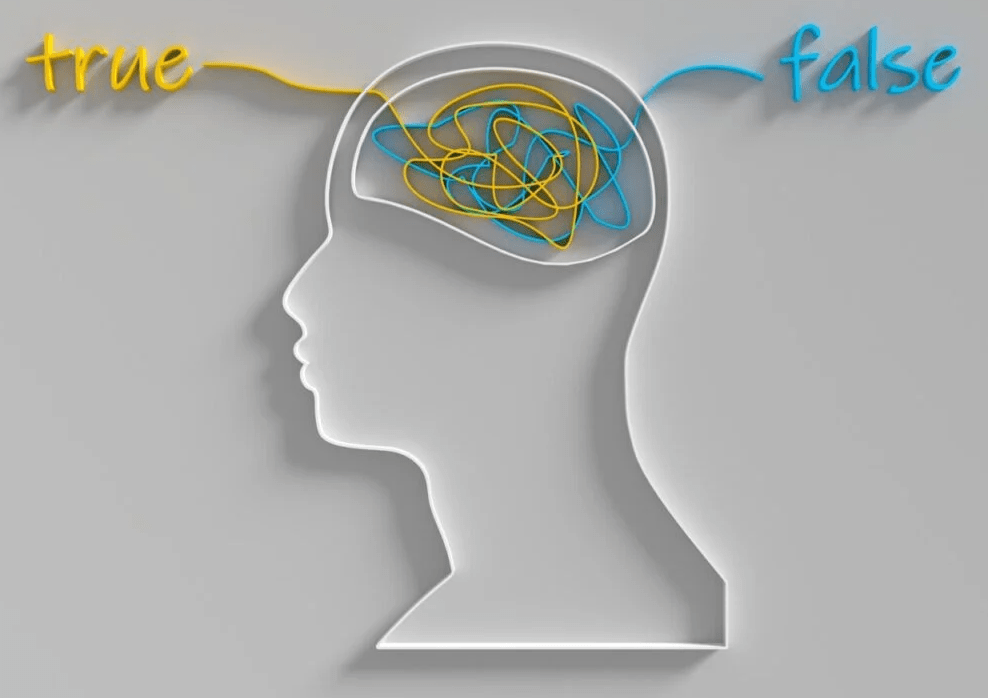
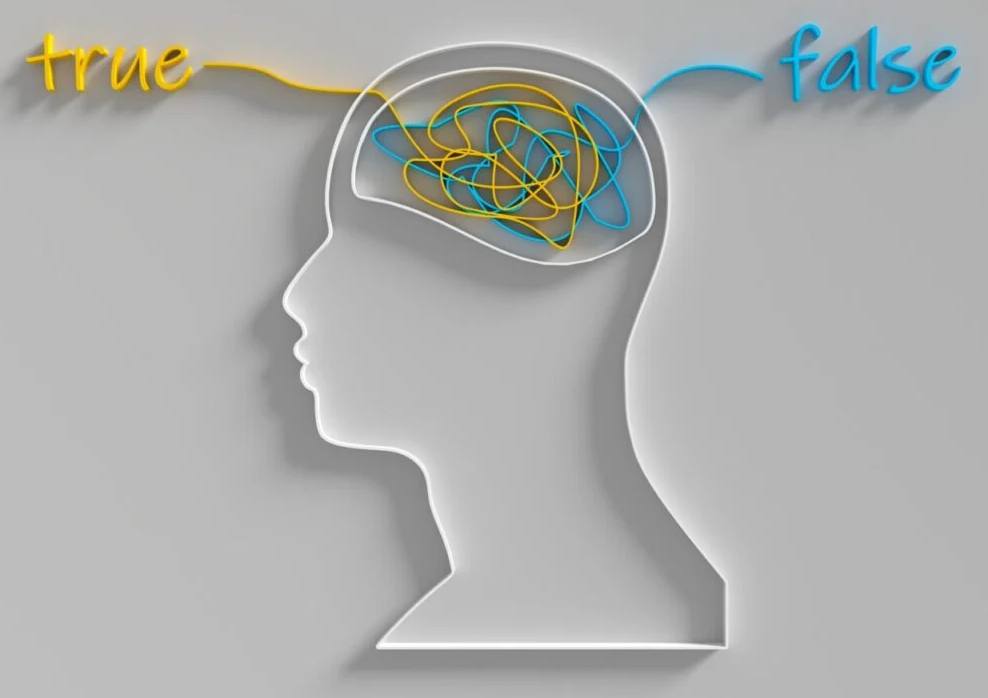
Suggestibility is where memory is distorted due to newer and/or misleading information (Ettinger, 2018). I think that this concept of implanting false memories through suggestion, might not be so recent of an idea despite the Ted Talk with psychologist Elizabeth Loftus speaking on seemingly modern events (Loftus, 2013). I am going to veer off onto a different perspective. People have been influencing others with the power of suggestion for at least the length of my life and probably much, much, longer before. I have seen parents, teachers, coaches, mentors, clergy, and others suggest and sway the thoughts and emotions of those who trust them. I have discussed this previously, specifically with the state of dependency and flashbulb memories, and how our thoughts and emotions can affect how we store our memories, whether perceived by us as being a good or a bad memory at any particular time (Ettinger, 2018).
(Walsh, 2017)
When a child is injured or sick, a parent or other adult might downplay the event by using wording such as “it’s not that bad”, “it could have been a lot worse” or “this is nothing” in order to not upset the child. However, these phrases might actually be causing the child to reprogram their thoughts to what an injury should feel like or even their tolerance to pain. Changing the perspective can change how the memories are encoded. These examples could be debated as good or bad depending upon the individual and their unique circumstances. For example, I broke my collarbone at a very young age, where I did not really remember the injury. When I was old enough to remember my parents told me how I was in pain and unable to grab with my right arm. This seemed somewhat traumatic to revisit when I was young, but years later my parents shared that due to my right arm being injured, I turned out to be left-handed. At this time, left-handedness was considered somewhat odd, or unique but also kind of special. Learning of this fact changed my memory of what my collarbone injury was in my mind, for the better.
(Perera, 2023)
My point here is that not only can others sway our thoughts and emotions, leading to our memories being considered as a favorable or unfavorable memory, but we can also change them ourselves. I have worked with many people over my years as a martial arts and self-defense instructor, that had suffered trauma from being injured or assaulted by others. Some of these people were able to not change their memory but rather change their perspective of the memory. This was accomplished by working with them through the memory of the event and how they dealt with the event at the time compared to how they might in the future. With gaining increased knowledge, awareness, and other strengths and skills, some people can change how memories affect them, whether for the better or for the worse.
References:
Ettinger, R. H. (2018). Psychology: The science of behavior (6th ed.). Redding, CA: BVT Publishing
I teach and offer lectures about holistic health, physical fitness, stress management, human behavior, meditation, phytotherapy (herbs), music for healing, self-massage (acupressure), Daoyin (yoga), qigong, tai chi, and baguazhang.
Please contact me if you, your business, organization, or group, might be interested in hosting me to speak on a wide spectrum of topics relative to better health, fitness, and well-being.
I look forward to further sharing more of my message by partnering with hospitals, wellness centers, VA centers, schools on all levels, businesses, and individuals who see the value in building a stronger nation through building a healthier population.
I also have hundreds of FREE education video classes, lectures, and seminars available on my YouTube channel at:








 United Martial Arts Association