
A Holistic Perspective on Price, Practice, and Prevention
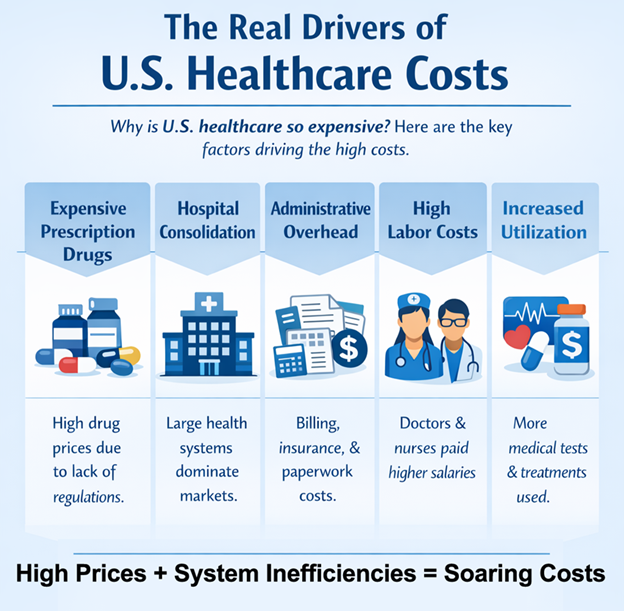
The United States spends more on healthcare than any other nation in the world, yet it does not consistently produce better health outcomes. This paradox raises an important question:
Why does the most expensive healthcare system fail to deliver proportionally better results?
Recent reporting highlights a central truth: the issue is not simply how much care Americans receive, but how the system is structured, priced, and incentivized (The Wall Street Journal, 2026).
The Price Problem: Paying More for the Same Care
One of the most significant drivers of high healthcare costs in the United States is price inflation across nearly all services. Hospital stays, diagnostic tests, and procedures routinely cost far more than in other developed countries.
Unlike many nations that regulate or negotiate healthcare pricing, the U.S. system allows market dynamics, often dominated by large institutions, to dictate cost (Anderson et al., 2019). The result is a system where identical treatments can vary dramatically in price depending on geography, provider, and insurance arrangements.
Prescription Drugs: A Major Cost Driver
Prescription medications represent another critical factor. The U.S. is one of the few countries where drug manufacturers maintain substantial pricing power, often without strict government negotiation.
This leads to significantly higher costs for both patients and insurers, especially with the rise of new specialty medications, including those for chronic conditions and metabolic disorders (Cubanski et al., 2025).
Administrative Complexity: The Hidden Burden
Beyond clinical care, a large portion of healthcare spending is tied to administrative overhead. Billing systems, insurance claims processing, coding requirements, and compliance structures create a complex web of non-clinical expenses.
Research suggests that administrative costs account for a substantial percentage of total healthcare spending in the U.S., far more than in other countries with simpler systems (Woolhandler et al., 2003)
From a holistic standpoint, this represents energy and resources diverted away from actual healing.
Hospital Consolidation and Reduced Competition
Over the past two decades, hospitals and healthcare systems have increasingly merged into large networks. While consolidation can improve efficiency in some cases, it often leads to reduced competition and increased pricing power.
When fewer providers dominate a region, insurers have less leverage to negotiate lower rates, costs that are ultimately passed on to patients (Baker et al., 2015).
Labor Costs and Professional Compensation
Healthcare professionals in the United States are generally paid more than their counterparts in other countries, particularly physicians and specialists.
While this reflects the high level of training and responsibility required, it also contributes to overall system costs (Papanicolas et al., 2018). However, higher compensation alone does not explain the full disparity, pricing structures and system inefficiencies remain the dominant factors.
Utilization: More Care, Not Always Better Care
Americans also tend to use more healthcare services, including tests, procedures, and pharmaceutical treatments. In some cases, this reflects access to advanced technology and innovation. In others, it reflects defensive medicine, over-testing, or profit-driven care models.
Notably, increased utilization does not always translate to improved outcomes. In fact, excessive intervention can sometimes lead to unnecessary procedures, increased risk, and higher long-term costs (Brownlee et al., 2017).
A System Misaligned with Health
From a holistic health perspective, the deeper issue becomes clear:
The modern healthcare system is structured around creating profit through managing disease, rather than cultivating health.
Preventive strategies such as nutrition, movement, stress management, and community engagement, are often underemphasized or underfunded. Instead, the system incentivizes:
- Procedures over prevention
- Medication over lifestyle change
- Intervention over education
This misalignment contributes not only to rising costs, but also to the growing prevalence of chronic conditions such as hypertension, obesity, and cardiovascular disease.
A Holistic Reflection
True health is not something that can be purchased at increasing cost. It is cultivated through daily habits, awareness, and personal responsibility.
While modern medicine offers extraordinary tools for acute care and life-saving interventions, it is not designed nor incentivized, to guide individuals toward long-term balance and resilience.
A more sustainable path forward may require a shift in perspective:
- From treatment to prevention
- From complexity to simplicity
- From external dependence to internal responsibility
Conclusion
The rising cost of healthcare in the United States is not the result of a single factor, but rather a convergence of:
- High service and drug prices
- Administrative inefficiencies
- Consolidated healthcare systems
- Increased utilization
Ultimately, the system reflects its priorities.
And until those priorities shift toward true health rather than managed disease, costs will likely continue to rise, without a corresponding improvement in well-being.
References
Anderson, G. F., Hussey, P., & Petrosyan, V. (2019). It’s still the prices, stupid: Why the US spends so much on health care, and a tribute to Uwe Reinhardt. Health Affairs, 38(1), 87–95. https://doi.org/10.1377/hlthaff.2018.05144
Baker, L., Bundorf, M. K., & Kessler, D. (2015). The effect of Hospital/Physician Integration on hospital choice. National Bureau of Economic Research. https://doi.org/10.3386/w21497
Brownlee, S., Chalkidou, K., Doust, J., Elshaug, A. G., Glasziou, P., Heath, I., Nagpal, S., Saini, V., Srivastava, D., & Chalmers, K. (2017). Evidence for overuse of medical services around the world. The Lancet, 390(10090), 156–168. https://doi.org/10.1016/S0140-6736(16)32585-5
Cubanski, J., Neuman, T., & Freed, M. (2025, August 21). Explaining the prescription drug provisions in the Inflation Reduction Act. KFF. https://www.kff.org/medicare/explaining-the-prescription-drug-provisions-in-the-inflation-reduction-act/
Papanicolas, I., Woskie, L. R., & Jha, A. K. (2018). Health care spending in the United States and other high-income countries. JAMA, 319(10), 1024–1039. https://doi.org/10.1001/jama.2018.1150
The Wall Street Journal. (2026). Why U.S. healthcare costs are so high. https://www.wsj.com/health/healthcare/us-healthcare-cost-charts-0fccfc06
Woolhandler, S., Campbell, T., & Himmelstein, D. U. (2003). Costs of health care administration in the United States and Canada. New England Journal of Medicine, 349(8), 768–775. https://doi.org/10.1056/nejmsa022033



 United Martial Arts Association